
The right equestrian estate is measured by how well its land and facilities support daily horse care, not by acreage alone. The Castle Rock horse-property snapshot lists 12 homes, giving buyers a range of property types to compare. For anyone searching Castle Park Ranch equestrian estates, the key is matching the home and land to the way they plan to ride, keep horses, and manage the property.
Acreage, barns, arenas, water, fencing, and septic systems all affect how a property works for horses. Attractive grounds do not necessarily mean the pasture layout or infrastructure will suit your routine, so look beyond listing photos and headline features.
This guide covers what to assess in Castle Park Ranch homes and land, from riding amenities to property systems and listing details. Compare each property’s practical features with your priorities to narrow the search to estates that fit your equestrian plans.
Key Takeaways
- Compare water supply, fencing, barn layout, and septic capacity against your horse-care routine before weighing a property’s overall appeal.
- Assess indoor and outdoor arenas by their dimensions and how well they support the riding you plan to do.
- Look beyond acreage totals to pasture layout, usable terrain, access, and how the land can function day to day.
- Compare current homes and land by their equestrian features, then narrow the search around the property priorities that matter most to you.
Property water, fencing, barns, and septic systems
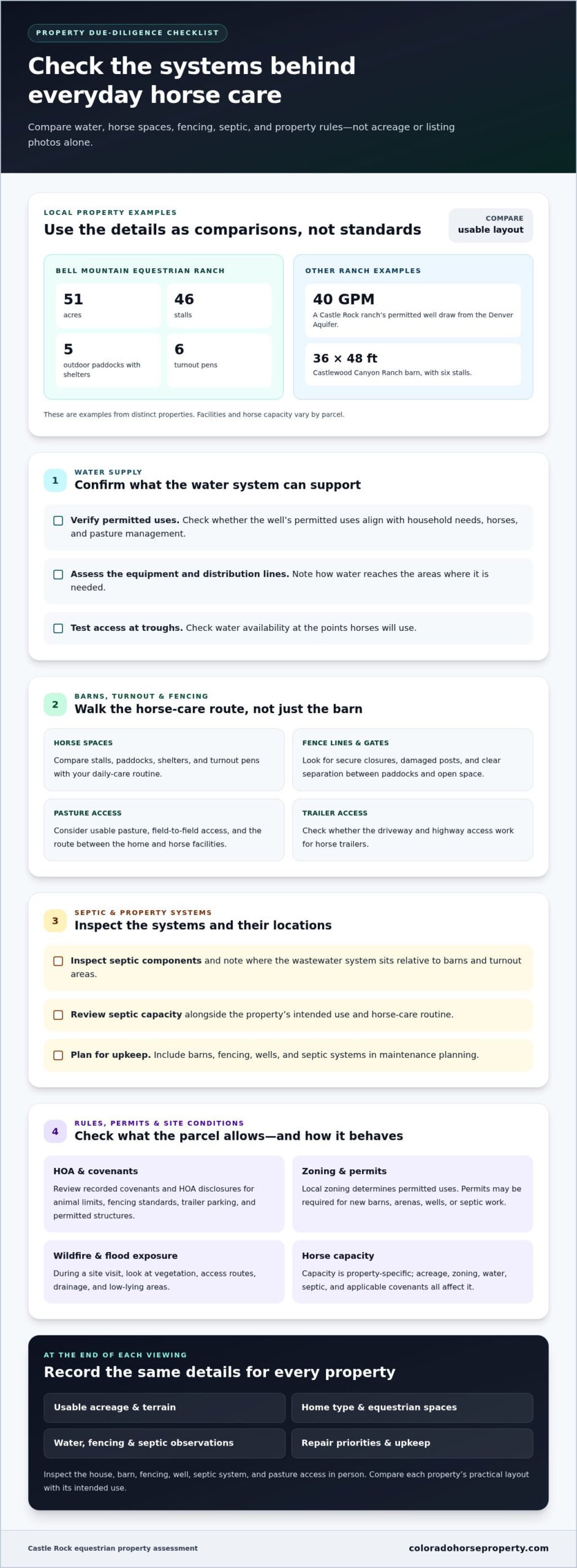
Castle Park Ranch is in Castle Rock, Colorado, where buyers can compare acreage homes with dedicated equestrian facilities. Bell Mountain Equestrian Ranch is a useful local comparison: its 51-acre property has 46 stalls, five outdoor paddocks with shelters, and six turnout pens. Compare usable pasture, horse spaces, and daily-care layout, not acreage alone.
Water capacity affects horses, household use, and pasture management. A Castle Rock ranch’s permitted well draws from the Denver Aquifer at 40 GPM. Confirm the well’s permitted uses and evaluate its equipment and distribution lines. Castlewood Canyon Ranch offers another barn example, with a 36-by-48-foot building and six stalls.
During a viewing, walk the fence lines and check each gate for secure closures, damaged posts, and clear separation between paddocks and open space. Test water access at troughs, inspect the septic components, and note the wastewater system’s location relative to barns and turnout areas. This gives you a clearer picture of layout and upkeep.
HOA fees, covenants, and equestrian rules vary by property. Review recorded covenants and HOA disclosures for animal limits, fencing standards, trailer parking, and permitted structures. Horse capacity is property-specific too: acreage, zoning, water, septic, and applicable covenants all affect how many horses the parcel can support.
Local zoning determines permitted uses, and permits may be required for new barns, arenas, wells, or septic work. When assessing wildfire and flood exposure, look at vegetation, access routes, drainage, and low-lying areas during your site visit. Conditions can vary across Castle Rock, even within the same community.
Before buying, inspect the house, barn, fencing, well, septic system, and pasture access in person. Compare a home on acreage with a purpose-built facility, such as Bell Mountain’s stalls and paddocks. Check whether driveways and highway access work for horse trailers, and whether the acreage and terrain suit your intended use.
Include property taxes and ongoing upkeep in your investment assessment. Taxes depend on the parcel’s assessed value and local taxing districts; barns, fencing, wells, and septic systems also factor into maintenance planning. Record usable acreage, home type, equestrian spaces, and repair priorities for each property before comparing options.
Indoor and outdoor riding amenities
Castle Park Ranch equestrian estates differ from property to property, so check each listing’s riding facilities rather than assuming every home has an arena. Local examples range from private arenas to trail access and open space. Consider what each amenity supports in your regular riding routine, including weather protection, footing care, and access between the barn and arena.
One Colorado ranch listing describes an indoor arena measuring 80 by 160 feet and an outdoor arena measuring 120 by 170 feet. Those dimensions help buyers judge whether the riding space suits their discipline, horse size, and training setup. At a viewing, inspect footing, drainage, lighting, ventilation, and the route from stalls to each arena. An indoor facility supports riding during poor weather, while an outdoor arena offers direct exposure to local conditions.
Other regional properties show how amenities differ. The Mountain View Estate in Sedalia includes a 7,200-square-foot indoor arena. Bell Mountain Equestrian Ranch offers direct access to over 30 miles of riding trails, while its community trail system was completed in the spring of 2003. The Castlewood Equestrian Center adjoins the Cherry Creek Trail system and Mesa Buttes open space. These are distinct properties, not standard features of every Castle Rock estate.
For a broader outdoor riding example, Dawson Butte Ranch Open Space has more than 60 jumps over 2.7 miles. Compare trail surfaces, access points, and whether riding routes connect conveniently to the property. A beautiful view matters, but practical access determines how easily riders can use the surrounding landscape.
Riding lessons are separate from property amenities. Evaluate a property’s arena and trail access against the lesson format you plan to pursue; the real-estate listing describes facilities, not instruction. To compare equestrian listings by features such as arenas and trail access, explore horse property search options.
There is no single package of properties and amenities across Castle Park Ranch. Listings may combine homes, barns, arenas, paddocks, or nearby trails in different ways. Review each property’s stated features and inspect the facilities in person.
Acreage and land features
Castle Rock equestrian listings range from compact horse properties to large ranch holdings. Examples include a 2.07-acre property on Clydesdale Road, a 35-acre property on Lemon Gulch Road, and Castlewood Canyon Ranch, described as almost 150 contiguous acres. These examples show why the parcel’s usable land matters as much as its total acreage.
For Castle Park Ranch homes, lot sizes and horse facilities vary by property; there is no single acreage or standard facility package. Castlewood Canyon Ranch comprises 143 acres, while Castlewood Equestrian Center in Franktown covers 151 acres, with an additional 36-acre property available separately. Read each listing’s detail to distinguish included land from nearby or separately offered acreage.
Walk the land before deciding whether it suits your equine plans. Note slopes, drainage, pasture shape, access between fields, and the distance from the home to horse facilities. A mountain view may be appealing, but terrain also affects daily turnout and equipment access. Mark gates, water points, and any indoor arena on a property map to understand the layout.
Trail access can add riding options, but confirm how routes connect to the property and where riders can enter. The Castlewood Equestrian Center adjoins the Cherry Creek Trail system and Mesa Buttes open space. Bell Mountain Ranch’s trail system was planned to include approximately 27 miles of trails, completed in the spring of 2003. These are examples from the surrounding area, not features shared by every ranch.
Use the same checklist for each parcel: acreage, usable pasture, terrain, access, and the location of barns, arenas, and paddocks. Compare those details with your horse-keeping routine. Permitted uses and recorded property documents help clarify how the land can be used. A consistent approach makes it easier to assess the differences between a small acreage home and a larger ranch.
Equestrian Estates home and land listings
Castle Rock listings span modest acreage homes and larger horse properties, so compare the actual land and facilities together. A market snapshot counted 12 homes listed, with an average of 94 days on site. Treat those figures as a snapshot, not a guarantee of current inventory or timing. For riders, the useful takeaway is to compare property function, not just the number of listings.
Examples show the range. A Castle Rock property on North Faver Drive has 13.41 acres, while a property on Happy Canyon Road has 5.37 acres. In Sedalia, the listing titled “Private oasis on 15 acres 10 minutes from town” describes a different acreage and setting. Those examples help frame searches, but each listing needs a close read of its included land and equestrian improvements.
Start with a shortlist based on the operation you want to run. For each candidate, record acreage, home type, horse-use details, barn capacity, arena access, and pasture layout. Distinguish features included with the property from nearby recreation, trail access, or land offered separately. Then compare practical details such as trailer access, storage, and the route between the house and horse facilities.
Location also shapes daily use. Castle Rock is 15 minutes from the Denver Metro area, while individual properties differ in access to roads, services, and open space. Map the drive to your usual destinations and consider how the local district and surrounding development fit your plans. A listing’s attractive setting matters most when it supports the routine you intend to keep.
Use the listing as a starting point, then view the house, land, and equestrian facility together. Note what requires maintenance and whether the site layout works for your horses. To compare Castle Rock-area options by acreage and equestrian features, browse horse-property listings and build a shortlist around your priorities.
Colorado Horse Property: AI-Powered Horse Property Search
Colorado Horse Property’s AI-Powered Horse Property Search helps buyers narrow their equestrian real estate search. Set priorities such as acreage, barns, arenas, water rights, and pasture size to focus on properties that fit your plans. It can be especially useful when listings vary widely and you want to compare land and horse facilities together.
For buyers evaluating specific properties, Buyer Representation supports the purchase process. Real Estate Listing Services help sellers present equestrian properties, while Transaction Management helps coordinate the transaction. These services support different stages, from searching and comparing properties to listing and completing a sale.
Ready to explore Castle Rock horse-property options or discuss a listing? Contact Colorado Horse Property or visit coloradohorseproperty.com.
Turn Your Property Priorities Into a Clear Next Step
Turn your wish list into a practical search brief. Rank the features that shape your daily routine, then separate essentials from preferences. This makes it easier to compare Castle Park Ranch equestrian estates by how well each property fits your plans, rather than by one headline feature. Consider the horse-keeping life you want, the work you’re prepared to manage, and the combination of home and land that supports both.
Colorado Horse Property can help focus your search. Its AI-Powered Horse Property Search helps buyers find properties by equestrian features, and Buyer Representation supports buyers as they evaluate their options. Sellers can use Real Estate Listing Services to bring an equestrian property to market. Choose the next step that suits your stage, whether you’re starting a search or preparing a property for sale.
Contact Colorado Horse Property to discuss your next move, and take the first step toward finding the right fit for your equestrian goals.
Frequently Asked Questions
What are current home and land prices at Castle Park Ranch?
Individual properties vary in acreage, residence, and equestrian improvements. They are distinct listings, not a single community price.
Are any Castle Park Ranch equestrian properties currently for sale?
The October 2026 Castle Rock horse-property snapshot reports 12 homes listed. That count covers Castle Rock horse properties, not necessarily homes within a specific community called Castle Park Ranch. Search listings by location and property features, then review each listing’s status and included acreage. A property may be a home with a few acres, a larger ranch, or an equestrian facility with established infrastructure.
What riding trails, arenas, and shared equestrian facilities are available nearby?
Nearby riding options include Bell Mountain Ranch trails and the Castlewood Equestrian Center’s connection to the Cherry Creek Trail system and Mesa Buttes open space. Arena access depends on the property. A trail connection does not mean a home includes an arena or shared facility. Compare on-property amenities with community access, and note the locations of trail entrances, arena facilities, and property boundaries as you assess a listing.
What are the property taxes, utility costs, and ongoing horse-keeping expenses?
Property taxes and operating costs depend on the parcel and its systems. Bell Mountain Equestrian Ranch’s property taxes were $36,747 for 2021, a figure specific to that ranch and year. Utility planning should account for well equipment, water distribution, septic maintenance, and household use. Horse-keeping budgets also depend on feed, bedding, veterinary and farrier care, fencing repairs, and manure handling.
How does Castle Park Ranch compare with other equestrian communities in the area?
Features vary by property, so compare land, barns, arenas, and trail access rather than assuming there is a standard package. Nearby examples include Bell Mountain’s stalls, paddocks, and trail access, and Castlewood Canyon Ranch’s six-stall barn. These are distinct properties, not standard features of Castle Park Ranch.
What are the HOA fees, covenants, and equestrian rules at Castle Park Ranch?
HOA fees, covenants, and equestrian rules vary by property. Review its recorded covenants and HOA disclosures for animal limits, fencing standards, trailer parking, and permitted structures.