
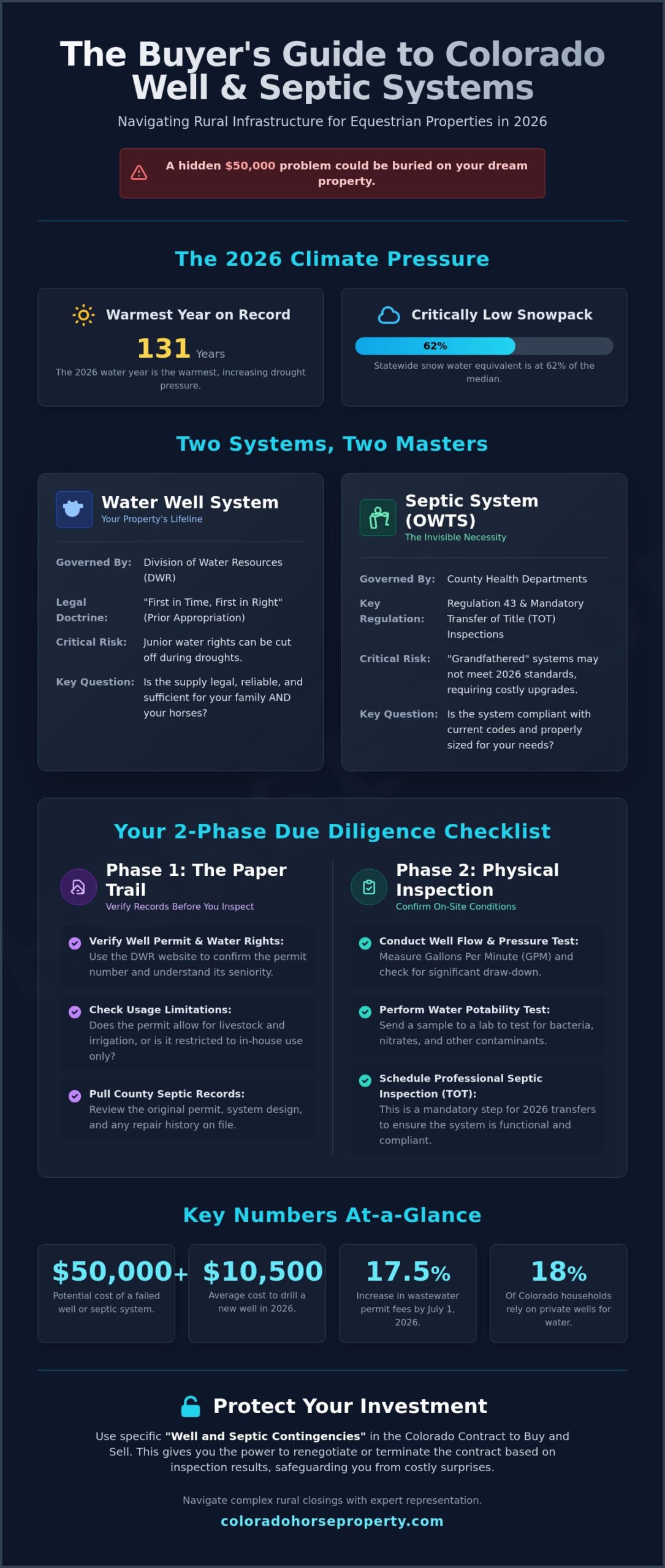
In the high-stakes world of Colorado ranching, your property’s value isn’t measured by the height of your arena’s ceiling, but by the reliability of the pipes buried beneath it. With the 2026 water year ranking as the warmest in 131 years and statewide snowpack at just 62% of the median, buying rural horse property with well and septic Colorado is now a complex technical and legal challenge. You’re right to feel anxious about the possibility of a dry well or a hidden $50,000 infrastructure failure. These aren’t just fears; they’re expensive realities for buyers who skip their due diligence in today’s tightening regulatory environment.
We understand that your dream of a rural lifestyle depends on functional systems that support both your family and your horses. This article provides a clear roadmap to verify every gallon of water and every foot of leach field before you sign the closing papers. You’ll learn how to navigate the 17.5% fee increases for water permits and the strict new Regulation 43 standards, such as the two-bedroom minimum for new septic builds. We’ll walk you through the 2026 due diligence checklist to ensure your equestrian estate remains a sanctuary rather than a financial burden.
Key Takeaways
- Understand why rural infrastructure is the primary deal-breaker in Colorado equestrian real estate and how it differs from municipal expectations.
- Learn how to locate and verify water rights and well permits through the Division of Water Resources to secure a reliable supply for your livestock.
- Master the essential steps for buying rural horse property with well and septic Colorado, including the mandatory 2026 Transfer of Title inspections for waste systems.
- Follow a rigorous two-phase due diligence checklist that combines historical permit searches with physical flow and potability testing.
- Discover how to use specific “Well and Septic Contingencies” in the Colorado Contract to Buy and Sell to protect your investment during the closing process.
The Critical Role of Well and Septic in Colorado Equestrian Real Estate
In Colorado, the utility pole usually marks the end of municipal convenience. For 18% of Colorado households, water doesn’t come from a city pipe; it comes from the ground. When buying rural horse property with well and septic Colorado, these systems aren’t just amenities. They are the lifeblood of the property. A failed leach field or a dry well can instantly drop a property’s value by $50,000 or more. This makes infrastructure the single biggest deal-breaker in 2026 transactions. If the water stops flowing or the waste stops moving, your lifestyle and your investment’s valuation vanish overnight.
To better understand the complexities of buying a property with these systems, watch this helpful video:
Understanding the Lifestyle and Dreams Connection
Your search for equestrian real estate Colorado is driven by a vision of freedom and space, but that dream depends on “boring” infrastructure. You can’t run a 10-stall barn or maintain a healthy pasture without a verified water source. In the high desert or along the Front Range, water scarcity is an emotional and financial burden. If a well permit only allows for “in-house use,” your plan for an irrigated arena or multiple horses might be legally impossible. Infrastructure limitations dictate the property’s carrying capacity, and ignoring these constraints can lead to heartbreaking choices later.
Regulatory Overview: DWR and County Health Departments
Purchasing rural land means you’re dealing with two distinct masters. The Division of Water Resources (DWR) manages what comes out of the tap, while County Health Departments manage what goes down the drain. While it’s useful to understand the basics of What is a Septic Tank?, you must also navigate modern Colorado mandates. Regulation 43 has changed the landscape for Onsite Wastewater Treatment Systems (OWTS). For instance, Garfield County’s updated regulations became effective May 28, 2026, establishing stricter standards for inspections and repairs.
Many “grandfathered” systems that functioned for decades won’t meet 2026 transfer requirements. With wastewater permit fees seeing a total 17.5% increase by July 1, 2026, the cost of non-compliance is rising. You need to know if a system requires an expensive engineered upgrade before you reach the closing table. Local expert representation isn’t just a luxury; it’s your primary defense against a $20,000 infrastructure surprise that could have been identified during a proper due diligence period.
Colorado Water Rights and Well Permits: Securing Your Supply
When buying rural horse property with well and septic Colorado, you aren’t just purchasing land; you’re acquiring a specific legal standing in the state’s water hierarchy. Colorado operates under the “Prior Appropriation” doctrine, often described as “First in Time, First in Right.” This means older water rights have priority over newer ones. In 2026, with the statewide snow water equivalent at just 62% of the median, this isn’t a legal abstraction. It’s a survival reality. If you hold a junior water right during a drought, the state can “call” the river, potentially shutting off your supply to satisfy senior holders downstream.
Before you fall in love with a barn or a pasture, you must verify the permit. You can locate and confirm these records through Colorado’s Division of Water Resources. A valid permit number is your only proof that the well is legal. Once verified, you need to look at the four critical metrics: total depth, static water level, yield in gallons per minute (GPM), and draw-down. With the average Colorado well depth sitting at 250 feet and drilling costs averaging $10,500 in 2026, knowing the physical state of the hole in the ground is vital. Don’t stop at a basic bacteria test. Colorado soils often contain high levels of uranium, alpha radiation, and nitrates that require specialized filtration systems.
Household Use Only vs. Domestic Well Permits
The type of permit attached to the land can make or break your equestrian dreams. A “Household Use Only” permit is a common trap; it strictly forbids any outdoor watering, which includes filling troughs or irrigating a small paddock. You want a “Domestic and Livestock” permit, which is the gold standard for equine estates. In Colorado, parcels of 35 acres or more generally qualify for a domestic well permit that allows for home use, fire protection, and the watering of domestic animals and livestock. If you’re searching for your next ranch, always check the acreage against the permit type.
The Well Productivity Test: What Every Buyer Needs
A well that produces five gallons per minute might be fine for a couple, but it’s often insufficient for a working horse property. We recommend a minimum 2-hour flow test to evaluate the recovery rate. This measures how quickly the water level returns to its static point after heavy use. Think about your morning chores: you’re filling three 100-gallon troughs while someone else is running the shower. This peak demand can exhaust a weak well. If the yield is low, you’ll need to inspect the infrastructure for a large cistern or storage tank to buffer your daily needs.
Navigating On-Site Wastewater Treatment Systems (OWTS) for Horse Properties
In the past, rural buyers looked for a “septic tank.” Today, Colorado regulators use the term On-Site Wastewater Treatment System (OWTS). This shift in vocabulary reflects a shift in complexity. When buying rural horse property with well and septic Colorado, you must navigate the stringent requirements of Regulation 43. As of 2026, many counties have implemented mandatory Transfer of Title inspections. For example, Gilpin County’s new regulations took effect on March 13, 2026, and Garfield County’s followed on May 28, 2026. These rules mean you cannot simply hand over a deed; the system must be inspected, and often pumped, to receive an official “Acceptance Document” or “Use Permit” from the county health department.
Your property’s geography dictates your system’s price tag. On the Sandy Plains, a basic gravity-fed system might cost between $6,500 and $20,000. However, in the Rocky Mountains or areas with high water tables, you’ll likely need an engineered system. These advanced treatment units can cost between $30,000 and $50,000. Additionally, Colorado now mandates a minimum of a two-bedroom build for any new septic installation, regardless of the actual house size. This ensures the system has the capacity to handle modern domestic loads, but it adds to the upfront infrastructure cost for the buyer.
Equestrian-Specific Septic Risks
Horses and septic systems are a dangerous mix. A 1,200-pound horse exerts significant ground pressure that can crush PVC pipes or compact the soil in your leach field. Compaction destroys the soil’s ability to filter effluent, leading to a total system failure. You should never build an arena, round pen, or even a temporary paddock over a leach field. Professional planning requires strict setback distances between the barn and the OWTS to prevent waste runoff from contaminating your equestrian facilities. Protecting this infrastructure is as vital as protecting your horses’ health.
Inspecting the Tank and Leach Field
A visual “walk-over” isn’t an inspection. To truly verify a system’s health, the tank must be pumped during the due diligence period. This allows a certified inspector to check the structural integrity of the baffles and the tank walls. Modern inspectors use specialized cameras to look for root intrusions or pipe collapses that aren’t visible from the surface. In the leach field, look for “lush spots” or ponding water. These are signs that the system is already failing to process waste. Catching these issues during the inspection phase can save you from a $30,000 mistake after closing.
The Rural Infrastructure Due Diligence Checklist
When buying rural horse property with well and septic Colorado, you need a structured approach to verify the systems that support your lifestyle. Relying on a seller’s verbal assurance is a recipe for a $50,000 mistake. A professional due diligence process should be divided into four distinct phases to ensure no detail is overlooked before your earnest money becomes non-refundable.
- Phase 1: Record Search. Start by pulling the well permit and log from the Division of Water Resources (DWR) database. You must verify the “Permitted Use” and check for any augmentation plans or HOA-managed water restrictions that might limit your horse count.
- Phase 2: Physical Inspections. Schedule a two-hour flow test to confirm the well can handle peak demand. Simultaneously, have a certified technician pump the septic tank and perform a visual inspection of the baffles and the leach field’s absorption rate.
- Phase 3: Legal Verification. Work with your title company to secure specific water endorsements. You also need to confirm that the property’s zoning and current septic capacity align with the number of horses you plan to keep on-site.
- Phase 4: Future Proofing. Evaluate the land for secondary well sites or expansion areas for the Onsite Wastewater Treatment System (OWTS). If you plan to build a larger barn or an accessory dwelling unit in the future, you need to know now if the soil can support it.
Immediate Red Flags to Watch For
Keep your eyes open during the initial property tour. If you see a patch of lush, bright green grass over the leach field during a dry Colorado summer, it’s a sign of a system failure. With the 2026 snow water equivalent at just 62% of the median, anything growing that well without irrigation is likely feeding on leaking effluent. Another red flag is the absence of well logs in the DWR database. If the state has no record of the well’s depth or yield, you may be looking at an illegal or “wildcat” well that carries massive legal liability. Finally, a yield under 5 gallons per minute (GPM) is insufficient for most equestrian operations unless the property includes a significant storage cistern to buffer usage.
Questions to Ask the Seller Directly
Be direct with your inquiries. Ask the seller exactly when the well pump was last replaced and if they have receipts for the work. Inquire if the property is part of an augmentation plan, which is common in over-appropriated basins. You also need to know if the septic system has ever been “rejuvenated” or repaired. If you’re ready to start your search with a team that understands these technical hurdles, you can find horse properties for sale using our specialized AI-powered search tools. Knowing the right questions to ask today prevents a dry well from ruining your dreams tomorrow.
Navigating Complex Rural Closings with Expert Representation
Residential real estate agents often struggle with the technical nuances of rural transactions. When buying rural horse property with well and septic Colorado, you aren’t just purchasing a home; you’re acquiring a private utility system and a complex set of water rights. This market operates differently than suburban neighborhoods. In a standard residential sale, the city guarantees the water and sewer. In a rural sale, that responsibility falls entirely on the buyer’s due diligence. You need a representative who knows how to spot a failing system before it becomes your financial burden.
Managing the “Well and Septic Contingency” in the Colorado Contract to Buy and Sell is the most critical part of the closing process. This specific section allows you to terminate the contract or request repairs if the inspections reveal issues with water yield, quality, or septic integrity. With wastewater permit fees increasing by 17.5% by July 1, 2026, and new “Waters of Colorado” rules affecting construction, these deadlines are more than just paperwork. They’re your legal shield. Missing a deadline by even an hour can mean the difference between a successful purchase and an expensive infrastructure nightmare.
Our AI-powered search tool simplifies this complex process by identifying high-quality colorado land that meets your specific equestrian requirements. We’ve designed our platform to filter for acreage, zoning, and existing infrastructure. This technology, combined with our nearly four decades of experience, ensures you don’t waste time on properties that can’t legally support your horses. When an inspection report comes back with a low flow rate or a damaged baffle at the 11th hour, our seasoned experts know exactly how to negotiate a resolution that protects your interests.
The Realty Oasis Advantage
We leverage our specialized network of rural inspectors and water attorneys to verify every detail of your potential ranch. Our team understands that your horse property for sale in colorado represents more than just a real estate transaction. It’s the foundation of your lifestyle and dreams. We focus on securing properties with superior water rights and functional Onsite Wastewater Treatment Systems (OWTS) so you can focus on your horses rather than your plumbing. Our no-nonsense approach is built on thirty-eight years of experience in the Colorado rural market.
Next Steps: From Search to Closing
Your journey to owning a secure, functional equestrian estate starts with the right data. We invite you to book a consultation to discuss your specific needs, whether you’re looking for a private training facility or a quiet mountain retreat. Our team will help you navigate the 2026 regulatory landscape with confidence and clarity. Don’t leave your infrastructure to chance when you can rely on proven expertise.
Search Colorado Horse Properties with Verified Infrastructure
Secure Your Colorado Equestrian Legacy
Success in buying rural horse property with well and septic Colorado depends on looking past the beautiful mountain views to the systems that sustain them. You now have the tools to verify water yields, navigate 2026 septic regulations, and protect your investment from hidden infrastructure costs. Remember that a property’s viability is defined by its legal water rights and its ability to process waste safely. Missing a single step in the due diligence process can turn a dream ranch into a financial burden.
With nearly 40 years of specialized Colorado real estate experience, we’ve seen how quickly a dream can sour without proper professional guidance. Our proprietary AI technology is specifically designed to help you find land that meets your equestrian needs while our team manages the complex zoning and water rights hurdles. Don’t leave your lifestyle and dreams to chance. Use our expert tools to find a property that’s as reliable as it is beautiful. Your horses deserve a home with a secure future.
Find Your Perfect Colorado Horse Property with AI-Powered Search
Frequently Asked Questions
Can I water my horses with a “Household Use Only” well permit in Colorado?
No; a “Household Use Only” permit strictly forbids any outdoor water use, which includes filling troughs or irrigating paddocks. To legally water livestock, you must have a “Domestic and Livestock” permit. This is a vital distinction when buying rural horse property with well and septic Colorado because the state can issue cease and desist orders for unauthorized water use. Always verify the permit type in the Division of Water Resources database before closing.
How much does a professional well and septic inspection cost in Colorado?
Expect to pay between $600 and $1,500 for a comprehensive professional inspection of both systems. This fee typically includes the septic tank pumping, a two hour well flow test, and basic potability lab work. While the Colorado Water Quality Control Division implemented a 17.5% fee increase for water permits by July 1, 2026, private inspection costs are separate. These inspections are your primary defense against a $30,000 infrastructure failure after you take ownership.
What happens if the septic system fails the transfer of title inspection?
The system must be repaired or replaced to meet current county standards before an “Acceptance Document” or “Use Permit” is issued. In counties like Gilpin and Garfield, which updated their regulations in early 2026, a failed system can halt a closing entirely. Usually, the buyer and seller negotiate who will cover the costs of the required upgrades. If the system is old, you may be required to install a new two-bedroom minimum system to comply with state law.
How many gallons per minute (GPM) do I need for a 4-horse property?
You should aim for a minimum of 5 gallons per minute (GPM) for a property with four horses. While a single horse only drinks 10 to 15 gallons daily, your peak demand for stall cleaning and trough filling happens all at once. If the well produces less than 5 GPM, you’ll need to install a storage cistern to buffer your daily usage. This ensures you don’t run the pump dry during morning chores when household water use is also high.
Can I build a barn or riding arena over my septic leach field?
No; you can never build any permanent structure or heavy riding surface over a leach field. The weight of a barn or the specialized footing of an arena will crush the distribution pipes and compact the soil. Compaction prevents the effluent from filtering correctly, which leads to a total system failure. Additionally, you should keep 1,200-pound horses off the leach field area to prevent them from damaging the underground infrastructure with their hooves.
What is an “augmentation plan” and do I need one for my horse property?
An augmentation plan is a court-approved program that replaces the water you pump from your well with water from another source to protect senior water rights. You generally need one if you’re buying rural horse property with well and septic Colorado in a “closed” or “over-appropriated” river basin. These plans are often managed by a local homeowners association or a water conservancy district. Without an augmentation plan, you might be legally restricted from any outdoor watering during drought conditions.
Is it possible to upgrade a Household Use Only permit to a Domestic permit?
Upgrading a permit is only possible if the property meets specific criteria, such as the 35-acre rule. In Colorado, parcels of 35 acres or more generally have a right to a domestic permit that includes livestock watering. If your parcel is smaller, you may have to purchase additional water rights or join an augmentation plan to change the permit status. This process is expensive and not guaranteed; it requires a formal application to the Division of Water Resources.
How often should a septic tank be pumped on a rural equestrian property?
You should have your septic tank pumped every 3 to 5 years to maintain system health. On a horse property, you must be extra vigilant about what enters the drains; excessive mud or horse hair from wash racks can clog the system faster than normal domestic waste. Regular pumping allows you to inspect the baffles and effluent filter before a small issue turns into a leach field failure. Consistent maintenance is the best way to avoid a $20,000 replacement cost.