
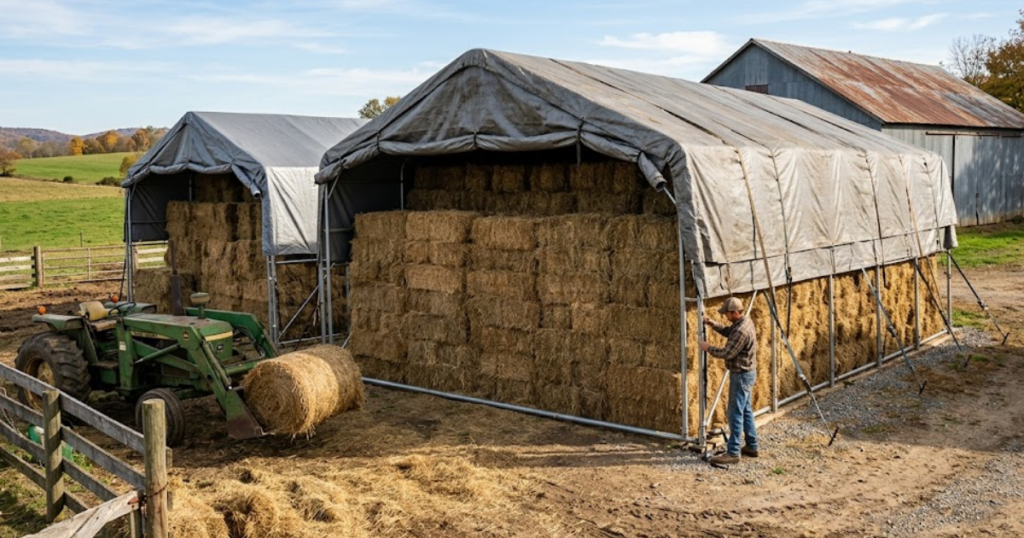
You buy a beautiful equestrian property that has a pristine center-aisle barn but no dedicated hay storage. You look at the cost of building a $30,000 custom hay shed and decide to take a shortcut. You head to the local hardware store, buy a $500 metal-tube carport with a heavy-duty fabric roof, and stack your winter hay supply underneath it.
In November, a massive Front Range windstorm rolls through. You wake up to find the tarp shredded, the metal frame twisted into a pretzel, and your entire winter hay supply soaked in freezing rain.
When establishing a horse property, trying to save money on hay storage usually ends up costing you double. While temporary shelters seem like an easy fix, they come with severe legal, environmental, and financial risks in the West.
Here is why relying on a temporary carport for your hay is a dangerous gamble, and how to evaluate storage before you buy.
Are "Temporary Shelters" (like tarp-covered carports) Allowed for Hay Storage?
Quick Summary: The False Economy
- The Code Crackdown: Most equestrian HOAs and strict county zoning boards explicitly ban unpermitted, tarp-covered tubular carports, classifying them as visual blights or unauthorized accessory structures.
- The Sail Effect: Colorado is famous for its sudden, 60-mph wind gusts. A cheap hardware-store carport acts like a massive parachute. When the wind catches it, the metal frame can buckle, snap, and blow directly into your pastures, creating lethal shrapnel for your horses.
- The Condensation Trap: Non-breathable tarps create a greenhouse effect. Ground moisture evaporates, hits the cold ceiling of the tarp, and drips right back down onto your hay. This hidden moisture creates toxic mold deep inside the bales, ruining your expensive feed.
- The Insurance Void: If a heavy Colorado snowstorm collapses a temporary shelter and ruins $5,000 worth of premium orchard grass, your hazard insurance will almost certainly deny the claim because the shelter was not a permanent, code-compliant structure.
Cheap temporary hay cover can look like a money saver, but on a horse property it often creates added risk in code compliance, storm durability, feed quality, and insurability.
1. The HOA and County Code Reality
You cannot always put whatever you want on your own dirt.
- The Visual Blight: Upscale rural neighborhoods protect their property values fiercely. HOA covenants almost universally ban tarp structures, pop-up tents, and temporary carports because they degrade the aesthetic of a multi-million-dollar equestrian community.
- The Permitting Trap: Even if you do not have an HOA, county building departments often have strict rules. Many Colorado counties state that any structure over 120 or 200 square feet requires a building permit. Because cheap carports are not engineered for local snow loads, the county will not issue a permit, making the structure illegal the moment you anchor it.
- Code Enforcement: If a neighbor complains about your flapping tarp, the county code enforcer will red-tag the structure, forcing you to dismantle it immediately and leaving your hay completely exposed to the elements.
2. Surviving the Colorado Wind
The environment in the West destroys cheap infrastructure.
- The Uplift Force: Standard temporary carports are designed to keep the sun off a Honda Civic, not to survive a high-altitude microburst. The open-ended design allows wind to rush in and push violently upward against the canopy.
- The Anchor Failure: Nailing the feet of a temporary shelter into native dirt with 12-inch stakes is useless in sandy or muddy soil. Once the wind rips the anchors out, the entire structure goes airborne.
- The Livestock Danger: A flying metal-tube structure is a deadly weapon. If a 300-pound twisted metal frame blows into a pasture of panicked horses, the resulting veterinary bills will instantly eclipse whatever money you saved by not building a proper barn.
If the structure is lightweight, tarp-covered, and not engineered for local conditions, Colorado wind will eventually test it harder than its manufacturer intended.
3. The Condensation and Mold Trap
Even if the shelter stays standing, it might still silently destroy your hay.
- The Breathing Requirement: Hay is a living, breathing organic material. To prevent combustion and mold, it requires massive amounts of ambient airflow.
- The Greenhouse Effect: Tarp roofs do not breathe. During the day, the sun beats down on the tarp, rapidly heating the space underneath. This draws moisture up from the bare dirt floor. When the temperature plummets at night, that trapped humidity condenses on the underside of the cold tarp and rains back down onto the top layer of your hay stack.
- The Invisible Spores: You might not realize the hay is ruined until you crack open a bale mid-winter and find it choked with white dust and toxic mold spores, rendering it completely inedible and forcing you to buy new hay at peak winter prices.
4. The Engineered Fabric Alternative
If you cannot afford a custom wood or steel barn, there is a right way to use fabric.
- Commercial Tension Buildings: Do not confuse a $500 hardware-store carport with a commercial fabric tension building like a Cover-All or ClearSpan structure.
- True Engineering: These heavy-duty agricultural structures feature massive, galvanized steel trusses and ultra-heavy, UV-resistant, breathable architectural fabric. They are fully engineered to withstand 100-mph winds and massive snow loads, meaning you can legally permit them with the county. While they cost significantly more than a temporary carport, they are still cheaper than traditional construction and offer genuine protection.
We Look at the Long-Term Logistics Before You Buy
We do not just look at the arena; we calculate where your feed will safely live.
When Mark Eibner and Belinda Seville help you purchase an equestrian estate, we bring operational foresight to the tour. We evaluate a property’s dedicated hay storage capacity, check the HOA covenants regarding outbuildings, and ensure you will not be forced to rely on dangerous, temporary band-aids to keep your herd fed through a harsh Colorado winter.
Contact Us Today to find a property with professional, code-compliant storage infrastructure.
Browse Active Colorado Horse Properties: Browse Active Colorado Horse Properties that are fully equipped to protect your feed and your investment
Frequently Asked Questions (FAQ) About Hay Storage
Can I just store my hay outside and cover the stack directly with heavy tarps?
Yes, this is a traditional method, but it requires precision. You cannot stack the hay on bare dirt. It must sit on wooden pallets over a thick gravel pad to block ground moisture. The tarps must be heavy-duty agricultural canvas, not cheap plastic, and you must leave the sides of the stack open to allow the wind to push air through the bales, preventing internal mold.
Are metal shipping containers, Conex boxes, a good alternative for hay storage?
They offer ultimate wind and fire protection, but they are notorious moisture traps. Because they are airtight steel boxes, shipping containers suffer from extreme interior condensation, the sweating effect. If you use a shipping container for hay, you must hire a welder to cut massive ventilation louvers into the sides and roof, or your hay will rot. Additionally, HOAs hate them and often ban them entirely.
How far should my hay storage be from my main horse barn?
Fire safety experts recommend keeping bulk hay storage a minimum of 50 to 100 feet away from any structure that houses livestock. If hay spontaneously combusts or catches fire from a lightning strike, it burns incredibly hot and fast. Keeping it in a detached, dedicated shed gives you the critical time needed to safely evacuate your horses from the primary barn.