
The city name on a listing won’t tell you whether a property can support your horses. For Boulder vs Longmont for horse farms, the right choice depends on your operation and the details of each parcel, including usable acreage, facilities, land-use rules, water, and access.
Both areas may have appealing options, but a property that looks ideal online can fall short once you assess its infrastructure or applicable restrictions. This comparison explains how to weigh Boulder and Longmont against your horse-keeping needs, which local records and property details to investigate, and how to build a focused search. The parcel’s county and land-use jurisdiction matter as much as its city address. Use the guidance below to identify the location and property that fit the way you plan to keep horses.
Key Takeaways
- For Boulder vs Longmont for horse farms, start with the horses you plan to keep and the routine you want, not the city label.
- Compare each parcel’s usable acreage, fencing, shelter, access, and existing facilities against your must-haves.
- Identify the parcel’s county, municipality, and land-use jurisdiction before drawing conclusions about horse-keeping rules.
- Treat visible water features, well permissions, and water rights as separate due-diligence questions, and review authoritative records.
- Use consistent property criteria and equestrian-focused search filters to narrow candidates and compare them clearly.
Boulder vs. Longmont for Horse Farms: Start With the Property, Not the City Label
Choose the location that supports the horse operation and daily routine you want. In the search for Boulder vs Longmont for horse farms, both areas are useful starting points, but the right fit depends on the individual property, its jurisdiction, and how you plan to use it.
A city name alone can’t establish whether a parcel has the land, permitted uses, water arrangements, or facilities your operation requires. Treat the address as a search filter, not a suitability check. General background on Boulder, Colorado can orient you to the area; parcel records and land-use sources help answer property-specific questions.
Use the same screening questions for candidate properties in both areas:
| Search area | Horse needs | Land questions | Verification |
|---|---|---|---|
| Boulder | Will the property support your horse count and daily routine? | Does usable acreage and the existing setup match your plans? | Identify the parcel’s county, municipality, and land-use jurisdiction. |
| Longmont | Can the property accommodate your essential facilities and care routine? | Review acreage, fencing, shelter, access, and water details. | Check applicable parcel records and land-use sources. |
What does a horse farm need from its location?
Start with your operation, not the listing photos. Write down how many horses you plan to keep, the care routine you expect to follow, and the facilities you need from day one. Separate must-haves, such as suitable space and safe access, from preferences, such as an existing barn or riding arena that could potentially be added later.
Then map your routine beyond the property line. Decide how much commuting matters, how you’ll prioritize access to veterinary care, and whether nearby riding opportunities are important. These priorities help set a practical search radius without assuming one city automatically suits every buyer better.
Why city limits and property labels are not enough
A mailing address may use a familiar city name without establishing which county or land-use authority governs the parcel. Listings may also use broad labels such as “horse property” without explaining whether your intended use is allowed. Confirm the property’s actual jurisdiction, then review the applicable rules and permitted uses for that parcel before relying on its marketing description.
For a broader framework on evaluating equestrian real estate, the Colorado equestrian real estate buyer’s guide can help you organize due diligence. Apply the same process to each candidate. The city narrows the map; the parcel determines whether the property fits your plans.
Compare Boulder and Longmont by Horse-Routine Fit and Property Setting
Compare the day each candidate property would support instead of choosing a city first. A commute that works on paper may feel different when paired with morning feeding, turnout, facility upkeep, and trips for services. The best location depends on your horse operation and the verified conditions of the parcel, not the city name alone.
Use the same prompts for both search areas. This keeps your comparison tied to your schedule and priorities rather than broad assumptions about Boulder or Longmont.
| Buyer priority | Boulder-area search | Longmont-area search |
|---|---|---|
| Work and routine travel | How would the trip from this property fit your regular schedule? | How does travel from this property fit the same schedule? |
| Daily horse care | Does the layout support the care routine you intend to follow? | Can the property support that routine with its actual setup? |
| Planned facilities | Do existing facilities meet your essentials, or will you need a different setup? | Which facilities are present, and which are priorities to add? |
| Property setting | Does the parcel meet your access and land-use criteria? | Does the parcel meet those same criteria? |
When a Boulder-area search may fit your priorities
Include Boulder in your search if specific candidate properties appear to match your land, access, and routine requirements. Map the drive from each address to work, veterinary services, and places you regularly travel. Consider how those trips fit around feeding and other horse-care tasks. Evaluate properties individually; the area label can’t tell you whether a parcel’s facilities or permitted uses suit your plans.
When a Longmont-area search may fit your priorities
Assess Longmont properties against the same checklist. Compare usable land, the condition and arrangement of facilities, access, and the time your regular schedule allows for travel and horse care. Don’t assume that a property near Longmont falls under a particular jurisdiction or shares the permitted uses of another nearby parcel. Confirm those details for each candidate.
Make the comparison practical. If you expect to ride at home, note whether an arena is essential or simply preferred, then compare each property’s current facilities with your plans for using the land. If your priority is a manageable daily routine, weigh travel time alongside how easily the property supports the care tasks you expect to handle. A desirable setting matters only if it works for your operation.
As you shortlist properties, record the same information for each one: travel priorities, routine fit, essential facilities, and parcel-specific questions to resolve. Equestrian-focused search filters for city, acreage, barns, arenas, pasture, and water can help organize candidates across both areas. Explore Colorado horse property search to compare listings against those priorities.
Compare Horse-Farm Parcels Near Boulder and Longmont: Land, Water, and Facilities
In the Boulder vs Longmont for horse farms comparison, acreage and feature labels are only a first screen. Evaluate how much land can practically support your intended use, what infrastructure is already in place, and what property records establish. Apply the same checklist to parcels in both areas so photos or marketing language don’t outweigh the facts.
How to assess usable acreage, fencing, and equestrian facilities
Total acreage doesn’t automatically equal usable horse acreage. Consider the land’s layout and condition, and whether the areas you expect to use can support turnout, movement, and planned facilities. During a property review, compare the current setup with your actual operation rather than assuming a large parcel or existing barn will be sufficient.
Record what you observe and what needs follow-up:
- Land: Note total acreage, usable areas, slopes or drainage concerns, and how the parcel is divided.
- Fencing and access: Review fence condition, gates, vehicle entry, and routes for moving equipment around the property.
- Shelter and buildings: Assess existing shelter, barns, storage, and whether their layout works for your planned use.
- Arena and improvements: Document any arena or other equestrian facilities, then identify what you’d need to add or change.
A property with fewer existing improvements may still suit a buyer planning a different layout, while a well-equipped listing may not match a particular operation. Compare the condition and function of each feature, not just whether it appears in the listing. The Colorado land buying guide offers a broader framework for assessing land against its intended use.
What to verify about water and local land use
Separate visible water from documented water rights. A pond, ditch, stream, or well shown in a listing doesn’t by itself establish the legal right to use that water for your plans. In Colorado, water rights are separate from land ownership; a well permit also defines specific limits and doesn’t automatically authorize every intended use. Review authoritative records for water rights, ditch shares, and relevant use information rather than relying on a listing description.
Before assessing horse-related uses, identify the parcel’s county, municipality, and applicable land-use jurisdiction. Then consult the relevant local sources for rules that apply to that specific property. Don’t assume a nearby parcel shares its zoning or permitted uses. For additional context on water due diligence, use this Colorado water rights guide as you organize questions for each candidate.
Keep a separate record for every property: acreage and usable areas, facility condition, access, jurisdiction, and documented water information. This makes it easier to see which parcel fits your plans and what still needs research before you decide.
A Practical Boulder-or-Longmont Horse-Farm Comparison Checklist
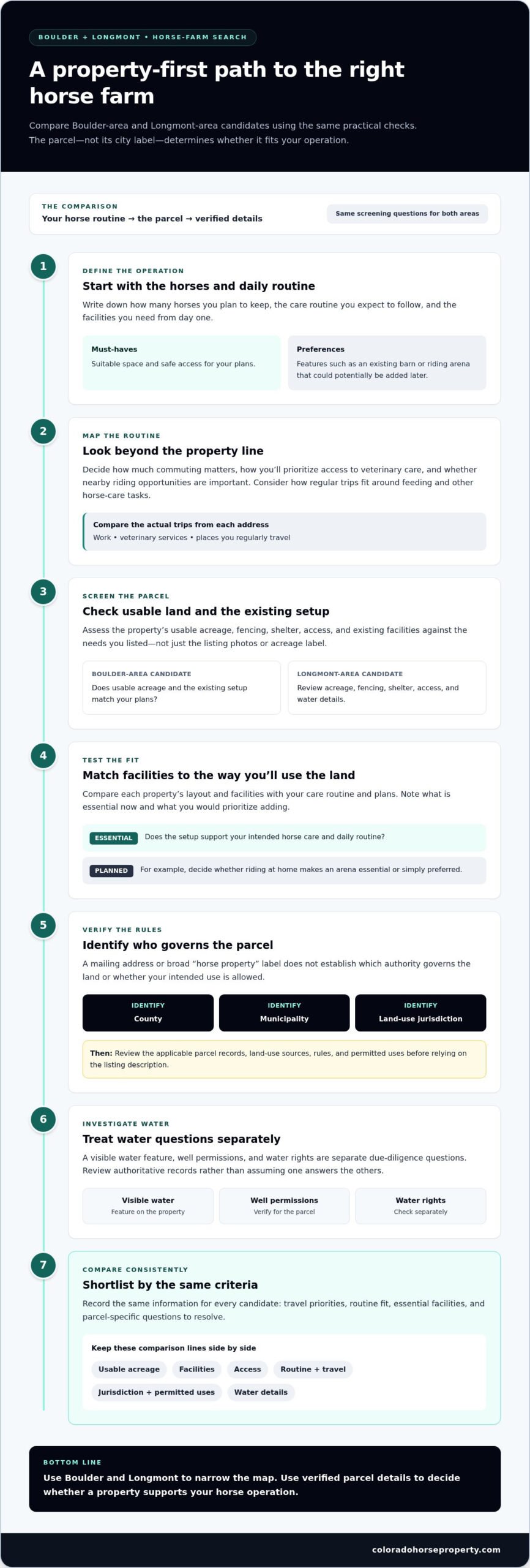
A consistent process makes the Boulder-versus-Longmont decision easier to evaluate. Define your horse operation, set non-negotiable property needs, identify each parcel’s jurisdiction, and compare documented details before deciding. Keep unresolved questions visible instead of treating a listing description as proof.
Build a side-by-side property scorecard
Use one scorecard for every candidate, whether it’s near Boulder or Longmont. Score properties against your own requirements, not a universal acreage formula. Mark each feature as a strong match, a partial match, or still unverified. That distinction helps keep an appealing listing from seeming more suitable than the available facts support.
| Comparison row | Record for each property |
|---|---|
| Usable land | What acreage and areas appear suited to your intended use? Separate documented details from listing claims. |
| Horse facilities | Note barns, shelter, fencing, arenas, and their observed condition or fit for your plans. |
| Access | Record property entry, internal routes, and access considerations for your routine and equipment. |
| Water documentation | List records reviewed for water rights, ditch shares, well permits, or other relevant water details. |
| Jurisdiction | Identify the county, municipality, and applicable land-use authority, then note which sources you reviewed. |
Label each entry as verified, listing description, or unresolved. For example, “arena shown in listing” is different from a confirmed understanding of its condition and whether its use suits your plans. A water feature in photos is not documentation of water rights. Add a clear follow-up question wherever the evidence is incomplete.
Turn search priorities into a focused property search
Set your search filters after defining your must-haves. Use city and county to explore the Boulder and Longmont areas, then narrow results by acreage and equestrian features such as barns, arenas, pasture, and water. Keep the filters and scorecard consistent across both areas so you can compare properties on equal terms.
Follow the steps in order:
- Write down your intended horse use, essential facilities, and daily access priorities.
- Set search boundaries and filters that reflect those needs.
- Record the same land, facility, water, access, and jurisdiction details for every candidate.
- Flag unanswered questions and distinguish them from verified information before weighing a property.
This sequence keeps the decision grounded: define horse needs, search to those priorities, compare parcels consistently, and verify records before choosing. For a focused start, search Colorado horse properties by your key criteria, including acreage, location, and equestrian features.
Find a Boulder or Longmont Horse Farm With Specialized Buyer Support
The decision comes down to fit: define your horse-keeping needs, compare actual parcels, and verify the details that apply to each property. A search focused only on “Boulder” or “Longmont” can miss candidates that better match your operation, while a polished listing can leave important questions unanswered. Keep your priorities and parcel-level due diligence at the center of the process.
How specialized search helps compare both areas
AI-powered horse-property search can help narrow Colorado listings by characteristics that matter to equestrians. Filter by city, county, and acreage, then focus on features such as barns, arenas, pasture, and water. Applying the same criteria to Boulder- and Longmont-area candidates makes it easier to compare relevant listings rather than sorting through properties that don’t match your plans.
Search filters are a starting point, not a substitute for checking the property itself. A listing feature can help you find a candidate, but it doesn’t establish the condition or suitability of a facility, the usable acreage, water rights, or applicable land-use rules. Carry your key questions from the search into the property review, and distinguish listing details from information verified through relevant records.
If an existing barn is essential, make it a search priority and assess each candidate against your requirements. If you’re open to adding facilities, keep that preference separate from your must-haves. This keeps the search focused without ruling out a property simply because its listing doesn’t present every feature in the way you expect.
What buyer representation supports through a purchase
Specialized buyer representation can help organize a search around your stated needs and compare candidate equestrian properties. As you move from listings to a potential purchase, transaction management supports the purchase process, while title and escrow coordination supports the closing steps. Keep the same property criteria in view throughout, including unresolved questions about parcel jurisdiction, land, facilities, access, and water documentation.
Mark and Alison Eibner lead Colorado Horse Property, a Colorado-focused equestrian real estate platform operated by Realty Oasis. Its search tools help buyers focus on equestrian property details, while buyer representation and transaction support provide a practical framework for moving from a broad location choice toward a purchase decision.
For Boulder vs Longmont for horse farms, don’t settle the question by comparing city names alone. Start with your intended horse operation, use consistent search filters to find relevant candidates, and evaluate each parcel on its own verified details. If you’re ready to put those priorities to work, start a Colorado horse-property search.
Turn Your Horse-Property Plan Into a Search
Before you browse again, write a short property brief: describe the horse operation you envision, the features you need immediately, and the compromises you could accept. This gives your search direction and helps you recognize a promising property without letting a city label make the decision for you. The right answer to Boulder vs Longmont for horse farms is the parcel that aligns with your plans and holds up to careful review.
Colorado Horse Property combines AI-powered search with equestrian-focused filters to help buyers find relevant Colorado listings. Buyer representation can support your search, while transaction management and title and escrow coordination help carry the purchase forward. These tools and services connect your property goals with the practical steps of buying.
Ready to shape your next move? Start your Colorado horse-property search and take the first step toward a property that fits your vision.
Frequently Asked Questions
Is Boulder or Longmont better for a horse farm?
Neither is automatically better; the right choice depends on your horse operation and the specific property. For Boulder vs Longmont for horse farms, compare candidate parcels against your expected horse count, care routine, work commute, and facility needs. A property that reduces travel may still be a poor fit if its usable land or permitted uses don’t work for your plans. Judge each parcel on its documented conditions, not its city label.
Can you keep horses on property near Boulder or Longmont?
Possibly, but horse keeping depends on the parcel’s jurisdiction, applicable land-use rules, and any private covenants. In Boulder County, animal-unit allowances differ by zone; the county’s rules describe one horse as one animal unit, but the relevant limits depend on the property’s zoning. Some residential zones have specific conditions for personal riding horses. Confirm the governing rules and any subdivision restrictions for the individual parcel before relying on a listing’s “horse property” description.
How do I find horse farms for sale near Boulder or Longmont?
Begin with a search that covers both city areas, then narrow candidates by county, acreage, and features that matter to your operation. Colorado Horse Property’s AI-powered search includes equestrian filters such as barns, arenas, pasture, and water. Keep a shortlist and compare listings against your requirements. For each promising property, use the parcel address to identify its jurisdiction and pursue records or documentation for details that listing photos and descriptions can’t establish.
What should I check before buying a horse property in Boulder County?
First identify whether the parcel falls under Boulder County’s land-use jurisdiction, then review current county rules for its zoning and intended horse use. County regulations set animal-unit limits by zone, and outdoor arena siting may also be subject to setback requirements. Check private covenants as well, since they can be more restrictive than zoning. Review parcel records and water documentation, and distinguish verified information from assumptions based on the listing.
Do horse farms near Longmont always fall under Longmont city rules?
No. A property described as “near Longmont” may be outside city limits, and a mailing address alone doesn’t establish its governing land-use authority. Determine the parcel’s county and whether it lies within a municipality or another jurisdiction. Then consult the applicable land-use sources for that specific property. This matters before you assume a horse use is permitted or apply rules you’ve heard about for a different parcel.
What water rights should I investigate when buying a horse property near Boulder or Longmont?
Investigate the legal water rights associated with the property, any ditch shares, and the documented uses and limits of a well permit. In Colorado, water rights are separate from land ownership, and a well permit allows only specified uses. A pond, ditch, or stream shown in a listing doesn’t establish your right to use that water. Review authoritative records for the parcel and clarify whether documented uses match your intended horse operation.
How can I compare horse properties in Boulder and Longmont?
Use one comparison sheet for all candidates, with a column for each parcel and rows for your priorities. Record usable land, facility condition, travel demands, access, jurisdiction, and the status of water documentation. Mark each detail as verified, listing-provided, or unresolved. Then compare properties against your own must-haves rather than a universal acreage target. This makes trade-offs visible and highlights questions to address before moving forward.