
What if the right horse property isn’t the one with the biggest barn, but the one whose land, water, access, and facilities fit your plans? Finding a horse property buyer’s agent in Colorado means looking beyond listing photos and general residential experience. The details that make acreage workable for horses can shape your search and due diligence from the start.
A property can look equestrian without supporting your intended use. Acreage alone doesn’t answer questions about pasture, fencing, water, land-use rules, or the condition of existing facilities. You need buyer representation that connects those details to your priorities and helps you identify what to investigate before making a decision.
This guide explains how to assess relevant equestrian real estate experience, define your horse and land requirements, and compare buyer-representation processes. It also covers how specialized property search, due diligence, negotiation, transaction management, and closing coordination can help you evaluate Colorado properties.
Key Takeaways
- When finding a horse property buyer’s agent in Colorado, prioritize relevant equestrian transactions and a clear process over broad marketing claims.
- Translate your plans into search criteria, including horse needs, facilities, acreage, location, and operating priorities.
- Assess land for its intended use by examining water, access, land-use rules, and equestrian infrastructure, not acreage alone.
- Compare agents by their Colorado knowledge, property-search approach, communication, and support from negotiation through closing.
- Specialized search filters can help focus your property search on features such as barns, arenas, water rights, and pasture.
Why Finding a Horse Property Buyer’s Agent in Colorado Takes a Specialist
A horse property purchase involves more than matching a home to a preferred location. The land and facilities also need to support how you plan to keep and ride horses, whether that means turnout space, an arena, or room for specific daily operations. Finding a horse property buyer’s agent in Colorado means choosing a representative who can translate those priorities into a focused search and help you assess how each property fits.
A buyer’s agent helps search listings, review property details, support negotiations, and coordinate transaction steps through closing. Buyer representation centers on the buyer’s goals; listing representation focuses on presenting a property and working with its seller. Since the roles differ, clarify whose interests your representative supports. The broader Colorado horse property buyer’s guide also explains the purchase process.
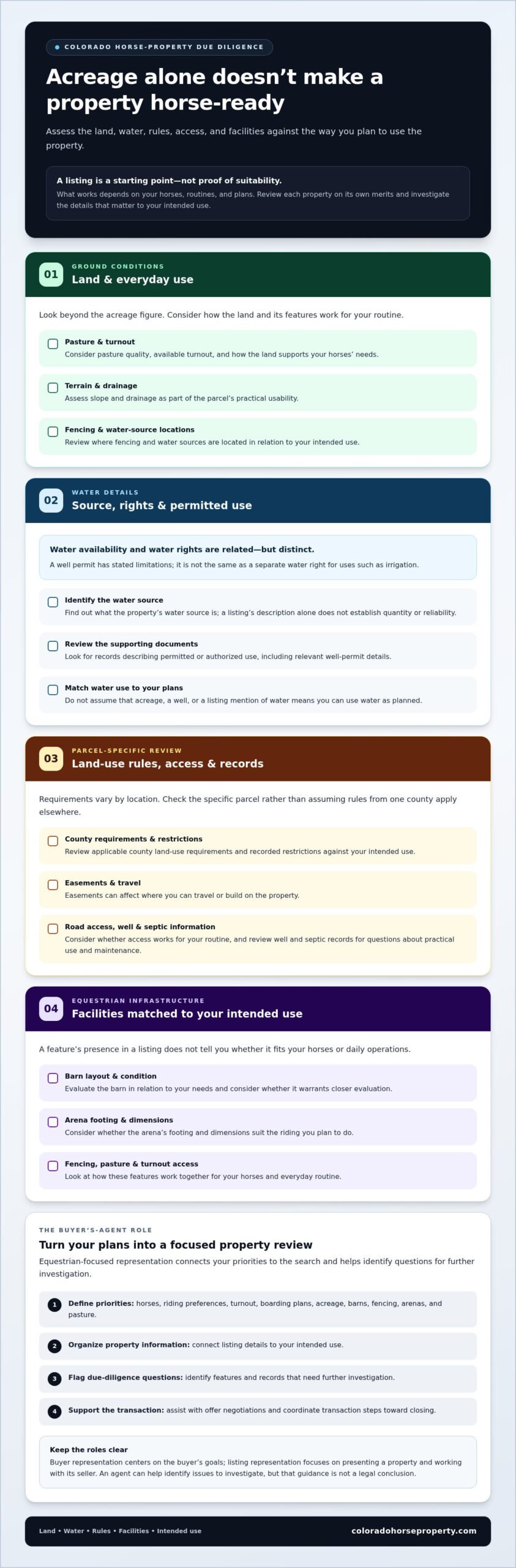
A practical look at horse-property considerations can help clarify what to assess during a search:
What does a horse-property buyer’s agent do?
A specialist starts by turning your plans into useful search criteria. The number of horses, riding preferences, turnout needs, and plans to board horses can all affect which facilities and land characteristics matter. A listing description is only a starting point. The real estate broker role provides general context, while equestrian-focused representation applies your priorities to the search and property review.
- Define search priorities, such as acreage, barns, fencing, arenas, and pasture.
- Identify relevant listings and organize property information around your intended use.
- Flag features and questions to investigate during due diligence.
- Support offer negotiations and coordinate transaction steps toward closing.
No agent can determine suitability from a listing alone. A property that works for one buyer may not fit another’s horses, routines, or plans. Evaluate each candidate on its own merits and complete appropriate due diligence before deciding.
Why Colorado experience matters to horse-property buyers
Colorado properties vary by region, and rural considerations can differ from one location to another. Water rights are distinct from water availability, and county land-use rules can affect how a parcel may be used. Access, fencing, barns, and other infrastructure also warrant property-specific review. An experienced agent can identify questions and issues for further investigation without presenting that guidance as a legal conclusion.
- Clarify the property’s water sources and the rights or permits associated with them.
- Identify applicable county land-use rules and other restrictions to investigate.
- Consider whether access works for your routine and intended property use.
- Review whether existing facilities match your needs and warrant closer evaluation.
Regional knowledge helps keep the search grounded in practical use, not just attractive acreage or a feature-rich listing. The aim is to understand what the listing tells you, identify what still needs verification, and make decisions with relevant information.
Colorado Horse Property Expertise: Land, Water, and Equestrian Use
A property’s acreage and equestrian features matter in relation to your plans. A few horses kept primarily at home may call for different pasture, turnout, and facility arrangements than regular riding or a boarding operation. A buyer’s agent with Colorado horse-property experience can help turn those priorities into specific questions about the parcel, its improvements, and the records that need review.
Start with the land. Pasture quality, slope, drainage, fencing, and the location of water sources can affect how usable an acreage is for your routine. A listing may mention water or pasture, but those terms don’t establish the quantity, reliability, legal use, or condition you need. Use broader Colorado land-buying considerations to frame questions as you evaluate a specific parcel.
Assessing Colorado water, access, and land-use questions
Water availability and water rights are related but distinct. A well permit governs use under its stated limitations; it isn’t the same as a separate water right for uses such as irrigation. Don’t assume acreage, a well, or a listing’s water description means you can use water as planned. Review relevant records and identify what needs further investigation.
Land-use requirements vary by location, so don’t assume rules in one county apply in another. Check the parcel’s applicable county requirements and recorded restrictions against your intended use. Easements can affect where you can travel or build, while road access, well details, and septic-system records can raise questions about practical use and maintenance. The Colorado Division of Real Estate provides official information about Colorado real estate regulation. Property-specific land and water questions still require careful review of the relevant records.
- Identify the water source and the documents describing its permitted or authorized use.
- Review county requirements and recorded easements for the specific parcel.
- Consider whether road access, well, and septic information fits your plans.
Matching equestrian facilities to intended use
Evaluate facilities by how you’ll use them, not just by whether they appear in the listing. Barn layout and condition, arena footing and dimensions, fencing, pasture, and turnout access all affect daily function. Walk the land where possible and compare its condition with the listing description. A barn that suits one setup may not work for another, and existing improvements may need closer assessment before you rely on them.
Build a short property-specific checklist: Which facilities are essential? Which could be adapted? Which land conditions would rule out a property? For barn-related tradeoffs, such as assessing an existing structure versus planning a build, the Colorado horse barn buying and building guide can inform your comparison.
Use those criteria to guide your search and due diligence. Colorado Horse Property’s search filters include features such as barns, arenas, water rights, and pasture, helping connect your priorities with relevant listings. Explore Colorado horse property search and buyer representation as you refine the requirements that matter most.
How to Compare Colorado Horse Property Buyer’s Agents
Strong marketing language can sound similar from one agent to the next. A more useful comparison focuses on the process: how the agent handles equestrian property details, narrows a search, communicates, and supports a buyer from representation through closing. When finding a horse property buyer’s agent in Colorado, compare practical examples and clear expectations rather than relying on labels such as “horse-property expert.”
Compare relevant experience and local knowledge
Prioritize experience that connects directly to your plans. An agent who understands acreage and equestrian facilities can help frame questions about barns, fencing, turnout, and land use. Regional familiarity matters too, since property characteristics and local considerations vary across Colorado. Look for specific examples of how the agent approaches property review and identifies details that may need further investigation.
| What to compare | Evidence of a clear process | What to clarify |
|---|---|---|
| Equestrian transaction experience | Examples involving horse properties, acreage, or facilities relevant to your plans | How that experience informs property review and due diligence |
| Colorado knowledge | Familiarity with the regions and property types you’re considering | How local land-use and access questions are identified for investigation |
| Search approach | A process for turning your priorities into focused listing criteria | How search results are adjusted as your needs become clearer |
| Communication and support | Defined updates and coordination through showings, negotiation, and transaction steps | Who communicates with you and how questions are handled |
Specificity is the test. “We know land” is a broad claim. A useful explanation connects relevant experience to how the agent helps review a property, spot unanswered questions, and coordinate follow-up. Colorado Horse Property provides buyer representation that brings equestrian-focused search and transaction coordination together. The platform is led by Mark and Alison Eibner.
Compare communication, search, and representation
Discuss how the agent will gather your requirements, share suitable listings, arrange showings, and keep you updated. A clear process should explain how negotiation support and transaction communication fit into the working relationship. Before engagement, review the agency relationship, scope of representation, and compensation terms in writing so you understand what you’re agreeing to.
Use the same questions with each agent, then compare the answers side by side. Can they explain how your priorities shape the search? Do they describe the support that continues after you identify a property? Are the boundaries of representation and compensation clear? Direct answers make it easier to distinguish a defined service approach from general promises.
- Experience: Does it relate to your intended property use?
- Process: Are search, communication, and transaction steps explained?
- Terms: Do you understand the representation scope and compensation in writing?
The best comparison is grounded in fit: relevant experience, a focused search method, and clear expectations for working together.
Steps to Find and Start Working With a Colorado Horse Property Agent
A focused search starts with your plans, not a list of listings. Clarify what your horses and daily routine require, identify buyer representation that fits those priorities, and understand the working relationship before scheduling property showings. This gives your agent a practical brief to guide the search and helps you compare properties against your intended use.
- Define your requirements. Note your horses’ needs, intended activities, preferred location, facilities, and operating priorities. Separate must-haves from features you’d consider adapting.
- Identify relevant expertise. Look for experience with equestrian properties and Colorado land, and ask how that experience informs the search and property review.
- Discuss representation. Review the agency relationship, scope of support, compensation terms, and applicable disclosures before proceeding. Make sure the terms are clear in writing.
- Begin a focused search. Use your brief to guide listing criteria, property comparisons, showings, and due-diligence questions. Refine your priorities as you learn more about available properties.
Prepare a clear horse-property search brief
Make the brief specific enough to guide a search without assuming acreage alone determines suitability. Describe the number of horses and their needs, the activities you plan, and how you expect to use the land. Include preferred locations, essential facilities, and practical operating priorities, such as turnout arrangements or access to an arena.
Mark each item as essential, preferred, or flexible. Add property-level questions about water, access, and existing improvements so they can be investigated as relevant listings emerge.
- Horse and land use: Herd needs, daily routines, and planned activities.
- Facilities: Barn features, fencing, arena, pasture, and turnout priorities.
- Location and operations: Preferred area, access needs, and other practical considerations.
Understand the representation and transaction process
Your goals should shape search criteria, and those criteria should guide property review. Once a property meets your priorities, the agent can support offer strategy and help coordinate the transaction. Ask how communication works at each step, from reviewing a listing to managing deadlines and closing details. Understand representation terms and applicable disclosures before moving forward.
Transaction management helps organize the steps and communications involved as a purchase progresses. Title and escrow coordination supports the closing process and keeps related details connected. Clear expectations make it easier to know what support you’ll receive and which decisions or documents need your attention.
Use your brief to focus on properties that match your plans. Explore Colorado horse property search to identify listings by equestrian features and land characteristics.
Colorado Horse Property Buyer Representation and Your Next Step
A focused search is only the beginning. Buyers also need a clear path from identifying promising properties to reviewing their fit, preparing an offer, and coordinating the steps toward closing. Colorado Horse Property is Realty Oasis’s specialized equestrian real estate platform, combining AI-powered property search with buyer representation and transaction support for buyers across Colorado.
A specialized search built around equestrian requirements
Search criteria can reflect the features that matter to your plans, rather than treating every acreage property as interchangeable. Filters support searches for barns, arenas, water rights, and pasture sizes. For example, a buyer prioritizing an arena and established pasture can use those features to narrow listings and focus on properties with relevant characteristics.
Search technology helps organize possibilities, but it doesn’t determine whether a particular property suits your horses or intended use. A listing that matches several filters still calls for property-specific review. Use results as a starting point: compare listing details with your priorities, identify unanswered questions, and consider the land and facilities in context before deciding whether a property belongs on your shortlist.
- Set useful criteria: Choose features that reflect your actual needs and operating priorities.
- Review relevant listings: Use search results to focus on properties with those features.
- Assess each property: Treat filters as a discovery tool, not a finding about suitability.
Personal guidance from search through closing
Buyer representation connects your goals to the property search and the decisions that follow. As you identify a potential purchase, transaction management helps coordinate the steps and communications involved in moving the transaction forward. Title and escrow coordination supports the related closing process and keeps these pieces connected as the purchase progresses.
Colorado Horse Property is led by Mark and Alison Eibner. Realty Oasis has served the Colorado Front Range for approximately 40 years, bringing regional real estate experience to a platform focused on equestrian property. The work centers on your requirements, the details of each property, and informed decisions throughout the transaction.
If you’re finding a horse property buyer’s agent in Colorado, look for a process that connects specialized search with buyer representation and transaction coordination. Start by turning your priorities into search criteria, then use relevant listings to guide your questions about land, facilities, and intended use.
Ready to put your requirements into a focused search? Start your Colorado horse-property search.
Turn Your Property Priorities Into a Search Plan
Make your priorities usable by writing down what your horses need, what you want to do on the property, and which features are essential from day one. Leave room for trade-offs. A property that doesn’t match every preference may still deserve a closer look if its land and layout support your plans.
Finding a horse property buyer’s agent in Colorado is most productive when you bring that clarity into the working relationship. Use your initial brief to guide conversations, refine search criteria, and decide which listings merit closer review. Update the brief as you learn more. Your requirements may become more specific once you compare real properties and consider how each could fit your daily routine.
When you’re ready to turn your priorities into a focused search, start your Colorado horse-property search. A clear brief gives your search a practical starting point.
Frequently Asked Questions
Do I need a specialized buyer’s agent to buy horse property in Colorado?
What should I look for in a Colorado horse property buyer’s agent?
Look for relevant experience, familiarity with the Colorado areas you’re considering, and a clear explanation of how the agent works with buyers. Ask how your priorities shape listing searches, how updates and showings are coordinated, and what support continues through an offer and closing. Finding a horse property buyer’s agent in Colorado is easier when you compare specific examples and written expectations rather than broad claims of expertise.
Can a buyer’s agent help evaluate water rights on a Colorado horse property?
A buyer’s agent can help identify water-related questions, locate relevant property information, and coordinate the purchase process around further review. For example, a listing that mentions a well doesn’t by itself show that irrigation or livestock use is authorized. Water availability, well-permit limits, and water rights are distinct matters. An agent can flag the distinction, but that guidance is not a technical or legal interpretation.
When should I contact a buyer’s agent about a Colorado horse property?
Contact an agent when you begin defining your search, before settling on a specific listing. Early discussion can help turn your intended use, preferred regions, and facility priorities into workable criteria. It also gives you time to understand the representation agreement and compensation terms before services begin. If you’ve already found a property, an agent can still help organize next steps and questions for review.
Does a horse property buyer’s agent help with barns, arenas, and acreage?
Yes. An agent can help you compare listed features with your intended use and identify details that deserve closer inspection. For instance, a property may advertise an arena, but you’ll want to assess whether its layout and condition suit your riding plans. The same principle applies to barn configuration, fencing, pasture, and acreage. Listing information is a starting point, not a substitute for property-specific assessment.
How does buyer-agent compensation work for Colorado horse property?
Compensation is negotiated and should be clearly explained in the written buyer agreement. As of August 12, 2026, Colorado requires a written agreement before an agent provides real estate services, with compensation stated in it. Discuss who is responsible for payment and whether a seller concession is part of the negotiated terms. Review the agreement carefully before signing.
Can an agent help me find horse property across different Colorado regions?
Yes. A search can cover multiple Colorado regions, especially if you’re comparing location, land characteristics, and access to the places you need to reach. Be specific about what you’re willing to trade off, such as proximity to a town versus a particular facility or parcel layout. Colorado Horse Property serves buyers across the state, and its search tools can organize listings around equestrian features and land preferences.