
The most appealing Colorado town may not be the best place to keep horses and work remotely. The top horse friendly towns in Colorado for remote workers are best judged by the property’s fit: internet service at the address, land and facilities suited to your horses, and practical access to the services you use. A popular mountain community can be a useful starting point, but it doesn’t guarantee that a specific parcel will work for you.
Look beyond scenery when comparing locations. Broadband options can vary from one property to the next, and horse-keeping rules depend on local jurisdiction and parcel details. A town’s conveniences and the horse properties beyond its limits may not line up with your priorities. This guide compares Salida, Buena Vista, Durango, and rural Front Range areas, with practical checks to help you build a shortlist.
Start with a checklist for internet, local rules, acreage, water, and equestrian features. Then narrow your search by region and acreage range. Colorado Horse Property’s AI-powered search can help you explore horse-friendly listings, and virtual tours are available for many properties, making it easier to review options from a distance.
Key Takeaways
- Compare Salida, Buena Vista, Durango, and rural Front Range areas against your work setup, horse needs, and preferred setting instead of choosing by reputation alone.
- Use the top horse friendly towns in Colorado for remote workers as a starting shortlist, then assess each property on its own merits.
- Check broadband options at the exact property address. Nearby town coverage doesn’t establish service or performance at a rural parcel.
- Review horse-use rules, acreage, pasture, water, barns, and arenas at the parcel level. Requirements and property features can vary.
- Once you have narrowed your regions and priorities, use Colorado Horse Property Search, acreage-range filters, and virtual tours available for many listings to compare properties from a distance.
Top horse-friendly towns in Colorado for remote workers: how to build a realistic shortlist
Choosing a Colorado base means balancing dependable work connectivity, a workable setup for your horses, access to everyday services, and a landscape you want to live in. A place that looks ideal on a map may not meet all four needs. Write down your priorities first, then treat each town or region as a place to investigate, not as a ready-made answer.
Salida, Buena Vista, and Durango are useful research candidates, as are rural communities around Fort Collins and Colorado Springs. These areas offer different settings and search possibilities, not guarantees about a particular property. Colorado’s diverse geography shapes how communities, properties, and routes are distributed. Your preferred setting can affect the kind of parcel you pursue and the logistics of living there.
Which Colorado lifestyle priorities should shape your town shortlist?
Separate your wish list into firm requirements and preferences before comparing locations. This makes trade-offs easier to see and helps you avoid dismissing a property for a feature that is only a nice-to-have.
- Horse access: Specify what you need for daily care, turnout, and riding. A town’s equestrian reputation doesn’t establish that an individual property meets those needs.
- Acreage: Choose a range that reflects your intended horse use and how much land you want to manage.
- Daily services: List the services you use regularly and decide how much travel you’re comfortable with to reach them.
- Landscape: Decide whether you prefer a mountain setting, foothills, or another environment. Consider how the setting may affect property choices and travel.
Also distinguish a town address from a nearby rural or unincorporated property. They may have different surroundings and fall under different local jurisdictions. Your preferred balance of convenience, land, and setting is personal. No one candidate is automatically best for every remote worker or horse owner.
Why does the exact property matter more than the town label?
A town name can organize your search, but it can’t tell you whether a specific parcel allows horses or has land and facilities suited to your plans. Those answers depend on the property, the rules that apply there, and how you intend to use it. The same goes for remote work: general impressions about a nearby community don’t establish internet availability or performance at a rural address. Evaluate every listing individually.
A horse-friendly remote-work location is one where the specific property supports your horse-keeping plans and work needs, not simply one with a well-known town name. Use your shortlist to guide comparisons, not to skip property-level research. Keep connectivity and horse requirements in view at the same time. A parcel that suits your land priorities may not support your work setup, while strong connectivity alone doesn’t make a property suitable for horses.
Compare Salida, Buena Vista, Durango, and Front Range options for horse owners
Use these places as distinct search areas, not as guarantees of a particular lifestyle. Compare Salida and Buena Vista separately, even if both are on your shortlist. Durango offers another town-centered search, while rural areas near Fort Collins or Colorado Springs extend your search beyond town limits. For each area, compare actual listings against the same criteria.
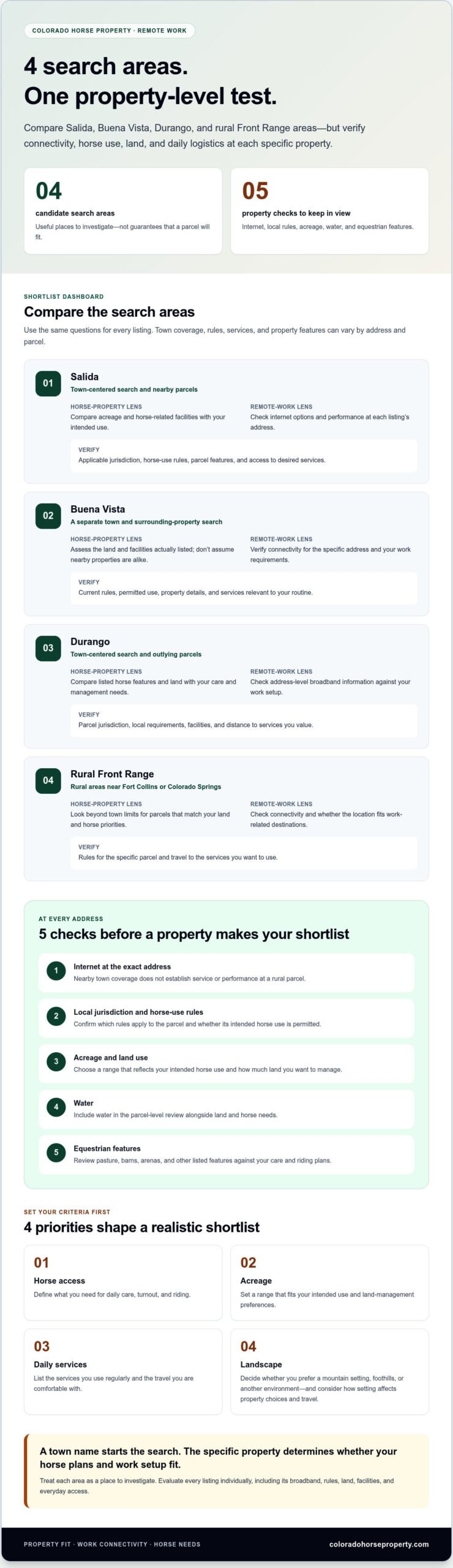
The table provides a starting framework for researching the top horse friendly towns in Colorado for remote workers. It highlights what to investigate without assuming local rules, services, or broadband are consistent across a town or region.
| Candidate area | Setting | Horse-property search considerations | Remote-work checks | Details to verify |
|---|---|---|---|---|
| Salida | Town-centered search and nearby parcels | Compare acreage, horse-related facilities, and how each property aligns with your intended use. | Check internet options and performance at each listing’s address. | Applicable jurisdiction, horse-use rules, parcel features, and access to your desired services. |
| Buena Vista | A separate town and surrounding-property search | Assess the land and facilities listed rather than assuming nearby properties are alike. | Verify connectivity for the specific address and your work requirements. | Current rules, permitted use, property details, and services relevant to your routine. |
| Durango | Town-centered search and outlying parcels | Compare listed horse features and land against your care and management needs. | Test the work setup against address-level broadband information. | Parcel jurisdiction, local requirements, facilities, and distance to the services you value. |
| Rural areas near Fort Collins or Colorado Springs | Search extends into surrounding rural communities | Look beyond town limits for parcels that match your land and horse priorities. | Check connectivity and the location’s fit with any work-related destinations. | Rules for the specific parcel, travel to desired services, and available property features. |
What should buyers compare around Salida, Buena Vista, and Durango?
Use the same questions for every listing. Does the location suit your preferred setting? Do the acreage and horse facilities fit your plans? Can you reach the services you want without disrupting your routine? Then check internet options and current local requirements for that address. Keep Salida and Buena Vista as separate candidates: findings for one don’t automatically apply to the other.
Could rural areas near Fort Collins or Colorado Springs fit better?
They may be worth researching if you’re open to properties outside town addresses. Expanding into nearby rural communities can change the parcels available and how far you are from services or work-related destinations. Those distances depend on the specific property, so compare locations individually rather than relying on a regional label or assumed commute.
Once you have promising areas in mind, compare listings by acreage and equestrian features. Colorado Horse Property’s AI-powered search can help you organize your search. Browse Colorado horse property listings as you refine your shortlist.
Remote work in Colorado: verify broadband and daily logistics at the property
A regional broadband map can point you toward areas to investigate, but it can’t establish which services are available at a specific rural address. For remote workers, internet is part of a property’s practical fit. Check address-specific options and assess daily travel alongside your work requirements before making a decision.
How can remote workers check internet at a Colorado horse property?
Use this sequence to assess each candidate address:
- Search the exact address. Use current provider availability tools to identify service options for the property itself. A town name, nearby listing, or general coverage map doesn’t prove service is available at the address.
- Review address-specific details. Compare the service options shown for the location. If a listing doesn’t have a recognized street address, use the most precise location information available and revisit the search as the property details become clear.
- Match service to your workday. Think about how you use the connection. Regular video meetings, large file uploads, cloud-based work, and simultaneous household use can place different demands on it. Compare the available service details with your actual work requirements rather than relying on a generic idea of “fast.”
- Plan for interruptions. Consider what you would do if your primary connection were interrupted during an important meeting or upload. Identify backup options that are realistic for the property and decide whether they fit your work obligations.
- Test the connection where possible. If you can access the property, assess the connection in the parts of the home where you plan to work and consider how it performs during typical work activities. A coverage listing alone doesn’t demonstrate day-to-day suitability.
Regional broadband availability is not the same as verified service at one property address. Nearby coverage can create an impression that doesn’t match the options at a specific parcel. Use coverage tools as a starting point, then assess address-specific service against your work needs.
What daily logistics belong in a remote-work location comparison?
Internet is only one part of the routine. Consider each property’s access to services you use regularly, such as groceries, appointments, supplies, or other household needs. Factor in any required in-person work too, including how often you travel and which destinations shape your schedule.
Map the property, the community you expect to use, and your regular destinations. Consider how the routes fit your preferred travel pattern, without assuming that two properties described as “near” the same town have the same access. Assess each listing’s location rather than relying on a regional commute estimate.
Keep a remote-work scorecard for each candidate property: address-specific service options, fit for meetings and uploads, a backup plan, household demands, and access to routine destinations. This makes it easier to compare the top horse friendly towns in Colorado for remote workers through the practical question that matters most: can this particular property support the way you work and live?
Horse-property checks for Colorado towns: rules, land, and equestrian features
A listing can help you spot promising horse properties, but it doesn’t establish whether a parcel fits your intended use. Requirements may vary by town, county, and property. Review each candidate on its own terms, and distinguish details stated in the listing from questions that still need property-level research.
Which horse-keeping details need parcel-specific verification?
Start with how you plan to keep and use horses. Identify the jurisdiction for the parcel and review its current requirements, including whether your intended use and number of horses are allowed. Then compare the land and listed features with your plans. Acreage or an equestrian label alone doesn’t establish suitability.
- Horse permission and use: Identify the applicable jurisdiction and review current requirements for your intended horse-keeping use and number of animals.
- Acreage and pasture: Note the acreage stated in the listing and assess whether the described land and pasture fit your plans. Acreage alone doesn’t establish carrying capacity or usable turnout.
- Water: Record what the listing says about water. Don’t infer a water source, permitted use, or availability for horses from a general reference to water.
- Barns and arenas: Distinguish features explicitly described or shown from assumptions about condition, dimensions, capacity, or permitted use.
For background on the broader purchase process, consult an equestrian real estate buyer’s guide and a Colorado land buyer’s guide. Use them to frame your research, then review the requirements and property details that apply to the specific parcel. General guidance can’t replace current, location-specific information.
How can buyers compare horse-property listings from a distance?
Use listing descriptions and available virtual tours to review visible features before deciding which properties merit closer attention. Tours can help you inspect what is shown, but they don’t establish details that aren’t stated or visible. Keep a record of open questions so your comparison stays grounded in the available information.
- Capture stated facts: Record listed acreage, pasture, water, barns, arenas, and other equestrian features mentioned in the description.
- Separate observations from assumptions: Note what a tour visibly shows, but don’t infer a facility’s condition, capacity, dimensions, or legal use.
- Track unresolved details: Flag questions about horse permission, intended use, land suitability, and facility specifications for property-level follow-up.
- Compare like with like: Use consistent acreage ranges and the same feature categories across listings in your preferred areas.
This approach makes it easier to compare the top horse friendly towns in Colorado for remote workers through actual property options rather than broad labels. Review Colorado Horse Property’s horse-property listings to compare acreage ranges and equestrian features. Virtual tours are available for many listings.
Find a Colorado horse property that fits your remote-work plans
Turn your location research into a focused property search. The top horse friendly towns in Colorado for remote workers are starting points, but the right listing needs to fit your work requirements and horse plans at the parcel level. Write down your priorities so appealing photos or a familiar town name don’t distract from practical details.
How can buyers narrow Colorado horse property listings?
Use a simple sequence to move from regional choices to individual properties:
- Choose candidate regions. Keep the towns and rural areas that fit your preferred setting and access to the communities you expect to use. Compare them as search areas, not as promises about a specific property.
- Set your work requirements. Record the connectivity you need for meetings, uploads, and household use, along with a backup plan. Keep address-level verification on your list for every serious candidate.
- Define your horse-property criteria. Note your intended horse use, land needs, and highest-priority features. Separate must-haves from preferences, such as a particular acreage range or listed equestrian features.
- Compare listings consistently. Review each description against the same criteria. Record what it states about acreage, pasture, water, barns, and arenas, and keep unanswered questions separate from confirmed details.
Colorado Horse Property Search is an AI-powered way to explore Colorado horse-property listings. After choosing promising regions, use acreage-range filters to focus on parcels that align with your land needs. Listing details help you compare the equestrian features described for each property, and virtual tours, available for many listings, let you review options from a distance.
What should your next step be after choosing candidate towns?
Create a concise shortlist before browsing deeply. Include preferred regions, acceptable distance to the services you use, address-specific connectivity requirements, horse-keeping plans, acreage range, and desired facilities. This gives every listing the same test, whether it’s near a town center or farther out.
As you review potential properties, distinguish what a listing shows from what still needs parcel-level research. A tour may help you examine visible features, but it doesn’t establish permitted use, condition, or suitability for your specific plans. Keep notes organized by property so you can compare options without relying on memory or broad regional assumptions.
The goal isn’t to find a town with the strongest reputation. It’s to identify a property that brings your work setup, horse requirements, land priorities, and preferred location into workable alignment. Start with the criteria you’ve established, then explore Colorado horse properties through Colorado Horse Property Search.
Turn your shortlist into a property search
Turn broad preferences into clear search criteria. Decide which locations you want to explore, what your work setup requires, and which horse-property features are essential. That gives you a practical way to compare listings and stay focused on property fit instead of reputation alone. The top horse friendly towns in Colorado for remote workers can point you toward promising areas, but the right match comes from finding a parcel that supports your plans.
Colorado Horse Property brings nearly four decades of Colorado real-estate experience to a focused property search. Its AI-powered Colorado Horse Property Search includes acreage-range filters, and virtual tours are available for many listings, helping you review options from a distance. Use these tools to move from a regional shortlist to properties worth a closer look.
Explore Colorado horse properties with Colorado Horse Property, and take the next step toward a property that fits both your work and equestrian goals.
Frequently Asked Questions
Which Colorado town is best for remote workers who own horses?
There isn’t one best town for every buyer. Compare Salida, Buena Vista, Durango, and rural Front Range areas against the specific parcel, your work setup, and your horse-care plans. For example, a listing that fits your acreage preference may still fall short if its rules don’t allow your intended use or its internet options don’t support your workday. The top horse friendly towns in Colorado for remote workers are the ones that meet your priorities property by property.
Is internet reliable in rural Colorado?
It depends on the address, so a blanket yes or no won’t tell you whether a particular property suits your needs. Check current service options for the exact location and compare them with your requirements for video calls, uploads, and household use. A regional map or nearby connection can guide your research, but it doesn’t verify service at the parcel. Don’t assume availability, speed, or reliability without property-level information.
Can you keep horses within Colorado town limits?
Permission depends on current local rules and the specific property, so there isn’t one statewide answer for every town parcel. Town boundaries, county jurisdiction, property restrictions, and your intended horse use may all affect what’s allowed. Identify which jurisdiction applies and review its current requirements for the parcel and your plans. A property’s location near a horse-owning community doesn’t by itself establish permission.
Is Salida a good place to live and work remotely with horses?
Salida is a candidate to investigate, not a guaranteed fit for every remote worker or horse owner. Compare individual properties for listed horse facilities and land, then review whether the applicable requirements align with your intended use. Separately, assess internet options at each property address against your work needs. Your preferred setting, access to services, and daily routine matter too, so base the decision on a specific listing rather than assumptions about the town.
Are Buena Vista and Salida the same kind of horse-property market?
No. Buena Vista and Salida are separate communities, and buyers should assess each independently rather than treating one as a proxy for the other. Compare actual listings for land and equestrian features, research the rules that apply to each parcel, and check address-level connectivity. Your location preferences and the services you want nearby may also influence your choice. Avoid drawing conclusions about inventory or prices without current information about the listings you’re considering.
Can I tour Colorado horse properties remotely before visiting?
Yes. Virtual tours are available for many Colorado Horse Property listings, though availability varies by listing. Use a tour to review visible features and decide which properties merit closer consideration. Pair what you see with the written listing details, and note anything the tour doesn’t show. A virtual tour doesn’t verify a property’s condition, legal use, broadband service, or other details that aren’t visible or stated.
How should a remote worker compare horse properties in different Colorado towns?
Use the same comparison criteria for each candidate so town names don’t skew your decision. Record internet information for the exact address, applicable horse-keeping requirements, acreage, and equestrian features stated in the listing. Add your preferred setting, access to routine services, and actual workday demands. For example, note whether the property supports frequent video meetings and has the horse facilities you need. Consistent notes make listings easier to assess without assuming they share the same conditions.