
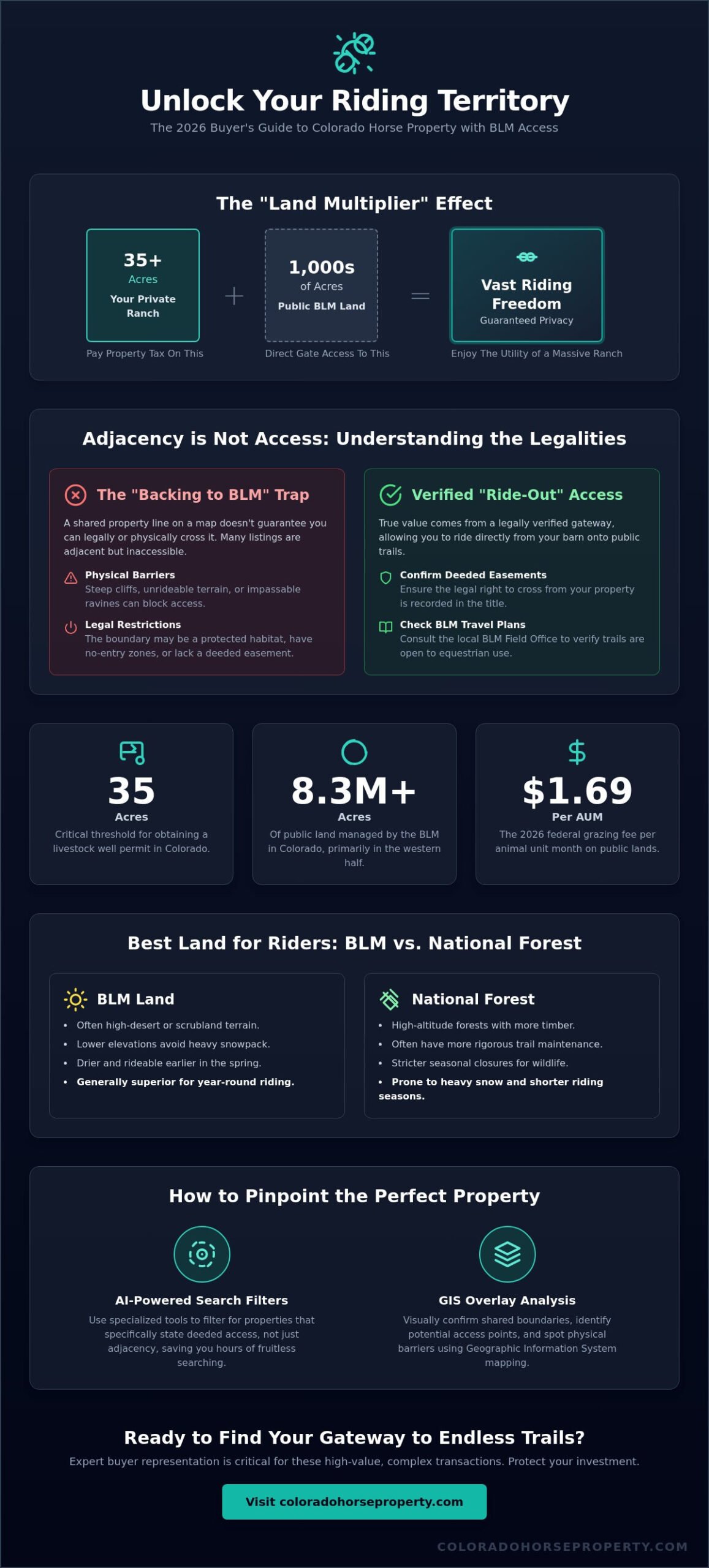
What if your 35-acre ranch actually gave you the riding freedom of 10,000 acres without the property tax bill to match? It’s the ultimate land multiplier for equestrians. Finding a Colorado horse property with BLM access turns a modest private parcel into a gateway for endless trail riding and guaranteed privacy. However, a property that simply backs to public land on a map doesn’t always guarantee you can legally cross the fence line.
You’ve likely felt the frustration of scrolling through generic listings only to find the access is blocked by a neighbor’s private gate. We understand that your goals are about more than just acreage; they’re about the freedom to ride from your barn directly onto public trails. This 2026 guide shows you how to secure direct gate rights and leverage the 2025 10th Circuit ruling on corner crossing to expand your territory. We also detail the 2026 federal grazing fee of $1.69 per animal unit month and why 35 acres remains the critical threshold for livestock well permits in Colorado.
Key Takeaways
- Learn why a 40-acre parcel can offer the utility of thousands of acres when you understand the “land multiplier” effect of public land adjacency.
- Avoid the common “backing to BLM” trap by verifying deeded easements and legal gate rights for your Colorado horse property with BLM access.
- Evaluate critical infrastructure needs, including terrain rideability for training and domestic well production limits for large-scale equestrian use.
- Discover how to use AI-powered search filters and GIS overlays to pinpoint properties that share actual boundaries with Bureau of Land Management territory.
- Understand how specialized buyer representation ensures your high-value transaction is protected through nearly four decades of expertise in rural title and escrow management.
What is a Colorado Horse Property with BLM Access?
A Colorado horse property with BLM access is a private estate that shares a boundary with land managed by the Bureau of Land Management (BLM). In Colorado, the BLM oversees roughly 8.3 million acres of public territory, much of it located in the western half of the state. For a horse owner, this means your backyard doesn’t end at your fence line. It extends into vast, government-protected landscapes that are often inaccessible to the general public, providing a buffer that most residential properties lack.
We call this the “Land Multiplier” effect. A buyer might purchase a 40-acre parcel, but if that land connects to a 4,000-acre BLM block, the usable riding area effectively increases by 100 times. You gain the utility of a massive ranch without the high property taxes or the intensive maintenance costs of owning thousands of deeded acres. This adjacency provides permanent privacy because the federal government is unlikely to develop your backyard into a modern subdivision.
To better understand how private land connects to public acreage, watch this helpful video:
The primary draw is the “ride-out” capability. You don’t need to load your horses into a trailer to reach a trail system; you simply open your back gate. You’ll find these opportunities most frequently in counties like Fremont, Eagle, and Mesa, where high-desert terrain meets mountain foothills. These regions offer diverse trail systems that range from flat sagebrush plains to technical canyon rim rides, making a Colorado horse property with BLM access a highly sought-after asset in the 2026 market.
The Value of Public Land Adjacency
Properties with direct public land access often command a premium. In 2026, these estates see higher appreciation rates because they are a finite resource. Beyond the financial upside, you get recreational rights for hiking and hunting. The psychological benefit is just as strong. Knowing your view of the mountains is protected from future construction provides a sense of peace. When evaluating colorado land, adjacency to public territory is one of the strongest hedges against local development.
BLM vs. National Forest: Which is Better for Riders?
While both offer public access, they differ in terrain and regulation. BLM land is often high-desert scrub, which stays dry and rideable earlier in the spring than high-altitude National Forests. National Forests often have more rigorous trail maintenance but stricter seasonal closures for wildlife protection. If you want year-round riding, a Colorado horse property with BLM access is usually the superior choice because the lower elevations avoid the heavy snowpacks found in the timberline forests.
Adjacency vs. Deeded Access: Understanding the Legalities
Many buyers believe that touching public land automatically grants them a private entrance. This isn’t always true. A Colorado horse property with BLM access requires a verified legal gateway to be truly valuable. The “Backing to BLM” trap occurs when a property is geographically adjacent but legally or physically cut off. For instance, a steep rimrock cliff might make riding impossible, or the specific parcel might be a protected habitat with no-entry zones. Before you sign a contract, contact the local BLM Field Office. They provide the definitive travel management plans that dictate where horses are allowed. You can also consult the Official BLM Website to review regional land-use permits and seasonal restrictions.
Fencing is another critical consideration for maintaining a “Good Neighbor” status. In Colorado, you’re responsible for keeping your livestock on your deeded acres. If your horses wander onto public land without a grazing permit, you could face fines based on the 2026 federal grazing fee of $1.69 per animal unit month. High-quality perimeter fencing isn’t just about containment; it’s about clearly defining your private sanctuary from the thousands of public acres next door. Using sturdy, horse-safe materials ensures your animals stay safe while you enjoy the benefit of a government-owned backyard.
Verifying Legal Gate Access
A private gate into public land is a massive value-add for a Colorado horse property with BLM access, but it must be legally documented. Check the property title for existing trail easements or historical access points that have been recorded with the county. During the due diligence period, your agent should verify that no local ordinances or federal rules prohibit a private entrance. If a gate doesn’t exist, you may need to negotiate with the BLM for a right-of-way permit. If you’re unsure where to start, our buyer representation services can help you navigate these complex title issues.
Public Land Boundaries and Trespassing
Modern GPS mapping tools are essential for the 2026 buyer. Use apps with GIS overlays to confirm that the fence line matches the actual surveyed boundary. The 2025 10th Circuit Court of Appeals ruling on corner crossing has clarified access to landlocked public parcels, but it doesn’t give the public a right to cross your deeded land. Use clear signage and “No Trespassing” markers at common entry points to prevent public land users from wandering into your arena or pastures. Proper boundary management ensures your privacy remains intact while you enjoy your extended backyard.
Essential Features to Evaluate Before You Buy
Owning a Colorado horse property with BLM access is only a dream if the land is actually usable. Before you commit, walk the boundary line to assess terrain rideability. Some BLM parcels consist of vertical rimrock or deep arroyos that even a seasoned mountain horse can’t navigate. You’re looking for sustainable trail grades and footing that won’t wash out during a heavy July monsoon. Understanding the U.S. Public Land Laws regarding rights-of-way is vital to ensure your access remains protected as federal management plans evolve.
Water is the lifeblood of any ranch. In Colorado, a minimum of 35 acres is generally required to secure an automatic domestic well permit that allows for watering livestock. If the property is smaller, you’ll likely be restricted to indoor use only, which is a deal-breaker for equine operations. Additionally, check the proximity to Wild Horse Herd Management Areas (HMAs) like Little Book Cliffs or Sand Wash Basin. While seeing wild mustangs is a draw, it can influence local grazing regulations and fencing requirements. Finally, review county-specific zoning for outbuildings. Whether you are looking at existing structures or browsing horse barns for sale to build your own, ensure the acreage supports the number of stalls you need.
Equestrian Infrastructure Requirements
Don’t overlook the logistics of daily operations. A functional barn needs more than just stalls; it requires ventilated hay storage and a dedicated tack room. For those who travel to shows, a 100-foot diameter trailer turnaround is a necessity, not a luxury. If you plan to install an arena, test the soil composition. Areas with heavy bentonite clay will require significant drainage work and expensive footings to remain rideable through the spring thaw. This infrastructure is what turns a simple piece of land into a professional-grade equestrian estate.
Analyzing the “Extended Backyard”
Your due diligence should extend at least five miles into the adjacent public land. Map the existing trail systems and look for seasonal closures. For example, many BLM areas in Eagle and Mesa counties close from December through April to protect winter range for elk. You should also identify shared access points. If a public trailhead is located within a half-mile of your gate, expect higher foot traffic and mountain bikers on your “private” trail system. A truly premium Colorado horse property with BLM access offers a buffer from these high-traffic zones, keeping your rides peaceful and your livestock secure.
How to Search for Colorado Horse Property with BLM Access
Finding a Colorado horse property with BLM access requires a more sophisticated approach than browsing generic real estate sites. Most national platforms don’t offer filters for public land adjacency, leaving buyers to manually cross-reference map coordinates. In 2026, the most efficient way to narrow your search is through AI-powered tools designed for rural land. These systems can instantly filter thousands of listings to find those sharing a surveyed boundary with federal territory. This technology eliminates the frustration of visiting a “ranch” only to find it’s separated from the trails by a mile of private road.
GIS (Geographic Information System) overlays are the gold standard for verifying these boundaries. These maps layer county assessor data directly over federal land ownership records. You can see exactly where the yellow-shaded BLM parcels meet the private deeded acres. Because these boundaries can be complex, working with an equestrian real estate Colorado specialist is essential. They use proprietary mapping software to identify properties in BLM-rich basins like the Uncompahgre or the San Luis Valley before they reach the general public. Ready to start your targeted search? Use our AI-powered property search to filter for public land adjacency today.
Mapping Tools for the Modern Buyer
You should use specialized mapping apps during every property showing. Tools like OnX Backcountry or Gaia GPS allow you to field-test access in real-time. While standing on the property, you can confirm if the existing fence line aligns with the legal BLM surface management maps. Look specifically for “landlocked” public parcels. These are sections of BLM land entirely surrounded by private property. If your potential ranch is the only one with a legal easement to that parcel, you effectively gain a private park that the general public cannot reach.
The Role of Local Knowledge
Digital tools are powerful, but they don’t replace boots-on-the-ground intelligence. Local trail riding groups often know which “accessible” BLM areas have become overgrown or blocked by natural shifts in terrain. We also recommend consulting with the specific BLM Field Office for the region, such as the Colorado River Valley or Royal Gorge offices. They can provide current travel management plans and alert you to any active grazing permits. If a neighbor holds a permit for the $1.69 AUM fee, you’ll want to know how their cattle movement might affect your trail access during certain months of the year.
Securing Your Dream: Expert Buyer Representation
Purchasing a Colorado horse property with BLM access is a complex legal and financial move that requires more than a generalist realtor. It demands a professional who understands federal land policy, water law, and the unique needs of equestrian infrastructure. With nearly four decades of experience in the Colorado market, our team knows that these transactions aren’t just about square footage. They’re about securing a legacy. We specialize in finding the hidden risks and opportunities that standard listings miss, ensuring your investment is protected from the first tour to the final signature.
Realty Oasis provides a level of specialization that’s critical for high-value colorado land deals. We manage the entire transaction process, including title and escrow services specifically tailored for rural and agricultural properties. This ensures every easement is verified and every grazing permit is properly understood. Our meticulous approach is why we’ve remained a trusted partner for Colorado ranchers for over 38 years. We don’t just find you a house; we find the property that fits your lifestyle and dreams.
The Realty Oasis Advantage
Our deep network of title experts, escrow officers, and agricultural partners provides a seamless experience for our clients. We include specialized contract contingencies in every horse property for sale in colorado to protect you during the due diligence period. These contingencies cover everything from well production testing to legal gate access verification. Our founder-forward approach means you work directly with experts who understand the equine world. We speak the language of barns and pastures, providing a reassuring partnership throughout the search.
Start Your Search Today
The 2026 market moves quickly, with a 12% increase in buyers seeking rural acreage over suburban homes. To stay ahead, you need the right technology and the right team. Our proprietary AI-driven property matching tool is designed to find a Colorado horse property with BLM access that meets your exact criteria, from terrain rideability to trail proximity. Before your first showing, prepare a checklist that includes your minimum acreage for a domestic well and your preferred county.
When you’re ready to take the next step, contact Mark Eibner and Belinda Seville to schedule a specialized property tour. We’ll help you define your goals and navigate the complexities of public land adjacency. Whether you’re looking for a private 35-acre retreat or a massive working ranch, our team has the knowledge and technology to make your equestrian dream a reality.
Secure Your Ride into the Future
Finding the perfect Colorado horse property with BLM access requires a strategic blend of modern technology and deep local expertise. You now understand why verifying legal deeded access is more important than a simple shared fence line. You also recognize that the 35-acre threshold remains the critical mark for securing a domestic well permit for your livestock. These technical details are the difference between a functional ranch and a restricted parcel. Focusing on rideable terrain and verified boundaries ensures your property serves your long-term goals rather than creating legal hurdles.
Our team brings nearly 40 years of specialized experience to your search. We combine AI-powered tools with a no-nonsense understanding of water rights and public land boundaries to help you find a legacy ranch. We don’t just list properties; we help you secure the freedom of the Colorado landscape. Find your Colorado Horse Property with BLM access using our AI Search Tool and let us help you turn your lifestyle and dreams into a reality. Your next great trail ride starts with a single, informed search.
Frequently Asked Questions
Does backing to BLM land mean I can build a private gate?
You don’t have an automatic right to install a private gate just because your property line touches public land. You must apply for a right-of-way permit or verify an existing deeded easement in your title. Without this legal documentation, crossing the boundary could be considered a violation of federal travel management plans. Always verify gate rights during your due diligence period.
Can I graze my horses on the adjacent BLM land?
Grazing requires a formal permit and cannot be done legally just by opening your back fence. For the 2026 season, the federal grazing fee is $1.69 per animal unit month (AUM). This permit is a separate legal right from your property deed. It must be maintained through the local BLM Field Office and is subject to specific seasonal use rules.
Is BLM land ever sold to private developers?
BLM land is rarely sold to developers because it’s managed under a multiple use mandate for the public. While land exchanges occasionally happen under the Federal Land Policy and Management Act, most parcels remain government-owned. This provides a permanent privacy buffer for your Colorado horse property with BLM access, protecting your mountain views from future subdivisions.
How do I verify if a property has “legal” access to public land?
Verify access by performing a comprehensive title search to look for recorded easements or historical rights-of-way. You should also cross-reference county GIS maps with BLM travel management plans. These documents will show if there are public access points or if the entry is restricted to specific private parcels. Consulting a specialized equestrian agent is the best way to confirm these details.
Are there more restrictions on my private land if I border the BLM?
Federal agencies don’t have jurisdiction over how you use your private deeded acres. However, Colorado is an open range state, meaning you’re responsible for fencing out neighbor’s livestock or keeping your horses contained. Your zoning is determined by the county. Bordering public land doesn’t change your ability to build barns or arenas on your own soil.
What is the difference between a BLM Herd Management Area and general public land?
Herd Management Areas (HMAs) are specific regions where the BLM manages wild horse and burro populations under the 1971 Wild Free-Roaming Horses and Burros Act. General public land is managed for broader uses like timber, mining, and recreation. Living near an HMA often means you’ll see wild mustangs, which can be a significant draw for a Colorado horse property with BLM access.
Do I need a special permit to ride my horses on BLM trails?
You don’t need a permit for private, non-commercial recreational riding on most BLM trails. Restrictions typically only apply if you’re running a commercial outfitting business or organized events with more than 25 participants. It’s still vital to check for local seasonal closures. Many areas close trails from December through April to protect elk winter ranges.
How does BLM adjacency affect my property taxes in Colorado?
Adjacency increases the market value of your property but doesn’t change the base tax rate. For the 2026 tax year, Colorado agricultural property is assessed at 25% of its actual value. To qualify for this lower rate, your land must be used for a primary agricultural purpose like hay production or commercial grazing, regardless of its proximity to public land.