
Did you know that while Colorado ranks in the top five states for horse farms, owning ten acres doesn’t guarantee you can actually keep a single horse? In many parts of the state, pasture-kept livestock require 20 to 40 acres to thrive, making the process of buying land for a horse barn in Colorado a complex legal and environmental puzzle. It’s exhausting to sift through countless property listings, only to repeatedly discover that a promising parcel lacks crucial water rights or carries restrictive zoning that prohibits your vision for a functional homestead.
We understand that building a horse barn is a feasibility study, not just a property transaction. This 2026 guide will help you master the technical and legal essentials of acquiring property, ensuring your investment supports your long-term lifestyle goals. You’ll gain a clear checklist for due diligence, an understanding of specific acreage requirements, and a streamlined search process. We’re moving past the guesswork to look at well permit production, local setbacks, and the usable land quality that truly matters for equestrian development.
Key Takeaways
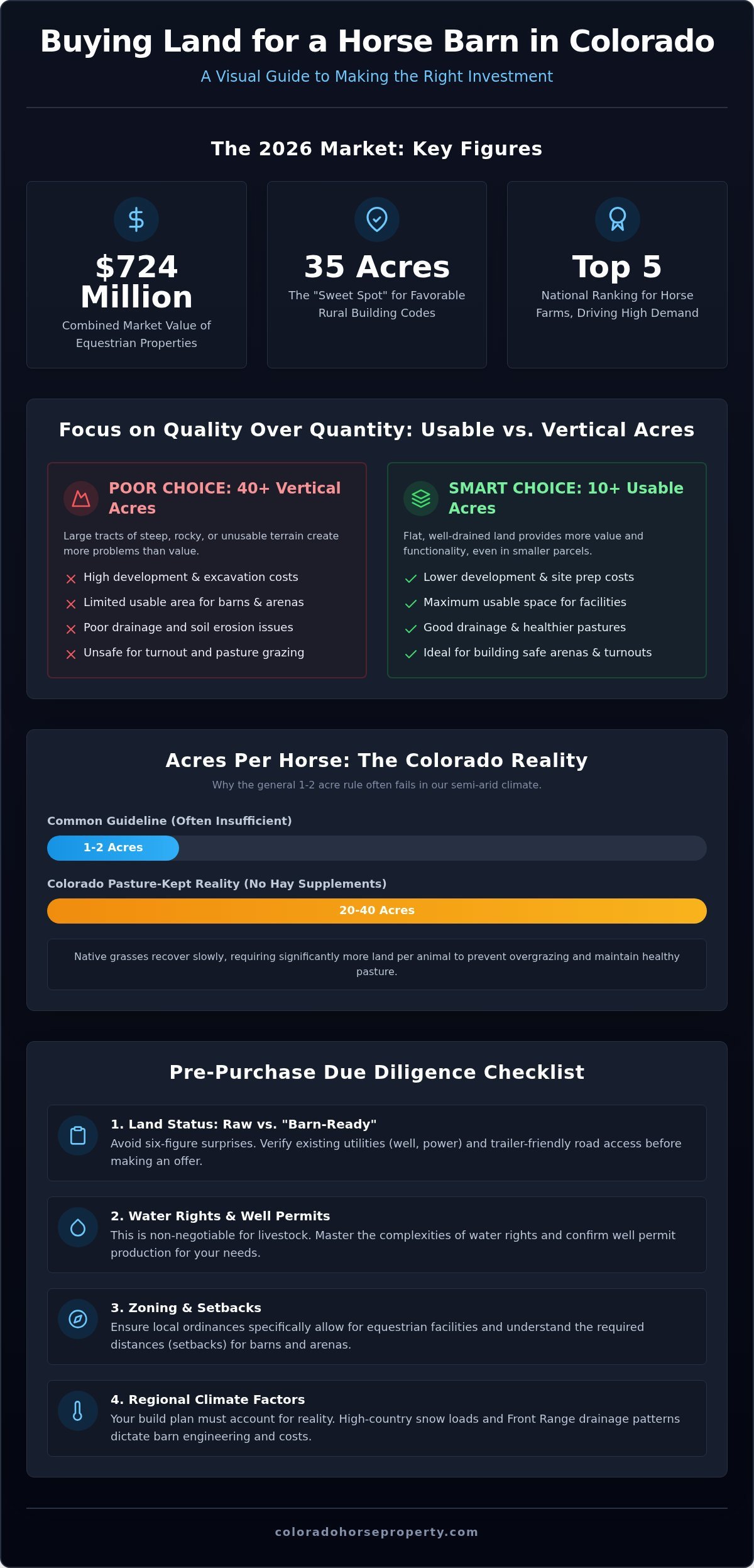
- Distinguish between raw land and “barn-ready” parcels to avoid the hidden costs of bringing utilities and trailer-friendly road access to your build site.
- Evaluate land quality over quantity by understanding why flat, usable acres provide more value for arena development than large tracts of vertical terrain.
- Navigate the legal complexities of buying land for a horse barn in Colorado by mastering water rights and local zoning setbacks before you sign a contract.
- Identify regional climate factors, such as high-country snow load requirements and Front Range drainage patterns, that dictate your barn’s structural engineering.
- Streamline your property hunt using AI-powered search tools that filter specifically for equestrian infrastructure and soil types suitable for livestock.
Navigating the Colorado Land Market in 2026
The 2026 market for Colorado acreage is defined by high demand and a shift toward specialized utility. With a combined market value of approximately $724 million for equestrian properties across the state, the stakes are high. The average lot size for land listings hovers around 723 acres, though most horse owners look for smaller, more manageable parcels. The Front Range continues to be the most competitive region. Its proximity to metropolitan centers and established trail systems keeps inventory low and prices firm. To navigate this environment, you need an expert perspective on land for sale in Colorado to identify value where others see only raw acreage.
When you’re buying land for a horse barn in Colorado, the distinction between raw and “barn-ready” land is critical. Raw land often lacks the fundamental infrastructure required for safe livestock housing. In contrast, barn-ready land typically includes established well permits, power at the lot line, and graded access roads. These improvements save you significant time and money during the construction phase, as trenching utilities across several acres can quickly exhaust a building budget.
To better understand how location and land type impact your search, watch this helpful video:
The 2026 Outlook for Colorado Land Values
Conservation easements are increasingly common, protecting large swaths of land but limiting the number of buildable parcels. This trend has created a premium for unencumbered land that allows for new barn construction. Price trends vary by region. The Eastern Plains offer more acreage for your dollar, while the Foothills and High Country command higher prices due to terrain and views. For those looking to understand the underlying value of their potential investment, BuyVacantLand.com provides a comprehensive guide on how to estimate land valuation. Many buyers focus on 35-acre parcels. This specific size often allows for easier subdivision and more flexible building codes in rural counties, making it a sweet spot for equestrian development.
Identifying Your Land Ownership Goals
Your search should begin with a specific horse count. This number dictates your acreage needs and barn size. Whether you’re planning a small hobby farm or a full-scale ranch, you must evaluate the “highest and best use” for any potential building site. Consider drainage, prevailing winds, and proximity to hay storage. By following horse management best practices, you can ensure your property layout promotes animal health. Buying land for a horse barn in Colorado requires a vision that balances your lifestyle dreams with the practical realities of land management and infrastructure costs.
Calculating Your Ideal Acreage: How Much Land Do You Actually Need?
A common mistake when buying land for a horse barn in Colorado is overestimating what the terrain can handle. In Colorado’s semi-arid environment, carrying capacity refers to the number of animals a specific parcel can support sustainably without degrading the soil or vegetation. While a listing might boast 40 acres, the usable portion is what determines your barn’s success. 10 flat, well-drained acres often provide more value than 40 vertical acres of scrubland where building a level arena or safe turnout becomes a structural nightmare.
Maintenance is another critical factor for solo owners. Managing a large tract requires significant time and heavy equipment. If your goal is to spend more time in the saddle than on a tractor, a smaller, highly improved parcel may be the better choice. You can filter for these specific features using our AI-powered property search to find land that matches your maintenance capacity and lifestyle goals.
The Equestrian Standard: Acres per Horse
The general guideline of 1-2 acres per horse is often insufficient in the high-desert climate of the Front Range. Without irrigation, Colorado’s native grasses recover slowly. For horses kept primarily on pasture, you may actually need 20 to 40 acres per animal to avoid overgrazing. Most owners supplement with hay, which allows for higher density on smaller plots. Regardless of size, you must verify your access to water. Understanding Colorado well permits is essential, as your permit type determines if you can legally water livestock. For those looking for ready-to-use setups, exploring horse property for sale in Colorado can provide a benchmark for what successful acreage ratios look like in different counties.
Small Acreage vs. Large Ranches
Your choice between a “Ranchette” and a working ranch depends on your long-term goals and tax considerations. Small parcels, typically 5 to 15 acres, are ideal for hobbyists with 2 to 4 horses. They offer enough space for a barn and small paddocks without the overwhelming management duties of a large estate. Working ranches of 40 acres or more often qualify for agricultural tax status, which can significantly lower your property taxes, but they require active land management and complex fencing.
Always calculate your usable acreage by subtracting steep slopes, rock outcroppings, and protected wetlands. A plot map can be deceiving; what looks like a vast field might actually be a series of unbuildable ravines. Focus on the flat ground where your barn, manure management system, and trailer turnarounds will actually sit. Buying land for a horse barn in Colorado is about finding the right balance between the horizon you want and the land you can realistically manage.
Beyond the Plot Map: Evaluating Zoning, Water, and Mineral Rights
Buying land for a horse barn in Colorado requires looking far beneath the surface. A standard title search won’t tell you if you actually have the legal right to water your animals or if a neighbor’s senior water right could leave your well dry during a drought. In the West, property rights are layered. You must investigate the “split estate” where surface, mineral, and water rights are often owned by different entities. Failing to do this due diligence before buying land for a horse barn in Colorado can lead to expensive legal battles or a property that can’t legally support livestock.
While the Rule of Capture allows landowners in some states to pump unlimited groundwater, Colorado uses a system of court-decreed priorities that dictates exactly who gets water and when. Don’t assume that owning the land gives you ownership of the resources underneath it. Mineral rights are frequently severed, meaning a third party could potentially have the right to access your property for extraction. This makes a specialized land search essential to ensure your future pastures aren’t interrupted by industrial infrastructure.
Understanding Colorado Water Rights
In 2026, “water-rich” land commands a 20-30% premium because of its increasing scarcity. Colorado operates under the Prior Appropriation Doctrine, where “senior” rights take precedence over “junior” ones. When evaluating a parcel, you must verify the specific well permit type with the Division of Water Resources. A “household-only” permit is a common pitfall; it doesn’t allow for livestock watering. You need a permit that explicitly includes domestic and livestock use to legally operate a barn. These decrees are public record, but they require a seasoned expert to interpret correctly during the transaction management phase.
Zoning and Land Use Regulations
Agricultural zoning like A-1 or A-2 is the baseline for equestrian use, but it’s only the start of your research. Even if the county allows horses, rural HOAs often hide restrictive covenants that limit the number of animals or the specific materials you can use for your barn. While Colorado’s “Right to Farm” laws offer some legal protection for agricultural noise and odors, they won’t override a county setback requirement that dictates where your barn can sit. Buying land for a horse barn in Colorado means balancing these local regulations with your operational needs to ensure your barn is both legal and functional for the long term.
Regional Breakdown: Where to Find the Best Acres in Colorado
Location dictates your structural requirements and daily operational costs more than any other factor. While the Eastern Plains offer vast acreage and lower price points, they often lack the immediate trail access found in the foothills. Conversely, the high country requires specialized barn engineering to handle extreme weather. For those looking for larger operations across these diverse landscapes, exploring colorado ranches for sale provides insight into how land management needs shift from one zip code to the next.
Proximity to veterinary services and equestrian supply hubs is a practical necessity that many buyers overlook. Living in a remote mountain valley is aspirational, but hauling a horse two hours for an emergency vet visit is a harsh reality. When buying land for a horse barn in Colorado, you must balance the desire for seclusion with the need for a reliable support network of farriers, hay growers, and specialized medical care.
The Front Range and Foothills
Douglas, Elbert, and Larimer Counties represent the heart of the state’s equestrian community. These areas provide the best proximity to world-class veterinary clinics and major supply outlets. Finding 5 to 10 acres within an hour of Denver or Fort Collins is a primary goal for many, though competition for these commutable parcels remains intense in 2026. Expect higher land costs here due to the proximity to the urban corridor. The trade-off is a robust infrastructure that makes daily horse management significantly more convenient.
The Western Slope and High Country
The Roaring Fork and Uncompahgre Valleys offer stunning equestrian estates with direct access to expansive public trail systems. However, buying land for a horse barn in Colorado’s high country introduces unique environmental challenges. Short growing seasons mean you’ll likely import hay for most of the year, which increases your recurring expenses. Barn construction must also account for specific snow load requirements. Depending on the elevation, local building codes may require roofs to support 50 to 100 pounds per square foot. These structural mandates can significantly increase your initial building budget compared to a similar project on the plains.
Logistics also play a major role in the high country. Steep mountain driveways require frequent plowing and sanding to remain trailer-accessible during the winter months. If you plan to travel frequently for shows or events, the flatter terrain of the Front Range or Eastern Plains offers a distinct advantage for year-round hauling. Before you commit to a specific region, use our AI-powered horse property search to filter listings by elevation, county-specific infrastructure, and existing barn features.
Finding Your Legacy: Using AI to Simplify Your Land Search
Traditional real estate platforms are designed for suburban residential sales, not the technical demands of agricultural acreage. When you’re buying land for a horse barn in Colorado, generic search filters for “acreage” or “lot size” fail to account for the nuances of equestrian life. They don’t show you if the soil is arena-ready or if the topography allows for safe trailer turnarounds. This gap in the market often leads to “Zillow fatigue,” where buyers sift through thousands of irrelevant listings that lack the fundamental infrastructure for livestock.
Our proprietary technology solves this problem by focusing on specialized data points. We move beyond simple measurements to evaluate the actual utility of the land. This streamlined process allows you to identify properties that meet your specific needs for barn placement, grazing potential, and drainage before you ever step foot on the dirt.
The Advantage of AI-Powered Property Search
Our AI-Powered Horse Property Search filters for “horse-ready” land rather than just raw space. It analyzes property specifications to find existing outbuildings, level building sites, and parcels with the correct well permit types. This automation handles the heavy lifting of the due diligence phase, saving you hundreds of hours of manual research. By analyzing historical data and current market trends, our system also identifies off-market potential. We find parcels that meet your criteria but aren’t yet visible on traditional public platforms, giving you a distinct advantage in a competitive market.
Expert Representation: Why Experience Matters
Technology finds the opportunity, but experience closes the deal. Mark and Alison Eibner provide buyer representation backed by 40 years of Colorado Front Range experience. Navigating a complex land purchase requires more than a standard real estate license; it demands a deep understanding of land management and rural infrastructure. We handle the transaction management, ensuring that title and escrow services account for every easement, water decree, and mineral right discussed in previous sections. You need a broker who understands animal husbandry and soil quality, not just square footage and curb appeal.
Moving from a search result to a successful land purchase is a journey of verification. Once our AI identifies a candidate, we guide you through the final steps: on-site inspections, soil testing for barn foundations, and confirming county-specific building setbacks. This comprehensive approach ensures your investment is secure and your equestrian goals are achievable. Start your AI-powered Colorado land search today to find a property that truly supports your vision.
Securing Your Equestrian Legacy
Buying land for a horse barn in Colorado is a significant investment that requires more than just a beautiful view. Success depends on verifying water decrees, understanding regional snow loads, and calculating the true carrying capacity of the soil. You’ve learned that flat, usable acreage often outweighs total land size. Local zoning laws can also dictate your building plans before you even break ground. These technical details are the difference between a functional homestead and a costly mistake.
Our specialized equestrian and ranch division is here to simplify this complex process. We combine 40 years of Colorado real estate expertise with proprietary AI search technology to help you filter for the exact infrastructure your horses need. From navigating title issues to identifying off-market potential, we ensure your land purchase is a legacy you can build on. We understand the specific requirements of livestock owners because we’re peers in this community.
Find Your Dream Colorado Acreage with AI-Powered Search today. Your vision of a perfect horse property is within reach when you have the right data and a seasoned team on your side.
Frequently Asked Questions
How many acres do I need for horses in Colorado?
You generally need a minimum of 1 to 2 acres per horse if you plan to provide supplemental hay year-round. However, for horses kept exclusively on pasture in Colorado’s semi-arid climate, 20 to 40 acres per animal may be required to prevent overgrazing. Local county regulations in places like Douglas or Elbert often set specific minimums for livestock. Always check the usable land percentage, as steep slopes and rock outcroppings don’t count toward grazing requirements.
What are water rights and why do they matter for Colorado land?
Water rights are legal entitlements to use water from a specific source, governed by the Prior Appropriation Doctrine. In Colorado, senior rights take precedence over junior ones during shortages. When buying land for a horse barn in Colorado, you must verify your well permit type. A household-only permit won’t allow you to water livestock. You need a domestic and livestock permit to legally support your horses and maintain your barn operations.
Can I build a horse barn on any acreage for sale in Colorado?
No, building a barn depends on specific zoning and local land use regulations. Even if a property is labeled agricultural, county setbacks or protective covenants in rural HOAs might restrict where you place a structure. You must confirm that the parcel’s zoning, such as A-1 or A-2, explicitly allows for equestrian buildings. Additionally, ensure the soil quality and topography can support the weight and drainage requirements of a permanent barn foundation.
What is the difference between a ranch and a farm in Colorado?
The primary difference lies in the land’s intended use and production focus. A ranch is typically dedicated to raising and grazing livestock, such as horses or cattle, on large tracts of native pasture. A farm focuses on cultivating crops, like hay or corn, which often requires irrigation and different soil management. In Colorado, these terms are sometimes used interchangeably in listings, but the infrastructure for a working ranch differs significantly from a crop-focused farm.
Are mineral rights usually included when buying land in CO?
Mineral rights are frequently severed from the surface rights in Colorado, creating what is known as a split estate. It’s common for a third party to own the rights to the oil, gas, or minerals beneath your pasture. If these rights aren’t included in your purchase, the owner might have the legal right to access your land for extraction. Always have a specialized title search performed to understand who owns the resources below your property.
What are the hidden costs of owning large acreage in Colorado?
Beyond the purchase price, you’ll face ongoing expenses for fencing, noxious weed control, and private road maintenance. If the land is raw, the cost of trenching utilities from the lot line to your barn site can be substantial. Snow removal for long, trailer-friendly driveways is another significant winter expense. You should also budget for professional manure management and the potential cost of hauling water if your well production drops during dry seasons.
How does agricultural zoning affect property taxes in CO?
Agricultural zoning can significantly lower your property taxes if the land is used for production purposes. In Colorado, properties that qualify for agricultural status are taxed at a much lower rate than residential land. To maintain this status, you must demonstrate active use, such as grazing livestock or harvesting hay. This tax benefit is a major advantage when buying land for a horse barn in Colorado, but it requires strict adherence to county management guidelines.
What should I look for in a land survey before buying?
A comprehensive land survey should identify all property boundaries, existing easements, and legal setbacks. Look for markers that indicate utility lines or shared access roads that might interfere with your barn placement. The survey should also highlight topographical features like floodplains or steep grades that affect buildability. Understanding these physical and legal constraints before closing ensures that your planned equestrian infrastructure won’t violate any property line restrictions or neighbor agreements.