
Most traditional mortgage lenders look at a $100,000 indoor arena and see exactly zero dollars in collateral value. When you begin the process of financing a horse property in Colorado, you’ll likely find that standard residential loans often fail the moment your acreage exceeds a certain limit or your infrastructure becomes specialized. It’s a common frustration for buyers who realize their dream ranch is being appraised as a simple house on a dirt lot, completely ignoring the massive investment in barns, arenas, and fencing.
You probably already know that securing a multi-use property requires more than just a good credit score; it requires a lender who understands agricultural zoning and the intricacies of Colorado water law. This guide will help you master the complexities of equestrian lending and secure the right loan for your Colorado ranch or hobby farm. We’ll provide a clear path to pre-approval by breaking down current 2026 interest rates, explaining the critical 35-acre rule, and showing you how to find specialized lenders who actually value your horse-ready infrastructure.
Key Takeaways
- Understand why traditional lenders often fail to value expensive infrastructure and how to find specialized alternatives that recognize the worth of your barn and arena.
- Compare the specific requirements for hobby farm versus agricultural loans to determine which financing path fits your acreage and intended property use.
- Learn how Colorado’s 35-Acre Rule and regional water rights impact your loan eligibility and long-term property value.
- Master the five essential steps for financing a horse property in Colorado, from preparing for higher down payments to securing pre-approval with the right niche lender.
- Discover how AI-powered search technology can help you filter for properties that align with specific lender criteria for zoning and equestrian features.
Why Traditional Mortgages Often Fail for Colorado Horse Properties
Big banks are built for efficiency, which usually means they prefer “cookie-cutter” homes in suburban subdivisions. When you attempt financing a horse property in Colorado through a traditional lender, you often hit a wall because these properties don’t fit into standard boxes. Equestrian financing is a specialized hybrid of residential and agricultural lending practices designed to account for both a primary residence and high-value animal infrastructure. Most retail banks simply aren’t equipped to handle the nuances of a property that includes more than a house and a small yard.
Standard lenders rely on Fannie Mae and Freddie Mac guidelines, which are designed to bundle and sell loans on the secondary market. These guidelines frequently limit the “allowable” acreage that can contribute to the property’s appraised value. If you’re looking at a 20-acre estate, a traditional lender might only value the house and the first five acres, treating the remaining land as a zero-value risk. This creates a massive gap between the purchase price and the loan amount, forcing buyers to come up with significantly higher down payments.
To better understand the unique challenges and joys of owning these properties, watch this helpful video:
The Problem with “Comps” in Rural Colorado
Appraising a horse property is a technical challenge that standard residential appraisers rarely master. In a suburban neighborhood, finding three similar houses that sold in the last six months is easy. In rural Colorado, your nearest comparable sale might be ten miles away and have completely different outbuildings. Appraisers often struggle with “contributory value,” which is the amount an improvement adds to the total value of the land. A professional-grade indoor arena might cost $200,000 to build, but a standard appraiser might only credit the property with $20,000 because they cannot find local “comps” with similar structures. Specialized lenders use appraisers who understand the market for a Hobby farm and recognize that fencing, stalls, and arenas are essential assets, not just “non-conforming” sheds.
Acreage Limits and the Secondary Market
Most conventional mortgage products have a strict “cutoff” for acreage, often ranging between 5 and 10 acres. When a property exceeds this limit, underwriters often flag it as “excess land.” This is particularly problematic in Colorado, where the 35-Acre Rule (Senate Bill 35) means many rural parcels are exactly that size or larger to avoid complex subdivision regulations. Once you cross that 35-acre threshold, you are no longer looking at a standard residential loan. With rural land valuations in Colorado rising 12.4 percent since early 2024, the financial gap caused by acreage limits has become a major hurdle for buyers who don’t have specialized agricultural lending partners.
Comparing 2026 Loan Options: Hobby Farms vs. Agricultural Ranches
Choosing the right path for financing a horse property in Colorado depends on your property’s primary purpose. Lenders generally categorize these assets into two main buckets: lifestyle-driven hobby farms and production-driven agricultural ranches. Hobby farm loans are ideal for residential properties between 2 and 20 acres where no commercial income is generated. If your goal is a working ranch with larger acreage or income-producing facilities like professional boarding, you’ll likely need a specialized agricultural (Ag) loan.
Portfolio loans offer a third alternative. These are specialized products held by local banks that don’t follow rigid national guidelines, allowing for more flexibility on “non-conforming” outbuildings. For buyers in specific geographic zones, USDA farm and rural housing loans provide accessible entry points, particularly for those who may not qualify for high-balance conventional products. You can use an AI-powered horse property search to filter for listings that align with the specific acreage thresholds required by these different loan types.
Conventional and Jumbo Loans for Equestrian Estates
A standard mortgage is often still viable if the property is under 10 acres and the residence is the primary source of value. However, with the median list price for Denver-area horse properties reaching $1,530,000 in 2026, many buyers find themselves in Jumbo loan territory. Current 30-year fixed Jumbo rates in Colorado are averaging around 6.875 percent. To secure these, you’ll typically need a credit score above 720 and a debt-to-income ratio below 43 percent. Private mortgage insurance (PMI) remains a factor for rural purchases with less than 20 percent down, though many equestrian buyers opt for higher down payments to avoid this added monthly cost.
Agricultural Lending for Working Ranches
Agricultural lenders like Farm Credit offer distinct advantages for larger Colorado properties. Unlike big banks, these institutions understand the value of water rights and specialized infrastructure. As of July 2026, the USDA Farm Service Agency (FSA) Direct Farm Ownership loan rate sits at 6.000 percent, while the Colorado Agricultural Future Loan Program offers a competitive 4 percent fixed rate for qualified applicants. One unique benefit of Ag lending is “patronage,” a cooperative model where the lender returns a portion of its profits to the borrower, effectively lowering your net interest rate. These lenders also offer flexible payment structures that can be timed to agricultural production cycles rather than strict monthly schedules.
Critical Colorado Factors: Water Rights, Zoning, and the 35-Acre Rule
In Colorado, land isn’t just about surface area; it’s about the legal rights attached to it. The “35-Acre Rule,” stemming from Senate Bill 35 passed in 1972, is a primary driver for rural property division. If a parcel is at least 35 acres, it bypasses the rigorous county subdivision approval process required for smaller lots. For those seeking financing a horse property in Colorado, this rule simplifies legal descriptions but often pushes the property into the agricultural lending category. While smaller parcels are easier to finance with residential products, they often face stricter zoning limits on the number of horses allowed.
Zoning classifications dictate your daily life and your loan options. Residential-Equestrian zones are common in the Front Range, allowing for personal horses but often prohibiting commercial boarding. Pure Agricultural zoning offers more freedom but requires different underwriting. If a property is under a Conservation Easement, you might find lower property taxes, though the restricted development rights can complicate appraisals. Adjudicated water rights are considered “real property” for loan security, meaning they are deeded assets that provide essential collateral for your lender.
Maintaining a “Greenbelt” or agricultural tax status is a significant financial advantage. In areas like Parker, where residential tax assessments are 6.8 percent in 2026, an agricultural designation can slash your annual tax bill by thousands. This lower carrying cost directly improves your debt-to-income (DTI) ratio, potentially allowing you to qualify for a higher loan amount than a standard residential property would allow.
Water Rights as Financial Collateral
Lenders view water as the lifeblood of a property’s value. A domestic well permit typically allows for watering livestock and irrigating up to one acre, while a “household-only” permit restricts water use to inside the home. Commercial wells are required if you plan to run a large-scale boarding facility. Water seniority, based on the doctrine of prior appropriation, is critical; “senior” rights are more valuable because they are the last to be shut off during a drought. Most lenders require a well recovery test and a potability report to ensure the property has a sustainable and safe water supply before they will fund the loan.
Zoning and Income-Producing Potential
If you plan to generate revenue through boarding or training, you must navigate the “Commercial Use” trap. A standard hobby farm loan is for personal use; the moment a lender sees a business plan or significant income from the arena, they may reclassify the transaction as a business loan. This usually requires a higher down payment and a shorter amortization period. Always verify local county regulations for equestrian facilities, as some jurisdictions require a Special Use Permit (SUP) for even small-scale commercial activities, which must be disclosed during the financing process.
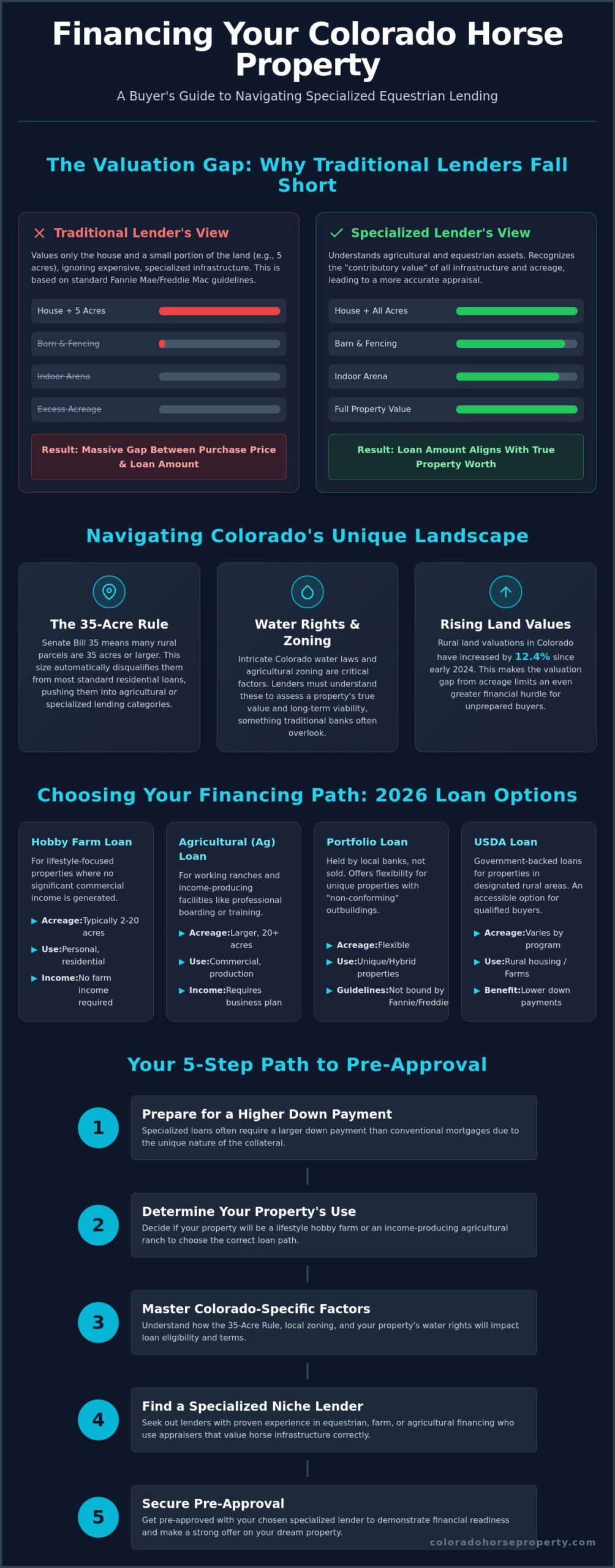
5 Steps to Secure Your Equestrian Property Loan in 2026
Securing financing a horse property in Colorado requires a proactive strategy that begins months before you visit your first barn. Because these transactions involve complex valuations of land and infrastructure, a standard mortgage approach will likely lead to delays or denials. Following a structured preparation plan ensures you’re positioned as a low-risk borrower to specialized lenders who understand rural assets.
- Audit your liquid capital: Prepare for a higher down payment. While residential homes might require 3 to 5 percent, land-heavy properties or raw acreage often require 20 to 30 percent down to satisfy secondary market requirements.
- Consult a specialized lender early: Do this before you fall in love with a specific property. A lender with a portfolio of agricultural products can tell you exactly which acreage thresholds or zoning types they are currently funding.
- Gather non-traditional documentation: Standard W-2s aren’t enough. You’ll need records for livestock valuations, agricultural equipment, and proof of adjudicated water rights to provide a full picture of the property’s utility.
- Perform a preliminary well and septic check: Colorado’s specific water regulations mean a failing well or an undersized septic system can kill a loan at the finish line. Budget for these specialized inspections early in the process.
- Work with a specialized brokerage: Choose a team that understands the intersection of land use and lending. An experienced agent can identify “un-financeable” issues in a listing before you spend money on an appraisal.
If you’re ready to start your search, you can use our AI-powered horse property search to find listings that match specific agricultural lending criteria.
The Pre-Approval Process for Rural Land
A standard pre-approval letter from a big-box bank often carries little weight with seasoned ranch sellers. They want to see a letter from a lender who has already reviewed your ability to handle a complex rural transaction. During this phase, you must identify “Red Flag” properties, such as those with significant “excess land” or non-permitted outbuildings, which will likely fail a standard appraisal. You should also budget for higher closing costs. In Colorado, a 40-acre property with multiple outbuildings can require an appraisal fee of around $1,500, which is significantly higher than a standard suburban home valuation.
Assembling Your Expert Team
Your team is your greatest asset in a specialized market. A specialized horse property agent acts as a liaison between the appraiser and the lender, ensuring the “contributory value” of your arena or stalls is properly documented. You also need a title company with deep experience in Colorado water and mineral rights. These specialists ensure that the water you’re counting on for your livestock is legally protected and properly deeded. For more details on finding the right partners, see our guide on Expert Buyer Representation for Your Colorado Property.
Leveraging Colorado Horse Property Technology for Better Financing
Technology has fundamentally changed the way buyers approach financing a horse property in Colorado. It’s no longer enough to just browse listings; you need data that aligns with your lender’s specific requirements. Our AI-powered search tool allows you to filter properties based on the granular details that underwriters care about, such as total acreage, zoning status, and the presence of documented water rights. By identifying “lender-friendly” properties early, you avoid wasting time and money on appraisals for estates that don’t meet your loan program’s specific criteria.
Our platform specifically targets the intersection of land utility and financial security. You can filter for “Barn Features” to ensure the infrastructure has the contributory value needed for a hobby farm loan, or search for “Senior Water Rights” to provide the collateral required by agricultural lenders. This data-driven approach gives you the leverage needed to negotiate prices based on the actual condition of the facilities rather than just the list price. It ensures that the property you fall in love with is one that a bank is actually willing to fund.
AI-Driven Search: Finding the Financial Fit
The pre-qualification stage is often where rural deals fall apart because the property doesn’t match the pre-approval letter. Our AI platform solves this by identifying properties with the exact acreage needed for USDA or specialized Ag loans. For example, if your lender requires a minimum of 35 acres to qualify for a specific interest rate, our tool isolates those parcels instantly. This precision saves weeks of manual research and keeps your financing timeline on track. To see how this works in practice, you can Find CO Horse Property Faster with Our AI Search Tool.
Closing the Deal with Realty Oasis
Successful financing doesn’t end with a loan commitment; it requires a coordinated effort through the closing table. Our transaction management team works directly with specialized title and escrow partners to ensure all documents are in order. We handle the complexities of ranches and estates, including the transfer of water deeds and the verification of mineral rights. These details are often what cause standard residential title companies to stumble, leading to costly delays.
With 40 years of experience in the Colorado Front Range, we’ve built strategic partnerships with the niche lenders mentioned throughout this guide. We know which bankers value an indoor arena and which ones will reject a loan over a shared well agreement. This longevity provides our clients with an authoritative advantage in a competitive market. Our leadership-forward approach means you’re working with experts who have seen every type of rural lending hurdle. If you’re ready to secure your future ranch, start your search with a team that knows the dirt and the dollars.
Securing Your Colorado Equestrian Future
Success in the 2026 market requires moving beyond standard residential lending. Infrastructure value, water seniority, and the 35-acre rule are the real pillars of a successful closing. Financing a horse property in Colorado is a technical process; it demands a partner who understands both the dirt and the dollars. By preparing your finances for higher land-based down payments and identifying properties that fit specific agricultural profiles, you position yourself as a serious buyer in a competitive landscape.
Our team brings over 40 years of experience in the Colorado Front Range to your search. We combine specialized AI search technology with comprehensive title and escrow coordination to ensure your transaction moves smoothly from search to closing. You don’t have to navigate these complexities alone. With the right data and a seasoned expert team, your dream of owning a functional, high-value ranch is entirely within reach.
Start Your AI-Powered Horse Property Search Today
Frequently Asked Questions
Can I use a VA loan to buy a horse property in Colorado?
You can use a VA loan for a horse property as long as the home serves as your primary residence. However, the VA appraiser must find that the property meets minimum property requirements for safety and habitability. These appraisers often struggle to value extensive outbuildings or large acreage, which can create a gap between the purchase price and the loan amount that you may have to cover out of pocket.
How many acres do I need for a property to be considered a farm for tax and loan purposes?
For financing a horse property in Colorado, 35 acres is the standard threshold for most agricultural loan products due to state subdivision laws. For tax purposes, requirements vary by county but often require at least 2 to 40 acres and proof of agricultural intent. Meeting these standards can lower your property tax assessment to 6.8 percent in specific jurisdictions like Parker during the 2026 tax year.
What is the typical down payment for a Colorado ranch loan?
A typical down payment for a Colorado ranch or specialized agricultural loan ranges from 20 to 30 percent. While smaller hobby farms might qualify for lower down payment residential products, larger parcels are seen as higher risk by secondary market investors. Lenders require this higher equity stake to protect against the volatility of rural land valuations, which have risen 12.4 percent across the state since early 2024.
Do lenders value horse barns and indoor arenas during the appraisal?
Standard residential lenders often give zero or minimal value to specialized equestrian infrastructure like indoor arenas. They frequently categorize these as “non-conforming” assets. To ensure your barns and stalls are properly valued, you must work with niche agricultural lenders. These institutions use specialized appraisers who understand the contributory value of horse-ready facilities and their impact on the total market price.
What happens if a horse property has mineral rights but not water rights?
Water rights are far more critical than mineral rights for securing a loan. In Colorado, adjudicated water is considered real property and acts as essential collateral for the lender. While owning mineral rights is a benefit, a property without a legal water source for livestock is often considered un-financeable. Lenders will prioritize a senior water decree over sub-surface ownership during the underwriting process every time.
Can I get a loan for a property with a domestic well in Colorado?
You can secure a loan for a property with a domestic well, but the permit type will dictate your property’s utility. A standard domestic well permit generally allows for watering household livestock and irrigating up to one acre. Lenders will require a recovery test and a potability report before closing to ensure the well provides a sustainable and safe water supply for both the residents and the animals.
How does a conservation easement affect my ability to get a mortgage?
A conservation easement can complicate your mortgage because it permanently restricts the development and use of the land. While it can significantly lower your annual property taxes, it also reduces the overall market value and narrows the pool of future buyers. Traditional lenders may view these properties as less liquid, leading to more conservative loan-to-value ratios or higher interest rate requirements.
Is it harder to finance a horse property in the mountains versus the plains?
Financing is typically easier on the plains because there is a higher volume of comparable sales for appraisers to use. Mountain properties often face hurdles like limited well recovery rates, difficult year-round access, and a lack of nearby “comps.” These factors can lead to higher insurance premiums and stricter underwriting requirements compared to the more straightforward agricultural parcels found along the Front Range or Eastern Plains.