
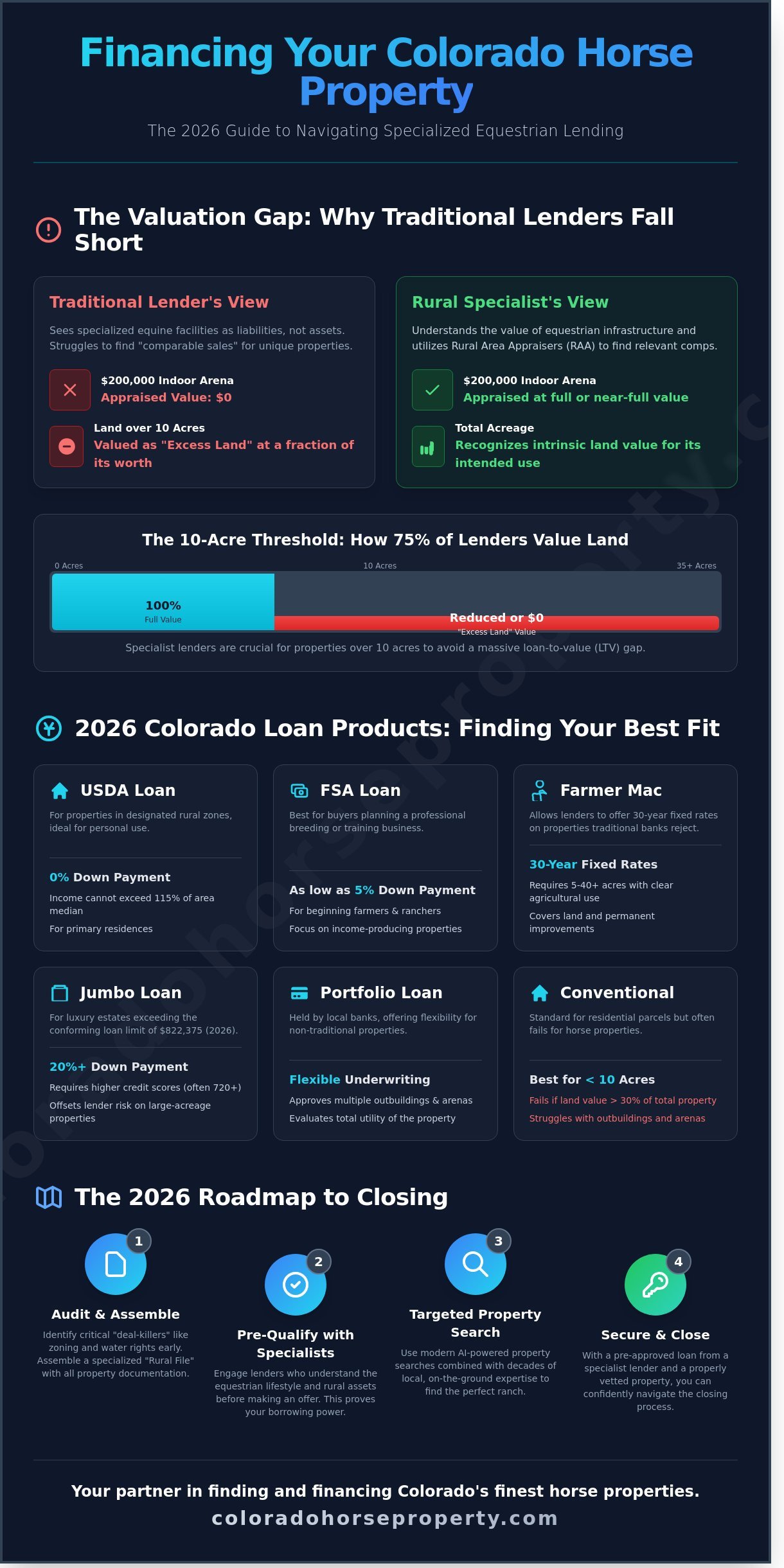
Your $200,000 professional-grade indoor arena might be worth exactly zero dollars to a traditional mortgage lender. It’s a harsh reality that many buyers faced in early 2025 when standard banks failed to properly value specialized equine infrastructure during appraisals. When you are financing a horse property in Colorado, you need a partner who recognizes that a 10-stall barn and professional footing are high-value assets, not just simple outbuildings.
You know that the right acreage is essential for your horses, yet the financial path often feels like an uphill battle against 30% down payment requirements and complex zoning laws. Drawing on nearly four decades of experience, we’ve designed this 2026 guide to help you master the complexities of equestrian lending and discover specific loan products that turn your ranching dreams into reality. We’ll show you how to identify lenders who understand rural assets, secure competitive interest rates, and ensure your property includes the valid water rights necessary for a sustainable Colorado lifestyle.
Key Takeaways
- Understand how the “Residential vs. Agricultural” divide impacts your borrowing power and why traditional lenders view horse facilities as atypical collateral.
- Explore the 2026 landscape of USDA, Ag, and Jumbo loans to select the most advantageous strategy for financing a horse property in Colorado.
- Identify critical “deal-killers” early by auditing zoning regulations and water rights that frequently stall rural real estate transactions.
- Master the 2026 closing roadmap by assembling a specialized “Rural File” and pre-qualifying with lenders who understand the equestrian lifestyle.
- Learn how to combine cutting-edge AI property searches with decades of local expertise to secure a ranch that fits your long-term dreams.
Why Financing a Horse Property in Colorado is Different
Lenders love predictability. A three-bedroom home on a suburban lot is easy to value because ten others sold nearby last month. Financing a horse property in Colorado is different because banks view acreage and specialized outbuildings as atypical collateral. Most national big-box lenders don’t have a formula for a 12-stall barn or a heated wash rack. They see these features as liabilities rather than assets. When a property doesn’t fit their rigid residential box, they often deny the loan entirely.
The “Highest and Best Use” clause is a major hurdle for many buyers in the 2026 market. An appraiser must determine if the property’s primary purpose is a residence or a commercial enterprise. When your dream property has a massive barn that outshines the house, a standard lender might classify it as a commercial farm. That shift changes everything from your interest rate to your required down payment. You need a strategy that proves the equine facilities support your lifestyle without turning the property into a commercial business entity.
The 10-Acre Threshold
Acreage is the primary reason conventional loans fail in rural Colorado. Approximately 75% of standard residential lenders stop their full valuation at the 10-acre mark. Anything beyond that is often labeled “excess land.” In a typical appraisal, the bank might give the first 10 acres full value but price the remaining 25 acres at a fraction of their worth; sometimes they value it at zero. This creates a massive gap in your loan-to-value (LTV) ratio. For the 10 to 35-acre ranchettes common in El Paso or Douglas County, you must work with lenders who understand Colorado’s agricultural zoning. They recognize that the land itself holds intrinsic value, regardless of the house size.
Appraising the Equestrian Lifestyle
Valuation gaps are common when specialized infrastructure is involved. You might spend $200,000 to build a state-of-the-art indoor arena in 2025, but a city-based appraiser could value it at $0. They do this because they can’t find “comparable sales” with similar arenas within a five-mile radius. This is why using a Rural Area Appraiser (RAA) is mandatory. RAAs have the expertise to look 20 miles away or across county lines to find appropriate comps. Without an RAA specialist, your financing a horse property in Colorado becomes a struggle. You risk a low appraisal that forces you to bring six figures of extra cash to the closing table to cover the difference between the sale price and the bank’s conservative valuation.
Colorado Loan Products: Finding Your Best Fit
Securing financing a horse property in Colorado requires matching your specific acreage needs with the right lender. Conventional loans remain the standard for residential parcels under 10 acres. However, these often fail when the land value exceeds 30% of the total property value. In Douglas County or Boulder County, luxury equestrian estates frequently exceed the 2026 conforming loan limit of $822,375. Buyers in these high-demand regions typically turn to Jumbo loans. These products require higher credit scores, often 720 or above, and 20% down payments to offset the lender’s risk on large-acreage improvements.
Portfolio loans fill the gap where national lenders hesitate. Local Colorado banks often keep these loans on their own books rather than selling them to Fannie Mae. This allows them to approve properties with multiple outbuildings, indoor arenas, or non-traditional water sources like shared wells. When financing a horse property in Colorado, these portfolio lenders evaluate the total utility of the land rather than just the bedroom count. By early 2026, specialized equine lending products have returned to the market. These niche loans specifically value high-end barns and professional-grade footing, ensuring your infrastructure adds real value to your loan-to-value ratio.
USDA and Farm Service Agency (FSA) Options
USDA Rural Development loans provide a 0% down payment option for properties in designated rural zones. To qualify in 2026, your household income generally cannot exceed 115% of the area median income. For buyers planning a professional breeding or training business, FSA loans are a better fit. The FSA provides Beginning Farmer loans with down payments as low as 5%. These programs help riders transition from boarding to owning their first facility without draining their liquid capital. They are essential tools for maintaining the state’s agricultural heritage.
Agricultural Loans and Farmer Mac
Farmer Mac serves as a vital secondary market for rural mortgages. It allows lenders to offer 30-year fixed rates on properties that traditional residential banks reject. Most Farmer Mac programs require at least 5 to 40 acres and a clear agricultural use. This financing covers both the raw land and permanent improvements like hay sheds, fencing, or loafing sheds. It’s a reliable path for buyers who want to lock in long-term stability while finding a property that fits their equestrian lifestyle and dreams on larger Colorado parcels. These loans provide the liquidity needed for long-term land stewardship that standard 15-year land loans can’t match.
Property Audits: Avoiding the “Deal-Killers”
Lenders view horse properties through a lens of risk that standard residential underwriters rarely consider. When you are financing a horse property in Colorado, the bank’s primary concern is the property’s long-term viability as a functional equine facility. If a property is marketed for horses but lacks the legal or physical infrastructure to support them, the deal will likely collapse during the appraisal or title review phase. These “deal-killers” are often hidden in the fine print of county records or state water permits.
Water Rights and Collateral Value
Colorado water law remains the most common reason rural transactions fail. A “Household Use Only” well permit restricts water usage strictly to the primary residence. You can’t legally water a single horse or irrigate a small paddock with this permit. Lenders require proof of a “Domestic” well permit or documented water rights to ensure livestock have a legal, sustainable source of hydration. Without this, the appraisal value can plummet by 20% because the land loses its agricultural utility. You can learn more about these nuances in our guide on Water Rights in Colorado.
Zoning and Legal Conformity
Zoning dictates the actual capacity of your dream ranch. Most Colorado counties use an Animal Unit (AU) calculation to limit the number of horses per acre. For instance, if a county allows 1.5 AU per acre and you have 5 acres, your limit is 7 horses. If you try to finance a property intended for a 20-stall boarding business on that same acreage, the lender won’t approve the loan based on that income potential.
The “Legal Non-Conforming” status creates another hurdle. This happens when a barn or arena was built before current setback laws existed. If that structure is destroyed by a 2026 wildfire or windstorm, local codes might forbid you from rebuilding it in the same spot. Lenders often respond to this uncertainty by hiking interest rates by 0.25% or requiring a 35% down payment to mitigate their risk. They want to ensure the collateral remains intact for the life of the loan.
Physical access is the final hurdle. A hay truck or a 4-horse slant load trailer requires a wide turning radius and a solid roadbed. If the property is accessed via a prescriptive easement that’s only 12 feet wide, the lender may deem the access insufficient for the property’s intended use. Always verify that easements are at least 24 feet wide and recorded properly in the county records.
Environmental history also plays a role. Checking for 20th-century pesticide plumes or old underground fuel tanks is vital. These hazards can lead to soil toxicity that ruins your pasture’s health and your property’s resale value. A clean environmental audit ensures your investment is protected and your horses stay healthy in their new home.
The 2026 Roadmap to Closing Your Ranch Loan
Securing financing a horse property in Colorado in 2026 requires more than a high credit score and a steady paycheck. With the 30-year fixed rate for rural properties stabilizing near 6.1% as of January 2026, lenders have tightened their requirements for non-traditional assets. You must pre-qualify with a niche agricultural lender before you begin your AI-driven property search. Standard big-box banks often stumble when they encounter outbuildings, shared wells, or complex water rights. Your “Rural File” is your ticket to an approval letter. This package must include your last three years of tax returns, detailed water decrees from the Colorado Division of Water Resources, and a formal business plan if you intend to seek an agricultural tax classification for a boarding or training facility.
The inspection period is where many deals fail due to lack of preparation. Budget at least $2,800 for specialized evaluations. A standard home inspector won’t have the expertise to evaluate a 40-acre ranch. You need a Level II septic inspection, a well recovery test to ensure the flow meets the 5-gallon-per-minute standard required for livestock, and a structural engineer to verify the integrity of indoor arenas or century-old barns. These reports protect your investment and are often required by underwriters before they release funds.
Preparing Your Financial Profile
Liquidity is the most important factor in a successful 2026 closing. Beyond your down payment, you need cash reserves for higher insurance premiums, which rose 14% in 2025 across the Front Range. If you currently pay for boarding, those monthly expenses impact your debt-to-income (DTI) ratio. Lenders look for a DTI below 43%, even when factoring in the costs of maintaining equine facilities. Ensure your Schedule F is clean; any reported losses on existing agricultural assets can lower your borrowing power significantly. It’s vital to show that you have the capital to manage the property without relying solely on future boarding income.
The Appraisal and Closing Process
Appraisals remain the primary hurdle when financing a horse property in Colorado. Suburban appraisers often undervalue specialized improvements like MD Barnmaster stalls, GGT footing, or pipe fencing. We recommend providing an “Appraisal Packet” that lists the replacement costs of all equine infrastructure and includes comps from similar properties sold within the last 180 days. Work with a specialized title company like Meridian Title & Escrow to handle the closing. They understand how to navigate mineral rights and access easements that are common in Elbert and Park Counties. Conduct your final walkthrough 24 hours before closing to ensure all fence lines are intact, stock tanks are operational, and the well pump is functioning correctly.
Leveraging AI and Expertise to Secure Your Dream
Securing financing a horse property in Colorado requires more than just a good credit score; it demands a deep understanding of how lenders view rural collateral. Most traditional realtors focus on beds and baths. We focus on the infrastructure that actually drives value for an equestrian. You need an advocate who understands that a 100-foot by 200-foot indoor arena isn’t just a “shed” to an appraiser. It’s a significant asset that requires specific valuation techniques to satisfy underwriter requirements. Without this expertise, your loan could stall during the appraisal phase because the lender doesn’t recognize the value of your equine improvements.
AI-Powered Search for Financable Land
Our proprietary AI tools analyze thousands of Front Range listings to find properties with specific “financable” traits. Many agricultural loans require a minimum of 10 to 35 acres to qualify for the most competitive interest rates. Our system filters these automatically. We also track water rights and well permits, ensuring the land meets the 2026 standards for sustainable livestock use. Buyers using our AI-driven search report a 40% reduction in time spent touring non-viable properties. This technology identifies turn-key estates that meet conventional appraisal standards before you ever schedule a showing, saving you from the frustration of falling for a property that won’t pass a bank’s rigorous inspection.
The Realty Oasis Advantage
Mark and Alison Eibner bring nearly four decades of Front Range real estate experience to your search. They understand the collateral puzzle. Lenders often struggle to value specialized equine improvements like heated wash racks or sub-irrigated pastures. The Eibners bridge this gap by connecting you with a curated ecosystem of specialized rural lenders, inspectors, and title experts. They know which banks will lend on properties with multiple outbuildings and which ones require a specific house-to-land value ratio. You gain access to off-market listings and a team that treats your dream as a serious investment. Find your next Colorado Horse Property with AI today to begin your journey with experts who know the territory.
Your agent’s ability to speak the language of zoning and water law is just as vital as their negotiation skills. In the competitive 2026 market, having a team that understands “Barns and Arenas” as well as “Beds and Baths” ensures your loan closes on time. Effectively financing a horse property in Colorado requires a partner who knows the local soil and the local lenders. We don’t just find you a house; we secure a legacy that fits your lifestyle and your balance sheet. Our goal is to make the transition from the city to the ranch as seamless as possible through data-backed decisions and decades of boots-on-the-ground knowledge.
Take the Reins on Your Colorado Ranch Investment
Securing a rural mortgage in 2026 requires more than just a high credit score. You must navigate specialized land appraisals and strict zoning audits that traditional lenders often overlook. Success starts with identifying the right loan product early to avoid the common deal-killers found in rural water rights or outbuilding inspections. We’ve spent nearly 40 years perfecting this process for equestrian buyers across the state. Navigating the complexities of financing a horse property in Colorado is simpler when you combine our deep industry network of rural lenders with advanced technology. Our specialized AI search tool filters for the exact barn configurations and acreage you need, saving you weeks of manual research. You don’t have to tackle these financial hurdles alone. We provide the expert guidance and title partnerships necessary to turn your lifestyle goals into a tangible reality on the Front Range or the Western Slope. Your dream of owning a piece of the Colorado landscape is within reach with the right team behind you.
Start your AI-powered search for the perfect Colorado horse property today
Frequently Asked Questions
Can I use a VA loan to buy a horse property in Colorado?
You can use a VA loan for financing a horse property in Colorado if it’s your primary residence and the land isn’t used for commercial profit. VA guidelines in 2026 allow for multiple acres, but the appraisal must justify the value based on comparable residential sales. If the property has 40 acres, the appraiser focuses on the home’s value plus the residential site, not the income potential of the soil.
How much down payment do I need for a 35-acre ranch?
A 35-acre ranch typically requires a 20% to 30% down payment through specialized agricultural lenders. Standard 3% or 5% residential programs rarely apply to parcels over 20 acres. In 2026, most buyers find that a 25% down payment secures the most competitive interest rates for large acreage tracts. This ensures you have enough equity to manage the unique risks associated with rural land ownership.
Does a horse barn add value to a home appraisal?
A horse barn adds value, but appraisers often value outbuildings at 50% to 70% of their actual construction cost. If a barn costs $100,000 to build, it might only add $60,000 to the total appraised value. Lenders look for contributory value based on what similar properties with barns sold for in the last 6 months. It’s a functional asset rather than a dollar for dollar investment.
What is the difference between a hobby farm loan and a working ranch loan?
The primary difference is how you earn your money. A hobby farm loan is for buyers who earn 100% of their income from outside jobs. A working ranch loan applies if 50% or more of your annual revenue comes from livestock or hay production. Hobby farm loans usually offer 30 year fixed rates, while working ranch loans often use adjustable rates and require detailed agricultural tax records.
Do I need a business plan to get a horse property loan?
You don’t need a business plan for a residential horse property loan intended for personal use. However, if you’re applying for a commercial agricultural loan to run a boarding facility, lenders require a 3 year financial pro forma. Financing a horse property in Colorado for private use relies on your personal debt to income ratio rather than a formal business strategy or revenue projections.
How do water rights affect my mortgage approval in Colorado?
Water rights are essential for mortgage approval because a property without a legal water source is considered unmarketable. Lenders verify your well permit through the Colorado Division of Water Resources to ensure it allows for livestock watering. A household only permit can disqualify a 35 acre horse property from traditional financing because it lacks the 0.05 acre feet of water typically required for equine care.
Can I finance the construction of a new arena into my mortgage?
You can finance a new arena using a construction to permanent loan or a specialized renovation mortgage. These programs allow you to borrow up to 75% of the as-completed value of the property. You’ll need a signed contract from a builder and detailed blueprints before the lender will approve the funds for a 150 foot by 250 foot riding space. This simplifies your monthly payments into one loan.
What credit score is needed for agricultural land loans in 2026?
Agricultural land loans in 2026 generally require a minimum credit score of 680 for approval. To secure the lowest interest rates, which currently hover near 6.5% for land heavy deals, you’ll need a score of 720 or higher. Lenders also look for a debt to income ratio below 43% to ensure you can handle the maintenance costs of rural acreage and potential emergency equine veterinary expenses.