
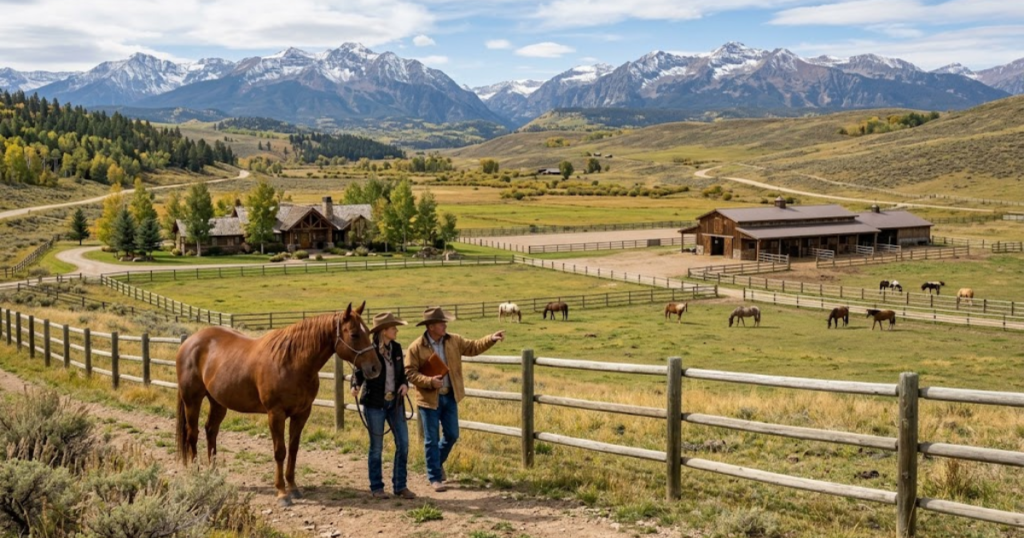
You decide you are ready to relocate your herd to Colorado. You open a real estate app and draw a massive circle around the entire state, searching for any property with a barn and five acres.
Within minutes, you are overwhelmed. You see a $500,000 property on the eastern plains that looks like a barren desert, a $2 million estate tucked into a steep mountain canyon, and a property in the northern farmlands that is surrounded by commercial cattle operations. Without understanding the distinct geographic zones of Colorado, you risk buying a property where the climate, soil, or local economy does not match your equestrian lifestyle.
When searching for horse properties in Colorado, location dictates exactly how you will manage your horses. Different regions require different winterizing strategies, feed budgets, and trail riding habits.
Here is a breakdown of the specific Colorado regions that equestrian real estate agents recommend for buying horse-friendly land.
Which Colorado Regions Do Equestrian Real Estate Agents Recommend for Buying Horse-Friendly Land?
Quick Summary: Matching the Region to the Rider
- The Front Range Premium: Parker, Franktown, Castle Rock, Boulder, Fort Collins, and surrounding communities offer strong equestrian infrastructure, easier access to veterinarians and trainers, and established horse communities. The tradeoff is significantly higher land prices.
- The Eastern Plains Advantage: Elbert, eastern Weld, and eastern El Paso counties offer significantly more acreage for the money. Buyers must be prepared for strong winds, fewer natural windbreaks, dryland pasture, and potentially expensive well and utility infrastructure.
- The Northern Agricultural Network: Loveland, Berthoud, Greeley, and surrounding areas provide access to a strong agricultural economy, hay producers, Western performance disciplines, and a dense network of farm services.
- The Western Slope Opportunity: Delta, Montrose, Grand Junction, and surrounding river valleys offer productive irrigated agricultural land, longer growing seasons in many lower valleys, and a strong traditional ranching culture.
- The Mountain Tradeoff: Foothill and mountain properties can offer spectacular trail access and natural beauty, but steep terrain, deep snow, wildfire exposure, short growing seasons, and expensive winter feed logistics must be carefully evaluated.
There is no single "best" region for every horse owner. The right location depends on your riding discipline, herd size, budget, commute, need for irrigated pasture, preferred climate, and tolerance for winter maintenance.
1. The Front Range: Convenience and Equestrian Infrastructure
The Front Range is the most competitive equestrian real estate market in Colorado because it combines rural horse ownership with access to major employment centers, veterinary hospitals, trainers, feed stores, and competition venues.
- Parker and Franktown: These communities are ideal for riders who want access to a dense network of hunter-jumper, dressage, eventing, and professional training facilities. Properties here often feature established barns, arenas, and mature equestrian infrastructure.
- Castle Rock and Sedalia: These areas offer luxury equestrian communities, larger parcels, private trail networks, and convenient access to the Denver metro area.
- The Price Premium: The convenience comes at a cost. Buyers searching within easy commuting distance of Denver generally pay substantially more per usable acre than buyers on the Eastern Plains or in southern Colorado.
- The Subdivision Factor: Many premium Front Range properties are located inside organized communities. Carefully review HOA covenants, animal-unit limits, barn restrictions, trailer parking rules, and commercial-use restrictions.
2. The Eastern Plains: Acreage and Affordability
If your priority is obtaining significantly more land for your budget, the Eastern Plains deserve serious consideration.
- Elbert County: Elizabeth, Kiowa, Agate, and Simla offer large rural parcels and a deeply rooted agricultural culture. Thirty-five-acre properties are common, providing room for larger herds, private riding tracks, barns, and future arena construction.
- Eastern Weld County: Communities east of Greeley provide broad, open acreage and access to a major agricultural economy. Buyers may benefit from proximity to hay producers, livestock services, and farm-equipment suppliers.
- The Wind Reality: Open prairie provides little natural protection. A property without mature trees, topographical windbreaks, or heavy-duty shelters can become extremely exposed during winter storms.
- The Dryland Reality: Large acreage does not necessarily mean abundant grazing. Native grass on non-irrigated land grows slowly in Colorado's semi-arid climate, meaning supplemental hay may still make up a large percentage of the annual feed budget.
- Infrastructure Costs: Affordable raw acreage can require major investment in wells, electrical service, fencing, driveways, septic systems, barns, and water distribution before horses can safely move onto the property.
3. Northern Colorado: Agriculture and Horse Community
Northern Colorado offers one of the strongest combinations of agricultural infrastructure and active horse culture in the state.
- Loveland and Berthoud: These areas are known for active Western disciplines, including reining, cutting, roping, and ranch riding. Buyers have access to trainers, veterinarians, farriers, feed suppliers, and large equestrian events.
- Larimer and Weld Counties: The agricultural base surrounding Fort Collins, Loveland, and Greeley creates excellent access to hay, livestock services, equipment dealers, and farm contractors.
- Irrigated Agriculture: Some properties have access to valuable ditch shares or other surface irrigation rights. These rights can dramatically change pasture productivity and the economics of feeding a herd.
- The Development Pressure: Areas closer to Fort Collins, Loveland, and Interstate 25 continue to compete with residential development. Prime horse acreage near major transportation corridors can command a substantial premium.
Northern Colorado can be especially attractive to buyers who want an active horse community, easy access to agricultural suppliers, and a strong Western-performance culture.
4. Western Colorado: Irrigated Valleys and Ranch Country
Western Colorado offers a dramatically different equestrian environment from the Front Range. The broad river valleys and agricultural communities can be ideal for buyers who prioritize productive land and traditional ranch infrastructure.
- Delta County: Delta and the surrounding agricultural areas are well known for livestock operations, large parcels, hay production, and irrigated pasture.
- Montrose County: Wide valleys, established ranches, and access to agricultural services make Montrose a strong option for buyers seeking larger working properties.
- The Irrigation Advantage: Mountain-fed ditch systems can support productive pasture and local hay production. Buyers must verify the exact water rights, shares, delivery schedules, seniority, and infrastructure associated with each property.
- The Hay Advantage: Lower agricultural valleys can provide better access to locally produced hay than isolated high-altitude mountain communities where premium forage may need to be trucked over mountain passes.
- The Distance Tradeoff: Western Colorado can offer excellent value and productive land, but buyers relocating from the Denver metro area must consider distance from major Front Range competition venues, specialty veterinary hospitals, and professional training programs.
5. Foothills and Mountain Communities: Trails and Terrain
Buyers who prioritize scenery and direct access to public trails often focus on the foothills and mountain communities, but these properties require the most careful topographical evaluation.
- Evergreen and Conifer: Jefferson County's foothill communities are popular with recreational trail riders who want access to mountain parks, forest land, and heavily timbered landscapes.
- The Usable Acreage Problem: A 20-acre mountain parcel may have only a few acres of flat, horse-safe ground. Steep slopes, rocky outcroppings, dense timber, and drainage channels can dramatically reduce usable turnout.
- The Winter Burden: High-elevation properties experience deeper snow, colder temperatures, longer freezes, and shorter growing seasons. Water lines, hydrants, barn access, and snow removal infrastructure must be designed for these conditions.
- The Forage Challenge: High-altitude regions may have short hay-growing seasons. If your horses require premium orchard grass or specific forage, determine whether it can be purchased locally or must be trucked over mountain passes.
- Wildfire and Evacuation: Heavily timbered properties require defensible space, reliable trailer access, adequate turnaround areas, and a realistic evacuation strategy for every horse on the property.
We Match the Region to Your Horse Lifestyle
We do not just search the entire state and send you every property with acreage. We narrow the geography based on how you actually live with your horses.
When Mark Eibner and Belinda Seville help you search for a Colorado equestrian property, we evaluate your herd size, riding discipline, commute requirements, budget, trail-access goals, feed needs, water requirements, and preferred climate. We then focus the search on the regions where those priorities realistically fit.
Contact Us Today to find premium horse properties Colorado buyers trust in the region that best fits their lifestyle.
Browse Active Colorado Horse Properties: Browse active Colorado horse ranches for sale or ask our team about finding a horse property for rent in Colorado while you determine which region is right for your permanent equestrian estate.
Frequently Asked Questions (FAQ) About Colorado Horse Property Regions
What part of Colorado is best for competitive equestrians?
The southern Denver Front Range, particularly Parker, Franktown, Castle Rock, and nearby Elbert County communities, is often attractive to competitive riders because of the dense concentration of trainers, show barns, equestrian services, and established horse properties.
Where can I generally find more affordable horse acreage in Colorado?
Buyers often find more acreage for their budget by looking east toward Elbert County, eastern Weld County, and eastern El Paso County, or farther south toward Pueblo and Fremont counties. Lower land prices should always be weighed against well depth, fencing, utilities, wind protection, and other infrastructure costs.
Is the Western Slope good for keeping horses?
Yes. Agricultural valleys around Delta and Montrose can offer productive irrigated acreage, established hay production, and traditional ranch infrastructure. However, buyers must carefully verify water rights because irrigation availability is one of the most important factors controlling pasture productivity in Western Colorado.
Are mountain horse properties harder to maintain?
They can be. Higher elevations generally mean deeper snow, longer freezes, shorter growing seasons, more difficult excavation, greater wildfire exposure, and potentially higher hay-delivery costs. Buyers should evaluate usable acreage and winter infrastructure rather than focusing only on total acreage and views.