
What if the 40 acres you just bought doesn’t actually come with the legal right to water a single horse? In Colorado, mountain views can be deceptive. Learning how to evaluate ranch land for horses requires you to look far beyond the scenery and into the technicalities of soil quality, zoning, and senior water rights. You want a sustainable sanctuary for your animals, but the fear of buying into a “dust bowl” or facing $500 per acre-foot groundwater fees is a valid concern for any buyer in 2026.
We understand that you’re looking for a functional lifestyle, not just a plot of dirt. This guide provides the critical steps for assessing Colorado acreage to ensure your land is safe, productive, and legally compliant. We’ll walk through a physical inspection checklist, explain the new SB26-010 agricultural tax classifications, and show you how to navigate the latest water court regulations. Backed by 40 years of experience in the Front Range, we’ll help you move from confusion to confidence so you can make an offer that secures your equine future.
Key Takeaways
- Verify zoning and HOA covenants to ensure your property legally supports your intended animal-to-acre ratio and barn specifications.
- Discover how to evaluate ranch land for horses by distinguishing total acreage from “usable equestrian acreage” based on topography and soil health.
- Audit water rights and well permits to confirm the legal authority for livestock watering rather than just basic household use.
- Evaluate existing infrastructure for safety, ventilation, and Colorado-specific requirements like wildlife-resistant fencing.
- Use AI-powered search tools to filter listings by specific equestrian attributes, saving time and focusing your search on viable ranch land.
Legal Foundations: Zoning, Covenants, and Land Use Rights
Buying land isn’t just about the soil; it’s about what the law permits. When you’re learning how to evaluate ranch land for horses, the first hurdle is legal “use by right.” You must confirm the property is zoned specifically for livestock and understand the specific animal-to-acre ratios required by the county. Don’t assume a property is horse-friendly just because it’s rural. Some “ranchettes” are governed by Homeowners Associations (HOAs) or protective covenants that can strictly limit the size of your barn or even the color of your fencing.
Navigating Local Zoning and Animal Units
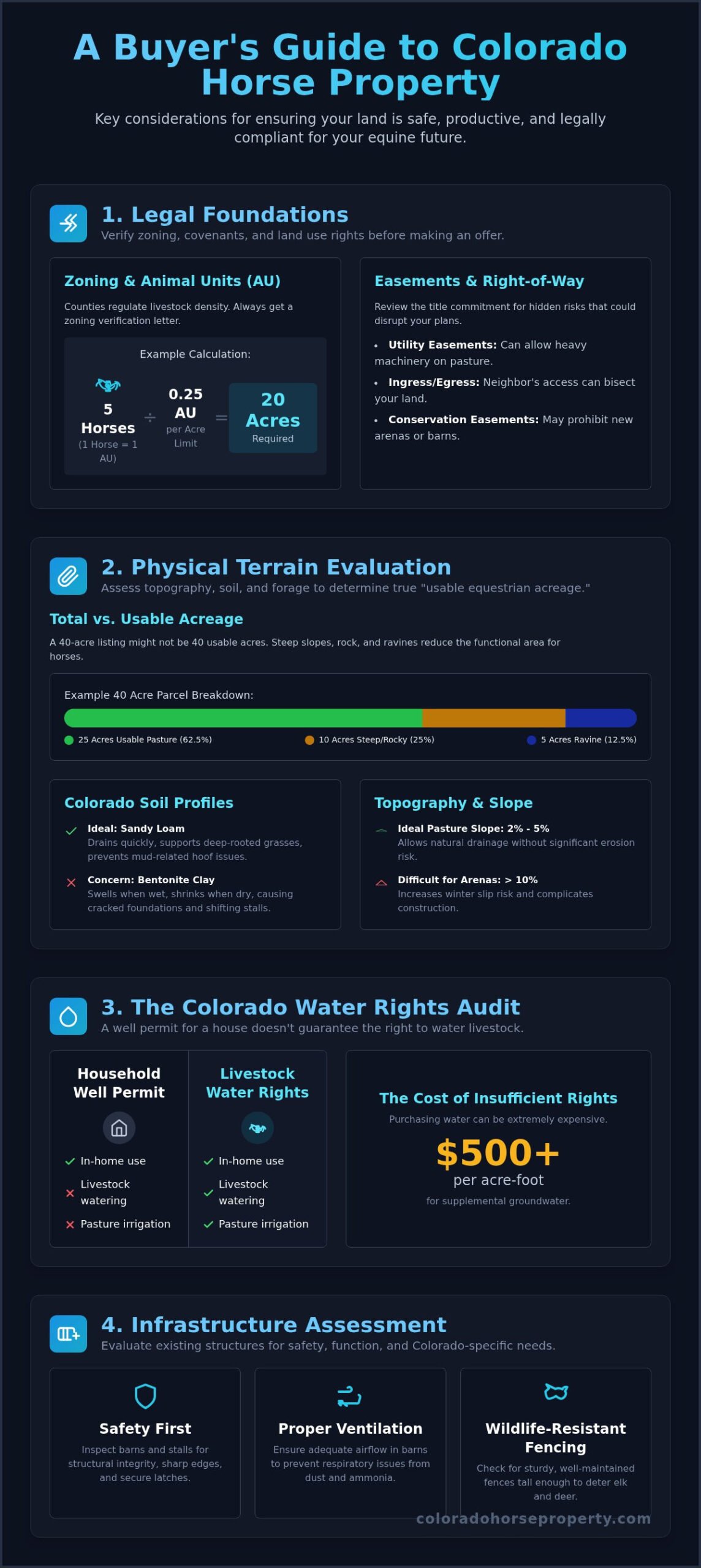
Colorado counties use “Animal Units” (AU) to regulate property density. Typically, one horse equals one AU. If a county ordinance specifies 0.25 AU per acre, you would need 20 acres to legally house five horses. Always request a zoning verification letter from the county planning department before closing. This official document confirms your intended use is legal and identifies required setbacks. These setbacks dictate how far manure management systems and barns must be from property lines or neighboring wells.
Easements and Right-of-Way Risks
Review the title commitment for any recorded easements. A utility company might have the right to run heavy machinery through your primary turnout. Similarly, a neighbor might hold an “ingress and egress” easement that cuts your pasture in half. These legal rights can disrupt your fencing layout and compromise horse safety. You should also watch for conservation easements. While they preserve the landscape, they often prohibit the construction of new structures like indoor arenas or additional hay sheds.
In February 2026, Colorado advanced SB26-010, which broadened the definition of a “ranch” for property tax purposes. This allows smaller, family-owned properties using land for grazing to qualify for agricultural tax exemptions. Implementing Rangeland management principles helps prove the land’s productive value, which is the basis for these lower tax rates. Finally, keep in mind that Colorado is an “open range” state. If you don’t want a neighbor’s cattle in your arena, it’s your legal responsibility to fence them out, not their responsibility to keep them in.
Evaluating Physical Terrain: Soil, Slope, and Forage Quality
When you’re browsing listings, 40 acres might sound like plenty of space. However, if 20 of those acres consist of vertical rock or deep ravines, your “usable equestrian acreage” is significantly lower than the total footprint. Learning how to evaluate ranch land for horses requires a shift in perspective. You aren’t just buying scenery; you’re buying a foundation for your animals’ health. You need flat, well drained spaces for an arena and gentle slopes for turnout to prevent injuries and erosion.
Colorado Soil Profiles and Drainage
Colorado soil is notoriously varied. Bentonite, a type of expansive clay, is common across the Front Range and plains. It’s a major concern for barn foundations because it swells when wet and shrinks when dry, which leads to cracked concrete and shifting stalls. For pastures, sandy loam is the gold standard. It drains quickly and supports deep-rooted grasses, preventing the mud-borne hoof issues that plague horses on heavy clay. If you’re looking at property in former mining districts, it’s wise to test the soil for heavy metals or contaminants before finalizing your offer.
Effective Horse pasture management starts with identifying what’s already growing. High quality native grasses are essential, but you must scan for toxic weeds like locoweed, Russian knapweed, or yellow starthistle. These species thrive in disturbed or overgrazed soil and can be lethal to livestock. Testing for soil drainage isn’t just about the grass; it’s about ensuring your horses don’t spend the spring standing in a swamp.
Slope and Natural Shelter
Topography dictates your ranch’s long term maintenance costs. The ideal slope for a pasture is between 2% and 5%. This range allows for natural drainage without inviting significant erosion. Anything steeper than 10% makes arena placement difficult and increases the risk of slips during winter. You should also look for natural draws and established tree lines. These features act as vital windbreaks during Colorado’s high-altitude winter storms, reducing the wind chill and protecting your herd. Always identify floodplains and high-water marks near mountain streams, as these areas are unsuitable for permanent structures like barns or hay sheds.
Understanding these physical constraints is the key to a successful purchase. Before you spend hours driving to remote locations, use our AI-powered search tools to filter properties by specific “horse-ready” attributes like arena potential and soil type.
The Colorado Water Rights and Resource Audit
In Colorado, owning the dirt doesn’t mean you own the water. The state operates under the doctrine of prior appropriation, which essentially means “first in time, first in right.” If you’re learning how to evaluate ranch land for horses, you must understand that water rights are separate, transferable property interests that don’t always convey with the deed. In May 2026, the passing of House Bill 1340 added even more complexity, requiring buyers to handle the costs of revegetation if water rights are removed from agricultural land. You cannot afford to skip a professional water audit during your due diligence period.
Understanding Prior Appropriation and Well Permits
Most horse properties rely on groundwater. However, not all well permits allow for livestock. You must verify the specific permit type with the Colorado Division of Water Resources (DWR). A “household use only” permit is strictly for indoor use and prohibits watering even a single horse or a small garden. You need a “domestic and livestock” permit to legally provide water for your herd. Be wary of unpermitted wells or shared well agreements, which often lead to legal disputes or supply shortages during dry years. With the San Luis Valley groundwater trial on June 29, 2026, highlighting potential fees as high as $500 per acre-foot for well owners, the financial stakes of groundwater management have never been higher.
Surface Water and Irrigation Ditches
If you plan to grow your own hay or maintain green pastures, you’ll likely need surface water rights. These are often managed through irrigation ditch companies. Owning shares in a ditch company gives you the right to a portion of the water flow, but it also comes with the legal duty to help maintain the ditch. You must evaluate the seniority of these rights. Junior rights are the first to be “called” or shut off when river levels drop. As of early 2026, over 31% of Colorado is experiencing severe drought, making senior water rights an incredibly valuable asset. Natural springs may look appealing, but they are rarely a reliable year-round source in a high-altitude climate. They often dry up exactly when your horses need them most during the peak of summer.
Securing a property with a proven water history is a cornerstone of a safe investment. Our team specializes in the technicalities of equestrian real estate Colorado transactions, ensuring you don’t end up with a “dry” ranch. We help you verify every permit and ditch share before you sign the closing papers.
Infrastructure Assessment: Existing vs. Potential Improvements
Developing raw land often carries hidden costs that exceed the initial purchase price. When you’re determining how to evaluate ranch land for horses, you must weigh the value of existing structures against the expense of building from scratch. Access is your first priority. A gravel driveway that looks fine in July can become impassable for a 20-ton hay delivery or a four-horse trailer during the spring thaw. Ensure the property has all-weather road base and sufficient turn-around space for large rigs. If the property is off-grid or remote, the cost of trenching for power, high-speed internet, and gas can escalate quickly, sometimes costing thousands of dollars for every few hundred feet.
Evaluating Existing Barns and Arenas
If the property already features horse barns for sale, look past the aesthetic appeal and audit the functional specs. Check the stall dimensions; while 12×12 is the standard, modern warmbloods or larger breeds often require 14×14 footprints for comfort. Aisle widths should be at least 12 feet to allow for safe passing and emergency access. In Colorado, ventilation is a dual-edged sword. You need constant airflow to prevent respiratory issues, but insulation is critical for protecting horses when temperatures drop to -20°F in the winter. For arenas, perform a footing analysis. Footing with too much clay will bake into concrete in the summer, while deep, unwashed sand can cause significant tendon strain.
Fencing and Perimeter Security
Fencing represents one of your most significant recurring maintenance costs. While barbed wire is standard on many cattle ranches, it’s a dangerous liability for horse owners and is generally considered a deal-breaker. Pipe, vinyl, or high-tensile electric fencing are safer alternatives that can withstand the Rockies’ extreme temperature swings. However, you must also account for Colorado’s wildlife. Your perimeter needs to be wildlife-friendly to prevent elk or deer from destroying your top rails. A common strategy involves using a solid top rail with flexible lower strands. This design allows smaller animals to pass under or over without snagging, which keeps your horses in and prevents the local elk population from leveling your fence line during their migration.
Before you commit to a property that requires extensive and expensive retrofitting, search our listings to compare turnkey equestrian estates with raw land opportunities.
Leveraging AI and Local Expertise in Your Search
In 2026, the process of finding specialized acreage has evolved. Generic real estate platforms often fail to distinguish between a large backyard and a functional equine facility. When you’re determining how to evaluate ranch land for horses, the sheer volume of data regarding water court filings and soil types can be overwhelming. Niche buyers are moving away from broad search engines in favor of specialized tools that understand the specific requirements of livestock and land management. You need a system that filters for utility, not just aesthetics.
The AI-Powered Advantage
Our proprietary AI search tool allows you to filter properties based on specific “horse-ready” attributes before you ever step foot on the dirt. Instead of guessing about the terrain, you can use satellite-integrated data to assess slope and natural shelter from your computer. This technology instantly identifies whether a property has the necessary water rights or arena potential discussed in previous sections. By analyzing market trends for ranches for sale colorado, AI helps you identify properties with high “equine-usable” footprints that generalists might overlook. It’s about working smarter to find a legacy property that fits your specific needs.
Expert Buyer Representation
Technology is a powerful filter, but local expertise is what closes the deal. You need a broker who understands “horse logic” and the nuances of high-altitude ranching. A specialized colorado land valuation goes beyond comparable sales; it accounts for the value of senior water rights, soil drainage, and existing infrastructure. We’ve spent 40 years navigating these complexities in the Front Range, ensuring our clients don’t buy into a legal or environmental nightmare.
A dedicated transaction manager plays a vital role in coordinating the technical side of your purchase. This includes:
- Scheduling environmental and soil tests for bentonite or heavy metal contaminants.
- Verifying well permits and ditch shares with the Division of Water Resources.
- Managing title and escrow services to ensure all resource rights are properly transferred.
- Executing a final 48-hour land audit checklist before the due diligence period ends.
Partnering with equestrian real estate Colorado specialists ensures that your investment is safe, legal, and sustainable. We provide the seasoned authority needed to navigate 2026’s complex regulatory landscape. Our goal is to move you from a broad search to a successful closing on a property that truly supports your equestrian dreams.
Securing Your Colorado Equestrian Legacy
Mastering how to evaluate ranch land for horses is the difference between a thriving pasture and a costly legal burden. You’ve learned that a property’s value lies in its senior water rights and usable terrain rather than its total acreage. From navigating the complexities of prior appropriation to identifying expansive bentonite clay, your due diligence ensures a safe environment for your herd. Niche land buyers in 2026 are prioritizing specialized data to protect their long-term investments.
With over 40 years of local experience, we specialize in the technicalities of water rights and equestrian zoning that generalists often miss. Our team provides the expert buyer representation and transaction management needed to navigate these high-stakes decisions with confidence. Start your AI-powered search for Colorado horse properties today to filter listings by the specific attributes your horses need. The expansive freedom of the Colorado landscape is within reach when you have the right expertise by your side. We look forward to helping you find a property where your equestrian lifestyle can truly flourish.
Frequently Asked Questions
How many acres do I need per horse in Colorado?
Zoning laws vary by county, but a common standard is one or two acres per horse. However, Colorado’s arid climate and fragile forage mean you often need five to ten acres per animal if you want them to subsist on pasture alone. Overgrazing happens quickly here, leading to dust and weed infestations. Always check the specific “Animal Unit” density allowed by your county’s planning department to ensure your herd size is legally compliant.
What are Colorado water rights and why do they matter for horses?
Water rights are legal property interests separate from land ownership. They matter because Colorado follows the “Prior Appropriation” doctrine, where older, senior rights get water first during shortages. If your property only has junior rights, you might be legally barred from watering your horses or irrigating pastures during a drought. In 2026, with 31% of the state in severe drought, securing senior rights is the only way to guarantee a reliable water supply for your herd.
Can I build a barn anywhere on my ranch land?
Barn placement is governed by county setbacks and environmental constraints. Most counties require structures to be a specific distance from property lines, wells, and septic systems. You also can’t build in designated floodplains or on steep slopes exceeding 10%. Additionally, you must avoid areas with bentonite clay, as this expansive soil can destroy a barn’s foundation. Always verify your building site with a zoning letter and a soil test before you commit to a purchase.
What is the best type of soil for a Colorado horse arena?
Sandy loam is considered the best soil for an arena because it offers superior drainage and a stable, non-slick surface. Many Colorado properties have high clay content or bentonite, which creates dangerous, slippery conditions when wet and hardens like concrete when dry. To create a safe arena, you’ll likely need to excavate the native soil and bring in washed sand or a specialized mix to ensure proper cushioning for your horse’s joints and tendons.
Is it cheaper to buy raw land or a pre-established horse property?
Learning how to evaluate ranch land for horses involves looking at the total cost of ownership, not just the sticker price. Raw land often costs more to develop than buying a pre-established property. The 2026 costs for drilling a well, installing wildlife-friendly fencing, and trenching utilities can be staggering. Turnkey ranches already have the usable acreage cleared and permitted, saving you from the stress of navigating complex zoning laws and high construction prices.
What should I look for in a Colorado well permit for livestock?
Your well permit must explicitly state it’s for “domestic and livestock” use. Many rural properties only have “household use only” permits, which legally restrict water to indoor faucets and toilets. Using a household well to water horses can lead to significant fines. You should also check the permit’s production rate in gallons per minute to ensure it can handle your herd’s needs, especially during the peak heat and drought conditions of a Colorado summer.
How do I know if the grass on a property is safe for grazing?
You must identify the specific plant species on the property. Look for native grasses like blue grama or buffalo grass, which are hardy and nutritious. Conversely, scan for toxic invaders like locoweed, knapweed, or yellow starthistle. These weeds often take over overgrazed land and are poisonous to horses. If the forage looks thin or contains unknown weeds, consult a local extension agent to perform a vegetation audit before you finalize your purchase agreement.
What is the most common mistake when buying Colorado ranch land?
The most frequent error is neglecting to learn how to evaluate ranch land for horses regarding legal water access and zoning limits. Many buyers fall in love with the mountain views and assume the infrastructure is sufficient. They later discover their well permit is invalid for livestock or their property lacks senior water rights needed during a drought. Skipping a professional land audit often leads to hidden costs and legal restrictions that ruin the equestrian dream.