
Would you rather spend three years and $700,000 navigating construction permits for a new indoor arena, or step into a fully operational facility today? In 2026, the surging cost of materials and labor has shifted the market. Most professional riders and breeders now realize that buying an existing asset is the only way to avoid the headaches of modern development. You want a property that works as hard as you do, but a “move-in ready” label can be misleading if the infrastructure isn’t built for the specific demands of the Rockies.
Finding the best turnkey equestrian facilities for sale in Colorado requires a sharp eye for technical details and a firm grasp of local regulations. It’s easy to fall in love with a mountain view, but Colorado Horse Property is here to ensure the barn’s snow load rating meets 2026 standards and the water rights are senior and secure. We’ll show you how to master these legal and structural requirements so you can buy with confidence. This guide covers everything from identifying professional-grade barn features to understanding the ROI of turnkey assets versus building from scratch. You’ll learn how to audit a property for climate resilience and verify zoning compliance before your earnest money is on the line.
Key Takeaways
- Learn why turnkey properties are currently outperforming new construction in the 2026 market due to rising material costs and lengthy permitting delays.
- Identify the specific structural standards, such as snow load ratings and ventilation systems, required when auditing turnkey equestrian facilities for sale Colorado.
- Get accurate 2026 cost-per-square-foot estimates for professional-grade arenas and barns to calculate the true value of an existing facility.
- Understand the critical intersection of Colorado water rights and livestock density limits to ensure your operation remains legally compliant.
- Discover how AI-powered search tools and four decades of local expertise can help you pinpoint properties with exact arena and stall configurations.
Evaluating Turnkey Equestrian Facilities for Sale in Colorado
The 2026 Colorado market has reached a tipping point for horse owners. Buyers are prioritizing properties with completed barns and arenas because the cost of new construction has become unpredictable and expensive. A comprehensive Equestrian facility overview reveals that professional-grade assets require specialized engineering that hobbyist setups often lack. In the Rockies, this distinction determines whether a property is a viable business asset or a maintenance liability.
Professional-grade facilities are designed for efficiency, safety, and durability. They feature wider aisles, rubber brick or textured concrete flooring, and wash racks with industrial drainage. Hobbyist properties often lack these heavy-duty components. Finding the right turnkey equestrian facilities for sale Colorado involves identifying these structural differences early. A property designed for three horses won’t survive the transition to a ten-horse training business without significant capital investment.
To see a prime example of a professional-grade Colorado horse property, watch this video:
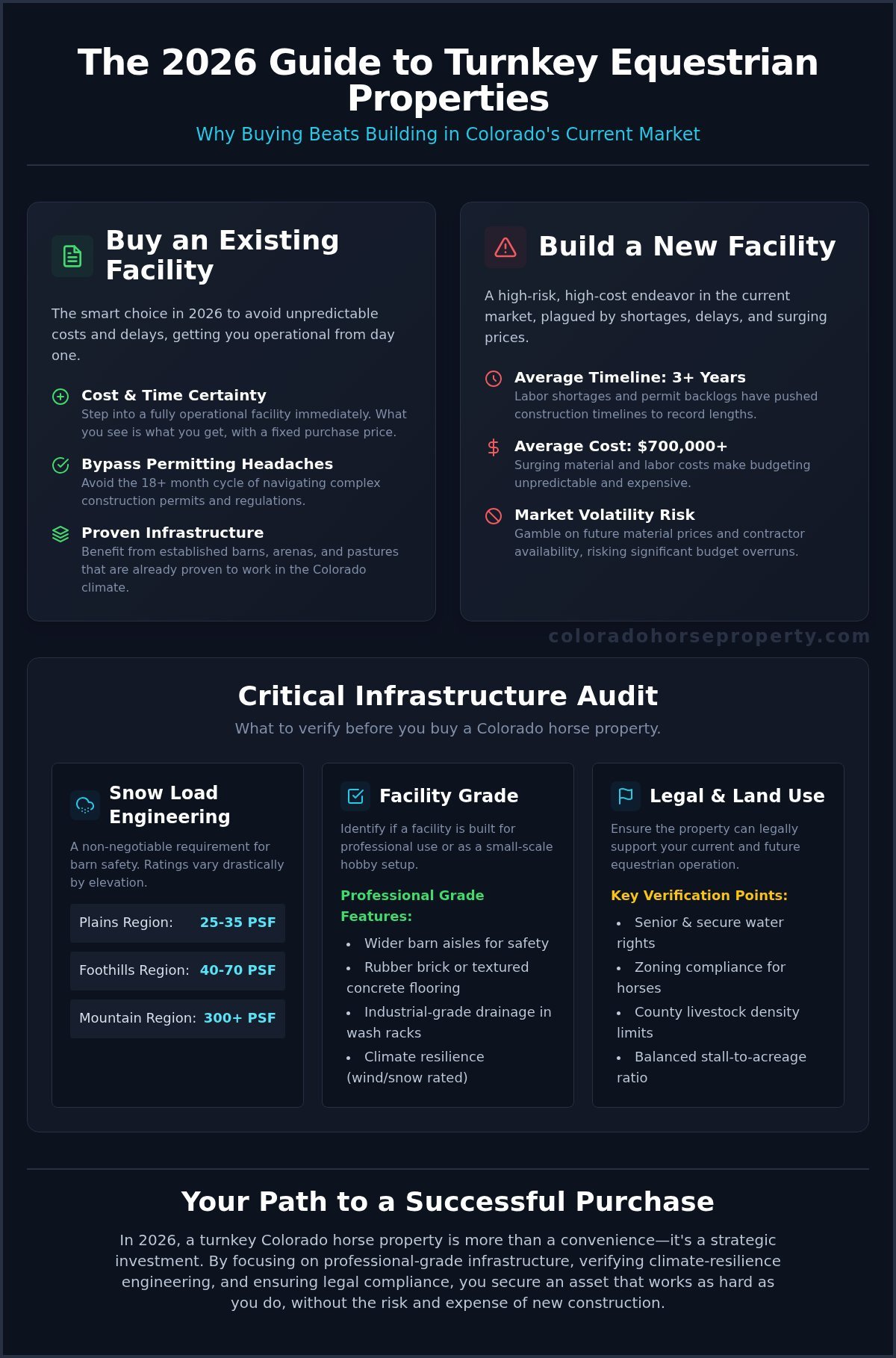
Turnkey equestrian facilities for sale Colorado command a premium because they bypass the 18-month permitting and construction cycle. Regional requirements vary significantly across the state. In the High Country, you need structures rated for extreme snow loads, sometimes exceeding 100 pounds per square foot. On the Front Range plains, the focus shifts to wind resistance and senior water rights for irrigation. A professional facility must be climate-resilient to protect your investment and your livestock.
The Value of Existing Infrastructure in 2026
Current labor shortages in the Rocky Mountain region have pushed construction timelines for pole barns and indoor arenas well beyond a year. When you evaluate an existing barn, don’t just look at the materials. Consider the time value of being able to house your horses immediately. A well-maintained facility with a finished arena can be worth significantly more than the sum of its parts. It’s often more cost-effective to pay the market premium for an existing facility than to gamble on 2026 material price fluctuations and contractor availability.
Determining Your Facility Requirements
A sustainable property requires a balanced stall-to-acreage ratio. Overstocking land leads to mud, parasite loads, and degraded pastures. Professional facilities should provide enough space for rotational grazing, though dry-lot systems are common in more arid regions. Discipline-specific layouts matter. A reining arena has different footing needs than a dressage court. Finally, look for expansion joints in the design. You should be able to add stalls or a hay shed without disrupting the existing workflow. Future-proofing means ensuring the land supports your herd’s growth within county density limits.
Critical Infrastructure: Snow Loads, Ventilation, and Barn Safety
When evaluating turnkey equestrian facilities for sale Colorado, the structural integrity of the barn is your first line of defense against the elements. A beautiful facade can hide engineering flaws that lead to catastrophic failure during a heavy spring snowstorm. You must look beyond the aesthetics to the bones of the building to ensure your investment survives the high-altitude climate.
Engineering for the Rocky Mountain Climate
In 2026, building codes specify rigorous snow load requirements based on elevation and region. For example, properties on the Plains usually require structures rated for 25 to 35 pounds per square foot (psf), while Foothills facilities must handle 40 to 70 psf. Mountain regions often see requirements exceeding 300 psf. Metal roofing is the preferred choice in these high-wind areas as it allows snow to shed more easily than shingles. Snow load engineering is a non-negotiable structural requirement that ensures a barn can withstand the weight of heavy, wet Colorado snow without collapsing.
Ventilation and Air Quality Management
Air quality is just as vital as structural strength. Many owners make the mistake of sealing barns too tightly in winter to keep them warm. This leads to ammonia buildup and excessive moisture, which causes chronic respiratory issues in horses. Passive systems like cupolas and ridge vents are effective, but active fans may be necessary for larger indoor arenas. Strategic placement of windows allows for natural cross-circulation. Proper stall drainage is also a factor. Using porous flooring or specialized stall mats prevents urine from pooling and contributing to poor air quality. While you’re auditing the barn’s physical health, don’t forget to check the utility infrastructure. Understanding Colorado well permitting regulations is essential because your barn’s water supply and wash racks depend on a legally compliant and functional well system.
Fire Safety and Electrical Standards
Fire is the greatest threat to any equestrian facility. Agricultural buildings accumulate dust and cobwebs that are highly flammable. All electrical fixtures must be dust-proof and moisture-proof. Ensure the barn has its own dedicated electrical panel separate from the main residence to prevent overloads. This prevents a tripped breaker in the house from shutting down your heated waterers or arena lights. If you’re unsure how to audit these technical features, using an AI-powered property search can help you filter for listings with updated, professional-grade infrastructure.
Buying vs. Building: Analyzing Equestrian Real Estate Value
Deciding between building a custom facility or purchasing turnkey equestrian facilities for sale Colorado often comes down to a choice between time and control. In 2026, the financial delta between these two paths has widened significantly. While building offers a tailored layout, the unpredictability of labor and material costs makes existing infrastructure a high-value asset. A well-built barn doesn’t just house horses; it anchors the property’s equity and resale potential. When you buy an established property, you’re essentially “locking in” yesterday’s construction prices while avoiding the two-year wait for permits and contractors.
The Real Cost of Building in 2026
Current data shows that a basic pole barn shell in Colorado now starts between $25 and $45 per square foot. However, once you add concrete floors, insulation, and professional finishes, those costs jump to $70 to $120 per square foot. Site preparation, utility hookups, and foundations can add another 20% to your total budget before the first post is set. For those considering an indoor riding arena, starting costs in 2026 begin at $300,000 for a basic structure, with mid-range 70’x150′ arenas costing between $450,000 and $700,000. You can explore a deeper breakdown in our guide on Horse Barns for Sale: Buying vs. Building Your Colorado Equestrian Dream. Choosing between pole barns and steel structures is critical. While steel offers longevity, pole barns remain the standard for many Colorado soil conditions and thermal needs.
Auditing an Existing Barn’s “Bones”
When viewing turnkey equestrian facilities for sale Colorado, you must look past the fresh paint. Foundation settling is a common issue in Colorado’s expansive soils. Look for cracks in concrete pads or stall doors that no longer swing true. Structural wood rot at the post bases can be a deal-breaker, often requiring expensive “sistering” of posts or full replacement. Assess the plumbing and automatic waterers carefully. If the lines weren’t buried below the local frost line, you’ll face annual repair costs every winter. Proper horse stable ventilation is another indicator of a builder’s expertise. Poor airflow leads to moisture trapped in the roof deck, which rots the structure from the inside out over time. If you find significant sagging in the roofline or evidence of major pest infestations in the support beams, it’s usually time to walk away and continue your search.
The lifespan of existing fencing and arena footing also impacts value. Professional-grade fencing like high-density polyethylene or treated wood can last 20 to 30 years, while cheaper alternatives may require total replacement within five. Similarly, a riding arena is only as good as its base. If the drainage is failed, you aren’t just buying an arena; you’re buying a $50,000 excavation project. Audit these components with the same rigor as the house to ensure the property’s “turnkey” status is legitimate.
Legal Essentials: Zoning, Livestock Density, and Water Rights
Legal due diligence is the most overlooked phase of purchasing turnkey equestrian facilities for sale Colorado. You can buy the most advanced barn in the state, but it’s worthless if local zoning prohibits the number of horses you intend to keep. Colorado’s legal landscape is a patchwork of county-specific density limits and hyper-local land use codes. For instance, a property in Elbert County might allow for different livestock ratios than one in Boulder County. You must also verify if the property is governed by “Use by Right” or if you require a “Special Use Permit” for activities like commercial boarding or hosting clinics.
Conflicts often arise between county zoning and Homeowners Association (HOA) covenants. Agricultural zoning might permit ten horses, but an HOA can legally restrict that number to two. In these cases, the more restrictive rule usually takes precedence. Before signing a contract, you must ensure the property’s intended use aligns with both public and private regulations. This is why working with a specialized agent is critical to avoid expensive legal battles after the closing date.
Colorado Water Law for Horse Owners
Water is the lifeblood of any Rocky Mountain ranch, and in Colorado, it’s a separate property right that doesn’t automatically transfer with the land. Most turnkey equestrian facilities for sale Colorado rely on wells. However, a standard “household-only” well permit does not legally allow you to water livestock. You need a domestic or livestock-permitted well to stay compliant with state law. With 2026 bringing intensified legal scrutiny over water scarcity and the doctrine of “first in time, first in right,” verifying the seniority of your rights is non-negotiable. Learn more about the technicalities in our guide to Water Rights in Colorado: What Every Buyer Must Know.
Zoning and Land Use Audits
Beyond animal counts, you must audit the physical placement of infrastructure. Setback requirements dictate how close a barn or manure pile can be to property lines and water sources. If a previous owner built an arena without a permit or violated a setback, you inherit that liability. Checking for commercial potential is also vital if you plan to generate income. A residential-zoned property might forbid “commercial boarding” even if it has twenty stalls. A title search must include a water and zoning audit to confirm the property’s legal utility matches its physical infrastructure.
If you want to ensure your next purchase is legally sound, our team specializes in Colorado buyer representation to navigate these complex water and zoning requirements.
Finding Your Ideal Horse Property with AI-Powered Search
Traditional real estate platforms often fail horse owners. They categorize properties by price and acreage, but they miss the technical nuances of the infrastructure. Finding the right turnkey equestrian facilities for sale Colorado requires a tool that understands the difference between a residential garage and a professional-grade barn. Our proprietary AI-powered search solves this by identifying specific equestrian features that generalist sites ignore. It allows you to skip the manual filtering and focus on assets that meet your operational standards.
Leveraging AI for Niche Feature Identification
Our AI tool scans listings for granular details that matter to serious equestrians. You can filter by stall count, indoor arena dimensions, and specific outbuilding square footage. This precision saves weeks of manual research. Instead of touring properties that lack the necessary clearances or professional footing, you target only “horse-ready” infrastructure. For a deeper look at the acquisition process, consult our Equestrian Real Estate Colorado: A Complete Buyer’s Guide. This data-driven approach ensures your search is efficient and technically accurate from day one.
Why Specialized Representation is Essential
Technology is only half the equation. Mark and Alison Eibner bring a 40-year legacy in the Colorado Front Range market to every transaction. We don’t just show you a property; we evaluate the facility’s integrity in real-time. We check for the structural and legal red flags mentioned earlier, such as unpermitted arenas or insufficient well permits. Our specialized equestrian division understands the nuances of land management and livestock requirements. This deep regional experience gives our clients a distinct advantage, especially when accessing exclusive, off-market equestrian estates that never hit the public MLS.
Streamlining the transaction is our final priority. We provide comprehensive buyer representation and transaction management services. Our network includes agricultural title and escrow partners who understand the complexities of water rights and land easements. This ensures a clean title and a confident closing. By combining high-tech search precision with decades of boots-on-the-ground expertise, we turn the search for turnkey equestrian facilities for sale Colorado into a manageable, professional process. You aren’t just buying a property; you’re securing a specialized asset with a team that knows exactly what to look for.
Securing Your Colorado Equestrian Future
Buying a professional horse property in the Rockies is a significant investment that requires more than just a passion for the lifestyle. You’ve seen why turnkey equestrian facilities for sale Colorado are commanding a premium in 2026. These properties offer immediate utility while bypassing the volatile construction costs and permitting delays associated with new builds. Success in this market depends on a rigorous audit of technical infrastructure, from snow load ratings to senior water rights.
Our specialized equestrian division at Colorado Horse Property brings 40 years of local experience to your search. We combine this deep regional knowledge with our proprietary AI-driven property search tool to help you identify facilities that meet your exact professional standards. Whether you need a specific arena footprint or verified zoning for a commercial operation, we provide the expert oversight required for a secure transaction. It’s time to find a property that supports your goals and protects your livestock for years to come.
Start Your AI-Powered Search for Turnkey Colorado Horse Properties
Frequently Asked Questions
How many horses can I legally keep on my property in Colorado?
Livestock density is determined at the county level. Most Front Range counties allow one or two horses per acre, but specific zoning classifications can change these ratios. For example, Elbert County may permit higher densities than residential zones in Douglas County. You must verify the “Use by Right” status for your specific parcel. Overstocking land leads to pasture degradation and potential legal citations from local code enforcement.
What is the average cost of a turnkey equestrian facility in Colorado in 2026?
Prices for turnkey equestrian facilities for sale Colorado vary significantly by location and infrastructure quality. A professional-grade facility on the Front Range with an indoor arena and ten stalls typically starts well above $1.5 million in 2026. Properties in more remote high-country regions may offer lower entry points but often lack the specialized arenas and senior water rights that drive premium valuations in the plains and foothills.
Do I need a special permit to run a commercial boarding barn in Colorado?
Most commercial boarding operations require a Special Use Permit or a Conditional Use Permit. Even if your land is zoned agricultural, “Use by Right” often only covers private livestock. If you plan to charge for boarding, training, or lessons, you must audit the county land use code. Failure to secure these permits can result in forced closures or heavy fines if neighbors report the increased traffic.
What are the best counties in the Colorado Front Range for horse properties?
Elbert County is a top choice for its generous livestock density limits and lower property taxes. Douglas County remains popular for its proximity to the Colorado Horse Park, though it carries a higher price tag. Weld and Larimer counties offer expansive acreage and excellent water access for agricultural use. Each region has unique soil types and wind patterns that affect how you manage your facility and pastures.
How do I check if my property has water rights for horses?
You must verify the well permit number through the Colorado Division of Water Resources database. Look specifically for a “Domestic” or “Livestock” designation. A “Household Use Only” permit legally forbids you from watering horses or irrigating pastures. Since water rights are separate from land ownership, you should also conduct a priority search to ensure your water isn’t subject to curtailment during a drought period.
What is a “snow load” and why does it matter for my barn insurance?
Snow load is the downward force of accumulated snow on a roof, measured in pounds per square foot (psf). In 2026, insurance companies often require proof that barns meet the International Building Code standards. For example, Pikes Peak regional codes require a ground snow load of 43 psf below 7000 feet. If your barn isn’t engineered for these specific regional loads, a structural collapse might not be covered.
Can I use a domestic well to water my horses in Colorado?
It depends on the specific permit type issued by the state. A standard “Domestic” well permit usually allows for the watering of domestic animals and livestock. However, “Household Use Only” permits are strictly for indoor use and do not allow for outdoor horse waterers or wash racks. Always verify the permit terms during the due diligence period to ensure your horses have a legal water source.
Is it better to buy a property with an existing barn or build new in 2026?
Buying turnkey is generally more cost-effective in 2026. With finished pole barns costing up to $120 per square foot and indoor arenas starting at $300,000, new construction is a financial gamble. Existing turnkey equestrian facilities for sale Colorado also bypass the 18-month permitting and building cycle. You can move your horses in immediately, avoiding the rising costs of materials and labor that often plague new development projects.