
Owning 35 acres of raw mountain land in Colorado can cost you ten times more in property taxes than owning the exact same acreage classified as a functional ranch. It’s a staggering reality that landowners face when they realize their lifestyle property is being taxed at the higher residential or vacant land rate. Understanding the tax benefits of owning a ranch in Colorado is no longer just a perk for commercial cattlemen. It’s a financial necessity for anyone looking to maintain a legacy in the Rocky Mountains in 2026.
You likely moved here for the freedom of the rural landscape, but you shouldn’t have to overpay the county for the privilege of owning it. We know the fear of losing agricultural status after a purchase is real, especially when the lines between IRS hobby loss rules and state property tax classifications feel blurred. This guide provides a clear roadmap to current regulations, showing you how to secure agricultural status and leverage refundable stewardship credits. We’ll examine the specific requirements for land maintenance and the documentation you need to keep your annual tax bill low while your Colorado dreams grow.
Key Takeaways
- Learn how agricultural classification shifts your property tax from “actual value” to a productivity-based formula, significantly lowering your annual overhead.
- Understand the mandatory two-year qualification period and how to prove continuity of use to ensure your land maintains its tax-advantaged status after purchase.
- Explore how to maximize the tax benefits of owning a ranch in Colorado through the new 2026 Agricultural Stewardship Tax Credit, which offers refundable payments regardless of your tax liability.
- Identify the specific criteria for horse properties to distinguish a business operation from a hobby, protecting your ability to claim essential IRS deductions.
- Discover how to use specialized search tools to find land with existing “legacy status,” making it easier to preserve your ranching heritage and financial assets.
Understanding the Agricultural Advantage in Colorado
Understanding the tax benefits of owning a ranch in Colorado starts with how the state views your dirt. Most property owners are used to “actual value” meaning what a buyer would pay on the open market. Colorado law treats qualified agricultural land differently. Instead of looking at comparable sales or development potential, the state looks at the earning capacity of the land itself. This shift in perspective creates a massive financial shield for landowners who maintain active operations.
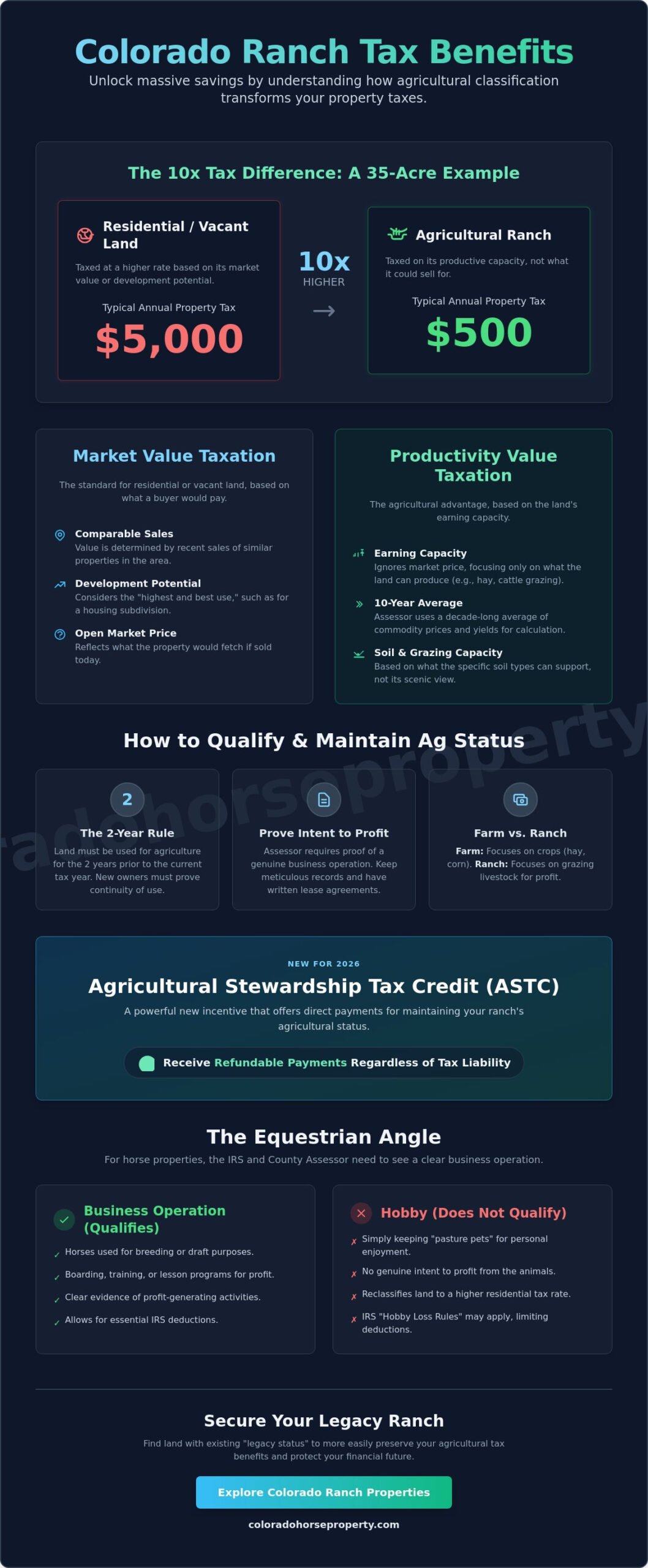
The financial impact of this classification is stark. Residential property is usually taxed at a higher assessment rate than the base values assigned to agricultural land. For example, maintaining your ag status can mean the difference between paying $500 versus $5,000 in annual taxes on the exact same acreage. This happens because the county ignores the multi-million dollar price tag a developer might offer and instead focuses on how many head of cattle the grass can support. This is one of the primary tax benefits of owning a ranch in Colorado that allows families to keep large tracts of land intact for decades.
To better understand how these classifications and changes affect your bottom line, watch this helpful video:
Farm vs. Ranch: How the State Defines Your Land
Colorado makes a clear distinction between a “Farm” and a “Ranch” for tax purposes. A farm focuses on the production of crops like hay, corn, or hemp for profit. You must show a monetary gain requirement to keep this status. A ranch is defined by the grazing of livestock for the primary purpose of profit. In the eyes of the state, livestock isn’t just cattle. It includes horses used for breeding, draft, or other profit-generating activities. If you’re simply keeping a “pasture pet,” you won’t qualify for these specific tax benefits of owning a ranch in Colorado.
The Productivity Formula vs. Market Value
The math behind your tax bill depends on the productivity formula. This is why your neighbors might pay significantly less tax on 200 acres than you do on a 5-acre residential lot nearby. The County Assessor determines the “base crop” or the grazing capacity of your specific soil types. They use a ten-year average of commodity prices and yields to calculate what the land can earn. This value is often a tiny fraction of the land’s actual resale price. Many owners choose to protect this low valuation by entering into a Conservation Easement, which prevents future development and can provide additional state tax credits. Agricultural Classification is a status based on current use and historical consistency.
The 2-Year Rule and Qualification Requirements
Colorado law is strict about who qualifies for agricultural tax breaks. To secure the tax benefits of owning a ranch in Colorado, your land must meet the “2-year rule.” This means the property must have been used for agricultural purposes for the two prior years before the current tax year. If there’s a gap in production, the assessor will likely reclassify the land as residential or vacant land. This change can increase your property tax bill by 10 times or more in many counties.
Classification isn’t a permanent status that stays with the deed; it’s a status that follows the activity. New owners must prove the agricultural operation is continuing. Your “present use” must align with the historical use to maintain the lower valuation without a gap. If the previous owner ran cattle and you decide to stop grazing to prepare for a housing subdivision, the county will trigger an immediate reclassification. Keeping the land productive is the only way to protect your investment from a sudden tax spike.
Proving “Intent to Profit” to the Assessor
Assessors look for a genuine “intent to profit” from the land. You don’t need to be a full-time rancher, but you must show the land is working. The most common way to do this is through written lease agreements with local cattle ranchers or hay farmers. These documents prove the land is producing food or fiber. You should also keep meticulous records of agricultural sales, itemized expenses, and your IRS Schedule F filings.
If your land is “lying fallow” for soil health or undergoing conservation restoration, you must document this carefully. The assessor needs to see that the pause is part of a standard agricultural practice and not an abandonment of the ranching operation. Providing a written management plan can help bridge the gap during these recovery periods.
Forestland and Conservation Exceptions
Not all ranch land is pasture. If you own 40 or more acres of forestland, you can qualify for agricultural status by implementing a Forest Management Plan. This plan must be approved by the Colorado State Forest Service and involve active management, such as thinning or fire mitigation. It’s an excellent way to maintain the tax benefits of owning a ranch in Colorado if your property is heavily timbered.
Conservation programs also play a vital role in maintaining status. The Conservation Reserve Program (CRP) allows you to keep your agricultural classification while land recovers from overgrazing or drought. Additionally, the Agricultural Stewardship Tax Credit offers specific incentives for landowners who implement conservation practices beginning in 2026. Integrating equestrian real estate Colorado strategies, such as professional boarding or training facilities, can also ensure the land remains productive enough to satisfy the county. If you’re looking for land that already meets these strict criteria, the team at Colorado Horse Property can help you find a parcel with a documented history of agricultural use.
The 2026 Agricultural Stewardship Tax Credit (ASTC)
House Bill 24-1249 introduces a significant financial opportunity for Colorado landowners. Starting in the 2026 tax year, the Agricultural Stewardship Tax Credit (ASTC) provides a refundable income tax credit for ranchers who implement specific conservation measures. This isn’t a standard deduction that merely lowers your taxable income. Because the credit is refundable, the state sends you a check for the balance if the credit amount exceeds what you owe in state taxes. It’s a direct cash injection for your ranching operation.
The Colorado Department of Agriculture (CDA) manages a strict $3 million annual pool for this credit. Demand will be high, and the funds are limited. Ranchers should prepare their documentation well before the 2026 application window opens. Early filing is a requirement for success because once the $3 million cap is reached, no further credits are issued for that year. This program represents one of the most proactive tax benefits of owning a ranch in Colorado for those focused on long-term land viability.
Qualified Stewardship Practices for Ranchers
To qualify for the ASTC, your land management must target three specific areas: soil health, water efficiency, and ecosystem diversity. Rotational grazing is a primary qualified practice. By moving livestock through planned patterns, you improve pasture health and increase carbon sequestration in the soil. Water upgrades are also eligible. This includes installing smart irrigation controllers or improved stock watering systems that reduce evaporation. Finally, ranchers can earn credits by restoring native Colorado grasses. These native species create the diverse and beneficial ecosystems that the state’s 2026 mandate seeks to protect.
Maximizing Your Refundable Credit
You don’t need to launch entirely new projects to see a return. The ASTC allows producers to apply for both new and pre-existing qualified practices on their acreage. It’s vital to understand that this is an income tax credit, which functions differently than the standard agricultural property tax exemptions you might already use. While property tax status lowers your annual land holding costs, the ASTC rewards the actual work you do on that land.
To secure the credit, you must consult with the CDA for practice attestation. They provide the necessary certification that your ranching methods meet the state’s 2026 definitions of stewardship. Combining these state-level incentives with federal conservation programs can significantly amplify the tax benefits of owning a ranch in Colorado. Working with a tax professional who understands rural land use is the best way to ensure your application is accurate and submitted before the annual funding pool evaporates.
The Equestrian Angle: Taxes for Horse Properties
Colorado designates horses as livestock, but the state’s Department of Revenue distinguishes between a casual owner and a commercial producer. To access the full tax benefits of owning a ranch in Colorado, your operation must demonstrate a clear intent to profit. The IRS uses Section 183, often called the Hobby Loss Rule, to make this determination. Unlike standard businesses that must show profit in three out of five years, horse operations follow a specific “2 out of 7” rule. If your breeding or training venture turns a profit in at least two of the last seven years, the IRS generally presumes you’re a business rather than a hobbyist. This distinction allows you to deduct expenses like feed, veterinary care, and equipment depreciation against your income. You should keep detailed logs of training hours, competition results, and marketing efforts to satisfy federal auditors during a review.
Boarding, Training, and Breeding Facilities
When browsing horse barns for sale, prioritize properties with commercial-grade infrastructure. Colorado assessors value indoor arenas and stables as “Agricultural Structures” rather than residential improvements, provided they support a profit-seeking venture. This classification keeps property tax rates significantly lower than residential rates. Additionally, active producers often qualify for sales tax exemptions on agricultural implements. This includes items like tractors, skid steers, and specific equestrian equipment used directly in production. Buying a property with these structures already in place can save you the 10% to 15% premium often associated with new construction permits and specialized material costs in 2026.
Zoning and Water Rights for Large Parcels
Securing colorado ranches for sale requires a deep dive into senior water rights. Without these rights, maintaining irrigated pasture for a large herd becomes cost-prohibitive. Most equestrian estates fall under “Agricultural Residential” zoning. This classification is unique because it recognizes the dual nature of the property. Colorado law treats the land under a ranch house as agricultural if the occupant is an active participant. This prevents the “home site” from being taxed at the significantly higher residential rate. Maximizing the tax benefits of owning a ranch in Colorado often hinges on how these boundaries are drawn. It’s a critical distinction that applies as long as the residential use is integral to the agricultural operation.
Ready to find a property that fits your equine business goals? Search our latest Colorado horse property listings today.
Securing Your Legacy with Colorado Horse Property
Finding a property that qualifies for agricultural tax status isn’t just about the view; it’s a calculated financial strategy. To maximize the tax benefits of owning a ranch in Colorado, you need to start with the right classification. Buying land that already holds a “legacy status” is much simpler than trying to convert residential acreage to agricultural use. Converting land often requires two consecutive years of proven agricultural production before a county assessor will grant the lower tax rate. When you purchase an established ranch, those tax savings are often preserved through the sale, protecting your bottom line from the start.
Mark and Alison Eibner specialize in helping buyers identify these high-value opportunities. With nearly four decades of experience, they understand the nuances of water rights and tax zoning that generalist realtors often miss. They focus on finding ranches for sale colorado that align with your specific financial goals, whether you’re looking for a working cattle operation or a private equestrian estate.
The AI Search Advantage for Ranch Buyers
Our proprietary AI-powered search tools take the guesswork out of the acquisition process. Instead of scrolling through hundreds of irrelevant listings, you can filter specifically for properties with existing agricultural classifications and water rights. This technology allows you to:
- Identify Acreage Thresholds: Quickly find properties that meet the 40-acre forestland threshold, which allows for easier classification under Colorado’s forest management guidelines.
- Analyze Improvements: Filter for properties with existing agricultural improvements like barns, arenas, and irrigation systems that contribute to your tax-advantaged status.
- Predict Liabilities: Use data-driven insights to project future property tax liabilities based on current agricultural valuations before you ever sit down at the closing table.
These tools ensure you aren’t just buying land; you’re investing in a tax-efficient asset that supports your lifestyle and dreams.
Next Steps: From Search to Stewardship
Securing the tax benefits of owning a ranch in Colorado requires proactive management. You shouldn’t wait until tax season to think about your classification. Successful landowners connect with specialized tax professionals and local county assessors early in the search process to ensure their intended use matches local requirements.
We recommend building a comprehensive 5-year ranch management plan immediately. This document serves as your roadmap for stewardship and provides the necessary paper trail to satisfy both state authorities and the IRS. Whether you’re managing hay production or grazing livestock, having a clear plan ensures your property remains a legacy for generations to come.
Secure Your Colorado Legacy and Financial Future
Owning a ranch in the Centennial State is more than a lifestyle choice; it’s a strategic financial move. To qualify for significant savings, you must navigate the 2-year rule for agricultural classification. This status drastically reduces property tax assessments compared to standard residential rates. Looking toward the 2026 tax year, the Agricultural Stewardship Tax Credit (ASTC) provides new incentives for landowners who implement specific conservation practices. Understanding the tax benefits of owning a ranch in Colorado requires a deep dive into water rights and zoning laws that vary by county. We bring nearly 40 years of specialized real estate experience to help you navigate these complexities. Our team uses proprietary AI technology to filter properties by precise criteria like acreage and equine facilities. Whether you’re looking for a working cattle ranch or a private equestrian estate, the right land secures your family’s heritage while protecting your bottom line.
Find your tax-efficient Colorado ranch with our AI-powered search tool
Your dream of wide-open spaces and a smart investment is within reach.
Frequently Asked Questions
Is it hard to get agricultural tax status in Colorado?
Securing agricultural status isn’t difficult if you provide the County Assessor with proof of a legitimate commercial operation. You’ll need to show the land’s primary use is for producing agricultural products for profit. This involves submitting lease agreements, grazing records, or sales receipts from the previous two years. While the process is rigorous, it’s a standard procedure for dedicated landowners who follow Colorado Department of Property Taxation guidelines.
How many acres do you need to be considered a ranch in Colorado for taxes?
Colorado law doesn’t set a universal minimum acreage for agricultural classification. Most county assessors use a 35 acre threshold as a benchmark for ranching land, but smaller parcels can qualify if they produce high-value crops or intensive livestock. You’ll need to demonstrate that the size of your land is sufficient to support the specific agricultural activity you’ve chosen for your business to satisfy the local assessor’s requirements.
Does a horse property count as agricultural land in Colorado?
A horse property counts as agricultural land if you use it for commercial purposes like breeding, boarding, or training equine for profit. You won’t qualify if you only keep personal pleasure horses on the land. To maximize the tax benefits of owning a ranch in Colorado, keep detailed records of your business transactions and client contracts to prove the land’s primary commercial function to the state.
What is the 2-year rule for Colorado agricultural land?
The 2-year rule requires you to prove the land was used for agricultural purposes for the two years immediately preceding the assessment year. For a 2026 tax status, you must show active production or grazing occurred throughout 2024 and 2025. This rule ensures that landowners don’t receive tax breaks for land that isn’t consistently contributing to the state’s agricultural economy through active and continuous use.
Can I lose my agricultural tax status if I stop grazing cattle?
You’ll likely lose your status if you stop grazing cattle and don’t replace that activity with another qualifying agricultural use. Colorado law requires continuous use for production or grazing to maintain the lower tax rate. If your land sits idle without a grazing lease or haying operation, the assessor will reclassify it to a higher tax rate; this often results in a significant property tax increase.
What is the Agricultural Stewardship Tax Credit for 2026?
The Agricultural Stewardship Tax Credit for 2026 rewards landowners who implement specific conservation practices like soil health improvements or water efficiency upgrades. Under programs managed by the Colorado Department of Agriculture, you can earn credits for verified stewardship that protects the state’s natural resources. These credits directly reduce your state income tax liability, providing a financial incentive for sustainable land management to help you realize the tax benefits of owning a ranch in Colorado.
How does the IRS Hobby Loss rule affect my Colorado horse ranch?
The IRS Hobby Loss rule, or Section 183, determines whether you can deduct ranch expenses that exceed your income. If your horse property doesn’t show a profit in 3 out of 5 years, the IRS might label it a hobby. This classification is critical because it limits your ability to use ranch losses to offset other income; this potentially increases your overall federal tax burden significantly.
Do I need to make a profit every year to keep my agricultural status?
You don’t need to show a profit every single year to maintain your Colorado agricultural status. The state’s requirement focuses on your intent to earn a profit rather than the actual net income. As long as you’re actively managing the land for production and can show evidence of commercial activity, you can keep your status even during years when market prices or weather cause a financial loss.