
A mountain view can look convincing in a listing and still be absent from the places you spend the day. When evaluating ranches with views of the Sangre de Cristo mountains, verify the outlook from the home, barn, pasture, and other areas you expect to use, not just from a carefully framed photo.
Scenery matters, but it’s only one part of a sound ranch purchase. Access, water rights, permitted uses, terrain, and infrastructure all affect whether a property fits your plans for horses, livestock, recreation, or acreage. This guide explains how to compare view quality and ranch practicality using consistent criteria, identify details that need document review or an on-site visit, and assess listings with greater confidence. You’ll also learn how feature-based property search can narrow the options, so you can focus on Colorado ranches that balance the landscape you want with the land and facilities you need.
Key Takeaways
- Regional proximity doesn’t guarantee a direct mountain view. Assess actual sightlines from the places that matter to you.
- Use a consistent process to review listing evidence, map important areas, inspect on site, and compare what you find.
- Compare ranch features with your intended use, whether you’re planning for horses, livestock, recreation, or a residence.
- For ranches with views of the Sangre de Cristo mountains, treat water, access, permitted uses, and improvements as separate due diligence questions.
- Narrow Colorado listings by location, acreage, improvements, and equestrian features to focus on properties that fit your priorities.
What Makes a Ranch a Sangre de Cristo Mountain-View Property?
A ranch earns the description “mountain-view” in a practical sense when the range is visible from places owners regularly use, not merely from a distant corner of the acreage. A listing may describe a property as near the Sangre de Cristo Mountains, but regional proximity alone doesn’t establish a clear sightline from the home or working areas. The Sangre de Cristo Mountains span a broad area, so each parcel’s position and terrain shape what can actually be seen.
A listed mountain view is a marketing description; a verified on-property sightline is a view confirmed from specific locations on the ranch. That distinction matters when comparing ranches with views of the Sangre de Cristo mountains. A ridge, tree cover, outbuildings, or the angle of the home may block the range from everyday-use areas, even if a photograph captures it from elsewhere.
Which parts of a ranch should have the view?
Start with the places tied to your plans. For a residence, check the main living areas and outdoor spaces. For an equestrian or working property, include the barn, arena, and principal access route. A striking image taken from a remote rise may not reflect the view from the house or the facilities you’ll use each day.
During an in-person visit, walk or drive to these locations and look toward the range from each one. Note obstructions and whether the view changes as you move across the property. If you can’t visit yet, use listing materials as preliminary evidence, not proof. Ask where each photograph was taken and compare that location with a property map before treating the view as a meaningful feature.
How do the San Luis Valley and Costilla County fit the search?
The San Luis Valley and Costilla County are useful regional search references for buyers exploring Southern Colorado. Sangre de Cristo Ranches is another named area buyers may encounter in listings. These place names help narrow a search, but they don’t guarantee that a particular parcel has a direct or unobstructed mountain view.
Evaluate each property individually. Consider its location relative to the range, the shape and elevation of the land, and sightlines from the areas you expect to use. This property-level check turns a broad scenic search into a more reliable comparison of ranches with views of the Sangre de Cristo mountains.
How to Evaluate Sangre de Cristo Views Beyond the Listing Photos
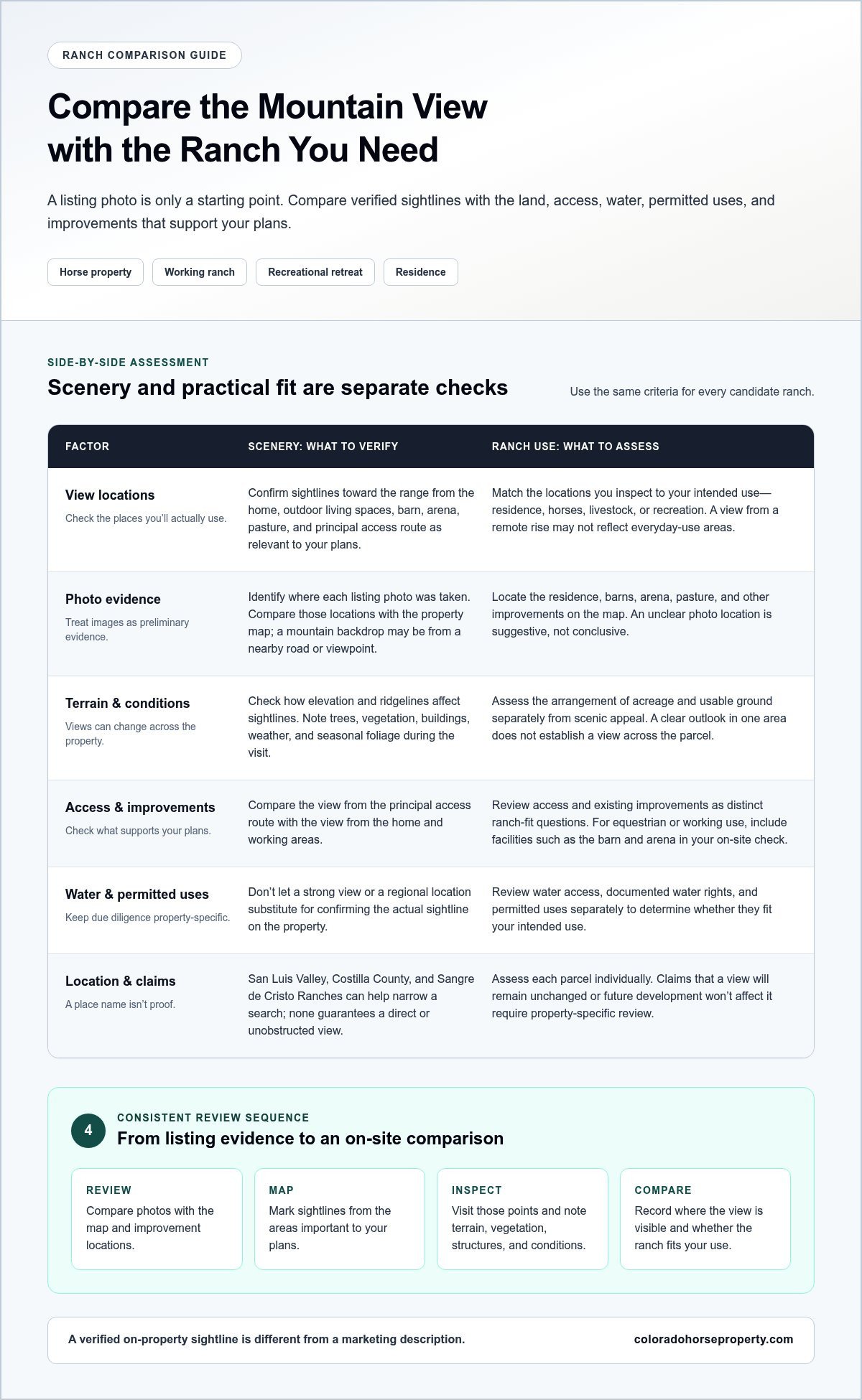
Use a consistent sequence to test the view: review the listing evidence, map important locations, inspect the ranch on site, then compare what you find with your priorities. This helps separate an attractive image from a dependable view and keeps scenery in perspective alongside access, usable acreage, and the infrastructure your plans require.
What evidence can confirm a property’s mountain views?
Start with the listing photographs and property map. Identify where the residence, barns, arena, pasture, and other improvements sit, then mark which locations each photograph appears to show. A mountain backdrop may come from a nearby road or scenic viewpoint rather than the property itself. If a photo’s location isn’t clear, treat it as suggestive, not conclusive.
Next, map the sightlines from the areas you’ll use most. On site, check the view from the house and outdoor living spaces, then walk to working areas and the principal access route. Look toward the range from each point. A view from the entrance may differ from one at the barn or arena, and a clear outlook from one part of the ranch doesn’t establish a view across the entire parcel.
How can terrain and season affect what you see?
Elevation and ridgelines can open or block a view as you move across the land. Trees, other vegetation, and buildings may also interrupt sightlines. Weather and seasonal foliage can change visibility, so consider the conditions during your visit and whether they represent the times of year when you expect to use the property. The U.S. Forest Service’s information about the Sangre de Cristo Wilderness offers context on the nearby mountain landscape, but it doesn’t verify a view from a specific ranch.
Be cautious about statements that a view will remain unchanged or that future development won’t affect it. Those claims require property-specific review. Focus on what you can observe and verify, and assess the ranch’s access, usable ground, and improvements separately from its scenic appeal.
- Review: Compare photos with the map and locations of improvements.
- Map: Mark sightlines from the home, barn, arena, pasture, and access route.
- Inspect: Visit those points and note terrain, vegetation, structures, and viewing conditions.
- Compare: Record which locations deliver the view and whether the property supports your intended use.
Once you know which features matter, search Colorado horse and ranch properties by your priorities, then apply the same view-checking process to each candidate. This makes it easier to compare ranches with views of the Sangre de Cristo mountains without letting a strong listing photo overshadow the property itself.
Compare Sangre de Cristo View Ranches by Scenery and Ranch Use
A useful comparison pairs the view with the work the property needs to support. For each candidate, record where the range is visible, how the acreage is arranged, what access and improvements are in place, and whether water access and documented rights fit your intended use. A large parcel or attractive view alone doesn’t establish operational suitability.
| Comparison factor | Horse property | Working ranch | Recreational retreat | Residence |
|---|---|---|---|---|
| View locations | Home, barn, arena, and riding areas | Home, working areas, and access route | Cabin or home, outdoor spaces, and recreation areas | Main living spaces and outdoor areas |
| Acreage configuration | Look for usable, connected areas suited to planned horse activities | Assess how pasture and working land are arranged for the operation | Consider the areas you’ll use for access and recreation | Focus on the land and outdoor space that suit your lifestyle |
| Access | Review routes to the home, barn, and riding areas | Consider access to working areas and the property as a whole | Check the route to the property and the places you plan to use | Assess everyday access to the residence |
| Improvements | Compare existing fencing, barns, and arenas with your needs | Review existing ranch infrastructure against planned operations | Note which improvements support your intended recreation | Consider the residence and outdoor amenities you value |
| Intended use | Verify permitted use and relevant water documentation | Review land-use rules, water access, and documented rights | Check permitted activities and property-specific water details | Confirm the property’s use aligns with your plans |
Which ranch features matter for horses or livestock?
Match the layout to the operation you envision. A horse buyer may prioritize practical access between the residence, barn, arena, and pasture. A livestock operator may focus on pasture configuration, fencing, and working areas. Separate existing improvements from features you would need to develop. Acreage by itself doesn’t determine carrying capacity or suitability; land conditions, water, and intended use all matter.
Review water access and documentation as property-specific items. Don’t infer available water or usable rights from green pasture, a pond, or other visible features. Review those details alongside land-use rules and existing improvements.
How should buyers balance views with practical priorities?
Rank operational requirements separately from scenic preferences. For example, note whether a barn or usable access is essential, then record whether the mountain view is visible from the home, arena, or only a remote part of the property. Use the table as a starting point and add columns for each ranch’s strengths, trade-offs, and questions to resolve. This makes it easier to compare ranches with views of the Sangre de Cristo mountains on consistent terms.
For broader purchase considerations, see the 2026 Colorado ranch buyer’s guide.
What to Verify Before Buying a Sangre de Cristo View Ranch
A dramatic mountain view tells you nothing by itself about whether a ranch has dependable access, usable water, permitted activities, or improvements suited to your plans. Treat scenic claims and legal or operational property facts as separate questions, and verify each through the evidence relevant to that property.
For ranches with views of the Sangre de Cristo mountains, due diligence should connect what you observe on the land with what the property records support. Listing descriptions can help identify questions, but they don’t establish rights, boundaries, or permitted uses.
Which property records and rights deserve review?
Review title materials and recorded easements to understand access rights and any recorded restrictions affecting the property. Compare those documents with the routes you expect to use, including the route to the residence and working areas. Land-use requirements and permitted activities also need property-specific review, particularly if you plan to keep horses or livestock or make changes to existing improvements.
Water requires particular care. Look for property-specific water documentation and review relevant records through the Colorado Division of Water Resources. A well permit is not the same as a water right, and a listing’s mention of a well, creek, or pond doesn’t establish the extent or permitted use of water. Have the relevant records reviewed with appropriate professionals before relying on water for household, livestock, or irrigation needs.
What should an on-site ranch visit establish?
Walk the property with your intended daily use in mind. Check the sightline from the residence and outdoor areas, then visit the barn, arena, pasture, livestock areas, and access points that matter to your plans. Observe how terrain affects movement across the parcel, note the condition and placement of existing improvements, and identify visible limitations that could affect use. A view from one spot doesn’t tell you whether the rest of the ranch functions as needed.
Keep a written list of questions as you go. Separate observations you can make on site from matters requiring document review, such as access rights, water documentation, land-use rules, title exceptions, or improvement records. This gives your transaction team a clear set of items to resolve rather than relying on impressions from a showing.
- Title and access: Review title materials, recorded easements, and access documentation.
- Water: Match water documentation to the intended use; don’t treat a well permit as proof of a water right.
- Land use: Review applicable rules and permitted uses against your plans.
- Improvements and views: Compare records and on-site observations with the ranch’s intended daily use.
Colorado Horse Property provides specialized Colorado ranch buyer representation to help compare scenic priorities with operational needs and coordinate transaction details as you evaluate a property.
Find and Compare Colorado Ranches with Sangre de Cristo Views
Turn your property priorities into a focused search. Define the geographic area first, then set acreage and improvement criteria around your intended use. Separate essentials, such as suitable access or equestrian facilities, from preferences like a view from a particular outdoor space. That distinction helps keep a scenic feature from outweighing the requirements that make a ranch workable for you.
How can buyers narrow the search to suitable ranch listings?
Colorado Horse Property’s AI-powered search lets buyers look for listings by specific property features. Use it to narrow options by location, acreage, barns, arenas, and other equestrian or ranch priorities reflected in listing information. Search results are a starting point, not a substitute for verifying a property’s current details, sightlines, or records.
For each candidate, apply the same comparison criteria: note where the mountain view is described or shown, which improvements are present, and what details still need on-site or document review. A listing that matches your preferred acreage and facilities may still need closer evaluation of the view location, access, water documentation, or permitted use. This consistent method makes it easier to compare ranches with views of the Sangre de Cristo mountains for both scenic appeal and practical fit.
- Set the search area: Focus on the region that supports your location priorities.
- Choose essential features: Identify acreage, barns, arenas, pasture, and access needs.
- Track preferences separately: Record desired view locations and other features that aren’t deal-breakers.
- Compare candidates: Keep a shortlist with strengths, trade-offs, and questions for follow-up.
How does specialized buyer representation support the purchase?
Specialized buyer representation brings scenic goals and ranch requirements into the same property evaluation. Colorado Horse Property helps buyers compare listings and keep their priorities in view while assessing a property. As a transaction progresses, transaction management and title and escrow coordination help organize the steps from an accepted offer toward closing.
Ranch purchases involve more than choosing a location or a view. Keep property-specific questions about access, water, land use, and improvements connected to the relevant records and transaction milestones. For broader guidance on evaluating Colorado acreage, read the Colorado land buying guide.
Use Colorado Horse Property’s search and buyer representation to compare listings against your criteria and organize the details involved in a purchase.
Choose a Ranch That Fits the View and Your Plans
The right property should offer more than a compelling mountain backdrop. Confirm where the view can be seen, then weigh it against the ranch’s access, acreage layout, water documentation, permitted uses, and improvements. A consistent comparison helps you identify trade-offs and focus on properties that fit your plans for horses, livestock, recreation, or a rural residence.
Finding ranches with views of the Sangre de Cristo mountains is easier when your search criteria reflect both the scenery you want and the features you need. Colorado Horse Property specializes in Colorado ranch and equestrian real estate, and its AI-powered search helps narrow listings by specific property features. Buyer representation and transaction management can support your evaluation as you move toward closing.
Explore Colorado ranch and horse property listings and start comparing properties around the features that matter to you.
Frequently Asked Questions
Can you find ranches with views of the Sangre de Cristo Mountains in Colorado?
Yes, Colorado ranch listings may describe Sangre de Cristo mountain views, but treat each listing as a starting point rather than proof. Confirm the view from the residence and other places you’ll use regularly, and consider how terrain, vegetation, or buildings affect sightlines. Then compare the ranch’s access, improvements, and land features with your intended use. Searching by location and property features can help you identify listings to evaluate more closely.
Where are the Sangre de Cristo Mountains visible from Colorado ranches?
The San Luis Valley and Costilla County appear in local search results associated with Sangre de Cristo scenery. That regional context doesn’t guarantee a direct view from any particular ranch. Evaluate each property’s location, elevation, orientation, terrain, and sightlines. Check from the residence and other areas you expect to use, such as a barn, pasture, or outdoor living space. A nearby range may still be screened or visible only from part of the property.
What should I look for when comparing ranches with mountain views?
Compare the view from everyday-use areas alongside acreage layout, access, improvements, and fit for your plans. For a horse property, assess pasture configuration, fencing, barns, and arena needs. Review water documentation and land-use information separately from visual features. A side-by-side comparison table can help you track each ranch’s strengths, trade-offs, and unanswered questions, so a striking view doesn’t distract from practical requirements or property details that need further review.
Are listing photos enough to verify a Sangre de Cristo mountain view?
No. A photo may show a favorable angle, a nearby scenic location, or a part of the property you won’t use regularly. Compare images with a property map and identify where the photographer was standing, if possible. During a visit, check the view from the home, barns, pasture, and access areas that matter to you. Verify sightlines for each property rather than relying on a listing description or a single image.
What property details should I verify before buying a Colorado ranch?
Review title materials, recorded access or easements, water documentation, land-use requirements, and existing improvements for the specific property. Check that the ranch aligns with your intended residential, equestrian, livestock, or recreational use. A scenic description doesn’t establish water rights, legal access, or permitted activities. Keep a written list of questions, and work through relevant records and transaction details with appropriate professionals before making a purchase decision.
How can I search for a horse-friendly ranch with Sangre de Cristo views?
Define your geographic search area, then separate essential features from preferences. List requirements such as acreage, pasture, barns, arenas, and water-related needs, along with where you want to see the mountains. Colorado Horse Property’s AI-powered search helps buyers discover listings by specific property features. Use search results to build a shortlist, then compare listing details and verify views, property conditions, and relevant records before choosing a ranch.