
Could your dream of owning a horse property turn into a dry-lot nightmare because you followed the wrong set of numbers? Many buyers assume that meeting the legal minimum acreage for horses in Colorado is enough to sustain a healthy lifestyle for their animals. However, in our high-desert climate, the floor set by zoning boards rarely aligns with the ceiling of environmental sustainability. You’ve likely felt the frustration of deciphering “Animal Unit” terminology or comparing the shifting rules between Douglas and Elbert counties.
It’s a complex landscape to navigate, especially with the Jefferson County Zoning Resolution update that took effect on July 1, 2026. This guide provides a direct roadmap through the latest 2026 regulations and land management realities. You’ll learn the specific horse limits for key counties, the impact of current 45.7 percent extreme drought conditions on grazing, and how to tell if a property is truly viable. We’ll give you a clear framework to evaluate potential land so you can move forward with the confidence of a seasoned expert. Whether you’re looking at an A-1 agricultural zone or a suburban residential lot, we’ll help you determine exactly how much space you need to keep your horses healthy and your land productive.
Key Takeaways
- Understand how the “Animal Unit” system serves as the legal foundation for livestock capacity across different Colorado zoning districts.
- Discover why the legal minimum acreage for horses in Colorado is merely a baseline that often falls short of what is required for sustainable land management.
- Learn to identify hidden restrictions like HOA covenants and specific water rights that can legally prohibit horses even on land zoned for agricultural use.
- Navigate the latest 2026 regulatory updates for Front Range counties to ensure your property remains compliant with evolving land use codes.
- Explore how AI-powered search technology can simplify your journey by filtering for specific equestrian infrastructure and verifying complex zoning data automatically.
Understanding Colorado Horse Zoning: The Animal Unit System
Colorado doesn’t have a single statewide law governing how many animals you can keep on your land. Instead, each county uses a specific framework to determine the minimum acreage for horses in Colorado based on local environmental needs and infrastructure. This system is designed to prevent property degradation and ensure that livestock density doesn’t overwhelm the local ecosystem. Understanding these rules is the first step toward finding a property that fits your lifestyle without triggering legal headaches.
Effective General horse management involves balancing the physical needs of the animal with the capacity of the land. In Colorado, this balance is legally codified through “Use by Right” and “Special Use Permits.” Use by Right means your zoning allows for horses automatically, as long as you stay within the prescribed animal limits. If you plan to exceed these limits or operate a business, you’ll likely need a Special Use Permit, which involves a public hearing and county approval.
To better understand how land and livestock interact in our state, watch this helpful video:
What is a Colorado Animal Unit?
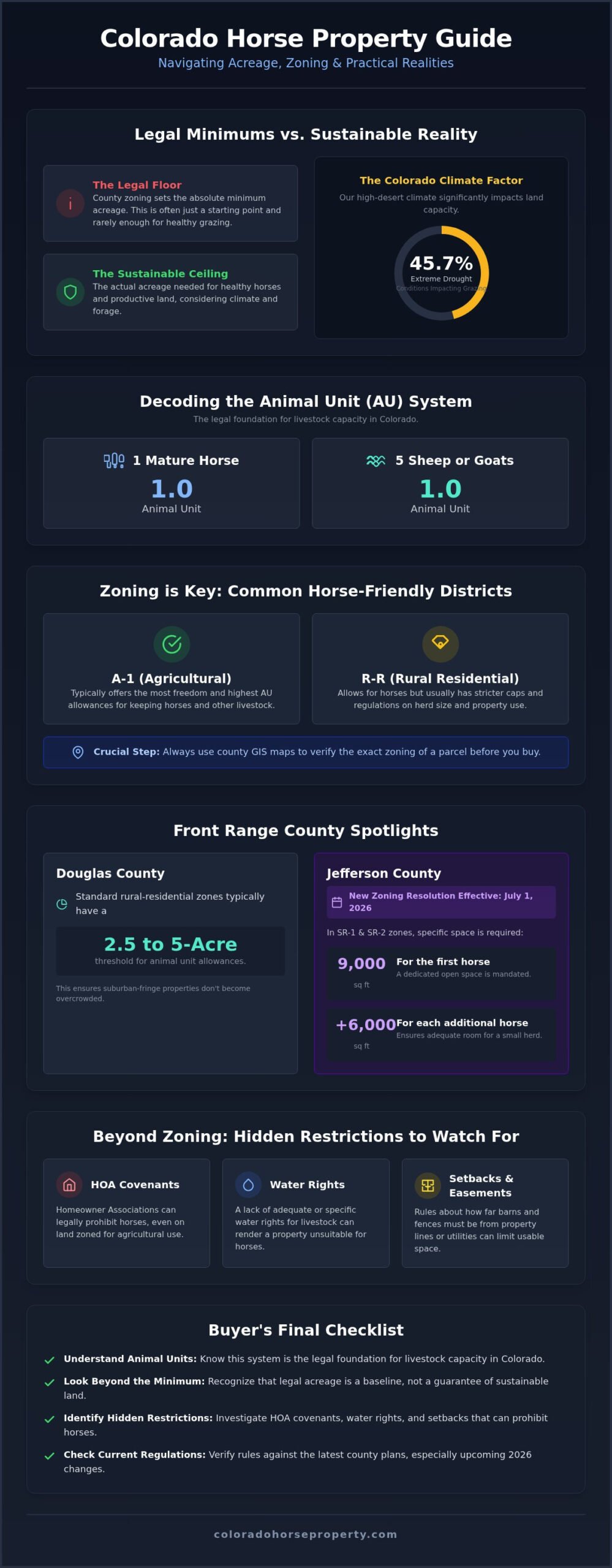
The Animal Unit (AU) is the standard currency of livestock zoning. In nearly every Colorado county, one mature horse is treated as 1.0 Animal Unit. If you’re considering a mix of livestock, the math becomes more intricate. For instance, five sheep or goats might be categorized as a single AU. Local planning departments define Animal Units as the legal density limit set to regulate livestock capacity on a per-acre basis. This measurement ensures that the land isn’t overtaxed by too many hooves and helps manage manure runoff into local watersheds.
Zoning Districts and Horse Allowances
Your property’s specific zoning code determines your legal horse capacity. Common codes like A-1 (Agricultural) or R-R (Rural Residential) each carry different AU allowances. An A-1 designation usually provides the most freedom, while residential-agricultural zones often have stricter caps. You can’t rely on a real estate listing to confirm legal status. Even if a property has a barn and fencing, it might not be legally compliant for your specific herd size. Always use county GIS (Geographic Information System) maps to verify the exact zoning of a parcel before you sign a contract. This due diligence is the only way to confirm the true minimum acreage for horses in Colorado for your specific needs.
County-Specific Minimums: Front Range and Beyond
The minimum acreage for horses in Colorado is a moving target that shifts the moment you cross a county line. While one county might prioritize open space preservation, another might focus on high-density residential growth. This disparity means that a five-acre lot in Arapahoe County often has different legal capacities than a five-acre lot in neighboring Elbert County. Relying on outdated information is a common mistake. You must verify rules against the 2026 comprehensive plans to ensure your property remains compliant with the newest land use codes.
County-specific comprehensive plans act as a blueprint for future development. These documents dictate whether a rural area will remain equestrian-friendly or eventually transition into suburban housing. When population density increases, counties often tighten their Animal Unit caps to manage noise, dust, and manure issues. Understanding these long-term trends is vital for protecting your property value and your lifestyle.
Douglas and Jefferson County Requirements
Douglas County generally adheres to a 2.5-acre to 5-acre threshold for standard Animal Unit allowances in its rural-residential zones. This ensures that suburban-fringe properties don’t become overcrowded. In Jefferson County, a new Zoning Resolution became effective on July 1, 2026. This update specifies that in SR-1 and SR-2 zones, you must provide 9,000 square feet of open space for the first horse and 6,000 square feet for each additional horse. While the code technically allows a maximum of four horses per acre, the “Mountain Residential” zoning complexities often reduce this number based on slope and soil stability.
Elbert and Larimer County Freedom
If you’re seeking fewer restrictions, Elbert County’s 35-acre parcels are often considered the gold standard. These large tracts usually allow for more significant livestock numbers without the constant oversight found in denser areas. Larimer County takes a more structured approach. Their current code limits the total number of horses to one per half-acre. If you plan to board horses, Larimer allows up to four boarded animals on lots 10 acres or smaller. For larger properties, the limit shifts to one boarded horse per 2.5 acres, up to a maximum of 20.
Purchasing in counties with lower population density often provides a buffer against future zoning changes. However, even in these areas, “horse-ready” doesn’t always mean legally compliant for your specific herd size. To simplify this complex verification process, you can use our AI-powered search tool to find properties that already meet your specific zoning needs.
Legal Minimum vs. Practical Reality: The Colorado Climate Factor
The traditional rule of thumb suggesting one horse per acre fails immediately when applied to the semi-arid West. While county zoning might establish a minimum acreage for horses in Colorado, these legal baselines rarely account for the state’s unique environmental challenges. High altitude, low humidity, and erratic rainfall create a fragile ecosystem where overgrazing can turn a lush pasture into a dust bowl in a single season. As of mid-July 2026, 45.7 percent of Colorado is experiencing extreme-exceptional drought conditions. This reality makes natural grazing a secondary benefit rather than a primary food source for your herd.
Sustainable land management requires looking beyond the total lot size. You must distinguish between gross acreage and usable equestrian acreage. A five-acre parcel might look sufficient on paper, but if two of those acres are occupied by a steep ravine, a dense stand of timber, or a massive septic leach field, your horses are left with limited room to roam. Successful owners understand that the legal floor is rarely the practical ceiling.
Grazing Capacity and Land Degradation
A typical 1,000 pound horse requires approximately 15 to 20 pounds of forage per day. In Colorado’s arid climate, native grasses grow slowly and recover even slower. Without rotational grazing and designated sacrifice areas or dry lots, a small herd can easily strip the land of its nutrients. This leads to soil compaction and the encroachment of invasive weeds. Most successful owners on smaller parcels rely heavily on supplemental feeding. With horse hay currently selling for approximately $375 per ton, the cost of maintaining a horse on insufficient acreage adds up quickly.
Infrastructure Footprints: Barns, Arenas, and Parking
Infrastructure footprints consume more space than most first-time buyers realize. Every building, driveway, and parking area reduces the available turnout. A standard 5-acre lot often provides only 3 acres of actual pasture once you account for the home, barn, hay storage, and manure management areas. You also need to consider setbacks from property lines and well heads, which can further restrict where you place fences or arenas. Planning for these dead zones is essential to ensure the minimum acreage for horses in Colorado you purchase actually functions as a working equestrian property rather than just a crowded residential lot.
Hidden Restrictions: HOAs, Setbacks, and Water Rights
Meeting the legal minimum acreage for horses in Colorado is only the first hurdle in a successful property search. While county zoning provides the baseline, private restrictions and resource limitations often carry more weight. Covenants, Conditions, and Restrictions (CC&Rs) can override county permissions entirely. If a Homeowners Association (HOA) prohibits livestock, the fact that your land is zoned for agricultural use will not protect your right to keep horses. You must look beyond the surface level of a listing to identify the legal layers that actually govern the dirt.
Setbacks are another critical factor that buyers frequently overlook. Even on a sprawling parcel, you cannot simply build a barn or arena wherever you choose. Most counties and HOAs require significant distances between livestock structures and property lines, well heads, or neighboring dwellings. In many Front Range districts, these setbacks can reach 50 to 100 feet. This effectively shrinks your usable acreage and can make a smaller, narrow lot impossible to develop for equestrian use. Don’t rely on the “Grandfathered” myth. Just because a previous owner kept horses doesn’t mean those rights automatically transfer to you if the land use code has since changed.
Colorado Water Rights for Horses
Water is the most complex and vital resource for any Western land owner. You cannot assume that a functional well provides the legal right to water livestock. Many residential wells in Colorado are restricted to “household use only” by the permit. This means you are legally prohibited from using that water for anything outside the home, including troughs or wash racks. You must verify the specific permit status through the Colorado Division of Water Resources. For a deeper look at these complexities, read The Ultimate Guide to Buying Colorado Land in 2026.
HOA and Covenant Limitations
HOAs often introduce management rules that are far stricter than county ordinances. These can include mandatory manure removal schedules, specific barn design requirements, and even restrictions on the number of horse trailers you can park on your property. Some covenants even limit the types of fencing materials you are allowed to use. Reviewing the Title Commitment before your objection deadline is the only way to uncover these traps. Expert buyer representation is essential for vetting these documents and ensuring the land truly supports your goals.
Identifying these hidden restrictions early saves you from costly legal battles or the heartbreak of a property you cannot use. Start your search with our specialized team to ensure every detail of your potential horse property is fully vetted for compliance and utility.
Finding the Right Colorado Horse Property with AI
Our proprietary search technology simplifies the process by indexing properties based on actual equestrian utility. It looks beyond simple acreage counts to identify parcels that are legally compliant and practically functional. This approach ensures you don’t waste time visiting properties that lack the necessary zoning or environmental capacity to support your herd. Whether you’re looking for a private estate or a commercial boarding facility, the right tools make the difference between a successful investment and a costly mistake.
Leveraging AI for Niche Equestrian Searches
Moving beyond basic search parameters is essential when evaluating specialized real estate. Our AI-Powered Horse Property Search acts as a digital scout, filtering inventory for “Equine Essentials” such as indoor arenas, perimeter fencing, and outbuildings. It cross-references current county land use codes, including the July 2026 updates, to ensure the land meets the minimum acreage for horses in Colorado for your specific needs. This tool saves you months of manual zoning research by providing a curated list of properties that are truly horse-ready.
Expert Representation and Transaction Management
Finding the property is only half the battle. Navigating a ranch sale requires specialized knowledge of title insurance, escrow coordination, and agricultural disclosures. Mark and Alison Eibner’s 40-year legacy in the Front Range provides the seasoned expertise necessary to protect your investment. We understand “horse language” and the unique challenges of Western land ownership, from soil types to manure management regulations. Our team provides comprehensive buyer representation and transaction management to ensure every detail, from the well permit to the property line setbacks, is fully vetted before you reach the closing table.
The journey to owning a Colorado horse property shouldn’t be a gamble. Start your search with the most advanced technology in the industry or contact us to list your property with a team that truly understands its value. We are ready to help you find the space and freedom you’ve been looking for.
Securing Your Colorado Equestrian Future
Determining the minimum acreage for horses in Colorado requires balancing current zoning codes with the environmental realities of the Front Range. You’ve seen how “Animal Units” provide a legal framework, but drought conditions and infrastructure footprints often dictate a larger practical minimum. Success depends on verifying well permits and navigating HOA covenants before the objection deadline passes. These layers of regulation and resource management are what turn a simple land purchase into a sustainable lifestyle.
With over 40 years of local expertise, our team understands the nuances of Colorado land that generalists often miss. We combine this historical knowledge with specialized AI search technology to identify properties that meet your specific livestock needs. From the initial search to end-to-end transaction management, we ensure your investment is protected and your closing is seamless. Your dream of wide-open spaces is within reach when you have the right data and a seasoned partner by your side.
Start your AI-powered search for Colorado horse properties today and find the land that truly supports your lifestyle.
Frequently Asked Questions
Is there a statewide minimum acreage for horses in Colorado?
No, Colorado doesn’t mandate a statewide minimum acreage for horses in Colorado. Every regulation is established at the local county or municipal level through specific zoning ordinances. These rules vary significantly between neighbors like Jefferson and Elbert counties, so you must research the exact parcel’s jurisdiction before purchasing.
What is the “Animal Unit” system used in Colorado zoning?
The Animal Unit (AU) system is a standardized method used by planning departments to measure livestock density. One mature horse typically equals 1.0 Animal Unit. This allows counties to set limits based on the land’s carrying capacity rather than just counting heads. It ensures that different types of livestock are accounted for proportionally on a single property.
Can an HOA ban horses even if the county zoning allows them?
Yes, Homeowners Association (HOA) covenants and CC&Rs can legally prohibit horses even if county zoning allows them. Private contracts like these are often more restrictive than government regulations. You must review the title commitment and association bylaws before your objection deadline to confirm your right to keep animals on the property.
How many horses can I have on 5 acres in Douglas County?
In Douglas County, the number of horses depends on your specific zoning district, but most rural-residential zones follow a 2.5-acre to 5-acre threshold for the first few animals. Typically, you can expect to keep two to four horses on a five-acre lot if the land is properly zoned. Always verify the current 2026 Animal Unit allocations for your specific parcel via the county planning office.
Do I need special water rights to have horses on my property?
You absolutely need the legal right to water your livestock, which is separate from your right to use water inside your home. In many parts of Colorado, water is a strictly governed senior right. If your property lacks the specific legal allocation for livestock watering, you might be forced to haul water or purchase additional rights, which can be a complex and expensive process.
Does a “domestic well” allow me to water my horses?
A standard “household-use-only” well permit generally doesn’t allow for livestock watering. You typically need a “domestic and livestock” well permit to legally provide water for horses. You can verify your permit status through the Colorado Division of Water Resources to ensure you aren’t in violation of state water law during your ownership.
What is the difference between a dry lot and a pasture in Colorado?
A pasture is an area intended for grazing where grasses are maintained for forage. A dry lot, or sacrifice area, is a smaller enclosure with no vegetation where horses are kept to prevent overgrazing of the main pastures. Given the 45.7 percent extreme drought conditions currently facing Colorado in 2026, dry lots are essential tools for sustainable land management on smaller parcels.
How do I check the zoning of a property before I buy it?
The most reliable way to check zoning is through the county’s Geographic Information System (GIS) map or by calling the local planning and development department. You can also use specialized search tools that aggregate this data. Relying on a standard residential listing is risky because “horse-ready” features don’t always equal legal compliance for the minimum acreage for horses in Colorado.