
A true legacy ranch in the Centennial State isn’t defined by its price tag alone, but by the priority of its water rights and the precision engineering of its arena footing. Most high-end buyers spend months touring residential properties that look the part but fail the technical requirements of a professional equine operation. You want a facility that supports the health of your horses and the longevity of your investment, not just a luxury home with a fence. It’s frustrating to find that a stunning property lacks the proper zoning for your specific livestock count or has junior water rights that won’t survive a dry season.
This 2026 definitive guide provides the technical roadmap to acquiring luxury equestrian estates Colorado offers, ensuring your next move is backed by data and expertise. You’ll learn how to navigate the latest agricultural tax classifications under Senate Bill 26-010 and identify premier regions like Franktown, where median prices now reflect a significant shift toward rural luxury. We’ll examine the essential criteria for professional-grade arenas, explain the complexities of modern water reclamation laws, and show you how AI-driven search technology streamlines your path to a world-class equestrian lifestyle.
Key Takeaways
- Identify the specific engineering standards for professional-grade barns and arena footing that differentiate high-end estates from standard residential properties.
- Understand the critical legal distinctions between senior and junior water rights to ensure your land supports long-term livestock and irrigation needs.
- Explore the most desirable regions for luxury equestrian estates Colorado buyers, including the technical zoning advantages of Douglas and Boulder counties.
- Learn how to leverage AI-powered search technology to pinpoint properties with exact facility specifications and specialized agricultural classifications.
- Discover why specialized buyer representation is essential for navigating the complex intersection of luxury residential architecture and professional equine infrastructure.
The Evolution of Luxury Equestrian Estates in Colorado
The definition of prestige has shifted. It’s no longer just about the square footage of the main residence. The 2026 standard for luxury equestrian estates Colorado investors demands a fusion of high-end aesthetics and technical precision. We’ve seen a definitive move away from simple hobby farms toward professional-grade private estates. These properties aren’t just places to keep horses; they’re sophisticated operations designed for peak performance and animal wellness. Modern luxury now includes smart-stable technology and sustainable infrastructure. Automated climate control, sensor-based watering systems, and solar-powered arenas are becoming baseline requirements. This shift protects the investment and the livestock.
Colorado’s heritage, rooted in the history of the Colorado Ranger horse, sets a high bar for land utility. Owners today seek “legacy land” in the Front Range that offers the rare combination of senior water rights and proximity to urban centers. Scarcity is driving the market; once these large, well-watered parcels are subdivided, they’re gone forever. Securing a property that qualifies as a legacy estate means looking for land that can support multiple generations of both family and equine athletes.
The Intersection of Lifestyle and Utility
The “equestrian house” has emerged as a unified design concept. This approach integrates the stable as a functional wing of the main residence, allowing for immediate interaction with the horses while maintaining strict boundaries for air quality and noise. It treats the barn with the same architectural reverence as the primary living spaces. Proximity to trail systems is now a non-negotiable feature. A property’s value is often tied directly to its ride-out potential. If you can’t access miles of groomed trails from your own gate, the estate isn’t truly luxury in the eyes of today’s discerning buyers.
For global investors who divide their time between the Rockies and the Swiss Alps, maintaining this level of luxury across all residences is paramount; you can visit GuestLee to discover premium Swiss property management tailored to high-end lifestyle needs.
Market Trends for 2026
Multi-generational compounds are the primary focus for 2026. Buyers want estates that accommodate extended family and professional staff in separate, high-end dwellings. Finding these niche properties has become faster by leveraging AI-Powered Horse Property Search tools. This technology allows buyers to filter for specific technical requirements, such as indoor arena dimensions or specific zoning codes, before scheduling a tour. While custom builds offer personalization, turnkey facilities are in highest demand. They allow owners to bypass the multi-year permitting and construction cycles common in the Rockies. A ready-to-use facility with professional footing and established pastures is the ultimate 2026 luxury.
World-Class Facilities: Technical Standards for High-End Estates
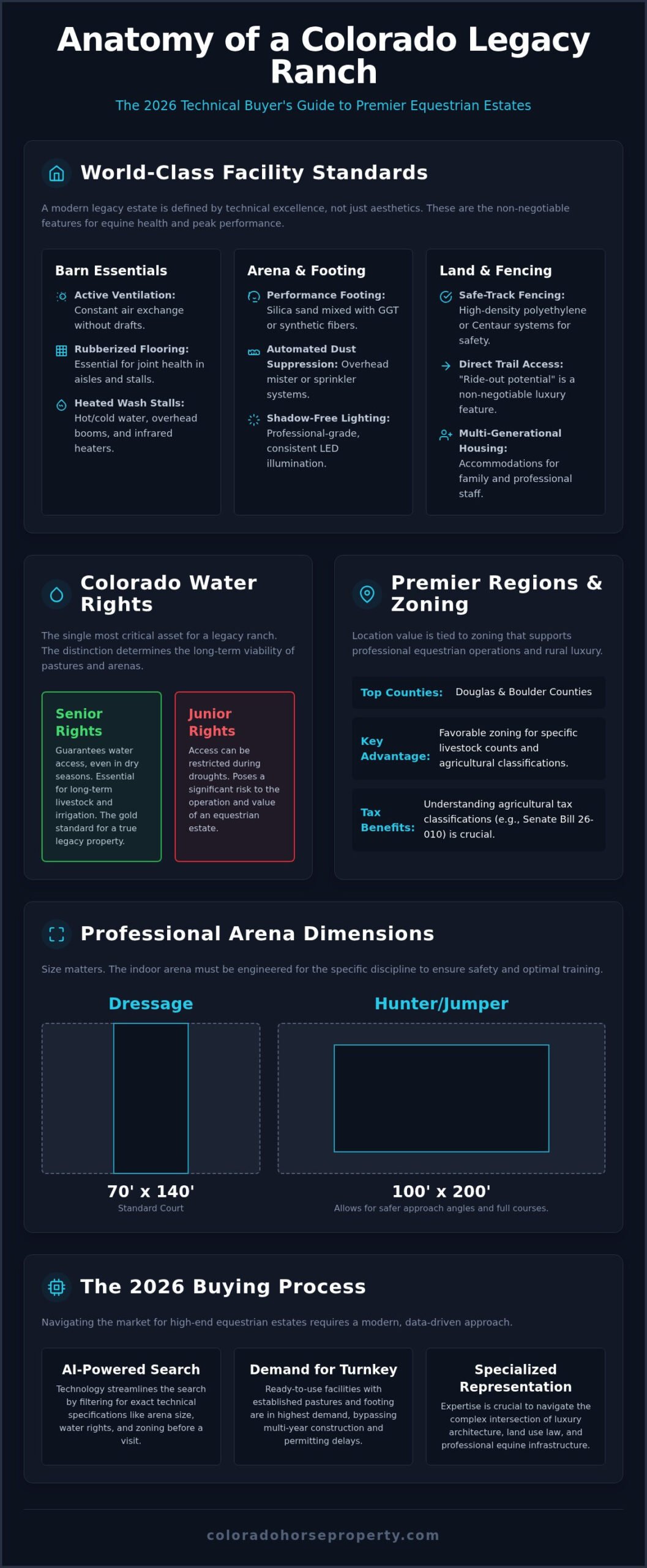
A high-end facility is more than just a collection of stalls. In the market for luxury equestrian estates Colorado, technical excellence is the primary differentiator. A professional-grade barn requires active ventilation systems that ensure constant air exchange without creating drafts. Rubberized flooring in aisles and stalls is no longer a luxury; it’s a requirement for equine joint health. Wash stalls must feature both hot and cold water with overhead booms and infrared heaters to manage the state’s rapid temperature swings during the winter months.
Footing technology remains the ultimate investment for any serious rider. High-performance silica sand mixed with GGT or other synthetic fibers provides the necessary rebound and shock absorption for elite athletes. Managing these facilities also requires a consistent water supply. Maintaining lush pastures and dust-free arenas depends heavily on the Colorado water rights system. Without senior rights or well permits that allow for irrigation, a property’s utility for livestock management is severely limited. Safe-track fencing systems, such as high-density polyethylene or centaur fencing, are preferred over traditional wood for their durability and safety.
The Professional Indoor Arena
Professional indoor arenas require specific dimensions based on the discipline. A standard dressage court fits within a 70 by 140-foot space, but hunter-jumpers require wider spans, often 100 by 200 feet, to allow for safe approach angles. Shadow-free LED lighting and integrated sound systems create an optimal training environment. Dust suppression is equally critical. Automated overhead misters or sub-irrigation systems keep the footing at the perfect moisture level without manual labor. Finding a property that already includes these specifications is easier when you use an AI-powered horse property search to filter for specific technical facility standards.
Smart Stable Technology
Smart technology has revolutionized stable management. AI-integrated cameras now monitor a horse’s movement patterns 24/7, alerting owners to signs of colic or distress. Automated watering systems track individual consumption, providing vital health data that manual checks might miss. Energy-efficient waste management, including covered manure composting systems, helps maintain the estate’s aesthetics and environmental health. These systems reduce labor costs and ensure that the facility runs with the precision expected of a world-class estate.
Navigating Colorado Land: Water Rights, Zoning, and Acreage
Land acquisition for luxury equestrian estates Colorado buyers involves more than evaluating the view or the soil quality. You’re purchasing a complex set of legal entitlements. Water is the most critical asset. Colorado operates under the doctrine of prior appropriation, which means “first in time, first in right.” Senior water rights are essential if you plan to irrigate pastures or maintain a dust-controlled arena. Without them, your water supply can be shut off during drought years to satisfy older claims. Recent 2026 legislation, specifically House Bill 1340, now mandates that entities removing irrigation water from land are responsible for its revegetation. This protects the ecological value of your estate even as water usage patterns shift across the state.
Water Rights and Irrigation
Verifying water availability requires a deep dive into well permits and ditch rights. Not all wells are created equal. A domestic well might only allow for in-house use, while an exempt well on a larger parcel might permit livestock watering. Our team’s Title and Escrow Services play a vital role in this process by performing the necessary due diligence to confirm that the water claims listed on a deed are actually valid and transferable. You don’t want to discover after closing that your “irrigated” pasture has no legal right to the water flowing through the ditch. We verify these claims early to prevent expensive legal battles later.
Zoning and Land Use
Zoning dictates the actual capacity of your estate. Every county has different “animal unit” restrictions that impact the density of luxury equestrian estates Colorado can support. For example, in 2026, Boulder County allows up to two horses per acre of pasture in rural residential zones, increasing to four in agricultural zones. Meanwhile, Larimer County uses a point system where exceeding one horse per half-acre triggers a Minor Special Review. In Douglas County, specific setbacks are required for manure piles, which must be at least 100 feet from any lot line or water source.
Understanding tax classifications is equally important for your bottom line. For the 2026 tax year, agricultural properties are assessed at 25 percent of their value. This is a significant distinction from the residential assessment rates, which sit at 7.05 percent for school districts and 6.8 percent for local governments. Senate Bill 26-010 has made it easier for smaller, pasture-based operations to qualify for these lower agricultural valuations if the land is predominantly used for profit-based agriculture. Balancing these legal requirements with your lifestyle goals is the only way to protect a legacy property’s value.
Premier Colorado Regions for Luxury Equestrian Living
Location determines more than your view; it dictates your access to specialized infrastructure. While mountain resort towns like Aspen recorded a median single-family home price of $17.5 million in 2025, the first half of 2026 saw a 51 percent year-over-year drop in sales volume. This shift has pushed affluent buyers toward the Front Range plains and foothills. These areas offer a better balance of expansive acreage and professional-grade facilities. For investors managing a global portfolio, Konradian provides specialized support in acquiring high-end properties across international borders. The Western Slope remains the choice for those seeking 35-plus acre parcels and high-country vistas, but the Front Range Corridor is where the most active market for luxury equestrian estates Colorado currently resides.
Douglas County is widely considered the heart of Colorado horse country. Franktown, in particular, has become a primary hub for high-end buyers who prioritize facility quality over urban proximity. As of June 2026, the median listing price in Franktown reached $1,715,000, reflecting the high demand for turnkey estates. Many of these properties offer direct, private access to extensive trail systems and are situated within minutes of the Colorado Horse Park in Parker. This proximity allows owners to participate in world-class competitions without the stress of long-distance hauling. Understanding the local market dynamics is essential, so you should review our equestrian real estate Colorado buyer’s guide to see how these south-metro enclaves compare to other regions.
Boulder & Northern Colorado
Boulder County offers a unique blend of prestige and sustainability. The luxury market here remains exceptionally strong; closed sales for properties over $2 million rose 44 percent year-over-year as of March 2026. Areas like Niwot and Longmont are prized for their Flatiron views and proximity to the state’s leading veterinary and training resources. In these northern corridors, you’ll find estates that emphasize eco-friendly pasture management and advanced irrigation systems. Further north, Larimer County provides a more rural feel with a median sale price of $600,000 as of July 2026, though luxury equestrian inventory remains tight. These northern properties often feature the specific zoning needed for larger livestock counts, which can be harder to find closer to Denver.
Identifying the right region requires a data-driven approach that considers zoning, water rights, and facility standards simultaneously. To find the most current listings in these premier counties, start your AI-powered horse property search today and filter by the specific regional features that matter most to your operation.
The Luxury Buying Process with Colorado Horse Property
Buying a legacy property requires more than a standard residential inspection. It involves a technical audit of the land and its infrastructure. For buyers of luxury equestrian estates Colorado, the stakes are high. One oversight in soil composition or water right seniority can lead to millions in lost value. Our process streamlines this by combining advanced technology with 40 years of regional expertise. We move beyond aesthetic tours to perform deep due diligence on soil drainage, facility ventilation, and legal property rights before you ever sign a contract.
AI-Powered Precision
Standard search platforms treat a barn as a generic outbuilding. Our proprietary AI-Powered Horse Property Search changes that. It filters for specific technical features like indoor arena dimensions, rubberized stall flooring, and senior water rights. You can set customized alerts for the luxury horse property for sale in Colorado market to ensure you see “horse-ready” land the moment it hits the MLS. This technology identifies properties that meet your exact facility requirements, saving weeks of wasted site visits to residential properties that lack proper equestrian zoning.
Expert Guidance from Mark and Alison Eibner
Technology is only half the equation. Mark and Alison Eibner bring 40 years of Realty Oasis heritage to every transaction. We provide expert buyer representation that addresses the complexities of high-net-worth land deals. Our team manages the entire process, from initial strategy to final title and escrow services. We’ve built a vetted network of equestrian facility builders and designers to help you evaluate potential custom-build sites or turnkey upgrades. This no-nonsense approach ensures your investment is technically sound and legally protected. We act as your specialized partner, not just a generalist real estate agent.
Transaction management is the final hurdle in the luxury buying process. We handle the granular details of complex contracts, ensuring all agricultural tax status requirements and conservation easements are properly documented. Our goal is to streamline the search and acquisition process, allowing you to focus on the fulfillment of your long-term equestrian goals. We provide a supportive, knowledgeable partnership that turns a high-stakes transaction into a secure legacy for your family and your horses.
Securing Your Colorado Equestrian Legacy
Acquiring a world-class horse property in the Rockies requires a shift in perspective. It’s about moving beyond the visual appeal of a mountain home to verify the technical integrity of its equine infrastructure. Whether you’re targeting the professional hubs of Douglas County or the sustainable enclaves of Boulder, success depends on understanding senior water rights and specific county zoning. These factors ensure your investment remains a viable operation for decades to come. Protecting your capital means prioritizing arena footing and barn ventilation over simple square footage.
Finding the right luxury equestrian estates Colorado offers doesn’t have to be an exhausting process. Led by industry veterans Mark and Alison Eibner, we bring 40 years of specialized Colorado experience to your side. By using our exclusive AI-powered search technology, you can filter for the exact facility specs and water rights your horses need. This data-driven approach removes the guesswork from complex land deals. Find Your Dream CO Luxury Estate with Our AI Search Tool and start your next chapter with confidence. Your ideal legacy property is within reach.
Frequently Asked Questions
What is the minimum acreage required for a horse property in Colorado?
Minimum acreage requirements depend on specific county zoning and land use codes. In Boulder County, rural residential zones typically allow two horses per acre, while agricultural zones allow up to four. Pitkin County requires development to occur on parcels of at least 35 acres to maintain its rural character. Larimer County uses a point system where exceeding one horse per half-acre triggers a Minor Special Review. Always verify local regulations before purchasing to ensure your intended livestock density is legal.
How do water rights affect the value of a luxury equestrian estate?
Water rights are a separate property right and are critical to an estate’s long-term utility. Senior rights ensure priority access during droughts, which is essential for irrigating pastures and maintaining arena footing. Under the 2026 House Bill 1340, entities removing irrigation water from land are now responsible for its revegetation. Acquiring luxury equestrian estates Colorado buyers prefer requires deep due diligence on well permits and ditch rights to secure the resources necessary for a professional operation.
What are the most desirable equestrian communities in the Denver area?
Franktown and Parker in Douglas County are the most sought-after hubs due to their proximity to the Colorado Horse Park. Franktown’s median listing price reached $1,715,000 in June 2026, reflecting high demand for its private trail systems and professional facilities. In the north, Niwot and Longmont offer prestigious estates with Flatiron views and access to world-class veterinary care. These regions provide the specialized infrastructure and community support required for high-end equestrian living and elite training.
Is it better to buy a turnkey estate or build a custom equestrian facility?
Turnkey estates are currently the preferred choice in 2026 because they allow buyers to bypass lengthy permitting and construction cycles. A move-in-ready facility with established pastures and professional footing provides immediate utility for your horses. While custom builds offer total personalization, the scarcity of “horse-ready” land and the rising costs of specialized construction make turnkey properties a more efficient investment. Our AI tools specialize in identifying these move-in-ready assets across the Front Range corridor.
What should I look for in arena footing when buying a horse property?
High-performance footing should consist of professional-grade silica sand blended with synthetic fibers like GGT for shock absorption. In Colorado’s arid climate, look for automated dust suppression systems, such as overhead misters or sub-irrigation, to keep moisture levels consistent. You should also evaluate the base layers to ensure proper drainage during the spring freeze-thaw cycle. Quality footing is a technical standard that protects equine athletes from joint stress and is a hallmark of a true luxury facility.
How does agricultural zoning impact property taxes on an equestrian estate?
Agricultural classification offers substantial tax relief in Colorado. For the 2026 tax year, agricultural properties are assessed at 25 percent of their actual value, which is a significant distinction from residential rates. Senate Bill 26-010 has expanded the definition of “ranch” and “farm,” making it easier for smaller, pasture-based operations to qualify for this lower valuation if the land is predominantly used for profit. This status can drastically reduce the annual carrying costs of a high-value estate.
Can I use AI to find specific features like indoor arenas or senior water rights?
Our proprietary AI-powered search technology is designed to filter for niche equestrian features that standard platforms often ignore. You can specifically target properties with indoor arenas, rubberized stall flooring, and senior water rights. This allows you to skip residential listings that lack the proper zoning or technical infrastructure your operation requires. It’s the most efficient way to find luxury equestrian estates Colorado offers while ensuring the land meets your specific professional standards and livestock needs.
What is the difference between a farm, a ranch, and an equestrian estate in Colorado?
The distinction lies in land use and infrastructure. A farm focuses on crop production, while a ranch typically involves large-scale livestock grazing on expansive acreage. An equestrian estate combines high-end residential architecture with professional-grade horse facilities like climate-controlled barns and arenas. Under the 2026 Senate Bill 26-010, the legal definitions of “farm” and “ranch” now emphasize land predominantly used for agricultural profit. Equestrian estates often qualify for these designations if they maintain active pasture management or breeding operations.