
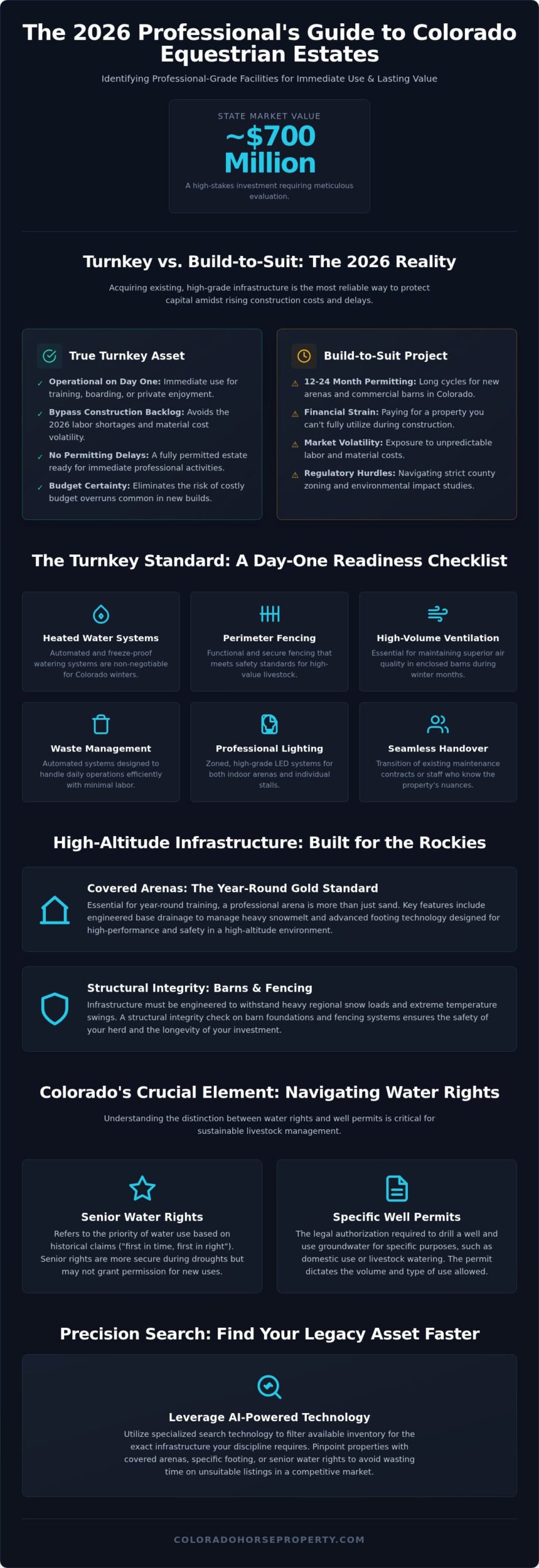
With the total market value of equestrian estates in the state reaching nearly $700 million, securing a turnkey equestrian facility for sale Colorado requires more than just a passion for the lifestyle. It’s a high-stakes investment where the difference between a dream property and a financial burden often lies in the infrastructure you can’t see. You’ve likely spent years dreaming of a legacy estate where you can unload the horses and start riding immediately. However, the fear of hidden repair costs or discovering your water rights aren’t as senior as promised can stall even the most seasoned buyer.
We understand that you’re looking for a professional-grade facility that functions perfectly from the moment you receive the keys. This 2026 guide provides a roadmap to identifying truly move-in ready properties, navigating Colorado’s complex water well construction rules, and understanding the zoning required for commercial boarding. You’ll learn how to evaluate high-altitude infrastructure and secure an asset that protects both your livestock and your capital. We’ll break down the essential amenities every professional facility needs and how to use specialized technology to filter for the best available inventory in a competitive market.
Key Takeaways
- Define what a true turnkey asset looks like in 2026, ensuring all infrastructure and permits are operational on day one to bypass rising construction costs and delays.
- Evaluate professional-grade amenities, including the necessity of covered arenas and advanced footing technology designed for Colorado’s high-altitude environment.
- Navigate the complexities of Colorado water law by distinguishing between senior rights and the specific well permits required for sustainable livestock management.
- Learn how specialized AI-powered search technology can help you locate a turnkey equestrian facility for sale Colorado that features the exact infrastructure your discipline requires.
- Use our structural integrity checklist to inspect barn foundations and fencing systems for durability against heavy regional snow loads and weather patterns.
What Defines a Turnkey Equestrian Facility in Colorado?
A turnkey equestrian facility for sale Colorado is more than a residence with acreage; it’s a specialized asset where every component from the irrigation to the arena footing is fully operational. It’s a complete system. Unlike a “horse-friendly” property that might require years of renovations, a turnkey estate allows for immediate use. This is particularly vital if you are researching what is a stud farm needs to operate, as breeding and training schedules don’t wait for construction crews.
In 2026, the demand for these move-in ready assets has surged because building from scratch in the Rockies has become increasingly complex. Between labor shortages and the volatility of material costs, buyers find that acquiring existing, high-grade infrastructure is the most reliable way to protect their capital. A professional facility offers immediate training capability for athletes and instant cash flow potential for those looking to offer boarding or professional services.
To see what a high-end operational estate looks like in practice, watch this helpful video:
The Operational Standard: Day One Readiness
True readiness means you don’t spend your first week fixing broken fence lines or thawing frozen pipes. A professional turnkey property features automated, heated watering systems and functional perimeter fencing that meets safety standards for high-value livestock. Mechanical systems must meet 2026 standards, including:
- High-volume ventilation: Essential for air quality in enclosed barns during Colorado winters.
- Automated waste management: Systems designed to handle daily operations with minimal labor.
- Zoned lighting: Professional-grade LED systems for both indoor arenas and individual stalls.
Often, the most valuable part of a sale is the transition of existing maintenance contracts or staff. These individuals already understand the nuances of the land, the specific irrigation cycles, and the mechanical quirks of the barn, ensuring a seamless handover.
The Premium of Turnkey vs. Build-to-Suit
Choosing a build-to-suit project in Colorado often involves a 12 to 24 month permitting cycle for new indoor arenas or commercial-scale barns. During this time, you’re paying for a property you can’t fully utilize while navigating strict county zoning and environmental impact studies. A turnkey facility eliminates this waiting period and the risk of budget overruns. A turnkey equestrian facility is a fully permitted, operationally complete estate that allows for the immediate commencement of professional equine activities without additional capital improvements or legal delays. By securing a turnkey equestrian facility for sale Colorado, you bypass the 2026 construction backlog and step directly into a legacy asset.
Professional Infrastructure: Barns, Arenas, and Footing Requirements
High-altitude environments demand infrastructure that resists extreme temperature swings. A turnkey equestrian facility for sale Colorado must provide shelter from both the intense summer sun and the sub-zero winter winds. It isn’t just about aesthetics; it’s about structural resilience and the safety of your herd. Soundness starts at the ground.
The Modern Riding Arena: More Than Just Sand
Covered arenas are the gold standard for year-round training in the Rockies. When evaluating a property, inspect the base drainage systems designed to manage Front Range snowmelt. Proper sub-layers prevent the footing from shifting or becoming waterlogged during the spring thaw. Without these engineered foundations, an arena becomes unusable for months at a time.
Footing technology has evolved significantly. The selection of arena footing material now favors high-performance synthetic surfaces. These dust-free blends are preferred in 2026 because they retain less heat and require minimal water, which is a major benefit during regional drought cycles. Professional-grade footing is often the highest value-add in a turnkey transaction. It represents a massive upfront capital saving for the buyer and ensures the facility is ready for high-level competition on day one.
Barn Efficiency and Equine Health
Effective barn design prioritizes airflow without sacrificing warmth. Colorado-proof insulation prevents pipes from freezing, while ridge vents ensure ammonia doesn’t build up in the rafters. Every professional facility should feature 12×12 stalls with heavy-duty rubber matting to reduce joint fatigue. Fire suppression systems are no longer a luxury in rural Colorado; they’re a necessity for insurance and equine safety.
Storage logistics are equally vital. High-altitude winters require massive forage reserves. A turnkey facility includes hay storage capable of housing a full season’s supply, protecting you from seasonal price volatility and ensuring access when roads are impassable. Modern facilities also integrate technology like remote monitoring and automated feeder compatibility. This infrastructure supports a professional workflow and reduces daily labor requirements. If you want to see how these technical specs impact property value, explore our detailed horse property listings to compare current market offerings.
- Integrated Wash Racks: Must include hot water systems and non-slip drainage.
- Climate-Controlled Tack Rooms: Essential for preserving expensive leather and medical supplies.
- LED Lighting: Zoned systems for arenas and stalls to reduce operational costs.
The Colorado Essentials: Water Rights and Land Management
Colorado operates under the Prior Appropriation Doctrine; essentially, “first in time, first in right.” When you evaluate a turnkey equestrian facility for sale Colorado, the priority date of its water rights is just as critical as the square footage of the barn. Senior water rights mean that during a drought, your access to water is protected before those with junior rights. In basins like the South Platte or Arkansas River, these senior decrees are what keep pastures viable when others go dry. Without these protections, a lush summer pasture can become a dust bowl in a single season.
Well permits add another layer of complexity. A standard residential well permit often restricts water use to inside the home. For an operational estate, you must verify the permit allows for livestock watering and irrigation. As of January 1, 2026, amended rules for water well construction and pump installation (2 CCR 402-2) are strictly enforced. Ensuring your well is compliant with these updated standards is a non-negotiable step in your due diligence process. It’s the difference between a fully functional facility and one that faces immediate state-mandated restrictions.
Securing Your Water Future
Verifying the validity of water decrees requires specialized expertise. You must confirm that the water has been “put to beneficial use” consistently to avoid the risk of abandonment. Many high-end properties rely on augmentation plans, which are court-approved documents that allow you to pump water by replacing what you consume. This ensures your operations don’t negatively impact senior water holders downstream. For a deeper look at these legal requirements and how they impact your investment, see our guide on equestrian real estate Colorado.
Zoning for Commercial vs. Private Use
A property isn’t truly turnkey if you can’t legally run your business. Many counties have strict limits on the number of horses allowed per acre, often based on soil health and carrying capacity. If you plan to offer boarding, lessons, or clinics, you may need a Conditional Use Permit (CUP). A professional facility should already have these permits in place or provide a clear, documented path to commercial compliance. Navigating these zoning restrictions is essential for anyone looking to scale their equine operations.
Land management also impacts your bottom line through agricultural tax assessments. For the 2026 tax year, agricultural property in Colorado is assessed at 25% of its actual value. This is significantly different from the residential assessment rate, which sits at 7.05% for schools. To maintain this status, the land must have been classified as agricultural for the ten years prior to the assessment and used for production for at least two years. Securing a turnkey equestrian facility for sale Colorado with an established agricultural history can save you thousands in annual holding costs while protecting the long-term health of your pastures.
Evaluating a Turnkey Horse Property: A Professional Checklist
Evaluating a turnkey equestrian facility for sale Colorado requires a systematic approach to physical assets. While previous sections focused on legalities and specialized footing, this phase centers on structural resilience. In the Front Range, barn foundations and arena trusses must handle significant snow loads. A roof designed for lower elevations can become a liability during a heavy winter storm. Inspecting these trusses for signs of stress or improper bracing is a critical safety step you shouldn’t skip. To understand the level of detail a professional assessment should entail, A Premier Home Inspection provides a benchmark for thoroughness in property evaluations.
Fencing systems represent a massive ongoing maintenance cost. You should evaluate existing perimeters for both safety and durability. Whether the property uses high-tensile wire, vinyl, or traditional wood, check the post depth and tension. A truly turnkey facility won’t require immediate fence replacement. Logistics also dictate the daily efficiency of a ranch. Ensure the property has adequate turn-around space for 40-foot trailers and large hay delivery trucks. If a driver can’t easily navigate the driveway, your operational costs will rise. Additionally, verify the manure management system. Compliant waste storage and removal systems are necessary to avoid environmental fines and maintain pasture health.
The “Hidden” Infrastructure Check
Winter performance is the true test of a Colorado facility. You must test automated waterer heaters before the first freeze. Reliable heaters prevent ice buildup and ensure your horses stay hydrated in sub-zero temperatures. Similarly, inspect the septic system. A residential septic tank might not be rated for the high-occupancy demands of a boarding facility with multiple staff members and clients. Evaluate the condition of utility lines running to outbuildings. Buried lines should be deep enough to avoid frost heave, and electrical panels must have the capacity for arena lighting and barn heaters.
The Lifestyle and Residential Component
When selling or upgrading a professional-grade estate, the interior presentation of the main house is just as vital as the arena footing. You can explore Project-based home staging and styling fees to see how professional designers create the cohesive, high-end look that defines a move-in ready property.
A turnkey estate should offer a balance between professional utility and residential comfort. Evaluate the main residence to ensure its quality matches the equestrian infrastructure. If the barn is world-class but the home requires a total renovation, the property isn’t truly turnkey. On-site staff housing is another vital asset. Having a manager’s apartment or a separate cottage allows for 24/7 care, which is essential for high-value athletes. For more property search tips, review our guide on horse property for sale in colorado. To ensure your investment meets these high standards, connect with our buyer representation team for a technical site evaluation.
Finding Your Legacy: Why Colorado Horse Property is Your Turnkey Specialist
Finding a turnkey equestrian facility for sale Colorado requires a level of technical scrutiny that generic real estate platforms simply can’t provide. While standard sites might list acreage or stalls, they often fail to account for the specific infrastructure requirements we’ve discussed, such as senior water rights or arena footing depth. This is where specialized expertise becomes your greatest asset. We focus exclusively on the intersection of agricultural utility and high-end residential living, ensuring you don’t waste time on properties that don’t meet professional standards.
Leveraging AI for Niche Property Search
Our proprietary AI-Powered Horse Property Search technology changes how you interact with the market. Instead of sifting through hundreds of irrelevant listings, our tool identifies specific features like 12×12 stalls, heated wash racks, and professional drainage systems. We filter for specific arena sizes and water right types, ensuring the data you see matches your operational needs. Our AI-driven search solves the “needle in a haystack” problem by analyzing technical metadata to identify properties with move-in ready infrastructure that standard filters overlook. This technology saves you months of physical site visits by identifying true turnkey assets online before you ever leave your current home.
Expert Guidance Through Closing
Success in this niche market depends on more than just a search tool. It requires the seasoned perspective of experts who have navigated the Front Range for four decades. Mark and Alison Eibner bring 40 years of experience to every transaction, offering an authoritative understanding of Colorado land laws and equestrian requirements. We don’t just find a property; we provide full-cycle support through our specialized Buyer Representation and Transaction Management services. This includes coordinating with Title and Escrow Services to ensure your investment is legally protected and your water decrees are verified.
Whether you’re looking for a private estate or a professional boarding center, your facility must fit your specific discipline. We analyze every listing through the lens of horse health and operational efficiency. By partnering with a team that understands the nuances of rural zoning and high-altitude land management, you secure a legacy asset that functions on day one. Search our exclusive turnkey equestrian listings today to find a property that meets your standards for excellence.
Securing Your Future in the Colorado Front Range
Securing a legacy asset requires a balance between professional-grade infrastructure and rigorous legal compliance. By prioritizing senior water rights and climate-proof barn designs, you protect your investment from the unique challenges of the Rocky Mountain region. A true turnkey equestrian facility for sale Colorado allows you to bypass the 2026 construction backlog and start training or boarding on day one. We ensure every technical detail, from soil carrying capacity to well permit compliance, aligns with your operational goals.
Our Specialized Equestrian & Ranch Division provides the technical oversight needed to navigate these complex land transactions. With 40 years of Front Range expertise and our proprietary AI-Powered Property Search, we identify the specific features that generic listings miss. We manage the transition from search to closing so you can focus on the health and performance of your horses. Browse Turnkey Equestrian Facilities for Sale in Colorado and find the estate that fits your discipline today. Your move-in ready ranch is within reach, and we’re here to help you secure it.
Frequently Asked Questions
Is it better to buy land or a turnkey equestrian facility in Colorado?
Buying a turnkey equestrian facility for sale Colorado is generally more advantageous in 2026 due to the 12 to 24 month permitting cycles for new arenas. Building from scratch exposes you to the volatility of material costs in the Rockies and labor shortages. A turnkey property provides immediate operational capability, allowing you to begin training or boarding on day one. While raw land offers a blank canvas, the time-cost of construction often outweighs the customization benefits for professional riders.
What are the most important water rights for a horse property?
Senior water rights are the most critical asset because they establish your priority during drought conditions. In Colorado, you must distinguish between a household-use-only well permit and one that specifically allows for livestock watering. Since amended rules for water well construction became effective on January 1, 2026, verifying your priority date and decree validity is essential. You need to ensure your augmentation plan is robust enough to support your specific herd size year-round.
How much acreage is required for a turnkey facility in Colorado?
The required acreage depends heavily on the soil’s carrying capacity and local county zoning laws. While the average land listing in the state is approximately 235 acres, many professional turnkey facilities operate efficiently on 10 to 40 acres. You must verify that the parcel size complies with the number of horses you intend to keep. Some counties use strict animal-unit-per-acre ratios to prevent overgrazing and maintain agricultural tax status in semi-arid environments.
Can I run a commercial boarding stable on any agricultural land in CO?
No, agricultural zoning does not automatically grant you the right to operate a commercial boarding business. Most Colorado counties require a Conditional Use Permit (CUP) for activities like boarding, lessons, or hosting public events. You should verify that the property already possesses these permits or has a documented path to compliance. Running a commercial operation without the proper legal framework can lead to significant fines and state-mandated shutdowns of your facility.
What should I look for in a professional riding arena footing?
Look for high-performance synthetic surfaces that are specifically blended to be dust-free and water-conserving. In 2026, top-tier facilities prioritize footing that retains less heat and provides superior joint support for high-level athletes. You should also inspect the base drainage system to ensure it can handle heavy snowmelt without shifting. Proper footing material is a major value-add that prevents the massive capital expense of a total arena renovation after your purchase.
How do Colorado winters affect equestrian facility maintenance?
Colorado winters demand structural resilience against heavy snow loads on barn roofs and arena trusses. You must maintain automated waterer heaters to ensure your livestock has access to liquid water during sub-zero temperatures. Proper insulation and ridge ventilation are necessary to prevent pipe bursts and ammonia buildup in enclosed spaces. A professional maintenance schedule includes checking the integrity of fence lines after frost heaves and ensuring your hay storage is sufficient for the entire season.
What is the average price for a turnkey horse property in the Front Range?
The average price for an equestrian property in Colorado is approximately $2.25 million, though costs vary by region. In areas like Greeley, you might find homes with acreage ranging from the mid-$700,000s to $1.2 million. Competitive communities like Flying Horse Ranch in Colorado Springs saw average prices around $799,000 in 2026. Finding a turnkey equestrian facility for sale Colorado at these price points requires specialized search tools to identify move-in ready infrastructure versus simple residential acreage.
Why do I need a specialized equestrian real estate agent?
A specialized agent understands the technical requirements of animal husbandry and land management that a generalist might miss. We use proprietary AI-powered search technology to identify specific features like arena drainage systems and water decree priority dates. Our team at Colorado Horse Property brings 40 years of Front Range experience to help you navigate complex transaction management and title services. This expertise ensures you acquire a legacy asset that is legally compliant and operationally sound from day one.