
What if the key liability question isn’t simply whether you own the horse, but what happened, where it happened, and what you knew beforehand? The legal liability of owning horses in Colorado can arise when a horse injures a rider or visitor, damages property after escaping, or someone is hurt on your land. Colorado’s equine-liability protections may be relevant, but they are not a blanket shield.
Colorado’s Equine Activity Liability Act may limit certain claims involving inherent risks of equine activities. Exceptions and premises-liability rules may also matter, depending on the circumstances. A waiver or insurance policy may not address every situation, so review the wording and facts closely.
This article outlines legal frameworks that may affect horse-related incidents and explains when to consult a Colorado attorney or licensed insurance professional. It also offers practical ways to manage risk, from checking fences and visitor access to confirming a property’s intended horse use and land-use restrictions before keeping horses there.
Key Takeaways
- The legal liability of owning horses in Colorado depends on the incident, setting, applicable law, and owner’s conduct, not ownership alone.
- Colorado’s equine-liability law may offer protection for inherent risks, but exceptions and statutory definitions can affect whether it applies.
- Compare an injury during a lesson or event with an incident involving a private visitor or neighbor. Seek professional review when the facts are unclear.
- Manage risk with consistent safety procedures and records of property maintenance, visitor information, and incident response.
- Before keeping horses on a property, check zoning, covenants, access, fencing, water arrangements, and intended activities with the appropriate professionals.
Legal Liability of Owning Horses in Colorado: What Can Make an Owner Responsible?
Liability depends on the facts, the law that applies, and the owner’s conduct. Owning a horse doesn’t automatically make someone responsible for every injury or loss involving the animal. A claim may turn on a particular event, a property condition, or how the owner managed the horse around other people.
Colorado has state laws addressing horse-related injury claims, as noted in this overview of U.S. state laws on horse liability. Statutory protections have limits, and the details matter. This section provides general education, not legal advice. For a specific incident, consult a Colorado attorney.
For a general introduction to equine liability and contracts, watch this video:
Which Colorado laws may apply to horse-related injuries?
The Colorado Equine Activity Liability Act, C.R.S. § 13-21-119, is a key framework for claims involving equine activities and their inherent risks. Whether it applies can depend on statutory definitions, the activity, and the people involved. It does not provide blanket immunity from a claim.
A premises-related claim may also raise questions under Colorado’s landowner-liability statute, C.R.S. § 13-21-115. For instance, an injury might involve both a horse-related activity and a condition on the property. How that statute applies depends on the circumstances. Before relying on a particular interpretation, ask a Colorado attorney to check the current statutory text, terminology, and scope of both laws.
Why the setting and owner’s role matter
Keeping horses for private recreation differs from operating lessons, boarding, or events. The setting and the owner’s role affect which legal questions may need review. Someone may be involved as a landowner, equine professional, event sponsor, or participant, and each role can bring different facts into focus.
Compare a visitor injured near a pasture with a participant hurt during a lesson. The horse, location, activity, property conditions, and each person’s role may all matter. No single detail guarantees an outcome. If someone is injured or a claim is threatened, preserve relevant information and speak with a Colorado attorney who can assess the specific facts.
Colorado’s Equine Liability Law: Protections, Exceptions, and Limits
Colorado’s Equine Activity Liability Act, C.R.S. § 13-21-119, addresses claims connected to the inherent risks of equine activities. It may limit liability in qualifying situations, but it does not automatically protect every horse owner, property holder, or business. The statute’s definitions and the injured person’s role matter. A horse’s presence alone does not establish that the law applies.
For the statutory text, review Colorado Revised Statute § 13-21-119. Ask a Colorado attorney to check the current wording, definitions, and application before relying on the law or publishing legal guidance.
Inherent risks are different from other claims
An inherent risk is a danger associated with equine activities, such as a horse behaving unpredictably. A claim may raise different questions if it concerns the owner’s conduct, faulty equipment, or a dangerous property condition. An injury during a horse activity might also raise premises-liability issues under a separate law, depending on the facts. These frameworks can overlap, so one should not be treated as a substitute for the other.
Colorado’s equine protections address certain inherent risks, not every injury or claim involving a horse.
Exceptions, warnings, and waivers
Colorado’s statute includes exceptions to its general protection. Examples identified in the law include knowingly providing faulty tack or equipment, failing to make reasonable efforts to assess a participant’s ability to manage the horse safely, and certain known dangerous conditions. Conduct involving willful or wanton disregard for safety or intentional injury may also fall outside the protection. Ask a Colorado attorney to confirm the current statutory language and how an exception may apply.
Warning-sign and written-warning provisions may also matter in some circumstances. Requirements depend on the statutory context, including the activity and the parties involved. Don’t assume a sign resolves every issue or that a participant’s waiver eliminates all duties or claims. Have counsel review the actual warning or waiver alongside the circumstances of the activity.
When assessing the legal liability of owning horses in Colorado, distinguish an inherent equine risk from a possible claim about conduct, equipment, or property conditions. If you’re evaluating a parcel for horse use, a Colorado horse property search can help identify features to investigate. Confirm land-use questions with the appropriate local authorities and legal professionals.
When Can a Colorado Horse Owner Face a Claim? Common Scenarios Compared
A horse-related claim can involve more than the animal’s behavior. The activity, property conditions, people involved, and sequence of events may all shape the legal analysis. This table highlights issues to discuss with a Colorado attorney. It does not determine who would be liable.
| Scenario | Potentially relevant issue | Facts for professional review |
|---|---|---|
| A rider is injured during a lesson or organized event | The Equine Activity Liability Act may be relevant, alongside questions about conduct or property conditions. | Was the activity covered by the statute? What warnings, supervision, equipment, and known hazards were involved? What was the participant’s experience and role? |
| A recreational guest or neighbor is injured on private property | The activity and premises-liability frameworks may need separate review. A visitor’s status and the condition involved can matter. | Why was the person on the property? Where did the injury occur? Was a hazard known, and what steps were taken around it? |
| A horse gets loose and causes an off-site injury or property damage | Possible responsibility depends on the circumstances. An escape does not, by itself, establish automatic liability. | How did the horse get out? What was known about the fencing or gate? Where and how did the damage occur, and what caused it? |
Lessons and events are not all the same
A paid lesson, an organized event, and an informal recreational ride may raise different questions. Payment or organization alone does not settle whether statutory protections apply. An attorney may need to assess the activity’s legal classification, each person’s role, and details such as warnings, supervision, tack or other equipment, hazards, and the participant’s circumstances. Don’t assume the legal outcome of one scenario determines another.
Property incidents, escaped horses, and insurance
For an injury on the land, C.R.S. § 13-21-115 may be relevant, but its application depends on the circumstances. If a horse escapes, document the condition of gates or fencing, the timeline, and any resulting damage. Those details may help professionals evaluate causation, notice, and conduct, but they do not establish a fixed rule that the owner is always responsible.
Potential legal responsibility and insurance coverage are separate questions. Coverage depends on the policy wording, exclusions, and incident facts. Ask a licensed insurance professional to review the actual policy rather than relying on a general description. For Colorado equine industry information and resources, consult the Colorado Horse Council. The legal liability of owning horses in Colorado cannot be determined from a scenario label alone. Have a Colorado attorney review the specific facts.
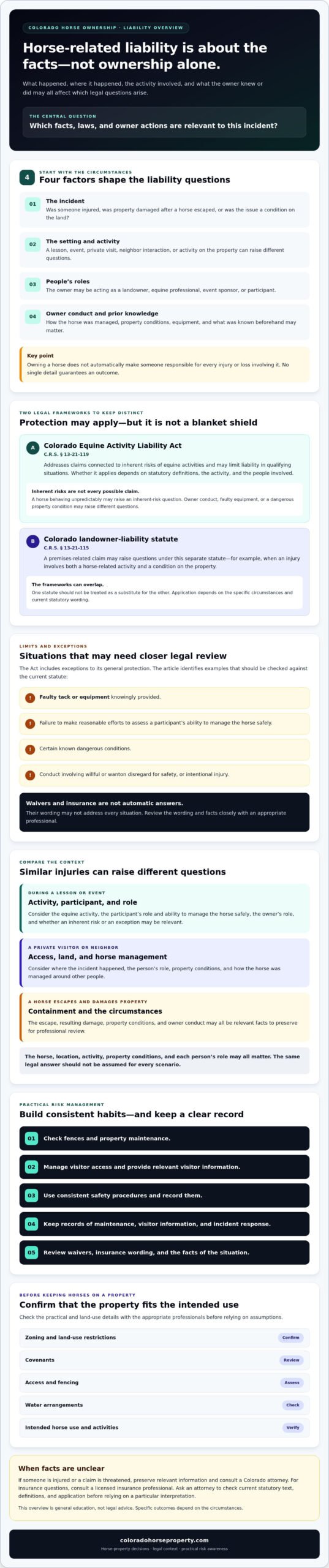
Practical Steps to Reduce Horse-Related Liability Risk in Colorado
Good risk management starts with consistent routines and clear records. These steps can help you spot issues and communicate expectations, but they cannot guarantee safety or prevent a claim. The legal liability of owning horses in Colorado depends on the facts and applicable law. Use this checklist as a practical starting point, not legal advice.
- Inspect fences, gates, and equipment. Set a regular schedule to check fencing, latches, tack, and other equipment. Record inspection dates, maintenance, and repairs, and note hazards that need follow-up.
- Set expectations for visitors and activities. Explain where guests may go, how to approach or handle horses, and what supervision is required. Tailor instructions to the activity and the people involved instead of relying on assumptions.
- Plan for emergencies. Establish a process for getting help, sharing relevant information, and responding to an injury or escaped horse. Make sure everyone involved in an activity understands their role.
- Keep useful records. Maintain written safety procedures, maintenance notes, visitor or participant information where appropriate, and incident reports. After a serious injury or claim, preserve relevant records and consult a Colorado attorney promptly.
- Review insurance with a licensed professional. Ask whether your policy addresses horse-related incidents, the activities on the property, and any business use. Discuss exclusions, coverage limits, and situations that may require different coverage. Check the answers against the policy wording.
- Have legal documents reviewed. Ask a Colorado attorney to draft or review waivers and activity agreements for their intended use. A form prepared for a different operation may not fit your circumstances.
Waivers and insurance policies need individual review. Neither should be assumed to cover every incident or remove every legal responsibility. If horse use involves water access or irrigation, verify the property’s water arrangements and rights with the appropriate professionals as part of your broader due diligence.
Considering a property for horse use? Explore Colorado horse property options, then verify intended use, land restrictions, access, and water details for the specific parcel with qualified local and legal professionals.
Buying or Owning Horse Property in Colorado: Check Use, Risk, and Next Steps
A barn, pasture, or arena may make a property look ready for horses, but visible features do not confirm that your intended use is permitted or that every risk has been addressed. Verify land-use permission separately from liability protection. A property may allow some horsekeeping activities while restrictions, site conditions, or your plans raise other questions.
What to verify before keeping horses on a Colorado property
Before you buy or bring horses onto a parcel, use this checklist to identify what needs property-specific review:
- Land-use rules: Ask the relevant county or municipality about zoning and permitted animal uses. Review recorded covenants and other restrictions for limits on livestock, structures, or activities such as lessons or events.
- Access: Check how horses, visitors, and emergency responders would reach the property and relevant facilities. Confirm access arrangements with the appropriate professionals.
- Fencing and facilities: Have fencing, gates, barns, and other structures inspected by qualified professionals. Note repairs or conditions that could affect your planned use.
- Water arrangements: Verify the source, availability, and legal arrangements for water with appropriate professionals. Don’t assume a well, ditch, or existing irrigation setup can be used as intended.
- Planned activities: Describe your actual plans, including private horsekeeping, visitors, riding, or commercial activity, when asking officials and advisers about applicable requirements.
For broader purchase due diligence, see Buying Horse Property in Colorado: The Ultimate Guide. A real estate professional can help investigate property features and transaction questions, but legal permission and statutory protections require separate review. A listing description or existing horse facilities do not establish that a parcel is legally suitable for your plans.
Who to consult and how to move forward
Direct questions about legal interpretation, land-use restrictions, or the legal liability of owning horses in Colorado to a Colorado attorney. Ask a licensed insurance professional to review policy language for your intended use. For physical conditions, consult qualified inspectors or other relevant professionals.
Colorado Horse Property provides specialized horse-property search and buyer representation, not legal advice. If you’re comparing parcels, you can explore Colorado horse-property search options and assess features such as barns, arenas, water rights, and pasture. Confirm each property’s intended use and restrictions before making decisions.
Make Your Next Horse-Property Decision with Confidence
The legal liability of owning horses in Colorado depends on the activity, the property, and the people involved. Equine-liability protections have limits, and a claim may also involve premises conditions or an escaped horse. Good records, clear safety practices, and careful review of insurance and waivers can help manage risk, but they are not guarantees.
Before keeping horses on a property, verify zoning, covenants, access, fencing, water arrangements, and intended use with the right professionals. Ask a Colorado attorney about legal questions and a licensed insurance professional about coverage. Property suitability also requires parcel-specific due diligence.
For your property search, Colorado Horse Property offers specialized search for Colorado equestrian and agricultural real estate, with AI-powered filters for features such as barns, arenas, water rights, and pasture. Buyer and seller representation is also available through its specialized brokerage. Explore Colorado horse-property search options as you plan your next steps.
With careful checks and professional guidance, you can move toward horse ownership with a clearer understanding of the property and its responsibilities.
Frequently Asked Questions
Am I automatically liable if my horse injures someone in Colorado?
No. Owning a horse alone doesn’t automatically make you liable for an injury. The analysis may depend on what happened, the activity, your conduct, the injured person’s role, and whether a property condition contributed. Colorado’s Equine Activity Liability Act may apply to qualifying claims involving inherent equine risks, but it has limits. A Colorado attorney can assess the facts of a specific incident.
Does Colorado’s Equine Activity Liability Act protect every horse owner?
No. C.R.S. § 13-21-119 addresses liability connected to inherent risks of equine activities, but coverage depends on the statute’s definitions and the circumstances. Exceptions may apply, including issues involving faulty equipment, participant capacity, known dangerous conditions, or certain conduct. The legal liability of owning horses in Colorado may also involve premises-liability questions. Ask a Colorado attorney to review the current law and your situation.
Can I be liable if my horse escapes and damages property?
Possibly, but an escaped horse does not automatically establish owner liability. Relevant facts may include how the horse got out, the condition of fencing or gates, what the owner knew, and how the escape caused the injury or damage. The location and circumstances also matter. Preserve relevant records and consult a Colorado attorney about legal responsibility. Separately, ask a licensed insurance professional whether your policy may cover the loss.
Does a liability waiver prevent someone from suing after a horse-related injury?
Don’t assume a waiver prevents every lawsuit or excuses every act or legal duty. Its effect may depend on the wording, circumstances, parties, and applicable law. A waiver also does not establish that statutory requirements have been met. Have a Colorado attorney draft or review waivers and activity agreements for their intended use. Keep signed documents with relevant activity records, but don’t treat them as a substitute for safety practices.
Will my homeowners insurance cover horse-related injuries in Colorado?
It depends on the policy and the circumstances. Coverage may be affected by policy wording, exclusions, limits, and whether the horse-related activity is private or connected to business use. Don’t assume a standard homeowners policy covers a visitor’s injury, an escaped horse, or a lesson or event. Ask a licensed insurance professional to review your actual policy and explain what coverage applies to your property and activities.
What happens if a visitor is injured while on my horse property?
A visitor’s injury may raise questions under Colorado premises-liability law, including C.R.S. § 13-21-115. The Equine Activity Liability Act may also be relevant, depending on the activity. The visitor’s reason for being there, the injury location, property conditions, warnings, and each person’s role can affect the analysis. Document what happened and preserve relevant information. For an incident-specific assessment, contact a Colorado attorney.
Do Colorado horse-property zoning rules protect owners from liability?
No. Zoning and land-use approval address whether certain uses may be permitted. They do not determine whether an owner is protected from an injury claim. Check applicable county or municipal rules, recorded covenants, and restrictions for your intended horse use. Assess property conditions and liability questions separately with qualified professionals. A real estate listing or existing barn does not confirm that a parcel is legally suitable for your plans.