
The biggest ranch on your shortlist may be the weakest investment. When you’re buying a ranch as a real estate investment, acreage alone won’t show whether the property can support income, retain long-term value, or fit the way you plan to own and manage land.
It’s reasonable to look for a property that combines financial potential with the appeal of Colorado’s open spaces. But a ranch’s investment case depends on usable resources and operating fit, not just size. Water documentation, legal access, land use, infrastructure, and the work required to manage the property can all affect its value and potential uses.
This 2026 buyer’s guide offers a practical framework for weighing income potential against lifestyle or legacy value, assessing property-specific risks, and comparing a working ranch with other real estate investments. You’ll learn how to match Colorado ranch opportunities to your goals and management capacity, so you can focus on properties whose resources and demands fit your plan.
Key Takeaways
- Set clear financial, operational, and personal-use goals before buying a ranch as a real estate investment; these outcomes are not interchangeable.
- Look beyond deeded acreage by assessing water documentation, legal access, usable land, improvements, and property condition.
- Compare working, leased-use, and land-hold scenarios only when the ranch’s verified features support them, including their obligations and possible exit considerations.
- Use a step-by-step due diligence process to examine records, resources, land-use constraints, conservation encumbrances, and your financial assumptions.
- Turn your investment criteria into focused search filters for location, acreage, water, access, and infrastructure to identify properties that fit your plans.
Buying a Ranch as a Real Estate Investment: Define the Return You Expect
Buying a ranch as a real estate investment means evaluating ownership against your financial goals, operating capacity, and the property’s role in your longer-term plans. A ranch may support livestock or other uses, serve as a personal retreat, or be held for its land and future possibilities. The term covers varied properties and uses. For background on what is a ranch, consider how a traditional working operation differs from a lifestyle or land-hold purchase.
Investment value depends on what the land can support and how well it fits your plan, not on acreage or listing price alone. Results depend on the property’s condition, management, market timing, and intended use. Separate potential financial return from personal benefits that may not produce income.
Income, appreciation, and owner-use goals are different investment cases
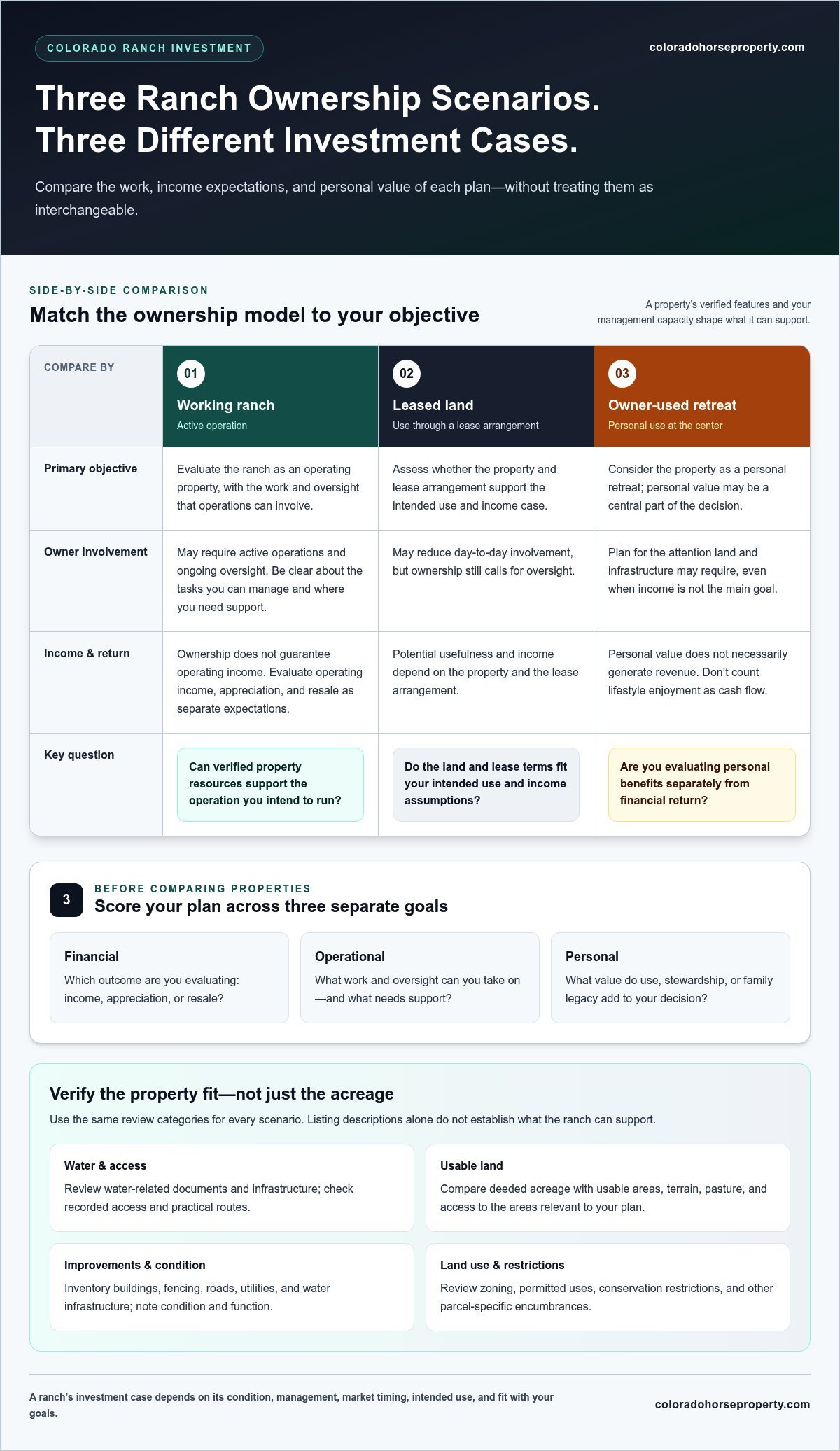
A working ranch may involve active operations and ongoing oversight, but ownership does not guarantee operating income. Leased land may reduce the owner’s day-to-day involvement, but its potential usefulness and income depend on the property and lease arrangement. An owner-used retreat may provide personal value without generating revenue. In each scenario, the use can affect expenses, management time, and the return you expect.
Before comparing properties, write down your primary objective and intended holding period. Are you prioritizing operating income, potential land appreciation, personal use, or a family legacy? Evaluate each separately, and don’t count lifestyle enjoyment as cash flow.
How to decide whether ranch ownership fits your investment approach
Then distinguish measurable financial return from conservation, lifestyle, or family-legacy value. Those goals can be meaningful, but they aren’t interchangeable with income or resale proceeds. Colorado ranch ownership is a property-specific decision, not a guaranteed investment outcome.
Use a simple scorecard before you shortlist properties:
- Financial: What income, appreciation, or resale outcome are you evaluating?
- Operational: What work and oversight can you take on?
- Personal: What value do use, stewardship, or legacy add to your decision?
Once these priorities are clear, compare ranches against the same objectives instead of letting acreage or an appealing setting define the investment case.
How Colorado Ranch Features Shape Investment Potential
A ranch’s acreage is only one part of its investment picture. Water documentation, legal access, usable ground, improvements, and land condition each affect what you can do with the property and what it may require from you. Assess these categories separately, then compare your findings with your intended use. A large parcel may include steep, rocky, wooded, or otherwise limited areas, so deeded acreage alone doesn’t establish pasture capacity or operating potential.
This distinction matters when buying a ranch as a real estate investment. A listing may describe water, barns, fencing, or pasture, but those features need to be assessed against property records, their condition, and your plan. Use the Colorado ranch land buyer checklist as a companion resource while organizing your review.
Water rights, access, and usable acreage in Colorado
Start with the property’s water-related documents and infrastructure. Distinguish documented rights or permits from physical features such as wells, ditches, and ponds. A well or other water source does not, by itself, establish a particular legal right or level of use. Review available records and property documents. Colorado water-rights questions require current authoritative information and qualified review.
Map usable ground against the stated acreage. Note pasture, slopes, terrain barriers, and access routes, including whether roads provide practical access to areas relevant to your intended use. Review recorded access documents and parcel records rather than relying only on a listing description or a visible track across the land.
Improvements, land use, and resource condition
Inventory the improvements that matter to your plan: buildings, barns, fencing, roads, utilities, and water infrastructure. Note their apparent condition and function. A structure or fence may not meet your operating needs, while deferred maintenance or limited utilities could change your assumptions about time, work, and future investment.
Review applicable zoning and permitted uses, along with conservation restrictions and other parcel-specific encumbrances. Land-use rules and water documentation can be complex and vary by property, so verify details through current records and qualified review. Specialized buyer representation can help organize property features against your stated criteria. Explore Colorado ranch property search to narrow options by relevant attributes.
- Water: Identify available records, infrastructure, and questions requiring further review.
- Land and access: Compare deeded acreage with usable areas and documented routes.
- Improvements and use: Match condition, restrictions, and permitted activities to your operating plan.
Compare Ranch Investment Scenarios Before You Make an Offer
A ranch can support different ownership strategies, but only if its documented features and permitted uses fit the plan. Compare a working operation, a leased-use arrangement, and a land-hold strategy using the same categories. Don’t assign income to a scenario unless the property’s characteristics, records, and applicable requirements support it.
Gross revenue is not the same as net operating income or investment return. Revenue is only one part of the picture. Build estimates using verified, property-specific figures for management, maintenance, insurance, taxes, and capital needs. Label estimates clearly and keep assumptions separate from known costs.
Model income and ownership obligations without assuming guaranteed returns
Use the table as a comparison framework, not a forecast. Fill it with buyer-supplied or verified property information. If an assumption changes, such as the amount of land available for an intended use, update the scenario rather than treating the original estimate as certain.
| Scenario | Acquisition assumptions | Potential income | Ongoing obligations | Exit considerations |
|---|---|---|---|---|
| Working operation | Land, water documentation, infrastructure, and permitted uses support the planned operation. | Include only income sources supported by the property and applicable requirements. | Account for hands-on management, maintenance, insurance, taxes, and capital needs using verified figures. | Consider which buyers may value the operating features and documented resources. |
| Leased use | Property features and applicable requirements support the proposed use and lease arrangement. | Model only income supported by a specific, verified lease assumption. | Include oversight, upkeep, insurance, taxes, and any owner responsibilities in the proposed arrangement. | Assess how the lease and property features may affect a future buyer’s options. |
| Land hold | The land fits a long-term ownership plan without relying on operating income. | Do not assume income unless a supported use is part of the plan. | Include property-specific carrying, maintenance, insurance, tax, and capital assumptions. | Evaluate future marketability without assuming appreciation or a sale date. |
Compare liquidity, holding period, and resale considerations
A shorter holding horizon calls for a clear exit plan and careful assumptions about resale value and transaction timing. A long-term plan may allow more flexibility, but still requires a realistic view of ongoing obligations and future buyer demand. Water documentation, access, usable acreage, and improvements may matter to particular buyers, but they don’t guarantee liquidity or a specific resale outcome.
As you compare options for buying a ranch as a real estate investment, test how your conclusion changes if income is lower, expenses are higher, or resale takes longer than assumed. For related context on Colorado ranch markets and valuation, see the Colorado ranch market and valuation guide.
Colorado Ranch Investment Due Diligence: Test the Risks Before Closing
Use a documented review sequence before relying on a ranch’s projected income, operating capacity, or resale potential. This helps expose gaps between listing claims and verified property facts. Specialized legal, tax, land, and financial questions require qualified review; this checklist is a framework for inquiry, not legal or investment advice.
Review records and property constraints before relying on projections
Compare listing representations with title materials, recorded documents, surveys, and available parcel records. Review water documentation, access, land-use information, and conservation encumbrances using current authoritative sources. Colorado water rights and local land-use requirements are property-specific, so don’t infer legal entitlements from a listing description or a visible feature.
Use this Colorado ranch land buyer guide as another practical reference alongside your property-specific review.
Stress-test management needs and Colorado land conditions
Estimate the time, skills, and oversight your intended operation or maintenance plan will require. Consider local climate, drought, wildfire exposure, and infrastructure condition as parcel-specific diligence subjects, not automatic defects. Review available property information and current local sources, and identify what needs further assessment.
Six checks to complete before closing
- Revisit your goals. Confirm the primary use, intended holding period, and outcome you’re evaluating.
- Reconcile records. Compare listing details with title materials, recorded documents, surveys, and parcel information. Note discrepancies.
- Verify resources. Review water documentation, legal access, usable areas, and relevant land-use constraints. Reserve specialized determinations for qualified review.
- Inspect improvements. Assess buildings, fencing, roads, utilities, and other infrastructure against your intended use and maintenance capacity.
- Build an operating plan. Identify the work, skills, oversight, and support the property may require, then test whether that plan is practical for you.
- Stress-test the numbers. Base financial assumptions on verified property-specific information. Mark unresolved facts as assumptions, and test how your analysis changes if they prove inaccurate.
Buying a ranch as a real estate investment calls for more than confirming acreage. Treat unresolved details as open questions, not established facts, and avoid building projections on assumptions you haven’t tested. To focus your search on ranch features that match your investment criteria, explore Colorado ranch properties.
Find a Colorado Ranch That Fits Your Investment Plan
Turn your investment thesis into a practical search brief before comparing listings. Define the location and acreage you’re targeting, the features your intended use requires, and the conditions that would rule out a candidate. This keeps a scenic setting or impressive acreage from distracting you from whether the ranch fits your ownership plan.
Convert your investment criteria into a property search
Separate requirements from preferences. For example, water documentation or suitable access may be essential to your intended use, while a particular building or recreational feature may be desirable but flexible. Colorado Horse Property’s AI-powered search can narrow options by relevant attributes, including water rights, barns, arenas, and pasture size. For broader purchase context, read the Colorado ranches buyer’s guide.
- Location: Identify the region and access needs that fit your ownership plan.
- Land: Set acreage and usable-ground priorities, not just a minimum parcel size.
- Resources: Specify the water documentation and access features you want to investigate.
- Improvements: List required buildings, fencing, arenas, utilities, or other infrastructure.
- Use: State whether the property is intended for an operation, leased use, personal use, or a land hold.
Move from shortlist to a well-managed transaction
Once you have a shortlist, buyer representation can help assess how each candidate’s features align with your investment and use criteria. Compare documented property attributes with your priorities, and keep open questions visible throughout the review. This makes the decision process more focused without treating a listing description as a substitute for property-specific diligence.
Transaction management supports the purchase process, while title and escrow coordination help organize those parts of the transaction. These services don’t guarantee a particular outcome or timeline, but they help keep key transaction details organized as you proceed toward closing.
Ready to put your criteria to work? Explore Colorado ranch properties and discuss buyer representation for a search aligned with your investment plan.
Make Your Colorado Ranch Search Investment-Focused
A sound ranch purchase starts with clear expectations. Separate potential operating income from appreciation, personal use, and legacy value, then assess the property’s water documentation, usable acreage, access, improvements, and land-use constraints against your plan. Compare ownership scenarios using verified property details, and treat unresolved facts as assumptions rather than guarantees.
Buying a ranch as a real estate investment is a property-specific decision, shaped by the land’s resources and the time and oversight you can commit. Colorado Horse Property focuses on ranch and equestrian real estate, with AI-powered search that can narrow properties by features such as water rights, barns, arenas, and pasture sizes. Buyer representation and transaction management support your review and purchase process.
Search Colorado ranch properties with criteria that fit your investment plan to take the next step toward finding a property aligned with your goals.
Frequently Asked Questions
Is buying a ranch a good real estate investment?
Buying a ranch can fit an investment plan, but it isn’t automatically a good investment. The case depends on the specific property, its resources and condition, the buyer’s management capacity, and the intended holding period. Assess potential operating income, land appreciation, personal use, and legacy value separately. Then compare property-specific income and ownership assumptions with other real estate options. A ranch may suit a long-term or lifestyle goal even when it doesn’t produce dependable operating income.
Can a ranch generate income as a real estate investment?
Yes, a ranch may generate income if its features and permitted uses support a viable activity or lease arrangement. Possibilities could include an operating ranch or leased land, but neither guarantees revenue. Evaluate the property’s water documentation, usable land, infrastructure, applicable land-use constraints, and management requirements. Estimate income only from verified property facts and supported assumptions, then account for taxes, maintenance, insurance, labor, and capital needs. Gross revenue alone doesn’t show net income or investment return.
What should you evaluate before buying a ranch in Colorado?
Before buying in Colorado, evaluate your investment goals, property records, water documentation, legal access, usable acreage, improvements, land-use constraints, and conservation encumbrances. Compare listing details with available title materials, recorded documents, surveys, and parcel information. Assess buildings, fencing, roads, utilities, and land condition against your intended operation. Also consider location-specific conditions such as drought or wildfire exposure. Qualified legal, tax, land, and financial review can help with specialized determinations and property-specific questions.
How do water rights affect a Colorado ranch investment?
Water documentation can affect how a Colorado ranch may be used, so review records rather than relying on a listing description. A well permit is not the same as a water right: a permit concerns well construction and use under specified limits, while a water right concerns legal use of water from a source. Colorado water rights are complex. Use current authoritative sources and qualified review before basing an investment plan on water availability.
How much does it cost to maintain a ranch?
There isn’t a reliable single maintenance figure for every ranch. Costs depend on acreage and condition, infrastructure, location, intended use, and how much work the owner takes on. Build a property-specific estimate that includes routine upkeep, repairs, roads, fencing, utilities, buildings, insurance, taxes, labor, and potential capital needs. Use available records, inspections, and other verified information. Treat unknown costs as open assumptions and test how higher expenses could change your ownership plan.
What happens if a ranch’s land use or water documentation does not match the listing?
Treat the discrepancy as unresolved, not as an established property feature. Compare the listing with available title materials, recorded documents, surveys, water records, and parcel information. Record what differs and avoid relying on the disputed detail in income or use projections until it’s clarified. Land-use and water questions can require specialized review, so use current authoritative sources and qualified review to understand the property-specific implications before proceeding.
Can you invest in a ranch without operating it yourself?
Yes. Depending on the property and applicable requirements, a buyer may consider a leased-use arrangement or a long-term land-hold strategy rather than personally operating a ranch. These approaches still require oversight, maintenance, and a clear plan for responsibilities and expenses. Don’t assume that a property can be leased or will generate income without supporting facts. Compare the owner’s obligations, potential income assumptions, and exit considerations with your desired level of involvement.