
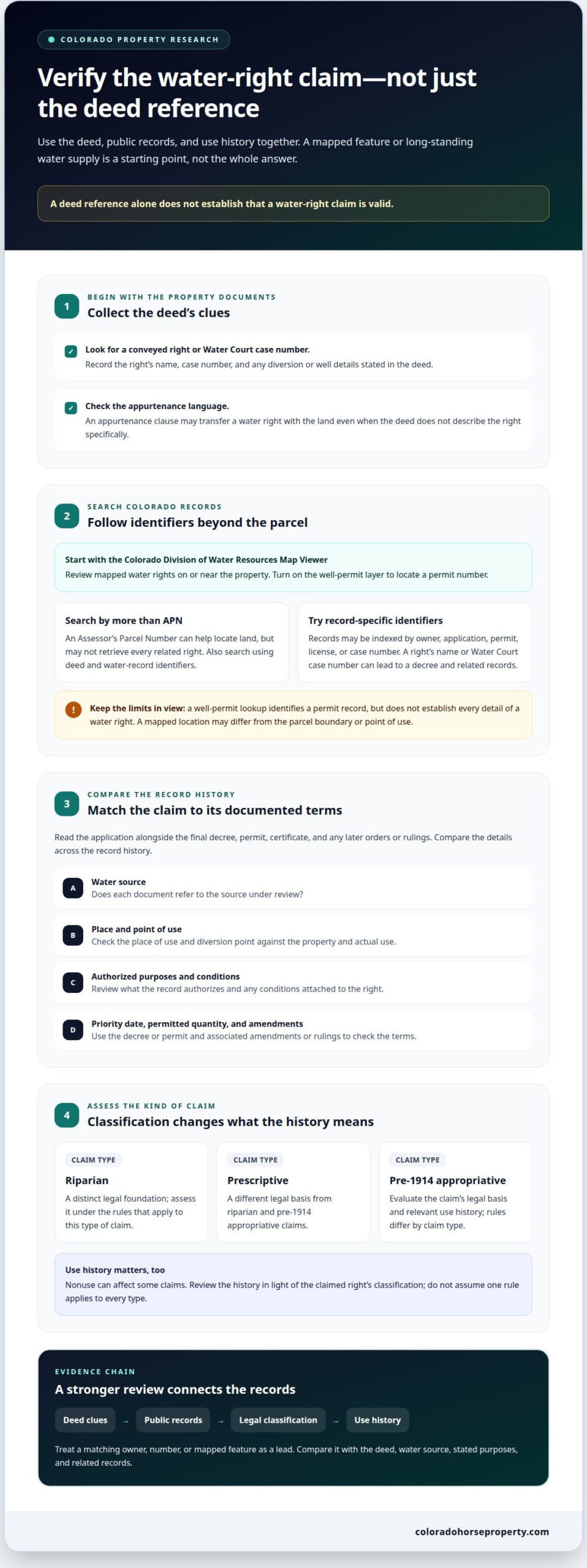
A deed reference alone doesn’t establish that a water-right claim is valid. To learn how to verify a property’s water rights claim in Colorado, start with the deed, then use the Colorado Division of Water Resources’ records and Map Viewer to trace the right and related records. The claim’s legal basis matters too: riparian, prescriptive, and pre-1914 appropriative rights follow different rules, and nonuse can affect some claims.
When evaluating land for a home, ranch, or horse property, a water source’s history is only part of the picture. You’ll also want to know what public records show, how the claimed right is classified, and whether its use history could affect it.
This guide explains where to search public records, how to distinguish common types of claims, and what applications, decrees, and rulings can tell you. A mapped feature or long-standing water supply is a starting point for research, not the whole answer.
Key Takeaways
- Start with the deed, then use Colorado’s public records and map tools to trace a water-right claim by owner, name, or identification number.
- Classify the claimed right before judging it: riparian, prescriptive, and pre-1914 appropriative rights have different legal foundations.
- Review use history as well as records, since nonuse can affect some appropriative rights while riparian rights follow different rules.
- Compare applications, decrees, orders, and rulings to understand a claim’s history and the limits attached to it.
What are water rights?
A water right is a legal right to use water from a defined source for authorized purposes. To understand how to verify a property’s water rights claim in Colorado, start with the deed. It may identify a conveyed right or cite a Water Court case number. An appurtenance clause may also transfer a right with the land, even if the deed does not describe it specifically. Record the right’s name, case number, and any diversion or well details.
Use public-record tools to follow those identifiers. The Colorado Division of Water Resources Map Viewer displays mapped water rights on or near a property. Turn on the well-permit layer to locate a permit number. A right’s name or Water Court case number can lead you to a decree, diversion records, and related public information. A well-permit lookup identifies a permit record, but does not establish every detail of a water right.
An Assessor’s Parcel Number (APN) can help you locate land, but it may not retrieve every related right. Records may be indexed by owner, application, permit, license, or case number. A mapped right’s location may also differ from the parcel boundary or point of use. For a thorough search, use the APN to locate the parcel, then search using identifiers from the deed and water records.
Search fields vary by state. California’s water-right records search accepts an application ID, permit ID, license ID, primary owner, source, or HUC. Nevada’s basic water-right search supports application or permit numbers, certificate numbers, and owner names. When checking how to verify a property’s water rights claim, compare results with the deed, water source, county, and stated purposes. A matching owner or number is a lead, not a complete title finding.
The cost of a water-right title search or legal review depends on the records, title history, and issues that need analysis. The fee is determined by the scope and complexity of the search.
Pre-1914 appropriative rights and periods of nonuse
In California, distinguish a riparian claim from an appropriative claim before assessing its history. A riparian right is generally tied to land bordering a natural watercourse and typically applies to use on that land. An appropriative right depends on diverting water for beneficial use, rather than simply owning adjoining property. Surface water use begun after 1914 generally requires State Water Board approval unless the user holds a riparian right.
A pre-1914 appropriative claim relies on use that began before the state permitting system applied. Look for records that identify the source, diversion point, purpose, place of use, and continuity of use. A permit, license, or certificate may document a later right, but an older claim may rely on historical evidence instead. Match each record to the land and water source under review; a document for a nearby diversion does not establish the subject property’s right.
Nonuse can change the analysis. In California, a pre-1914 appropriative right may be lost if construction, diversion, or water use lapses for five or more consecutive years. Appropriative rights depend on continued use, while riparian rights are not lost through nonuse. Compare dated diversion records and evidence of actual use across the relevant period. A gap in one record alone doesn’t establish whether the right was abandoned, so assess the full history and the kind of right claimed.
Consult a water-right attorney when deeds, diversion records, or the claimed period of use conflict. A hydrologist can help assess physical questions, including the source, diversion works, and evidence of water use on the land.
For a property search, explore Colorado horse properties with water rights among the features to investigate.
Reviewing water-right applications, orders, and rulings
Public records show how a claim was filed, reviewed, and documented. Compare the application with the final decree, permit, certificate, and any later orders. Check the water source, place of use, authorized purposes, diversion point, and conditions. For irrigation from a stream, these details help distinguish the authorized right from the property’s actual water use.
To verify the priority date, permitted quantity, and authorized use, review the decree or permit and any amendments or rulings associated with it. Compare these terms across the record history. Nevada’s State Engineer orders search can locate decisions on basin designations, preferred use, metering, reporting, and studies. Nevada’s decrees and adjudications search helps locate pre-statutory vested claims by system stream, county, or adjudication status.
Review Schedule B exceptions in the preliminary title report, then obtain the referenced easement documents. A summary alone may omit terms that affect access or use. Title research may also be needed to establish who owns a particular water right. To determine whether rights transfer with a deed, examine its water-right language, appurtenance clauses, legal description, and title history. In Colorado, an appurtenance clause can transfer rights even when the deed does not name them specifically.
For statutory claims, distinguish a recorded claim from a confirmed right. Idaho statutory claims record information about existing beneficial-use rights, but the claim itself doesn’t confirm the right through a license, decree, or other confirmation. Idaho enacted a recording statute in 1978 for beneficial-use rights, except rights used solely for domestic purposes. Washington’s Water Rights Search includes use location, authorized sources, and water-use reporting requirements. In Washington, judicial processes are the means of confirming a claim’s validity, so don’t rely on the search application alone for a purchase decision.
Gather the deed, title report, referenced easements, applications, decrees, permits, certificates, and relevant orders. Read together, these records connect the claimed right to its owner, source, use, and documented history.
Identifying riparian, prescriptive, and pre-1914 water rights
Classify a claim by its legal basis, not simply by the presence of water. In California, a riparian right is generally tied to land bordering a natural watercourse and typically applies to use on that land. Compare the parcel boundary, stream location, and claimed place of use. A nearby creek or groundwater source alone does not show that the property has a confirmed right.
A prescriptive water right is based on a history of use, rather than ownership of land beside a stream. In California, the required prescriptive period is five years. Search records for evidence connecting the claimed use to the source, diversion, and property. The period matters, but a timeline alone does not establish the claim’s legal status. Distinguish documented water use from a general history of access or pumping.
Pre-1914 appropriative rights involve a different basis: an appropriative claim tied to water use that began before California’s permitting system. Surface water or subterranean-stream use begun after 1914 generally requires State Water Board approval unless the user has a riparian right. Compare historical records with permits, licenses, certificates, and later agency records. Check whether the claimed source and use match the current property, rather than assuming an old diversion serves the parcel today.
Nonuse also depends on classification. California riparian rights aren’t lost through nonuse, while appropriative rights may be. A pre-1914 appropriative right may be lost if construction, diversion, or water use lapses for five or more consecutive years. Trace the activity record across that period and note what kind of right each document describes. The California State Water Resources Control Board’s records can help research surface-water authorizations, but a map or record entry alone doesn’t settle every ownership or validity question.
For land where water access is central to your plans, explore horse-property listings and assess each property’s water-right records alongside its features.
Colorado Horse Property: AI-Powered Horse Property Search
Colorado Horse Property’s AI-Powered Horse Property Search helps buyers find land that fits equestrian priorities, including water-right features. Use it to narrow your property search by the facilities and acreage that support your plans.
After reviewing public records, Buyer Representation can help you evaluate properties during the purchase process. Real Estate Listing Services support owners preparing to market equestrian land, and Transaction Management helps coordinate the steps involved in a transaction. These services complement your records research; they do not replace reviewing the specific right, its terms, and its history.
Bring your property criteria and the water-right records you’ve gathered to your next real estate decision. Visit coloradohorseproperty.com to explore properties or contact Colorado Horse Property.
Turn your findings into a confident property decision
Public-record research is most useful when it informs how you evaluate a property. Before moving forward, connect the water claim to your intended use of the land. Consider how dependable water access fits your plans for pasture, facilities, or future improvements. Keep unresolved record questions in view as part of your purchase decision, rather than treating them as minor paperwork.
A disciplined approach to how to verify a property’s water rights claim gives you a clearer basis for comparing properties and assessing their water features. It can also help you focus on land that fits your goals instead of relying on a listing description alone.
If you’re weighing a Colorado property purchase, contact Colorado Horse Property to discuss your search. Take the next step with a clear picture of what the land needs to support, and move toward a property that fits your plans.
Frequently Asked Questions
Is the claim valid?
A record search can support a claim, but a map marker or owner-name match alone does not establish its legal validity. Compare the claimed right’s source, place of use, authorized purpose, and history with the property and transaction documents. In Washington, the validity of a water-right claim can be confirmed only through judicial processes. Keep clear the distinction between locating a claim and establishing its legal status.
Do I already have a water right?
You may have a right if it was conveyed with the land or is documented under your ownership, but owning a well or water-service account alone does not settle the question. Compare your deed and title history with agency records, including any named right, permit, decree, or appurtenance language. If a record lists a former owner, trace the conveyance documents connecting the right to the current parcel.
How do I know if I have a riparian, prescriptive, or pre-1914 water right?
Look at the claim’s source and evidence of use. A parcel bordering a natural watercourse may point to a riparian claim; a prescriptive claim rests on a qualifying history of use. A pre-1914 appropriative claim depends on evidence that water use began before the permitting system. In California, prescriptive claims require five years of use, while pre-1914 appropriative rights have separate nonuse considerations.
How do water rights work in the United States, and how do they vary by state?
Water rights are governed by state-specific systems, so a claim’s type, records, and rules depend on its location and water source. California recognizes riparian and appropriative rights, with distinct treatment of pre-1914 use. Nevada treats water as public and subject to appropriation for beneficial use. Colorado records can include Water Court decrees and well permits. Apply the rules of the state where the property sits.
How can I find recorded water rights for a property in county and state records?
Start with the deed and title report, then search the state water-right database by owner, permit, certificate, application, or case number. Use county land records to follow deeds and recorded easements that may identify conveyances or access. Use the parcel number as a locator, then broaden your search to names and identifiers because water-right records may not be indexed directly to a parcel.
Which agencies keep water rights permits, certificates, claims, and well records?
Record custodians vary by state and record type. Colorado’s Division of Water Resources provides water-right research tools and well-permit lookups. California surface-water rights are regulated by the State Water Resources Control Board. The Idaho Department of Water Resources maintains Idaho records, and Nevada’s Division of Water Resources provides searches for water rights and State Engineer decisions. Use the relevant state agency’s database for the record category you need.