
A 1031 exchange for Colorado horse property can defer gain when qualifying real estate held for business or investment is exchanged for like-kind real estate. The property’s use matters: a ranch or acreage held for business or investment may qualify, while a personal residence does not. According to the Internal Revenue Service, replacement property generally must be identified within 45 days after the sale and received within 180 days after the sale, or by the applicable tax-return due date, whichever is earlier.
Horse facilities, pasture, and acreage can make a property a practical fit for an equestrian operation, but those features alone don’t establish 1031 eligibility. The key is whether the real estate is held for business or investment and whether the exchange follows the applicable rules. This guide explains how tax deferral works, which Colorado horse properties may qualify, what a qualified intermediary does, and how federal requirements apply in Colorado, so you can assess the exchange alongside your plans for land and horses.
Key Takeaways
- Eligibility depends on whether the real estate is held for business or investment, not simply on its barns, acreage, or equestrian use.
- Understand the exchange deadlines and identification rules before selling, since they shape which replacement properties can be acquired.
- A qualified intermediary facilitates a delayed exchange by holding sale proceeds and coordinating the exchange process.
- Compare Colorado properties by how their land and equestrian features fit your intended use, alongside the exchange requirements.
What is a 1031 Exchange?
A 1031 exchange can defer gain when qualifying business or investment real estate is exchanged for like-kind property. For horse property, the intended use and the exchange deadlines matter alongside barns, pasture, and acreage.
Identification and Completion Deadlines
These deadlines set when replacement property must be identified and acquired after a relinquished property sale. For a Colorado deferred 1031 exchange, the taxpayer generally must identify replacement property within 45 days after closing, according to the Internal Revenue Service. The replacement property generally must be received within 180 days after sale or by the applicable tax-return due date, whichever is earlier, according to the Internal Revenue Service.
A reverse exchange changes the sequence: according to the Internal Revenue Service, an exchange accommodation titleholder holds the replacement property for no more than 180 days while the taxpayer disposes of the relinquished property. Missing a deadline can put tax deferral at risk.
Property Identification Rules
Identification rules govern how many replacement properties can be named during the 45-day window. Under the three-property rule, a taxpayer may identify up to three properties regardless of value, according to the Internal Revenue Service. This can suit a buyer comparing a few ranches or acreage options.
The 200 percent rule allows identification of any number of properties if their combined fair market value does not exceed 200% of the relinquished properties’ fair market value, according to the Internal Revenue Service. The 95 percent rule allows any number to be identified if the taxpayer acquires 95% of the value of the identified properties, according to the Internal Revenue Service. These alternatives shape the search and purchase plan.
Value, Equity, and Debt Requirements
Value, equity, and debt all affect how much gain an exchange can defer. To defer the full gain, an investor generally needs to reinvest all equity and acquire replacement property of equal or greater value. Before committing, compare the sale proceeds and financing needs with the replacement purchase, including any new debt.
Compared with selling a Colorado horse property and paying capital gains tax, a qualifying exchange defers gain rather than recognizing it in the sale year. Colorado generally honors federal 1031 deferral when federal requirements are met; ownership-related local taxes remain separate from gain deferral.
Risks That Can Disqualify an Exchange
Common risks include missing the 45-day identification deadline, acquiring a property that wasn’t identified, or treating personal-use property as eligible investment real estate. A ranch’s equestrian features alone don’t make it qualify; its business or investment use matters.
Real estate and personal property aren’t interchangeable for Section 1031 purposes, so livestock or farm equipment cannot be included as replacement real estate. Keep the property description and intended use aligned across identification and purchase documents. A delayed exchange also requires the exchange process to follow its deadlines, not simply a later purchase.
Like-kind investment property
Internal Revenue Code Section 1031 provides for nonrecognition of gain or loss when qualifying business or investment property is exchanged for like-kind property held for business or investment, according to the Office of the Law Revision Counsel, U.S. House of Representatives. A 1031 exchange for Colorado horse property therefore depends on how the real estate is held and used, not simply on its equestrian features.
“Like-kind” generally refers to the nature or character of real estate, not identical buildings or land features. Investment land may be exchanged for improved real estate, or improved property for unimproved land. For example, a business-use ranch with a barn and arena may be exchanged for investment acreage without those improvements, provided the exchange meets the applicable requirements.
Colorado agricultural land and investment ranches may qualify when held for business or investment use. A 1031 exchange for Colorado horse property can involve eligible land and buildings, but livestock and farm equipment are separate personal property. Don’t assume those assets qualify just because they support the ranch operation.
A personal residence does not qualify as investment property. A hobby farm used for personal enjoyment does not qualify on that basis, while a farm held for business or investment may qualify under the use test. A horse boarding property may qualify when its real estate is held for business or investment, but boarding activity alone does not establish eligibility.
Before selling, distinguish real estate from personal-use assets and clarify the property’s use. Planning a 1031 exchange for Colorado horse property around eligible land and buildings can help focus the replacement search on relevant properties. Browse Colorado horse-property listings to compare acreage and equestrian features as you consider potential replacement property.
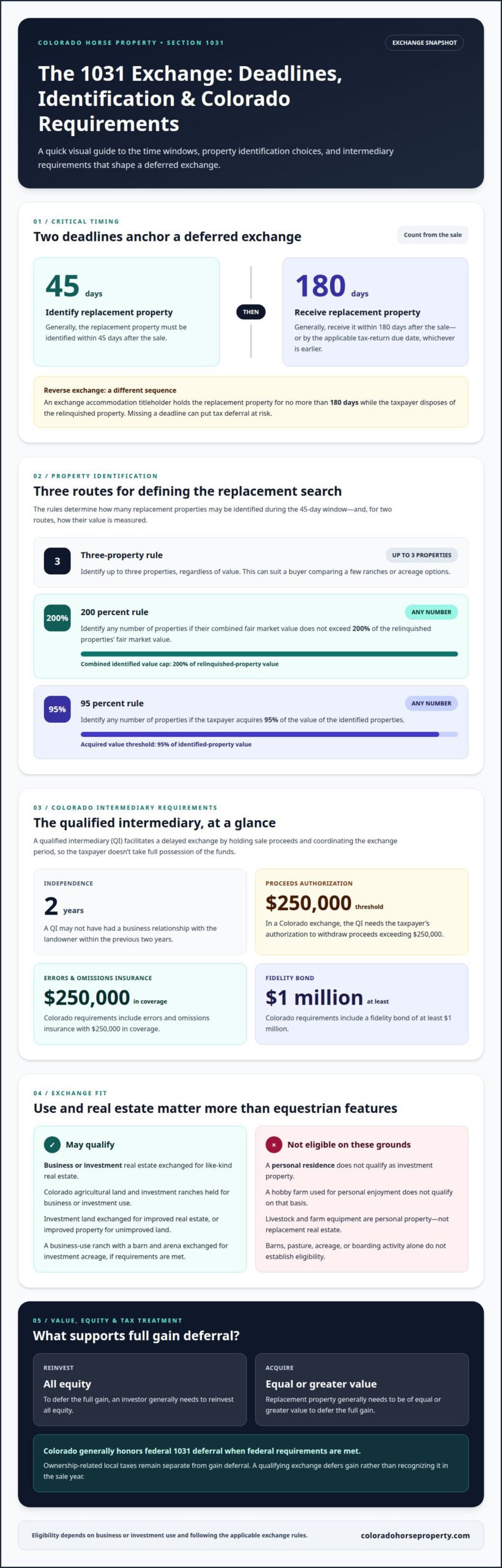
Qualified intermediary requirements
A qualified intermediary (QI) facilitates a delayed 1031 exchange between the sale of relinquished property and the replacement purchase. The QI holds the sale proceeds during that period, so the taxpayer doesn’t take full possession of the funds. This arrangement supports the exchange process and helps preserve potential capital-gains deferral.
Role and independence matter. A QI may not have had a business relationship with the landowner within the previous two years. In a Colorado exchange, the QI also needs the taxpayer’s authorization to withdraw proceeds exceeding $250,000. Colorado requirements include errors and omissions insurance with $250,000 in coverage and a fidelity bond of at least $1 million.
Before the sale closes, coordinate the exchange agreement and assignment of the sale contract with the qualified intermediary (QI). The proceeds then move through the exchange arrangement rather than directly to the taxpayer. The QI holds them until the replacement-property purchase, helping keep the transaction on track during the identification and completion periods.
A replacement interest may be a whole property or a fractional interest in a Delaware statutory trust (DST). For example, an investor replacing a ranch might acquire another whole ranch or a qualifying fractional real-property interest. The ownership structure changes, but the exchange must still meet the applicable real-property and business-or-investment requirements.
Typical QI fees and closing costs vary by case, with pricing provided after a quote request. Factors include exchange complexity, property count, transaction structure, and closing needs. Before the relinquished property closes, review the QI agreement for how it handles proceeds, withdrawal authorization, and transaction responsibilities. Clear coordination helps align exchange funds with the intended replacement purchase.
Colorado real estate eligibility for Section 1031 exchanges
Colorado generally honors federal Section 1031 tax deferral when an exchange meets federal requirements. Eligibility turns on the property’s use and classification, not its equestrian features alone. A Colorado ranch or agricultural parcel held for business or investment may qualify as real property for an exchange.
Horse property can include land, barns, arenas, and other real-estate improvements. Improved property may be exchanged for unimproved land, or unimproved land for improved real estate. For example, an owner may sell a business-use ranch with a barn and acquire investment acreage without one. A different layout alone does not prevent like-kind treatment.
Yes. Colorado horse property can qualify as like-kind real estate when held for business or investment purposes and the exchange meets federal requirements. Agricultural land and investment ranches are potential qualifying property types, but horse facilities alone do not establish eligibility.
Property use draws an important line. A personal residence and personal-use property do not qualify as Section 1031 investment property. A lease of 30 years or more may qualify as like-kind real property. By contrast, livestock and farm equipment are personal property, not real estate, and cannot serve as like-kind replacement real property.
For a Colorado exchange, classify each asset separately before structuring the transaction. Identify which parts are land or buildings and which are equipment or livestock, then align the exchange with the property’s business or investment use. The replacement property generally must be received within 180 days after the relinquished-property sale or by the applicable tax-return due date, whichever is earlier, according to the Internal Revenue Service. Explore Colorado horse properties to assess land and equestrian features for a potential replacement.
Colorado Horse Property: AI-Powered Horse Property Search
Colorado Horse Property helps buyers find potential replacement acreage with its AI-Powered Horse Property Search. Filter listings by equestrian features such as barns, arenas, water, and pasture, then compare properties with your intended business or investment use in mind.
When you’re ready to pursue a suitable property, Buyer Representation and Real Estate Listing Services support the transaction. Transaction Management can help coordinate the purchase alongside your exchange timeline. These services focus on finding and managing property transactions, not determining tax eligibility or providing tax advice.
Use the search to find Colorado properties that fit your land and facility priorities, then discuss representation as you prepare to buy. Contact Colorado Horse Property or visit coloradohorseproperty.com to explore your next steps.
Plan Your Next Move With Confidence
Your next step is to connect the exchange timeline with the kind of property that supports your plans for land, horses, and daily operations. Define the features that matter most, such as pasture, water access, or existing facilities, and keep those priorities central as you consider a replacement. A 1031 exchange for Colorado horse property brings real estate planning and equestrian needs together, so a clear search can help you focus on suitable possibilities.
Colorado Horse Property offers AI-Powered Horse Property Search, Real Estate Listing Services, and Buyer Representation to support your search and purchase. Explore the available options and discuss the next move that fits your plans.
Contact Colorado Horse Property and take a practical step toward the Colorado property you envision.
Frequently Asked Questions
Are there time restrictions?
Yes. A delayed exchange has separate identification and acquisition deadlines. For example, if a Colorado ranch sale closes, the replacement property generally must be identified within 45 days and received within 180 days, or by the applicable tax-return due date if earlier, according to the Internal Revenue Service. A reverse exchange follows a different sequence, so its structure also needs to fit the applicable time limit.
How do you identify and what is the identification period?
The identification period is the time after the relinquished-property sale when you name potential replacement properties in writing. Submit an identification notice to the qualified intermediary and describe each property clearly. For a ranch, include its address and legal description so the intended parcel is distinguishable from nearby acreage. Acquiring a different, unlisted property later can jeopardize the exchange.
How long is the gain deferred?
Gain is deferred until you sell the replacement property in a taxable transaction. Exchanging one investment ranch for another does not erase the deferred gain; the tax consequence carries forward. If you later sell the replacement ranch without another qualifying exchange, the deferred gain may become recognizable in that taxable sale. Deferral changes the timing, not the underlying gain.
Is there a holding requirement?
The property must be held for business or investment, rather than personal use. The actual use matters: operating a ranch as a business differs from using acreage solely for personal recreation. Related-party exchanges have an additional condition: the exchanged property must be held for at least two years to avoid IRS scrutiny. Keep records that reflect the property’s purpose and use.
What is the first step in an exchange?
Before the relinquished property closes, arrange the exchange with a qualified intermediary and coordinate the sale documents. Timing matters because taking possession of the proceeds can interfere with the exchange structure. For example, a seller planning to move from one working ranch to another should align the sale, intermediary arrangements, and replacement-property search before closing.
What is the “like-kind” requirement?
Like-kind refers to the nature of the real estate, not a perfect match in features or use. A U.S. investment ranch may be exchanged for other qualifying U.S. real estate, even if one property has a barn and the other is undeveloped land. Real property outside the United States is not like-kind to U.S. real property, and livestock or equipment is not replacement real estate.