
Buying a Colorado ranch isn’t just a real estate transaction; it’s a high-stakes acquisition of complex resource rights where a single overlooked water decree can cost you more than the land itself. You’re likely searching for more than just acreage; you’re looking for a legacy, a productive cattle operation, or a private equestrian retreat. It’s understandable to feel overwhelmed by the technical hurdles. Between the expiration of the 2007 Colorado River guidelines and the new 2026 requirements for signed buyer agreements, the process of securing rural land has never been more intricate.
This guide provides an expert framework to help you master the technical, legal, and logistical steps of learning how to buy a ranch in Colorado while avoiding expensive pitfalls. We’ll show you how to secure a legacy property with verified water and mineral rights, even in a shifting regulatory environment. You’ll learn to use specialized AI-powered search tools to filter thousands of listings for specific infrastructure needs and how to navigate the latest 2026 drought response plans. From the initial search to the final title coordination, this is your roadmap to a successful and secure rural acquisition.
Key Takeaways
- Define your ranch’s primary use—whether working cattle or recreational—to effectively narrow your search across Colorado’s diverse geographic regions.
- Secure your legacy by performing deep due diligence on senior water rights and mineral ownership, two critical factors in Colorado’s split-estate legal landscape.
- Leverage modern AI-powered search tools to learn how to buy a ranch in Colorado efficiently, filtering for specific “horse-ready” infrastructure that standard listings often miss.
- Assess the quality and durability of existing outbuildings and fencing to avoid high immediate costs for repairs or agricultural upgrades.
- Ensure a secure closing by working with a specialized transaction team that understands the specific title exceptions and escrow requirements unique to rural land sales.
Identifying Your Ideal Colorado Ranch Type
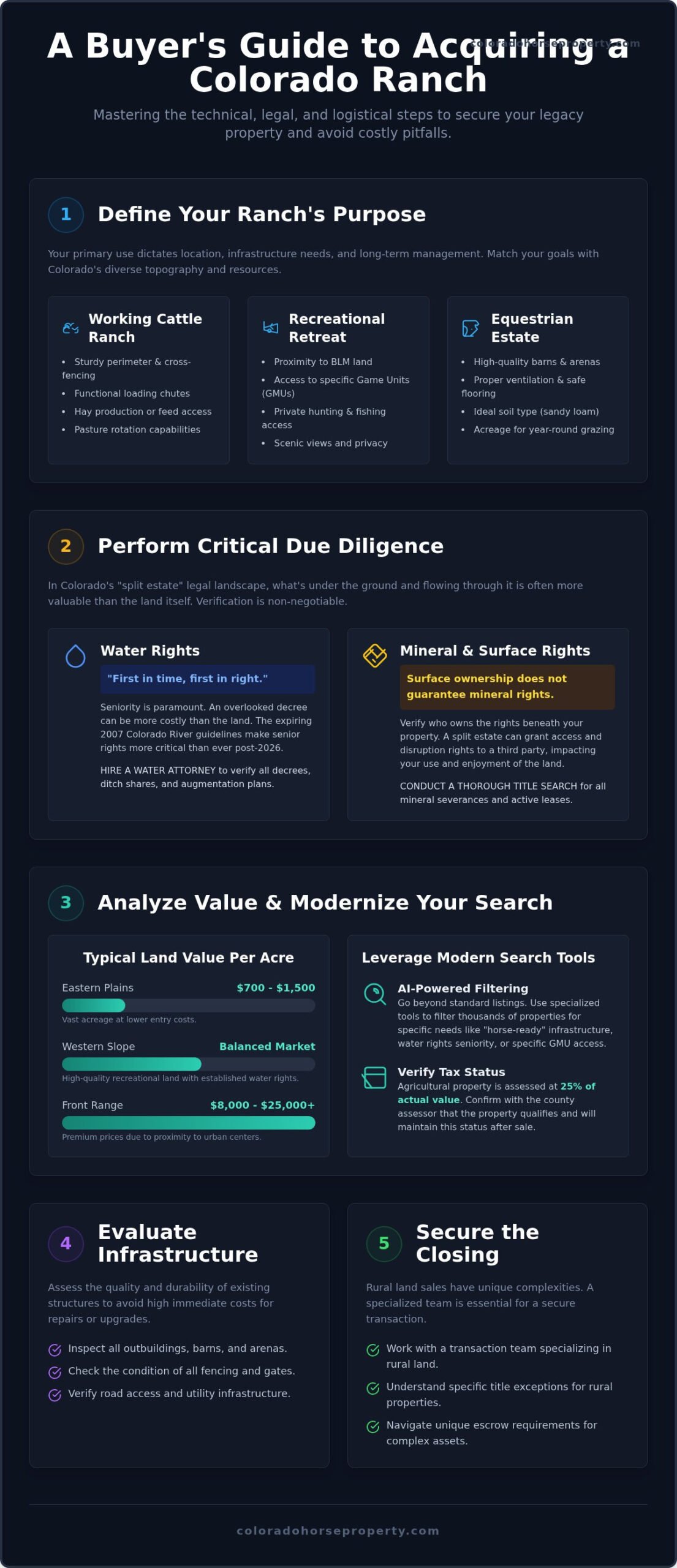
Selecting the right property begins with a clear definition of utility. A Ranch in the high country requires different management than one on the Eastern Plains. Your choice dictates everything from your tax liability to your daily maintenance schedule. Understanding how to buy a ranch in colorado requires matching your long-term goals with the state’s diverse topography and resource availability.
To better understand the complexities of land acquisition, watch this helpful video:
Geography is the primary driver of value and lifestyle. The Eastern Plains offer vast acreage and lower entry costs, often ranging from $700 to $1,500 per acre in counties like Las Animas. Conversely, the Front Range commands premiums of $8,000 to over $25,000 per acre due to development pressure and proximity to urban centers. On the Western Slope, the 2026 market has stabilized, offering a balanced environment for buyers seeking high-quality recreational land with established water rights.
Acreage requirements are often tied to agricultural tax status. In Colorado, agricultural property is assessed at 25% of its actual value. Qualifying for this lower rate requires proof of a primary profit motive, such as active grazing or hay production. Buyers should verify minimum acreage requirements with the specific county assessor to ensure the property maintains this status after the sale.
Working Cattle Ranches vs. Recreational Retreats
Working cattle operations require specific infrastructure that recreational buyers often overlook. You’ll need sturdy perimeter fencing, cross-fencing for pasture rotation, and functional loading chutes. If the ranch doesn’t already produce its own hay, you must account for the cost of bringing in feed during winter months. Recreational retreats prioritize different metrics, such as proximity to Bureau of Land Management (BLM) property or specific Game Management Units (GMUs) for hunting. Learning how to buy a ranch in colorado involves assessing these infrastructure needs before making an offer.
Equestrian-Focused Estates and Ranchettes
When evaluating equestrian real estate Colorado, the quality of existing barns and arenas is paramount. Look for structures with proper ventilation, safe flooring, and efficient hay storage. Soil health is equally critical; sandy loam is ideal for drainage, while heavy clay can lead to hoof issues and poor pasture management. If you’re planning a professional training facility, ensure the zoning allows for high-traffic equestrian use and that the acreage supports year-round grazing without overtaxing the land’s natural resources.
The Technical Due Diligence: Water, Mineral, and Zoning Rights
Understanding the legal landscape is the most vital step when you’re looking at how to buy a ranch in colorado. Surface beauty is often a distraction from the complex web of rights that actually determine a property’s value. You’re entering a “split estate” environment where water, minerals, and land use are governed by distinct, often conflicting, sets of laws. Failing to verify these rights during the due diligence period can turn a legacy property into a significant financial liability.
Navigating Colorado Water Rights
Colorado water law follows the doctrine of prior appropriation. This “first in time, first in right” rule means senior rights holders get their water first during shortages. With the 2007 Colorado River guidelines expiring in 2026 and new negotiations underway between basin states, the seniority of your Colorado water rights is paramount. You must distinguish between well permits for domestic use and ditch shares for irrigation. If you plan to build new structures, you’ll likely need an augmentation plan to replace any water you consume. Given the technical nature of these decrees, hiring a water attorney is a standard practice for high-value agricultural acquisitions.
Mineral Interests and Surface Use Agreements
In Colorado, mineral rights are frequently severed from the surface land. It’s common for an energy company to own the rights to the resources beneath your hay field. A standard title search won’t always reveal the full history of these interests; you need a specialized mineral title search to confirm what you actually own. Existing oil or gas leases can grant third parties the right to access your property. However, you can protect your operations with a Surface Use Agreement (SUA). This legal document defines exactly where equipment can be placed and how the surface must be reclaimed, ensuring your livestock and privacy are protected.
Zoning is strictly a local matter in the Centennial State. Every county maintains its own rules for agricultural density, outbuilding height, and equestrian facilities. You should also investigate conservation easements. While these can protect your ranch’s legacy and provide significant tax relief, they permanently restrict future development or subdivision. Don’t forget environmental checks. Noxious weeds, soil quality, and new 2026 state-level protections for wetlands under House Bill 1379 can all impact your management costs. To navigate these technical hurdles with confidence, our team provides comprehensive buyer representation to ensure no detail is overlooked.
Modern Search Strategies: AI-Powered vs. Traditional Browsing
Most buyers start their journey on general real estate platforms. However, standard MLS filters are designed for residential subdivisions, not complex agricultural operations. They often fail to distinguish between a “large backyard” and “productive acreage.” When you are learning how to buy a ranch in colorado, you’ll find that technical specifications like soil composition and outbuilding utility are rarely captured in basic search fields. Relying on traditional browsing often means wasting hours scrolling through properties that lack the fundamental infrastructure your livestock requires.
Modern search strategies now integrate topographical and satellite data to provide a more accurate picture of a property’s potential. This allows you to evaluate slope, drainage patterns, and vegetation health from your desk. Using these tools to analyze colorado land ensures you only spend time visiting sites that can actually support your intended agricultural or equestrian use.
The Power of AI in Equestrian Real Estate
Our proprietary AI-Powered Horse Property Search changes the dynamic of rural real estate. Instead of relying on a listing agent’s manual tags, the system uses visual and data analysis to identify “horse-ready” land. It can filter for specific barn types, indoor arena dimensions, and even the style of pasture fencing. This technology also utilizes predictive modeling based on historical ranch sales to help you understand if a property is priced fairly for its specific infrastructure. By automating the filtering process, we save buyers hundreds of hours and focus only on assets that meet a high standard of utility.
Working with a Niche Specialist Broker
Technology is a powerful tool, but it doesn’t replace the deep-rooted connections of a seasoned expert. Generalist agents often struggle with the nuances of agricultural appraisals and county-specific zoning laws. Alison and Mark Eibner bring 40 years of experience specifically in the Colorado Front Range. This longevity provides access to “pocket listings,” which are high-value ranches that never hit the public market. These off-market opportunities are often the most desirable legacy properties available. A specialist broker understands how to buy a ranch in colorado by leveraging these industry connections, ensuring you have the first look at prime acreage before it becomes a competitive public listing.
Evaluating Infrastructure and Land Stewardship
A ranch’s true value is often hidden in its utility rather than its views. While mountain vistas are attractive, they won’t feed your livestock or keep your equipment dry. When you’re assessing how to buy a ranch in colorado, you must evaluate the property as a functional business asset. This means inspecting outbuildings, fencing, and rural utilities with a critical eye. A beautiful barn with a failing foundation is a liability, not an amenity.
Access is a primary concern, especially for owners managing transactions remotely. You must verify that the property has legal ingress and egress that supports heavy machinery. If you need to bring in hay semi-trucks or livestock trailers, a narrow, unmaintained easement won’t suffice. Check for recorded road maintenance agreements, particularly in high-altitude counties where snow removal isn’t a guaranteed municipal service. Without these, you could be stranded during the winter months.
The Essential Ranch Infrastructure Checklist
Reliable water is the lifeblood of any agricultural operation. Beyond checking the permit, you should conduct a well flow test to ensure the production meets the demands of both the household and your animals. Water quality testing is equally vital to identify high mineral content that could damage plumbing or affect livestock health. You don’t want to discover a dry well after the closing date.
- Structural Integrity: Inspect the foundation, roofing, and ventilation of existing horse barns for sale to determine if they require immediate capital investment.
- Fencing and Cross-Fencing: Evaluate the material durability. High-tensile wire or pipe fencing is preferred for livestock safety and long-term maintenance.
- Rural Utilities: Confirm the age and capacity of the septic system. While broadband is expanding, verify high-speed internet availability if you plan to work from the ranch.
Land Management and Soil Health
Stewardship is a continuous obligation that starts before you sign the deed. You need to identify the land’s actual carrying capacity, which is the number of animals it can support without overgrazing. Colorado’s semi-arid climate means pasture recovery is slow. Managing noxious weeds is a legal requirement under state law; failing to do so can lead to county-enforced remediation costs. Additionally, with 40 counties under the Phase 2 Drought Response Plan as of March 2026, wildfire mitigation through brush clearing and defensible space is a critical necessity.
Current soil tests are essential if you intend to produce hay or maintain a large garden. These tests reveal nutrient deficiencies that could limit your yield or require expensive amendments. To ensure you’re making an informed investment in the land’s future, partner with our expert buyer representatives to evaluate the functional viability of your potential acquisition.
Closing the Deal: Transaction Management and Title
The closing phase is where the technical due diligence discussed earlier culminates in a legal transfer of ownership. In a market as complex as Colorado’s, the final steps require more than just a signature. As of August 12, 2026, buyers and sellers are required to have a signed, written agreement before any services are performed. This ensures full disclosure of agent compensation and clear representation. Managing these high-value rural transactions requires a specialized team that understands the intersection of real estate law and agricultural practice.
Our approach to transaction management ensures that every contingency is met before you wire funds. This is a critical part of how to buy a ranch in colorado with confidence. We partner with Meridian Title & Escrow to provide a secure closing environment. They understand the nuances of rural land, from agricultural property tax assessment rates to the specific closing costs associated with large acreage. Coordination with a title company that recognizes agricultural exceptions is vital for your long-term security.
Title Insurance for Ranches
Standard residential title policies are often insufficient for properties over 35 acres. A ranch title search must identify historical exceptions that don’t exist in urban settings. We look for “clouds on title” related to 19th-century land grants or abandoned railroad easements. An ALTA (American Land Title Association) survey is essential to confirm boundaries and identify potential encroachments. This survey provides a higher level of protection by identifying issues that a standard physical inspection might miss. It’s the only way to ensure your fence lines actually match the legal description of the land.
The Final Walkthrough and Handover
The final walkthrough for a ranch is far more intensive than a standard home inspection. You aren’t just checking light switches; you’re verifying that the functional infrastructure remains intact. If the contract included specific equipment, such as tractors or hay balers, or even specific livestock, you must confirm their presence and condition. Ensure you receive all gate codes, well documentation, and keys to various outbuildings.
Post-closing logistics often involve the formal transfer of water shares and grazing leases. These assets don’t always move automatically with the deed. You’ll need to file the appropriate paperwork with the water conservancy district or the state to ensure your rights are protected. For a deeper look at these technicalities, explore the 2026 expert buyer’s guide for Colorado ranches. Successfully learning how to buy a ranch in colorado ends with a seamless transition that protects your legacy from day one.
Secure Your Colorado Legacy Today
Acquiring rural land in 2026 requires a technical approach that prioritizes resource rights and infrastructure viability over simple aesthetics. By mastering the nuances of water seniority and conducting rigorous site evaluations, you protect your investment from the start. Understanding how to buy a ranch in colorado means balancing these legal hurdles with a clear vision for your property’s long-term stewardship.
Success in this specialized market depends on having the right team in your corner. We combine over 40 years of local Colorado real estate expertise with proprietary AI technology built specifically for horse and ranch buyers. Our strategic partnership with Meridian Title & Escrow ensures your transaction is handled with the highest level of security and professional oversight. Whether you’re seeking a working cattle operation or a private equestrian estate, the right tools and representation make all the difference.
Start Your AI-Powered Colorado Ranch Search Today and take the first step toward owning a piece of the American West. Your dream property is within reach when you have a seasoned expert guiding the way.
Frequently Asked Questions
Do I need a special license to run a cattle ranch in Colorado?
No general ranching license is required, but you must register a brand with the Colorado Brand Board if you plan to move or sell livestock. You’ll also need a Premises Identification Number (PIN). If you sell meat directly to consumers, specific USDA or state health department certifications apply. Most operators focus on brand inspections, which are mandatory for any change of ownership or transport over 75 miles.
How many acres do I need to qualify for agricultural tax status in Colorado?
There’s no single statewide acreage minimum; instead, the land must be used for a primary profit motive. Most counties look for a minimum of 35 to 80 acres for dryland grazing, though smaller parcels can qualify if they’re intensively farmed or used for orchards. You must demonstrate active production, such as grazing records or hay sales, to benefit from the 25% assessment rate on actual value.
What is the difference between deeded acres and leased land (BLM/Forest Service)?
Deeded acres are land you own outright, while leased land refers to permits to graze on public land managed by the Bureau of Land Management or the U.S. Forest Service. These permits don’t convey ownership but provide essential grazing capacity. When learning how to buy a ranch in colorado, it’s vital to check if these permits are transferable and what seasonal restrictions apply to the specific allotment.
Can I build a second home or “ADU” on my Colorado ranch land?
Building rights depend entirely on county zoning and your property’s specific water augmentation plan. While many rural counties allow a secondary dwelling for ranch hands or family, others have strict “one unit per 35 acres” rules. You must also verify that your well permit allows for more than one household. Always check the specific land use code for your county before planning additional structures.
How do I verify if a property has senior water rights?
You must review the water decree through the Colorado Division of Water Resources (DWR) database. A senior right is one with an older appropriation date than other users on the same stream. In a dry year, senior holders get their full allocation before junior holders receive anything. We recommend hiring a water attorney to perform a title search on these rights to ensure they haven’t been abandoned.
What are the typical closing costs for a Colorado ranch purchase?
Closing costs generally range from 2% to 4% of the loan amount. In Colorado, there is a state real estate transfer tax of 0.01% of the sale price. Beyond standard lender fees, ranch buyers should budget for specialized title insurance, ALTA surveys, and environmental assessments. These costs are essential to secure a high-value rural transaction and protect against boundary or resource disputes later.
How does the AI search tool help me find specific equestrian features?
Our proprietary AI tool analyzes visual data and listing descriptions to find features that standard filters miss. It can identify properties with specific arena dimensions, round pens, or loafing sheds without you having to click through every photo. This technology is the most efficient way to understand how to buy a ranch in colorado that meets exact training or boarding requirements, saving you weeks of manual research.
Should I buy a ranch in my own name or an LLC?
Most ranch owners choose an LLC or a similar entity for liability protection and estate planning. An LLC shields your personal assets from ranch-related risks, such as livestock accidents or visitor injuries. It also simplifies the transfer of ownership to heirs. You should consult with a tax professional or attorney to determine if an entity structure aligns with your specific financial goals and agricultural operations.