
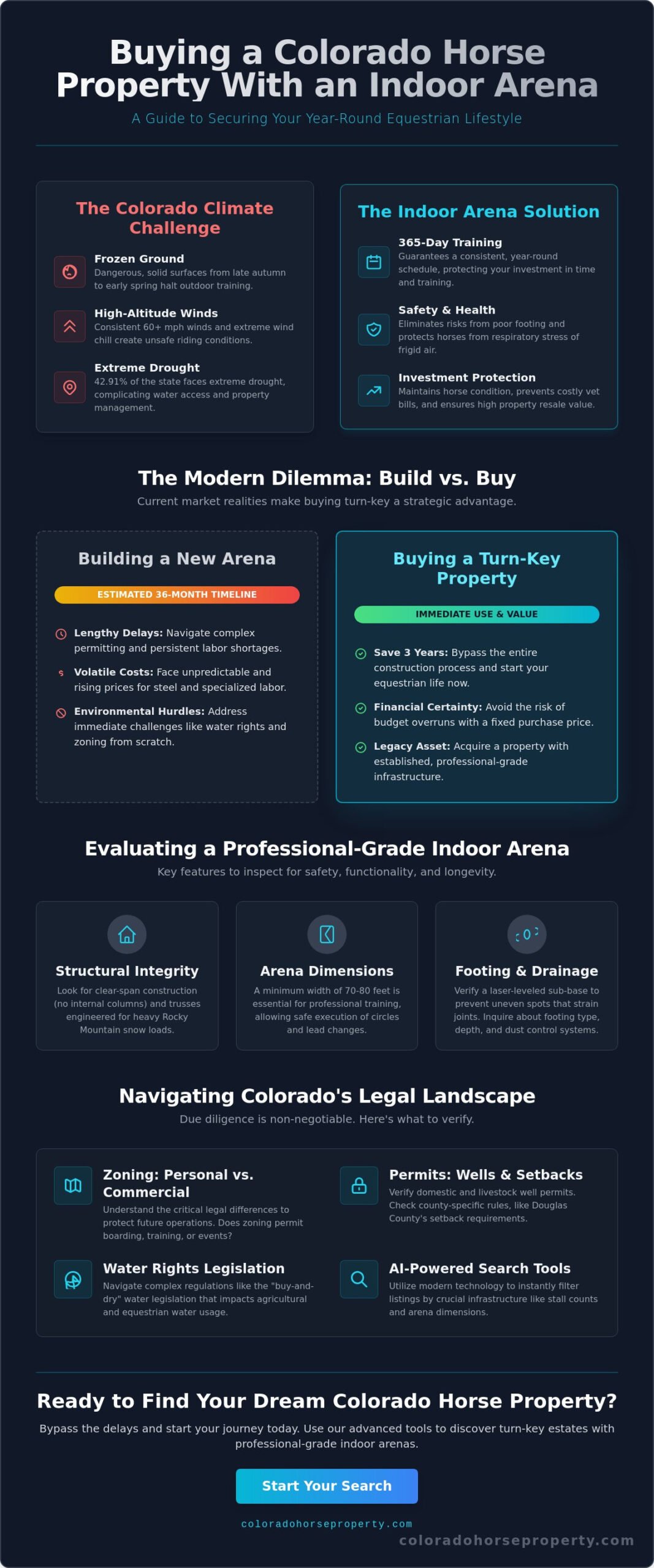
In Colorado, an indoor arena is a 365-day training insurance policy rather than just a luxury feature. You likely already know that Rocky Mountain winters can effectively cut your riding season in half. With current construction timelines for new equestrian facilities now stretching to an estimated 36 months due to permitting and labor shortages, finding a turn-key horse property with indoor arena for sale Colorado is the most efficient way to secure your lifestyle. Buying an established estate allows you to bypass the headache of rising material costs and immediate environmental hurdles.
We agree that the search process is daunting when you’re balancing water rights, zoning laws, and the 42.91% extreme drought conditions currently affecting the state. This 2026 guide promises to show you how to evaluate professional-grade facilities and navigate complex local regulations like the recently passed “buy-and-dry” water legislation. You’ll learn how to use AI-powered search tools to filter for specific infrastructure and understand the real ROI of an existing arena. We’ll cover everything from Douglas County setback requirements to verifying domestic and livestock well permits so you can move forward with total confidence.
Key Takeaways
- Learn how to evaluate the structural integrity and footing quality of existing facilities to ensure they meet professional training standards.
- Identify the top geographic regions to find a horse property with indoor arena for sale Colorado that balances accessibility with expansive rural acreage.
- Navigate the critical legal differences between personal use and commercial equestrian zoning to protect your future property operations.
- Discover how to utilize AI-powered search tools to instantly filter listings by specific infrastructure like stall counts and arena dimensions.
- Understand the long-term ROI of securing a turn-key estate compared to the current risks and timelines of new construction.
The Value of Horse Properties with Indoor Arenas in Colorado
An indoor arena estate is more than a luxury; it’s a functional necessity for the serious equestrian. In the 2026 market, these properties sit at the top tier of real estate because they solve Colorado’s most significant geographic challenge. While the region boasts 300 days of sunshine, the reality of high altitude weather includes 60 mph winds and sub-zero temperatures that make outdoor training impossible. When you search for a horse property with indoor arena for sale Colorado, you’re looking for a facility that guarantees a consistent training schedule. This consistency is what separates professional-grade estates from standard hobby farms. It’s about protecting your investment in your horses and your time.
To see how these facilities integrate into a professional-grade ranch, watch this property walkthrough:
Why Colorado Winters Demand Indoor Facilities
The “frozen ground” factor is a primary driver for arena demand. From late autumn through early spring, moisture in outdoor footing freezes solid, creating a surface that’s dangerous for both horse and rider. A high-quality indoor riding arena provides a climate-controlled environment that mitigates these risks. Beyond the footing, indoor spaces protect horses from extreme wind chill and the respiratory stress caused by inhaling frigid air during heavy work. In Front Range counties like Douglas or Elbert, where wind is a constant factor, the utility of an indoor space far outweighs that of an outdoor ring. It keeps your horses in peak condition year-round without the seasonal setbacks common in the Rockies.
The Investment Perspective: ROI on Equestrian Infrastructure
From an investment standpoint, purchasing an existing facility is a savvy move. Building a new arena from scratch currently carries an estimated 36-month timeline due to permitting delays and labor shortages. When you factor in the volatile costs of steel and specialized construction, turn-key properties offer immediate value. These estates are considered legacy assets because the infrastructure is already in place to support a professional training program or a high-end private collection. The resale value of a horse property with indoor arena for sale Colorado remains high because buyers aren’t willing to wait years for a construction project to finish. You’re buying three years of saved time and a protected lifestyle.
Critical Features of a High-Quality Indoor Riding Arena
Evaluating a horse property with indoor arena for sale Colorado requires a technical eye. You aren’t just buying a building; you’re buying a specialized piece of machinery. During a showing, look for clear-span construction. Columns or pillars inside the riding space are safety hazards and limit your maneuverability. A professional-grade arena should offer at least 70 to 80 feet of width to accommodate circles and lead changes safely. High-altitude properties also need to account for heavy snow loads. Check the roof pitch and the structural integrity of the trusses to ensure the building can handle the weight of a typical Rocky Mountain winter.
Maintenance is often a buyer’s biggest concern. While large indoor spaces require regular grooming and moisture management, the cost is offset by the longevity of your horses. Poor footing leads to soft tissue injuries and expensive vet bills. If you’re concerned about the water requirements for dust control, it’s vital to research Colorado water rights to ensure your well permit allows for sufficient irrigation or commercial use. Securing a horse property with indoor arena for sale Colorado ensures your training program remains uninterrupted, provided the facility meets these technical benchmarks.
Footing, Drainage, and Dust Control
The arena is only as good as its base. A laser-leveled sub-base is essential to prevent “dead spots” or uneven surfaces that strain a horse’s joints. In Colorado, popular footing choices include GGT (German Geo Textile) and sand-fiber mixes because they hold moisture without becoming slick. Dust control is another priority. With 42.91% of the state currently in extreme drought, you should look for properties with overhead sprinkler systems or those using magnesium chloride to bind the footing and reduce water consumption.
Lighting, Ventilation, and Insulation
Effective lighting is critical for evening training. Look for LED fixtures that provide shadow-free illumination across the entire surface. Ventilation is equally important. Without passive airflow through ridge vents or cupolas, ammonia from stalls and condensation from the roof will degrade air quality. In the high-altitude regions of the Rockies, an insulated roof prevents “indoor rain” caused by condensation and helps maintain a manageable temperature during the coldest January mornings. Our specialized search tools help you identify properties with these exact specifications without the manual sorting.
Top Colorado Regions for Equestrian Real Estate
Location determines the daily utility and long-term value of your investment. In Colorado, the market for a horse property with indoor arena for sale Colorado is concentrated in specific corridors that support the equine industry. Whether you’re a competitive hunter-jumper or a working rancher, your regional choice impacts everything from hay availability to show access. For a complete market overview, consult our equestrian real estate Colorado resource. The state is effectively split between high-density show hubs and expansive mountain retreats, each offering different benefits for arena owners.
The Front Range: Douglas, Elbert, and Boulder Counties
Douglas, Elbert, and Boulder counties are the primary hubs for professional training facilities. Parker and Elizabeth serve as the state’s equestrian capitals, largely due to their proximity to the Colorado Horse Park. These areas offer high-end estates on smaller parcels, often ranging from 5 to 40 acres. You’ll find turn-key properties with sophisticated drainage and lighting systems already in place. Because these counties are high-demand commuter zones, the Colorado Equestrian Protection Laws are vital. These regulations help local governments preserve specialized equestrian zones even as suburban development expands.
The Western Slope and High Country
If your goals require vast acreage, look toward the Western Slope and the High Country. Areas like Grand Junction, Montrose, and Steamboat Springs offer sprawling ranches for sale colorado where land is measured in hundreds of acres rather than tens. These regions provide unparalleled privacy and direct access to public land, though they present unique maintenance challenges. High-altitude arenas must be engineered for massive snow loads and extreme temperature swings. While the Front Range focuses on proximity to show circuits, the Western Slope focuses on the heritage of the working ranch and the freedom of the open range.
Choosing between these regions comes down to your daily routine. Do you need to be within 30 minutes of a major show circuit, or do you prefer the silence of a mountain valley? Both markets offer premier horse property with indoor arena for sale Colorado, but they cater to very different equestrian lifestyles. The Front Range offers convenience and luxury, while the Western Slope provides the scale needed for larger breeding or livestock operations.
Due Diligence: Zoning, Permits, and Water Rights
Securing a horse property with indoor arena for sale Colorado requires a deep dive into the legal framework of the land. You aren’t just buying a residence; you’re acquiring a specialized facility that must comply with strict county regulations. One of the most common questions buyers ask is whether they can operate a commercial training or boarding business from their new arena. The answer is rarely a simple yes or no. Most residential-agricultural zones are intended for private use. If you plan to generate income, you must verify if the property has a “Use by Special Review” (USR) or if the current zoning allows for commercial equestrian activities. In Douglas County, for example, properties under 2.3 acres are limited to two horses, while larger parcels must follow specific Section 24 guidelines for livestock density and manure management.
Verifying building permits is equally critical for large-scale structures. An unpermitted indoor arena is a significant liability that can lead to fines or even demolition orders. Ensure that the arena, its electrical systems, and any plumbing were fully permitted and inspected at the time of construction. If you’re planning future additions to the property, our guide on horse barns for sale provides essential advice on navigating the transition from buying to building. Before you sign a contract, consult with a specialized equestrian real estate agent who understands the nuances of local zoning maps and land use resolutions.
Verifying Commercial vs. Private Use
Zoning varies significantly between counties. While Douglas and Elbert counties are horse-friendly, they have specific requirements for setbacks, typically requiring arenas to be at least 25 feet from property lines. Beyond county law, you must scrutinize homeowner association (HOA) covenants. Many high-end equestrian subdivisions allow for large indoor arenas but strictly prohibit commercial traffic or professional clinics. A specialized agent can help you review these “hidden” restrictions before you commit to a purchase.
Water Rights and Well Permits
Water is the most valuable resource in the 2026 Colorado market, especially with 42.91% of the state currently experiencing extreme or exceptional drought. A standard “household-only” well permit is insufficient for a horse property with indoor arena for sale Colorado. You legally require a “domestic and livestock” permit to water animals and manage dust in a large riding hall. Furthermore, the recently passed “buy-and-dry” legislation (HB 26-1340) highlights the state’s focus on protecting agricultural land from water stripping. If the property relies on an augmentation plan, ensure the water rights are secure and transferable. Without the correct permit, you could face severe usage restrictions during peak drought months.
Finding Your Dream Colorado Property with AI Search
The 2026 real estate market moves too fast for manual browsing. When you’re looking for a horse property with indoor arena for sale Colorado, the difference between a successful acquisition and a missed opportunity often comes down to the quality of your data. General real estate platforms are built for suburban houses; they don’t distinguish between a small loafing shed and a professional-grade, clear-span riding hall. Our AI-powered search tool bridges this gap by scanning listing data for specific equestrian infrastructure. This technology identifies properties with existing arenas, specific stall counts, and established fencing styles, allowing you to move from “browsing” to “strategizing” with precision.
In a market where 42.91% of the state is facing extreme drought and hay prices have spiked 70% since February, you can’t afford to waste time on properties that don’t meet your technical requirements. Our system filters for the critical assets we’ve discussed, such as domestic and livestock well permits and insulated facilities. By focusing only on properties that align with your professional standards, you can secure a turn-key estate and avoid the current 36-month construction wait times for new builds.
Why Niche Search Tools Beat General Real Estate Sites
General MLS feeds often suffer from a “data gap” regarding specialized improvements. A standard listing might mention an “outbuilding” without specifying the height of the trusses or the quality of the base material. Our AI-driven platform extracts these details, specifically filtering for the term “Indoor Arena” to save you hours of manual sorting. Understanding the nuances of horse real estate for sale is essential for making a competitive offer that reflects the actual value of the infrastructure. This specialized data ensures you don’t overpay for a facility that requires a total footing overhaul or structural remediation.
The Realty Oasis Advantage
Technology is a powerful tool, but it’s most effective when backed by human expertise. Mark and Alison Eibner bring 40 years of Colorado real estate experience to every transaction. We don’t just provide a search tool; we offer a comprehensive ecosystem of services designed for the equestrian buyer. This includes dedicated buyer representation, transaction management, and in-house title and escrow services. Our team understands the unique requirements of land and livestock owners because we’re peers in this community. We help you navigate the complexities of “buy-and-dry” water legislation and county-specific zoning resolutions with the confidence that only decades of industry tenure can provide.
Don’t settle for a generic search process when your lifestyle and investment are on the line. Start your AI-powered search for Colorado horse properties with indoor arenas today.
Securing Your Colorado Equestrian Legacy
Finding the right horse property with indoor arena for sale Colorado requires a balance of technical inspection and legal verification. You now understand that a high-quality facility is defined by its clear-span construction and climate-appropriate insulation. Beyond the structure, securing domestic and livestock water rights is the most critical step in protecting your investment against ongoing drought conditions. Buying a turn-key estate allows you to avoid the multi-year construction delays currently impacting the Rocky Mountain region.
We’re here to streamline this complex transition. Our AI-powered niche search identifies the specific equestrian features you need, while our 40 years of local Colorado expertise ensures no detail is overlooked. We provide full-cycle transaction management, from the initial search through final title and escrow services. It’s time to stop compromising on your training schedule and start riding on your own terms. Browse Colorado Horse Properties with Indoor Arenas Now and take the first step toward your dream estate. We look forward to helping you find a property that supports your passion and your horses.
Frequently Asked Questions
How much does an indoor riding arena add to property value in Colorado?
An indoor arena significantly increases marketability and resale value by extending the usable training season through the winter months. In the current market, properties with professional-grade arenas command a premium because they bypass the high costs and long permitting delays of new construction. While exact dollar amounts vary by county and facility quality, an existing arena is often viewed as a critical asset for high-end equestrian buyers looking for turn-key solutions.
What is the minimum recommended size for an indoor arena in Colorado?
A minimum size of 70′ x 120′ is typically recommended for general riding, though jumping and dressage require more space. Professional trainers often look for at least 80′ x 200′ to allow for full courses and safe lead changes. When viewing a horse property with indoor arena for sale Colorado, ensure the width is sufficient for your specific discipline. Narrower arenas can limit training progress and increase the risk of injury during tight turns.
Do I need a special permit to have a commercial boarding business in an indoor arena?
Yes, most Colorado counties require a Use by Special Review (USR) or a similar commercial permit to operate a boarding or training business. Zoning for agricultural use often covers personal horses but doesn’t automatically grant the right to run a public facility. You should check the specific land use code for your county before beginning operations. Operating without these permits can lead to legal action or the loss of your business license.
How do I check if an existing indoor arena was built with proper permits?
You can verify permit history through the local county building department’s online portal or by requesting a records search. Check for the original structural permit as well as electrical and plumbing inspections. If a horse property with indoor arena for sale Colorado lacks a certificate of occupancy or final sign-off, it could complicate your financing or future resale. A specialized real estate agent can assist in pulling these records during your due diligence period.
What is the best type of footing for a Colorado indoor arena?
GGT (German Geo Textile) and sand-fiber mixes are currently considered the gold standard for Colorado’s dry climate. These materials provide superior cushioning and moisture retention compared to traditional dirt. Because the state’s humidity is low, you need footing that won’t pulverize into dust quickly. Many professional facilities also use magnesium chloride treatments or specialized polymer-coated sands to maintain stability and reduce the need for constant watering throughout the week.
Can I use a domestic well to water my indoor arena for dust control?
It depends on the specific language of your well permit. A standard household-only permit generally prohibits outdoor use or large-scale irrigation. You typically need a domestic and livestock permit to legally use water for an arena or animal care. In some restricted basins, you might even need an augmentation plan to offset your water usage. Always have a water rights specialist review the permit before you close on a property.
What are the typical maintenance costs for an indoor riding arena?
Annual maintenance costs include footing additives, water for dust suppression, and the fuel for grooming equipment. You should also budget for periodic laser-leveling to prevent the base from becoming uneven over time. Lighting can be a significant expense if the facility hasn’t been upgraded to LED fixtures. While costs vary based on usage, regular dragging and moisture management are essential to prevent the need for an expensive footing replacement every few years.
Are there specific counties in Colorado that are more “horse-friendly” for building arenas?
Douglas, Elbert, and Weld counties are widely recognized for their horse-friendly zoning and established equestrian communities. These regions have clearer guidelines for arena setbacks and livestock density compared to more urbanized areas. However, horse-friendly doesn’t mean a lack of regulation. Even in these counties, you’ll need to navigate specific manure management plans and drainage requirements. Researching the local land use resolutions is the only way to ensure your property remains compliant.