
What if your $1,530,000 investment in a Denver equestrian estate became a legal liability the moment you accepted payment for your first boarding stall? In 2026, many entrepreneurs discover too late that a residential horse property label doesn’t automatically grant the right to run a business. You’ve likely spent months scouting acreage, yet the fear of a zoning violation or a household-only well permit shutting down your stables is a real concern. Finding a Colorado horse property with commercial zoning requires more than a standard search; it demands a deep dive into county land use codes and specific water augmentations.
We understand that your goal is a secure, income-producing asset rather than a costly hobby farm. This guide will teach you how to identify, verify, and secure properties that legally support your boarding, training, or event business. We’ll explore the critical intersection of specialized zoning, the updated January 2026 water well rules, and the infrastructure requirements for commercial-grade operations. From navigating a 40% property tax assessment increase to ensuring your well permit allows for commercial livestock use, you’ll gain the clarity needed to make a confident purchase in today’s competitive landscape.
Key Takeaways
- Distinguish between permanent “By-Right” commercial use and temporary Special Use Permits to ensure your boarding or training business has long-term legal standing.
- Identify a Colorado horse property with commercial zoning that meets specific county horse-per-acre ratios and mandatory infrastructure requirements like manure management plans.
- Verify well permit types and augmentation plan requirements to secure the legal right to water livestock for commercial purposes rather than just household use.
- Learn why an existing owner’s permit might not protect you after closing and how specialized due diligence prevents costly zoning violations.
- Leverage AI-powered search tools to filter for properties without restrictive covenants or HOAs, identifying high-potential commercial parcels before they hit the general market.
What Defines a Colorado Horse Property with Commercial Zoning?
A Colorado horse property with commercial zoning is land specifically designated by county officials to support income-generating equestrian activities. This legal status allows you to operate professional boarding stables, training facilities, or public clinics without violating local land-use laws. Most residential or standard agricultural parcels are intended for private use only. When you transition to a business model, the county requires the land to meet higher standards for traffic management, animal waste disposal, and public safety.
To better understand how these properties differ from standard residential listings, watch this helpful video:
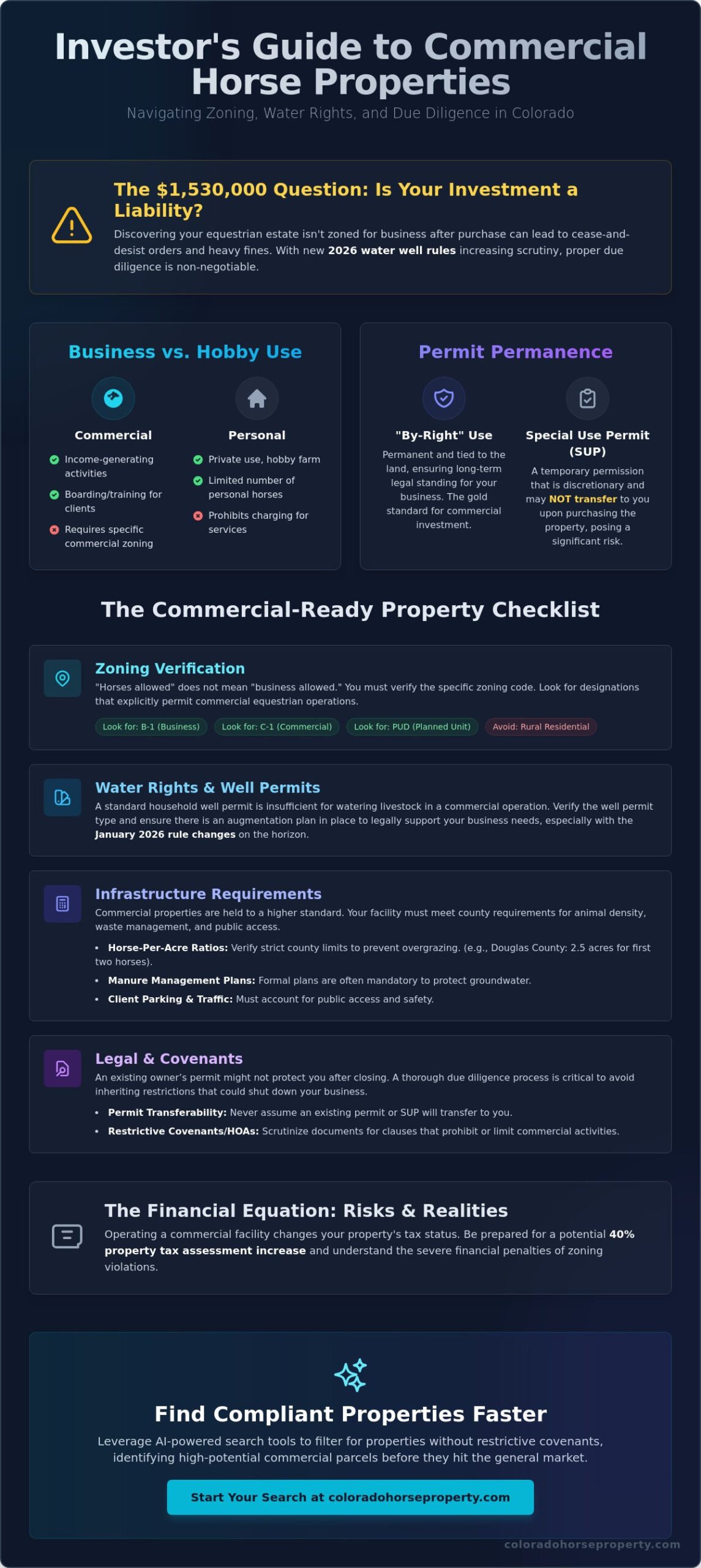
Standard agricultural zoning, such as A-1 or A-2, often creates a ceiling for entrepreneurs. These zones typically limit the number of horses not owned by the property resident. If your business plan involves boarding twenty horses owned by outside clients, a standard agricultural tag might not be sufficient. The 2026 Colorado land-use updates have placed more scrutiny on these limits, requiring owners to prove their operations don’t exceed the intended intensity of the land. You must also distinguish between “By-Right” use and “Special Use Permits” (SUP). By-Right use is permanent and tied to the land. Conversely, an SUP is a temporary permission that may not transfer to you when you buy the property.
Income-Generating vs. Personal Use
The line between a hobby and a business is thinner than most people think. Charging for a single stall or a single lesson can technically move your property into the commercial category in the eyes of the county. Running a “silent” boarding business on land zoned for residential use is a massive risk. It can lead to immediate cease-and-desist orders or heavy fines. Per Douglas County standards, commercial equestrian use is defined as any facility where horses not owned by the resident are boarded, trained, or used for lessons for compensation.
Common Commercial Zoning Designations
When searching for a Colorado horse property with commercial zoning, look for specific codes like B-1 (Business), C-1 (Commercial), or PUD (Planned Unit Development). A PUD is often the best fit for large-scale facilities because it allows for a custom mix of residential and business uses. However, you must verify the specific development plan for that PUD to ensure horses are explicitly permitted. Rural Residential zones are frequently too restrictive for public-facing businesses. For a more detailed look at the current market and how these zones impact availability, consult our equestrian real estate Colorado guide.
Zoning Requirements for Boarding and Training Facilities
Many buyers mistake “horses allowed” for “business allowed.” Just because a parcel permits livestock doesn’t mean the county permits a commercial boarding operation. In the Front Range, density limits are strictly enforced. For example, Douglas County requires 2.5 acres for the first two horses. Commercial operations often face even tighter restrictions to prevent overgrazing and soil erosion. If you plan to scale your business, you’ll need to verify the specific horse-per-acre ratios for your target county. Using an AI-powered search tool can help you filter for these specific zoning codes before you waste time on site visits.
Infrastructure requirements for a Colorado horse property with commercial zoning go far beyond stalls and fences. Counties now mandate formal manure management plans to protect local groundwater. You’ll also need to account for client parking. A commercial stable isn’t just a home for horses; it’s a place of business that must accommodate trailers and visitor vehicles without impacting local traffic flow. If you’re planning a large-scale indoor arena, be prepared for environmental impact studies. These studies evaluate how your facility affects drainage and local wildlife, especially in high-growth areas. Before you commit to a purchase, performing Critical Due Diligence: Water Rights and Commercial Wells is non-negotiable to ensure your business can legally operate.
Insurance is another critical factor that many entrepreneurs overlook. Most liability carriers won’t issue a commercial policy without proof of proper zoning. If an accident occurs and your land is only zoned for residential use, your carrier might deny the claim. This leaves your personal assets vulnerable. Proper zoning acts as a shield, validating your operation in the eyes of both the law and your insurance provider.
Boarding and Training Legalities
Legal definitions vary significantly between counties. You might find yourself choosing between a “Guest Ranch” and a “Commercial Stable” designation. In Elbert County, obtaining a commercial permit often requires a traffic study to prove that your boarding clients won’t degrade rural roads. Additionally, the number of employees you hire can change your zoning classification. Once you move beyond family labor, you might trigger additional workplace safety and land-use requirements that aren’t present on private farms.
Public Events and Clinics
If your business model includes hosting horse shows or clinics, you’ll need to navigate the world of event permits. There’s a major difference between a temporary use permit and permanent commercial zoning. Temporary permits are often limited to a specific number of days per year. For a full-time event center, you’ll need permanent zoning to avoid constant reapplications. You can find more details on these land-use specifics in our guide to Colorado land, which covers everything from high country ranches to equestrian estates.
Commercial Zoning vs. Special Use Permits (SUP)
Choosing between a Colorado horse property with commercial zoning and one operating under a Special Use Permit (SUP) is a decision that impacts your business’s longevity. Many buyers fall into the “SUP Trap.” They assume that because the current owner runs a boarding business, the right automatically transfers to the next owner. This isn’t always true. An SUP is often a personal agreement between the current owner and the county. When the property sells, the permit might expire. You’d then have to re-apply, facing public hearings and potential opposition from neighbors who don’t want increased traffic on their rural roads.
Commercial zoning offers permanent, “By-Right” status. This means the land is legally designated for business use regardless of who owns it. It provides far more security for long-term investments. While SUPs are sometimes easier to obtain on smaller parcels and can result in lower property tax rates, they are becoming harder to renew. In 2026, county boards are increasingly strict with equestrian SUP renewals, often adding new conditions related to dust control or noise. For a deeper look at these nuances, review the Zoning Requirements for Boarding and Training Facilities guide from the Equine Land Conservation Resource.
Understanding Permit Transferability
Before you sign a contract, you must verify if an existing permit “runs with the land” or if it’s tied to the individual operator. If it’s the latter, your business plan is at the mercy of a county vote. Neighbor opposition is a significant risk during these public hearings. Even one vocal neighbor can complicate the approval process for a new permit. You should always make your purchase agreement contingent on the formal verification and successful transfer of all necessary operational permits.
Resale Value and Long-Term Strategy
Properties with “By-Right” commercial status command a premium in the market. This designation significantly boosts horse real estate for sale valuations because it removes the legal risk for future buyers. Investors and professional trainers prioritize these parcels because they offer a guaranteed path to income. At Colorado Horse Property, we’ve spent 40 years tracking Colorado land values. We know that legal certainty is the single biggest driver of appreciation for equestrian assets. Selecting a Colorado horse property with commercial zoning ensures your equity remains protected even as local regulations tighten.
For high-level investors looking to maximize their portfolio’s potential, you can explore The Boardroom Mastermind Membership to access a network of elite real estate entrepreneurs and educational resources.
Critical Due Diligence: Water Rights and Commercial Wells
Water security is the most critical factor when evaluating a Colorado horse property with commercial zoning. As of May 2026, 58.19% of the state is experiencing extreme drought. This environmental reality has forced the Colorado Division of Water Resources (DWR) to intensify its scrutiny of well usage. A standard residential well permit, which often limits use to indoor household needs, is legally insufficient for a commercial boarding operation. You must follow a rigorous due diligence process to ensure your business remains compliant and operational.
- Step 1: Identify the well permit number and type. Verify if the permit is “household-only” or if it includes “domestic and livestock” designations.
- Step 2: Verify “Augmentation Plan” requirements. Commercial operations usually require an augmentation plan to replace the water they consume, ensuring they don’t impact senior water rights holders.
- Step 3: Calculate “Acre-Foot” requirements. A single acre-foot is roughly 325,851 gallons. You need enough volume to support your projected number of horses, wash racks, and facility maintenance.
- Step 4: Review the Title Commitment. Pay close attention to water rights exceptions that might strip the water from the land.
- Step 5: Consult with a water attorney. In over-appropriated basins, legal counsel is necessary to navigate the complex hierarchy of water seniority.
The Commercial Well Requirement
You cannot legally water a commercial boarding herd with a standard domestic well. Under the updated 2 CCR 402-2 rules effective January 1, 2026, all well permits are under intense scrutiny. A copy of your permit must be posted at the well site during any work. If you need to drill a new system, the state average cost is $22,000, with drilling rates ranging from $45 to $70 per foot. Augmenting an existing well for a Colorado horse property with commercial zoning involves purchasing water shares or joining a local water association. This process ensures your commercial livestock watering doesn’t trigger a cease-and-desist order from the DWR. If you’re ready to find a property with the right water infrastructure, explore our commercial-ready listings.
Infrastructure for Business Scale
Infrastructure must match your business ambitions. A commercial wash rack requires a septic system designed for high-volume drainage and solids management. Standard residential septics will fail under the pressure of a 20-stall barn. We also emphasize the importance of senior water rights in drought-prone Front Range regions. These rights are older and more protected during times of scarcity. Colorado Horse Property prioritizes water security in every commercial transaction because without a legal, reliable water source, your equestrian business cannot survive a Colorado summer. Water isn’t just a utility. It’s a legal asset that defines your property’s value.
Finding Commercial Horse Properties with AI-Powered Search
Locating a Colorado horse property with commercial zoning in a market where inventory remains limited requires a proactive approach. General real estate platforms often fail because they don’t allow you to filter for specific land-use codes or well permit types. Our proprietary AI-powered search bridges this gap. It identifies properties with commercial potential before they are listed on broad consumer sites. By analyzing county data and infrastructure specifications, we help you pinpoint parcels that meet the legal requirements for your business.
We prioritize filtering for “No HOA” and “Commercial Potential” to ensure you avoid restrictive covenants. These private rules can override county zoning and stop a boarding business before it starts. Our database allows you to bypass these obstacles, focusing only on land that offers true operational freedom. This level of technical filtering is essential in the 2026 market, where competition for prime commercial land has intensified.
The Power of Specialized Data
Our AI doesn’t just look at acreage. It cross-references county tax records with existing equestrian infrastructure like indoor arenas and specialized septic systems. This allows us to identify properties with legacy zoning that might permit a higher livestock density than current regulations. For example, some older parcels in the Weld County corridor retain rights that newer developments lack. To begin your journey, you can browse our curated list of horse property for sale in colorado to see current market availability.
Expert Representation with Mark and Alison Eibner
Navigating the complexities of a commercial transaction requires a broker who understands the business side of the equestrian world. Mark and Alison Eibner bring a 40-year perspective to every deal, offering specialized knowledge that generalist agents simply don’t possess. We don’t just find the land; we coordinate with title companies and zoning consultants to ensure every aspect of your due diligence is complete. We know that verifying the updated 2026 well permit rules and augmentation plans is as important as the stables themselves.
Colorado Horse Property manages the entire process, from buyer representation to transaction management and escrow services. We understand that your goal is a turnkey facility where you can start operations on day one. We focus our customized search strategies on the primary equestrian corridors of Elbert, Douglas, and Weld counties, where commercial opportunities are most viable. When you’re ready to secure your business’s future, you can Start Your AI-Powered Commercial Horse Property Search today.
Securing Your Equestrian Business Future
Transitioning from a private rider to a commercial operator requires a fundamental shift in how you evaluate land. You now understand that a Colorado horse property with commercial zoning provides the permanent legal certainty that temporary permits often lack. Verifying your well’s augmentation plan and calculating specific acre-foot requirements are the technical foundations of a successful 2026 purchase. These steps protect your investment from shifting county regulations and water scarcity.
Mark and Alison Eibner bring over 40 years of specialized Colorado real estate expertise to your search. We don’t just look for functional stables; we analyze the underlying zoning and water rights that make a business viable. Our proprietary AI-powered search is built to identify high-potential commercial parcels before they are saturated by the general market. It’s time to move beyond standard listings and find a property that supports your professional ambitions.
Find Your Commercial Equestrian Opportunity with Our AI Search Tool
Your goal of owning a professional boarding or training facility is achievable when you have the right data and veteran representation behind you. We look forward to helping you secure a property where your business can thrive for decades to come.
Frequently Asked Questions
Can I run a commercial boarding business on land zoned as Agricultural?
You generally cannot run a full-scale commercial boarding business on land zoned as standard Agricultural (A-1 or A-2) without a Special Use Permit. While these zones allow you to keep your own horses, counties typically limit the number of non-owned horses you can house for compensation. If you plan to board more than a few horses for profit, you’ll need to verify if your county requires a specific commercial designation to stay compliant with local land-use laws.
Does “Commercial Zoning” automatically include water rights for my horses?
No, commercial zoning and water rights are separate legal entities that don’t automatically overlap. Zoning determines how you use the surface of the land, while water rights and well permits regulate your access to groundwater. You must verify that your well permit specifically allows for “commercial livestock” or “domestic and livestock” use. A property can have the correct zoning for a business but still lack the legal water volume necessary to support a large boarding herd.
What is the difference between a Special Use Permit and Commercial Zoning?
Commercial zoning is a permanent designation that runs with the land, whereas a Special Use Permit (SUP) is often a personal permission granted to the current owner. If you buy a property operating under an SUP, that permit might expire upon the sale. You’d then have to re-apply through public hearings. Permanent commercial zoning provides much higher legal security and long-term resale value because the business rights are tied to the parcel itself rather than the individual operator.
How many horses can I legally board on a 35-acre Colorado property?
The number of horses you can legally board depends on county-specific density ratios and soil conservation rules. For example, Douglas County requires 2.5 acres for the first two horses, with additional acreage needed for each subsequent animal. On a 35-acre parcel, you might be capped at 15 to 20 horses depending on your manure management plan and local water availability. Always check the specific animal unit equivalents for your target county before finalizing your business plan.
Will a Homeowners Association (HOA) allow me to have a commercial stable?
It’s highly unlikely that a standard HOA will permit a commercial stable operation within its boundaries. Most HOAs have restrictive covenants that explicitly prohibit home-based businesses that generate client traffic or noise. Even if you find a Colorado horse property with commercial zoning, the HOA’s private rules can be more restrictive than the county’s laws. We recommend focusing your search on non-HOA parcels to ensure your business can operate without internal community interference.
How do I change the zoning of a property from residential to commercial in Colorado?
Changing a property’s zoning is a complex, multi-month process that requires formal applications, filing fees, and public hearings. You’ll often need to provide traffic studies or environmental impact reports to prove the business won’t negatively affect the surrounding area. Neighbors have the legal right to protest your application during the hearing phase. Because the risk of denial is high, most entrepreneurs find it more efficient to purchase a property that already has the necessary commercial designation.
What are the best Colorado counties for commercial equestrian businesses in 2026?
Elbert, Douglas, and Weld counties remain the strongest corridors for a Colorado horse property with commercial zoning due to their established infrastructure and larger parcels. However, you must account for new 2026 regulations in specific areas. For instance, Boulder County has introduced stricter building regulations this year that may limit the size of new indoor arenas. Our specialized search tools help you navigate these county-specific hurdles by identifying properties that already meet your operational needs.
Do I need a commercial well if I only board five horses for profit?
Yes, if you’re generating income from those horses, you technically need a well permit that allows for commercial livestock use. Under the January 1, 2026 updated rules, the Colorado Division of Water Resources has increased scrutiny on well usage. A standard “household-only” permit is strictly for indoor domestic use and doesn’t cover for-profit boarding. Using a domestic well for a business can lead to cease-and-desist orders, so you’ll likely need an augmented permit to ensure legal compliance.