
Most real estate listings claiming to be trailside are actually miles from the nearest trailhead, requiring a trailer and a highway crossing just to reach the dirt. For a serious rider, there’s a massive difference between a home that’s “nearby” and a horse property near Colorado Trail access that offers true ride-out capability. You’ve likely spent hours filtering through properties that border public land on a map, only to find a locked gate or impassable terrain blocking your path. It’s frustrating to search for a legacy estate when the data doesn’t account for the specific needs of an equestrian lifestyle.
We understand that a property’s value isn’t just in the house; it’s in the direct connection to the 567-mile Colorado Trail and the security of your water rights. This guide provides the technical expertise and local insight you need to identify rare parcels that actually border the Forest Service. You’ll learn how to navigate 2026 tax assessment rates, evaluate high-altitude livestock infrastructure, and use specialized search tools to find land that holds value for generations. We’ll walk you through the essential due diligence required to turn your dream of a mountain riding retreat into a functional, legal reality.
Key Takeaways
- Identify the most valuable trail segments for equestrian use, from the Front Range hubs of Buffalo Creek to the high-country ranches near the Collegiate Peaks.
- Learn to evaluate specialized infrastructure like “trail rooms” and perimeter fencing that facilitate seamless transitions from your barn to the backcountry.
- Discover why generic search platforms fail and how to use an AI-powered horse property near Colorado Trail access search to filter for true ride-out capability.
- Understand the critical role of expert representation in securing legacy assets that border Forest Service or BLM land while protecting your long-term investment.
The Allure of Ride-Out Living: Why Horse Property Near Colorado Trail Access is the 2026 Gold Standard
Owning a horse property near Colorado Trail access is about more than just proximity; it’s about the “ride-out” lifestyle. A true equestrian house isn’t just a mountain home with a hitching post. It’s a property designed with functional infrastructure like wide barn aisles, year-round water access, and most importantly, a gate that opens directly onto public land. While a standard mountain home might have a view of the peaks, an equestrian estate focuses on the utility of the land. This includes level ground for turnouts and a layout that allows a horse and rider to transition from the barn to the wilderness in minutes.
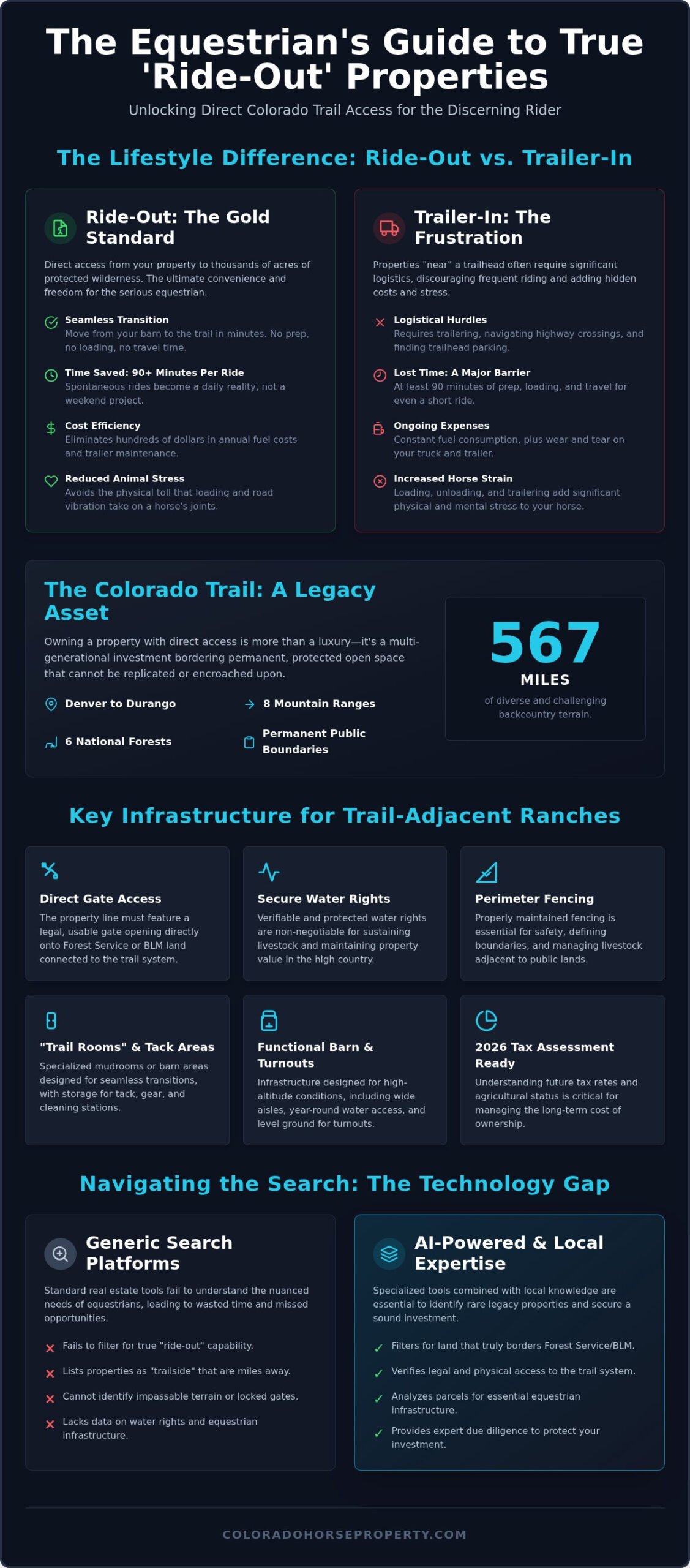
Stretching 567 miles from Denver to Durango, The Colorado Trail offers some of the most diverse and challenging backcountry terrain in North America. Properties that share a fence line with this corridor represent the gold standard of 2026 real estate because they eliminate the logistical hurdles that keep most riders stuck in an arena. The value premium for these parcels is significant. Buyers aren’t just paying for the acreage; they’re paying for the exclusive, permanent access to millions of acres of public land.
To see what this lifestyle looks like in practice, watch this tour of a historic estate with immediate trail connectivity:
Ride-Out vs. Trailer-In: The Practical Difference
The difference between these two lifestyles is purely practical. Trailering a horse requires at least 90 minutes of prep, loading, and travel for even a short ride. This logistical weight often discourages owners from riding during the work week. Direct access saves hundreds of dollars in fuel annually and eliminates the physical toll that loading and road vibration take on a horse’s joints. It expands your daily riding radius from a small arena to thousands of acres of protected wilderness. You don’t have to check if a trailhead parking lot is full; you just saddle up at your own barn and hit the dirt.
The Colorado Trail as a Legacy Asset
These properties are a finite resource. Because the trail often borders Forest Service and BLM land, these boundaries are permanent. This scarcity ensures that these ranches appreciate faster than standard mountain homes, as there’s no way to manufacture more land that touches the CT. A legacy equestrian property is a multi-generational asset bordering permanent open space. Investing in a horse property near Colorado Trail access means securing a piece of the West that cannot be encroached upon by future development. It’s a hedge against urban sprawl and a commitment to preserving the equestrian heritage of the Front Range.
Mapping the High-Value Segments: Where to Find the Best Trail Access
The Colorado Trail spans eight mountain ranges and six national forests. Finding the right horse property near Colorado Trail access depends on your tolerance for altitude and your proximity to urban centers. Each segment offers a distinct micro-market with unique challenges regarding climate and infrastructure. From the rolling foothills of the Front Range to the jagged peaks of the San Juans, the “best” segment is the one that aligns with your riding frequency and your horses’ metabolic needs.
The Front Range: Proximity to Denver and Tech Hubs
Douglas and Jefferson Counties represent the most sought-after segments for professionals who need to stay connected to Denver or Colorado Springs. Segments 1 through 3, running from Waterton Canyon to Buffalo Creek, offer lower elevations that permit longer riding seasons. The Indian Creek Trailhead serves as a primary artery for local riders, providing a gateway to the larger trail system. This area is highly competitive because it balances wilderness access with a manageable commute. Multiple studies on property values near trails confirm that these locations maintain higher resale values than isolated rural tracts. If you’re starting your search, our equestrian real estate Colorado guide provides a detailed breakdown of Front Range zoning.
The High Rockies: Ranching in the Clouds
Moving into Segments 11 through 13 near Leadville and the Arkansas River Valley, the landscape changes. At elevations exceeding 9,000 feet, you must account for high-altitude livestock management. Hay production is limited by a short growing season, so most owners import feed from lower valleys. Barns in this region require engineered roof systems to handle 2026 snow load standards, which can exceed 100 pounds per square foot in certain pockets. While these properties offer dramatic views of the Collegiate Peaks, they require a commitment to heavy-duty infrastructure and specialized winter care.
For those seeking rugged isolation, the Western Slope segments near Durango and Silverton offer dramatic San Juan Mountain scenery. These areas feature high-end recreational ranches with reliable water sources and direct forest boundaries. Balancing horse health means finding the “sweet spot” at 7,000 to 8,500 feet, where the air is manageable for performance horses but the trail access remains immediate. To narrow down these specific geographic pockets, you can search our latest listings using our proprietary mapping tools to find properties that truly border public land.
Evaluating Equestrian Infrastructure: Must-Have Features for Trail-Adjacent Ranches
Even with direct “ride-out” capability, you still need dedicated trailer parking. A large, gravel-based turnaround area remains essential for veterinary emergencies, transporting horses to regional shows, or accessing distant trail segments. Additionally, you must verify your water rights during the due diligence phase. In Colorado, water is a separate property right. You need to ensure your well or surface rights legally allow for livestock watering, especially during drought years when the Forest Service might restrict access to natural streams bordering the property.
Bordering public land creates a unique set of legal and practical challenges. If you want to install a private gate in your back fence to reach the dirt, you must consult Official Colorado Trail Information and local forest rangers. In many cases, a Special Use Permit is required to create a formal access point onto federal land. Perimeter fencing must be robust enough to keep your livestock in while managing the high volume of hikers and mountain bikers on the other side of the wire.
Living on the edge of the wilderness also means managing frequent wildlife encounters. Perimeter fences should be “wildlife friendly” to allow elk and deer to pass without injury, yet secure enough to deter predators. Bears and mountain lions are common along the trail corridor. Secure grain storage and bear-proof trash enclosures are non-negotiable for a horse property near Colorado Trail access. These safety measures protect your livestock and maintain the integrity of the surrounding ecosystem.
Horse Barns and Stables for the Trail Rider
In Colorado’s variable mountain climate, the choice between traditional stalls and loafing sheds is critical. Many trail riders prefer open-sided loafing sheds equipped with heated automatic waterers. These structures allow horses to self-regulate their temperature and maintain better respiratory health than they would in a closed barn environment. If you are debating between a custom build or an existing structure, check our guide on horse barns for sale to compare costs. The ideal trail-side barn is a low-maintenance, hardy structure with easy pasture turnover.
Navigating the Search: Using AI and Local Expertise to Secure Trail-Side Land
Generic residential search engines are inadequate for finding a horse property near Colorado Trail access. These mainstream platforms prioritize bedrooms and bathrooms over boundary lines and topography. They often label a property as “near trails” when it’s actually separated by a busy highway or a private parcel with no legal easement. Generic searches fail here. To secure a true ride-out location, you need data that standard residential feeds don’t highlight. Specialized expertise is non-negotiable for identifying these rare assets.
Leveraging AI for Niche Features
Our proprietary AI-Powered Horse Property Search changes the search dynamic. Instead of scrolling through thousands of irrelevant listings, our technology identifies specific topographical features and public land boundaries. It can filter for properties that share a physical border with the US Forest Service or BLM land. This allows you to find land with the right grazing acreage and legal water rights before it even hits the general market. For a broader look at the current market, check our 2026 guide on horse property for sale in colorado.
Local brokers often hold “pocket listings” that never appear on public sites. These off-market opportunities are frequent in high-demand areas near the CT. However, technology only gets you halfway. You still need physical verification. A map might show a trail connection. A physical inspection reveals if the terrain is actually navigable. We check for seasonal washes or impassable grades that digital maps often miss, ensuring your horses can safely reach the trail from your barn door.
Zoning and Land Management for Trail Properties
Zoning is another critical hurdle. In counties like Douglas or Jefferson, you’ll encounter A-1 and A-2 agricultural designations. A-1 zoning typically allows for more intensive livestock use. A-2 may have stricter limits on the number of animals per acre. Understanding these nuances is vital for transaction management. Additionally, many properties bordering the CT have conservation easements. These protect the land from development but may restrict where you can build a barn or arena. Our team handles the title and escrow coordination to ensure these complex ranch sales proceed without legal surprises.
If you’re ready to find a property that truly connects to the dirt, start your journey with our AI-Powered Horse Property Search today.
Expert Representation for Your Legacy Property: Partnering with Colorado Horse Property
Securing a horse property near Colorado Trail access isn’t a task for a real estate generalist. It requires a partner who understands the distinction between a scenic mountain view and a functional backcountry trailhead. Mark and Alison Eibner, operating under Realty Oasis, bring 40 years of Front Range real estate history to your search. Their expertise isn’t just in closing deals; it’s in the equestrian lifestyle itself. They understand the logistical demands of managing livestock at high altitudes and the legal complexities of bordering federal land. When you partner with us, you’re gaining an advocate who knows exactly what it takes to maintain a working ranch in the Colorado Rockies.
Our team provides full-cycle transaction management that covers every detail from initial valuation to the final handshake at closing. We offer access to a curated ecosystem of title, escrow, and land management partners who specialize in rural assets. This network is vital for navigating the technical hurdles of 2026 real estate, such as verifying water rights and ensuring legal access to public land corridors. We take the guesswork out of complex ranch sales, allowing you to focus on the dream of riding out from your own barn.
Why a Specialized Broker Matters
Many buyers fall into the “generalist trap” by hiring an agent who primarily sells suburban residential homes. An agent who doesn’t know horses won’t notice a poorly graded arena or a well that lacks the capacity for a 10-head herd. Negotiating the nuances of ranch land vs. farm land requires a deep understanding of soil types, grazing capacity, and water decree history. If you’re looking for larger legacy parcels, our guide to ranches for sale colorado breaks down these technical requirements in detail. Specialized knowledge prevents expensive mistakes that a generalist would likely miss.
Your Next Steps to Trail-Side Living
The 2026 market outlook for Colorado equestrian estates shows a continued trend of limited inventory for A-Class recreational ranches. Scarcity is driving value, particularly for properties with reliable water sources and direct trail connectivity. To stay ahead of other buyers, your first step is setting up a custom AI search alert for a horse property near Colorado Trail access. This tool identifies properties with the specific topographical features and boundary types we’ve discussed. Once you’ve identified a potential match, scheduling a consultation with the Eibners is the final step to validating the property’s utility and long-term investment potential. We’re here to help you secure a legacy asset that will serve your family for generations.
Secure Your Legacy on the Colorado Trail
Finding a horse property near Colorado Trail access is about more than a simple real estate transaction; it’s about securing a permanent connection to the Western landscape. We’ve explored how true ride-out capability transforms your daily routine and why specialized infrastructure is non-negotiable for mountain living. You now understand that verifying Forest Service boundaries and managing complex water rights are the essential pillars of a successful ranch acquisition in 2026. These steps ensure your property remains a functional asset for years to come.
With 40 years of local expertise, Mark and Alison Eibner help you navigate these technical hurdles with confidence. Our proprietary AI-powered niche search technology allows you to filter for the exact trail proximity and boundary types that generalist platforms often miss. We specialize in equestrian and legacy ranches, ensuring your investment is protected for generations. The trail is waiting. The right property is out there.
Find your dream Colorado Trail property with our AI search tool today!
Frequently Asked Questions
Can I legally install a private gate onto the Colorado Trail from my property?
You can generally install a private gate, but you must obtain a Special Use Permit from the U.S. Forest Service or the relevant land management agency first. Private gates onto federal land are not a deeded right. You must prove the gate won’t negatively impact trail integrity or wildlife corridors. We recommend verifying current 2026 Forest Service permit requirements during your due diligence period to ensure the gate is authorized.
What are the best counties for horse property near Colorado Trail access?
Douglas, Jefferson, and Lake Counties are the top choices for a horse property near Colorado Trail access. Douglas and Jefferson provide lower elevation riding and proximity to Denver, while Lake County offers high altitude alpine access near Leadville. Other high value regions include Chaffee County for the Collegiate Peaks and La Plata County for San Juan Mountain access. Each county has different zoning rules that affect livestock density and infrastructure.
Do I need special permits to keep horses on land bordering the US Forest Service?
You don’t need a federal permit to keep horses on your own private land, but you must comply with local county zoning and health regulations. However, if you plan to graze your horses on the adjacent Forest Service land, you must secure a specific grazing allotment or permit. Most trail adjacent owners focus on ride out access rather than grazing, which only requires following standard trail use regulations without a permit.
How many acres do I need for a horse property with trail access?
A minimum of 5 to 10 acres is usually necessary to support an equestrian lifestyle with direct trail connectivity. While smaller parcels exist, larger tracts of 35 acres or more provide better grazing rotation and privacy from trail traffic. In high demand areas like the Front Range, acreage is a finite resource. We use AI powered search technology to identify properties that maximize usable land while maintaining direct boundaries with the Colorado Trail.
Are there specific sections of the Colorado Trail that are closed to horses?
Most of the 567 mile Colorado Trail is open to equestrians, but certain wilderness areas have specific restrictions. Horses are permitted through all segments, though some high altitude passes or rocky sections may be challenging for inexperienced stock. It’s vital to check for temporary seasonal closures due to trail maintenance or wildlife protection. Our team verifies trail connectivity and terrain navigability for every listing we represent to ensure it meets specific rider needs.
How does proximity to the Colorado Trail affect property taxes?
Proximity to the trail itself doesn’t trigger a specific tax, but the land’s classification is the primary factor. In 2026, residential property is assessed at 7.05% for schools and 6.8% for local governments. If your property is classified as agricultural, the rate is 25% to 26%. Because trail adjacent properties are often legacy assets with significant acreage, maintaining an agricultural status can be a strategic way to manage long term holding costs.
What should I look for regarding water rights on a trail-adjacent ranch?
You must verify that your water rights are legally decreed for livestock use and not just domestic household use. In Colorado, water is a separate property right and isn’t automatically included with the land. Look for senior water rights that provide a reliable source during drought years. We coordinate with title and escrow experts to perform deep dive due diligence on well permits and surface rights before you commit to a purchase.
How can I find off-market horse properties near the Colorado Trail?
Finding off-market pocket listings requires a combination of local networking and advanced technology. We use a proprietary AI powered horse property search tool that identifies niche features and public land boundaries before they reach standard platforms. With 40 years of Front Range experience, Mark and Alison Eibner maintain relationships with long term landowners who may be considering a private sale. This approach gives our clients access to rare, trail side estates.