
Why does a standard mortgage lender see your dream equestrian estate as a high-risk “hobby farm” rather than a sound investment? It’s frustrating to find that traditional banks often lack the framework to value specialized infrastructure like professional arenas or agricultural zoning. You’ve likely realized that financing a horse property in Colorado requires much more than a standard residential application. The technicalities of water rights and land management can stall a transaction before it even begins.
This guide provides the expert clarity you need to handle the 2026 Colorado lending landscape. You’ll learn how to secure a mortgage that covers both your home and your acreage while leveraging the latest state programs designed for rural buyers. We will break down the impact of Senate Bill 26-010 on your property taxes and explore the 4% fixed-rate Colorado Agricultural Future Loan program. We also detail the 2026 conforming loan limits, which have reached $832,750 for most counties, to help you plan your purchase with precision and confidence.
Key Takeaways
- Learn how to navigate the “appraisal gap” that occurs when specialized equestrian infrastructure like barns and arenas carries a high percentage of the property’s total value.
- Discover why financing a horse property requires a specialized approach compared to standard residential loans, particularly when dealing with Colorado’s unique acreage tiers.
- Understand the critical role of Colorado water rights and “Right to Farm” zoning laws in securing final mortgage approval for your estate.
- Identify the specific liquidity reserves and debt-to-income metrics that niche lenders require to ensure you can manage high-maintenance equestrian facilities.
- Learn how to use AI-powered search technology to filter for properties that specifically meet the technical requirements for USDA or Farm Credit financing.
Why Financing a Horse Property Differs from Standard Residential Loans
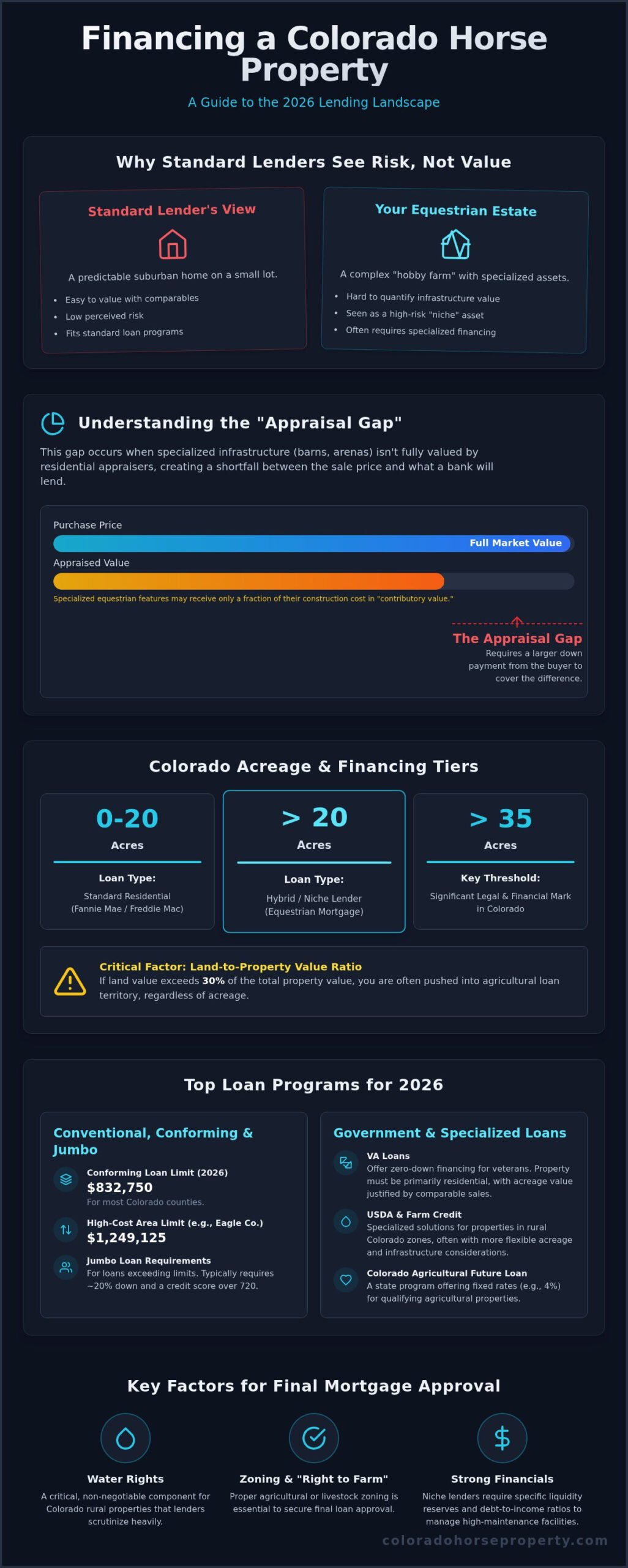
Lenders often struggle with the “appraisal gap” found on equestrian estates. This happens when a property features high-value improvements like a $200,000 indoor arena or a custom 10-stall barn. A residential appraiser might only give these structures a fraction of their construction cost in “contributory value” because they don’t fit the standard residential mold. This leaves a gap between the purchase price and the loanable amount, often requiring a larger down payment from the buyer.
The Residential vs. Agricultural Threshold
In Colorado, the 35-acre mark is a significant legal and financial threshold. For many lenders, once a property exceeds 10 or 20 acres, it no longer qualifies for standard Fannie Mae or Freddie Mac programs. These agencies are designed for “residential” use, and they often cap the amount of land value they’ll include in a loan. If the land value exceeds 30% of the total property value, you’ll likely find yourself pushed into agricultural loan territory. An equestrian mortgage acts as a hybrid between residential and agricultural lending. Underwriters must determine the “highest and best use” of the parcel. If the property is capable of generating income through boarding or training, it may be classified as a commercial farm, which carries different interest rates and stricter debt-to-income requirements.
Why Your Local Bank Might Say No
Local retail banks often lack the expertise to evaluate complex rural assets. They rely on “comparable sales” within a tight radius, which are rare for specialized horse properties. A property with senior water rights or specific zoning for livestock requires a deeper level of due diligence than a city bungalow. For those planning a commercial venture, understanding Farm Service Agency operating loans is vital for managing ongoing costs, yet most residential lenders won’t even mention these options.
The risk assessment for non-standard infrastructure, like round pens or specialized fencing, often leads to rejection from generalist banks. They see these features as “liquidity risks” that might make the property harder to sell in a foreclosure. This is why working with equestrian real estate Colorado specialists is essential. These professionals bridge the communication gap by providing lenders with the data they need to understand the true market value of equestrian infrastructure. They ensure that financing a horse property doesn’t stall due to a lack of specialized knowledge on the lender’s part.
Top Loan Programs for Colorado Equestrian Estates in 2026
Choosing the right strategy for financing a horse property involves matching your specific acreage with a lender’s risk appetite. In 2026, Colorado buyers have more options than ever, but the requirements are strict. For properties under 10 acres that serve primarily as a residence, a conventional mortgage is often the most efficient path. The 2026 conforming loan limits have increased to $832,750 for most Colorado counties, while high-cost areas like Eagle County now allow up to $1,249,125. If your dream estate exceeds these limits, a Jumbo loan is necessary, typically requiring a 20% down payment and a credit score above 720.
Veterans looking to establish a ranch can utilize VA loans, which offer zero-down financing. While the VA doesn’t set a hard limit on acreage, the property must have a residential focus. The appraiser will need to find similar sold properties in the area to justify the value of the land and outbuildings. If you’re struggling to find a property that fits these traditional buckets, you can use our AI-powered search to filter for listings that specifically match your financing criteria.
USDA and Farm Credit: Specialized Solutions
For buyers targeting rural Colorado zones, the USDA offers unique advantages. The USDA Section 502 Direct Loan Program currently offers a 5.25% interest rate for eligible low-income borrowers in rural areas. This is significantly lower than the standard 30-year fixed rates, which hovered around 6.875% in August 2026.
For larger operations or commercial facilities, Farm Credit remains the gold standard. Unlike traditional banks, Farm Credit is a cooperative. They offer “Patronage Dividends,” which effectively return a portion of your interest payments back to you at the end of the year. This can lower your effective interest rate by 1% or more. They are also far more comfortable with variable rate structures for agricultural land, which can provide flexibility if you expect rates to drop in the future.
Financing for Raw Land vs. Improved Property
Buying vacant land in Colorado requires a different financial profile. Most lenders require a down payment of 25% to 35% for raw land because it represents a higher risk. If you plan to build, a construction-to-permanent loan is your best tool. This allows you to finance the purchase of the land and the cost of building horse barns for sale or custom stables under a single closing. Once the certificate of occupancy is issued, the loan automatically converts into a traditional mortgage, saving you on closing costs and protecting you from interest rate hikes during the construction phase.
How Colorado Property Features Impact Your Mortgage Appraisal
When financing a horse property, the appraisal process moves beyond the four walls of the home. A residential appraiser often struggles to assign value to specialized equestrian infrastructure. Features like professional-grade footing, heated wash racks, or expansive hay sheds are frequently depreciated or even “zeroed out” if the appraiser cannot find similar local sales. This creates a discrepancy between the market price and the loanable value. Understanding how farmland is valued as an asset class helps buyers realize why lenders view acreage with skepticism. They look for “highest and best use,” and if your improvements are too niche, the bank may see them as a liability rather than an asset.
Lenders also demand proof of legal access and clear easements. In rural Colorado, many properties are reached via shared private roads or across adjacent parcels. If a formal, recorded easement for ingress and egress is missing, the loan will be denied. Your title company must verify that these access points are legally binding and transferable. Any ambiguity regarding property boundaries or encroaching fences can stall the funding process. This is why we partner with specialized title and escrow companies that understand the intricacies of ranch transactions.
Water Rights and Well Permits
Water is the most critical factor in Colorado real estate valuation. A property without adequate water is essentially unfinanceable for livestock use. Lenders look closely at the type of well permit attached to the land. A “household only” permit generally prohibits watering livestock or irrigating pastures. For a functional horse property, you typically need a “domestic” permit, which allows for the watering of domestic animals. A lack of senior water rights can lead to a declined loan because the property’s long-term utility is at risk. For a deeper look at these technicalities, see our guide on water rights in Colorado.
Zoning and Land Use Codes
Before issuing a loan commitment, underwriters must verify that the property’s zoning allows for your intended number of horses. Most Colorado counties use “Animal Units Per Acre” (AUPA) to determine capacity. If a property is currently used for ten horses but only zoned for two, it’s considered a “non-conforming use.” This legal mismatch can trigger an immediate loan denial. Lenders also require an Improvement Location Certificate (ILC) or a full survey during the financing a horse property process. This document ensures that all barns, arenas, and septic systems are within property lines and comply with local setback requirements. Ensuring these legal markers are in place protects both your investment and the lender’s collateral.
Preparing Your Financial Profile for an Equestrian Loan
Lenders for equestrian estates scrutinize your financial health differently than residential banks. When you’re financing a horse property, your debt-to-income (DTI) ratio must account for the higher carrying costs of acreage. While a 43% DTI is a common residential ceiling, agricultural lenders often look for more conservative numbers unless the property is income-producing. You need cash on hand. Most specialized lenders require a substantial liquidity reserve, often six to twelve months of mortgage payments. This cash ensures you can handle specialized repairs like fence mending, tractor maintenance, or emergency well service without defaulting on your loan.
Documenting your income requires a detailed approach if you intend to run a professional operation. Standard W-2s work for the residential portion, but income from boarding, training, or agricultural leases must be consistent over a two-year period to be considered. For 2026, most specialized lenders look for a credit score of 700 or higher to secure the most competitive rates. With conventional 30-year fixed rates at 6.875% as of August 2026, a strong credit profile is your best leverage to keep monthly costs manageable.
Proving Income from the Land
If your property qualifies as a farm or ranch, you’ll likely use Schedule F (Profit or Loss from Farming) on your tax returns. This document is essential for qualifying for larger agricultural loans. If you are eyeing commercial ranches for sale colorado, a professional business plan is often required. This plan should outline your revenue streams, whether from hay production or livestock sales, to prove the land’s viability to the underwriter. Be prepared to discuss any conservation easements, as these can provide tax benefits but might impact the total appraisal value used for the loan.
Closing Costs and Escrow Considerations
Ranch transactions involve unique expenses that suburban buyers don’t face. You must budget for specialized inspections, including well-flow tests, septic scoping, and soil analysis for arena drainage. These can easily double your initial inspection budget. Title insurance is also more complex here. It must protect against ancient mineral right claims that could allow third parties to access your land. Because of these technicalities and the need for new surveys or water right transfers, expect an escrow period of 45 to 60 days. If you need assistance preparing for these complex requirements, our team provides expert buyer representation specifically for Colorado’s rural markets.
Strategic Searching: Finding Financeable Colorado Horse Properties
The search for an equestrian estate should never be a hunt for a home alone. It’s a search for a financeable asset. In the 2026 Colorado market, the most successful buyers align their property search with their lender’s specific requirements from day one. This prevents the heartbreak of falling in love with a property that a bank simply won’t touch. One of the most effective ways to streamline financing a horse property is to target parcels that already possess an agricultural tax classification. Under Senate Bill 26-010, which became effective in March 2026, the definition of “farm” and “ranch” was broadened to include more small, pasture-based operations. This is vital for your financial profile because agricultural property is assessed at just 25% of its actual value, significantly lowering your monthly tax obligation and improving your debt-to-income ratio.
In Colorado, “35+ acres” remains a magic number for many financing programs. Parcels of this size often bypass the complex county subdivision regulations that can complicate title work. Lenders, particularly those through Farm Credit or the USDA, view these larger tracts as true agricultural assets rather than residential “hobby farms.” This distinction often leads to more favorable loan terms and higher appraisal values for outbuildings. Identifying these properties early in your search allows you to approach lenders with a clear, low-risk collateral profile.
Leveraging AI for Financial Efficiency
Our proprietary AI-powered search technology changes how buyers identify viable estates. Instead of manually sifting through thousands of listings, the AI filters for “loan-ready” features such as documented senior water rights, permitted domestic wells, and professional-grade arenas. It identifies properties where the infrastructure value is supported by local comparable sales, which is essential for a smooth appraisal process. AI-driven data reduces the risk of a failed appraisal by identifying properties with infrastructure that matches current lending standards. This precision ensures you don’t waste time or inspection fees on properties with unpermitted structures or insufficient water access.
The Expert Advantage in 2026
The complexity of 2026 lending requires more than just a real estate license. It requires a deep referral network of niche lenders who understand the value of a 10-stall barn or a specialized irrigation system. Mark and Alison Eibner bring a 40-year legacy of experience in the Colorado rural market to every transaction. This longevity means they speak the “language of lenders” and can advocate for the true value of your equestrian improvements during the underwriting process. They partner with specialized title and escrow companies to ensure that every easement and water right is perfectly documented for the bank’s final approval. Start your journey by browsing horse property for sale in colorado today to find an estate that fits both your lifestyle and your financial goals.
Secure Your Colorado Equestrian Legacy
Success in the 2026 market requires a shift from standard residential thinking to a specialized agricultural perspective. You now understand that financing a horse property involves more than just a credit check. It’s about validating senior water rights, navigating “Right to Farm” zoning, and bridging the appraisal gap for specialized infrastructure. By identifying properties that fit the 35-acre threshold or carry existing agricultural tax status, you can lock in more favorable terms and protect your long-term investment from the start.
Our team provides the expert guidance necessary to navigate these technical hurdles. We combine 40 years of Colorado ranch expertise with a specialized lender referral network to ensure your transaction remains on track. You don’t have to guess which properties meet bank standards or struggle with uncooperative underwriters. Search Financeable Colorado Horse Properties with Our AI Tool today to find estates that align with your financial profile and lifestyle goals. We are ready to help you turn your vision of a high-country ranch or Front Range stable into a reality. Your future in the Colorado landscape starts with a single, strategic search.
Frequently Asked Questions
What is the minimum down payment for a horse property in Colorado?
Minimum down payments range from 0% to 35% depending on the loan program and property size. For a standard residential horse property under 10 acres, you might qualify for a conventional loan with 5% down. However, larger tracts or raw land usually require 25% to 35% down because lenders view acreage as a higher risk. Specialized programs like VA or USDA offer zero-down options for eligible rural Colorado properties.
Can I use a standard FHA loan to buy a farm with horses?
You can use a standard FHA loan for a horse property if the land is considered an accessory to the primary residence. FHA guidelines generally prohibit properties used for commercial agricultural operations or income-producing boarding facilities. If the property is a hobby farm where horses are kept for personal use and the acreage is typical for the area, FHA financing remains a viable option.
How do water rights affect my ability to get a mortgage?
Water rights are a fundamental requirement for securing a mortgage on a Colorado ranch or estate. Lenders require proof of a permitted well or decreed water rights to ensure the property has a legal, long-term water supply for both the home and livestock. If a property lacks senior water rights or has a restricted household-only permit, the bank may decline the loan due to the diminished value and utility of the land.
Do lenders consider income from horse boarding when qualifying me for a loan?
Most lenders will consider income from horse boarding if you can document a two-year history of that income on your tax returns. You’ll typically need to provide Schedule F or a similar business profit and loss statement to prove the consistency of the revenue. Without this historical data, banks generally exclude potential boarding income from your debt-to-income calculations when you are financing a horse property.
Is it harder to finance a property with an indoor riding arena?
Financing a property with an indoor riding arena is often more difficult because of the appraisal gap. Residential appraisers frequently struggle to find comparable sales with similar structures, which may lead them to under-value the arena. If the arena’s value isn’t supported by local comparable sales, you may need to provide a larger down payment to cover the difference between the purchase price and the appraised value.
What is the difference between a residential and an agricultural appraisal?
A residential appraisal focuses on the home’s living square footage and neighborhood sales; meanwhile, an agricultural appraisal values the land’s productivity and specialized outbuildings. Agricultural appraisers consider soil quality, irrigation infrastructure, and the income-generating potential of the barns or arenas. This specialized approach is necessary for financing a horse property that exceeds standard residential acreage limits or involves commercial operations.
Can I finance the construction of a new barn into my home mortgage?
You can finance the construction of a new barn into your mortgage using a construction-to-permanent loan or a specialized renovation product. These loans allow you to bundle the costs of the land, home, and equestrian infrastructure into a single closing. Once the barn is completed and the certificate of occupancy is issued, the construction loan converts into a traditional long-term mortgage, which protects you from multiple sets of closing costs.
How many acres do I need to qualify for a USDA loan in Colorado?
There is no strict maximum acreage limit for a USDA loan in Colorado, but the property must be located in a designated rural area. The land value cannot significantly exceed the value of the dwelling, and the property must be used primarily as a residence rather than a commercial farm. Our AI search tool helps identify properties in counties like Weld or Elbert that meet these specific USDA geographic and usage requirements.