
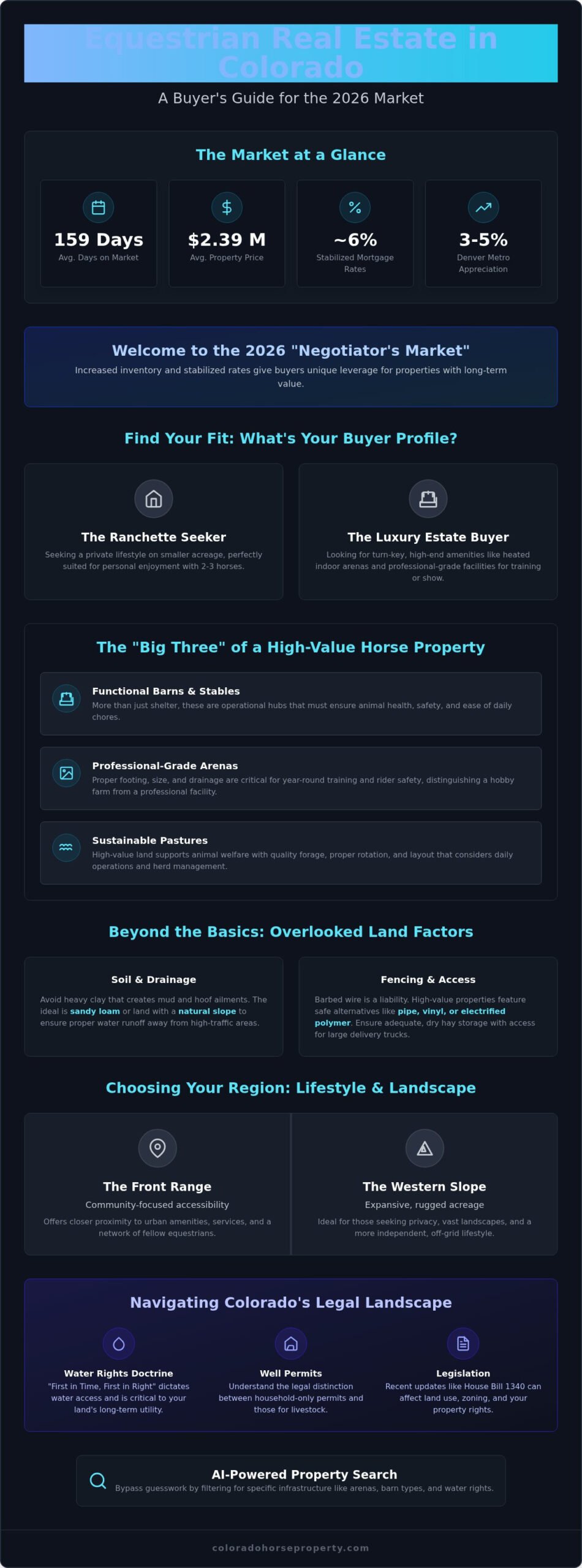
Did you know the average equestrian property in Colorado sits on the market for 159 days? This extended timeline often stems from a fundamental mismatch between generic equestrian real estate Colorado listings and the technical realities of high-altitude land management. You’ve likely spent hours scrolling through “horse-friendly” properties only to discover they lack the specific infrastructure, well permits, or irrigation rights your animals require. It’s frustrating when a property looks perfect on screen but fails the test of Colorado’s complex zoning laws.
This guide provides a streamlined path to your dream property by combining proprietary AI-powered search technology with 40 years of local expertise. You’ll gain the confidence to navigate a 2026 “negotiator’s market” where water rights and regional nuances dictate long-term value. Our goal is to help you bypass the guesswork and focus on properties that meet your exact specifications for acreage and facilities.
We’ll break down the differences between the Front Range and the Western Slope, explain the critical “first in time, first in right” water doctrine, and reveal how 2026 legislative updates like House Bill 1340 affect your land use. You’ll finish this guide with a clear strategy to secure a functional, legal, and beautiful home for your herd.
Key Takeaways
- Learn how to use proprietary AI search tools to filter listings by specific infrastructure like arenas and barns, eliminating the frustration of vague “horse-friendly” descriptions.
- Discover why the 2026 “negotiator’s market” offers unique leverage for buyers seeking equestrian real estate Colorado with long-term appreciation potential.
- Understand the critical legal distinction between household and livestock well permits and how the “first in time, first in right” doctrine impacts your land’s utility.
- Identify the “Big Three” infrastructure features—barns, arenas, and pastures—that define a high-value property and ensure proper drainage for year-round riding.
- Compare the community-focused accessibility of the Front Range with the expansive, rugged acreage of the Western Slope to find the region that best fits your lifestyle.
The State of Equestrian Real Estate in Colorado for 2026
True equestrian real estate Colorado is defined by more than a house and a perimeter fence. In 2026, savvy buyers recognize these properties as complex operational assets that require specific infrastructure to support animal health and rider safety. The demand for these properties remains high because they represent a connection to the historic and pioneer spirit of the West, offering a lifestyle that general residential developments can’t replicate.
To better understand how high-end infrastructure transforms a property, watch this look at a premier estate:
Why Niche Expertise Matters in the Rockies
General real estate platforms often fail equestrian buyers because they don’t distinguish between a hobby farm and a professional training facility. A property might be listed as horse-friendly yet lack the drainage or soil quality necessary for year-round riding. With Denver metro home values expected to appreciate by 3 to 5 percent in 2026, making the right choice is critical for your equity. Specialized equestrian real estate Colorado experts protect your investment by auditing well permits and verifying that the land can actually support your intended number of horses.
The 2026 Buyer Profile: What Are You Looking For?
Today’s buyers typically fall into two categories. Many are seeking the Ranchette, a smaller acreage property that offers a private lifestyle for two or three horses without the maintenance of a full-scale ranch. Others are looking for luxury estates that feature high-end amenities like heated indoor arenas and professional-grade stalls. Identifying whether your goal is personal enjoyment or professional training determines which regional zoning and infrastructure requirements will be most relevant to your search.
Essential Features of a High-Value Horse Property
Finding a premium piece of equestrian real estate Colorado requires looking past the aesthetic appeal of a farmhouse. You must evaluate the “Big Three” of infrastructure: functional barns, professional-grade arenas, and sustainable pasture. These elements dictate the property’s utility and its long-term resale value. High-value land isn’t just about size; it’s about how the layout supports daily operations and animal welfare.
Soil quality and drainage are often overlooked but critical. In the Rockies, you want to avoid heavy clay that turns into a bog during the spring thaw. Look for sandy loam or properties with a natural slope that directs water away from high-traffic areas. Mud creates a breeding ground for hoof ailments and makes daily chores a nightmare. If you’re unsure about a specific parcel’s drainage, you can consult with a specialist to review the land’s topography before making an offer.
Fencing and storage also play major roles in property valuation. Barbed wire is a liability and should be replaced with safe alternatives like pipe, vinyl, or electrified polymer. Additionally, ensure there’s adequate hay storage. A single horse consumes thousands of pounds of forage annually. You need a dry, ventilated space that’s accessible for large delivery trucks and tractors. Without proper equipment access, your maintenance costs will skyrocket.
Barns and Stables: More Than Just Shelter
Modern equestrian facilities prioritize air quality and ergonomics. Look for 12×12 stalls with rubber mats and integrated ventilation systems. A high-value barn often includes a dedicated wash rack with hot water, a climate-controlled tack room, and perhaps a small office. When evaluating horse barns for sale, consider the “buy vs. build” reality. In 2026, the cost of materials makes purchasing an existing, well-designed barn significantly more efficient than starting a new construction project.
Arenas and Riding Surfaces
Colorado’s climate makes an indoor arena a prized asset for equestrian real estate Colorado, allowing for training through the winter months. If a property only has an outdoor arena, inspect the footing carefully. Soundness starts from the ground up. You need a stable base of compacted rock topped with high-quality sand or a synthetic mix. Finally, verify the zoning. A private arena is usually permitted, but if you plan to host clinics or board horses, you’ll likely need a Special Use Permit from the county.
Navigating Colorado Water Rights and Zoning Laws
In the high desert climate of the Rockies, water isn’t just an amenity. It’s the most valuable asset on a ranch. Agriculture accounts for approximately 80% of the water use in the Colorado River basin, making it the central focus of land value and legal disputes. When evaluating equestrian real estate Colorado, you must look beyond the surface of a property to understand the invisible legal framework that dictates its utility.
One of the most common pitfalls for new buyers is misunderstanding well permits. A standard “household use only” permit does not legally allow you to water livestock or irrigate a pasture. You specifically need a permit that allows for livestock watering. If a property relies on a well, verifying the permit’s augmentation plan is a non-negotiable step in your due diligence. Without the correct water rights, a beautiful ten-acre parcel may be legally restricted to a single-family home with no animals allowed.
Colorado Water Law 101
Colorado operates under the doctrine of prior appropriation. This principle, often summarized as “first in time, first in right,” means the first person to divert water for a beneficial use holds the senior right. In 2026, as negotiations over the Colorado River Compact intensify, senior rights have become even more critical for long-term investment security. These rights significantly impact horse property for sale in Colorado pricing. A parcel with adjudicated water shares will always command a premium over dryland property because it guarantees forage production even during drought cycles.
Zoning and Land Use Permits
Zoning laws determine exactly how many horses you can keep on your land. While a general guideline suggests 1 to 2 acres per horse on irrigated pasture, non-irrigated dryland may require 30 to 40 acres per horse to meet forage needs. You cannot assume that a rural designation automatically grants you unlimited animal density. Most counties have strict “Right to Farm” laws that protect agricultural activities, but they also impose limits to prevent overgrazing and soil erosion.
If you plan to run a commercial operation like boarding or training, you’ll likely need a Conditional or Special Use Permit. These permits are not guaranteed and often involve public hearings. Specialized agents who understand horse real estate for sale legalities can help you navigate these hurdles. They ensure that easements or public access issues don’t interfere with your private use or liability coverage. Protecting your investment means verifying every legal detail before the closing date.
Top Colorado Regions for Equestrian Living
Choosing a location for equestrian real estate Colorado requires a clear understanding of how the state’s geography dictates your daily routine. The climate and soil vary significantly from the plains to the peaks, affecting everything from forage quality to training schedules. With an average of 159 days on market for horse properties, buyers have time to evaluate these regional differences before committing to a specific zip code.
The Front Range Corridor (Parker, Elizabeth, Castle Rock)
Parker remains the undisputed hub for competitive riders. Its proximity to the Colorado Horse Park makes it a magnet for those involved in show circuits. In the suburban-rural fringe of Elizabeth and Castle Rock, you’ll find a high concentration of professional facilities and social communities. While home values here are expected to appreciate by 3 to 5 percent in 2026, the demand for ranches for sale Colorado stays strong due to the balance of accessibility and infrastructure. These areas offer the best veterinary access and specialized farrier services in the state.
Western Slope and High Country
If your goal is expansive acreage and a rugged lifestyle, the Western Slope is the premier choice. This region is ideal for those looking at colorado ranches for sale that can support both cattle and horses. You’ll need to account for high-altitude management, as horses require time to acclimate to thinner air and different mineral profiles in the soil. Public land access is a major draw here, with thousands of acres of BLM and National Forest land available for trail riding. Keep in mind that non-irrigated dryland in this region often requires 30 to 40 acres per horse to sustain forage needs during the summer months.
Southern Colorado is also emerging as a high-value alternative. Areas around Pueblo and Trinidad offer diverse landscapes and more affordable entry points for equestrian real estate Colorado. These regions provide longer riding seasons due to milder winters, though water rights remain a critical factor in every transaction. Whether you prefer the groomed arenas of the Front Range or the wild trails of the High Country, your regional choice will define your equestrian legacy.
Ready to explore these diverse landscapes? Start your regional property search today with our specialized AI tools.
How AI is Revolutionizing the Horse Property Search
Traditional real estate platforms often fail because “horse-friendly” is a subjective and dangerously vague term. To a generalist agent, it might mean a small backyard with a shed. To a serious rider, it requires the specific infrastructure, soil quality, and legal permits discussed in previous sections. Using AI to find equestrian real estate Colorado allows you to strip away the noise and focus on technical viability. Instead of scrolling through hundreds of irrelevant listings, you can target properties that already possess adjudicated water rights and professional-grade drainage.
AI technology analyzes data points that are often buried in deep property records. It cross-references county zoning designations with listing descriptions to ensure a property actually supports your specific animal density requirements. This precision saves weeks of wasted site visits and prevents the frustration of falling in love with a property that can’t legally house your horses. However, data is only one part of the equation. You still need a seasoned expert to interpret the “boots on the ground” reality of a property’s condition and local community nuances.
Using the AI-Powered Horse Property Search
Finding your legacy ranch shouldn’t be a full-time job. Our proprietary system streamlines the discovery phase into three actionable steps:
- Step 1: Define your “Must-Have” equestrian features. Specify your requirements for the number of stalls, indoor arena dimensions, and the specific type of footing you need for your discipline.
- Step 2: Filter by Colorado-specific land requirements. Narrow your search by well permit types, irrigation shares, and specific county zoning designations to ensure legal compliance from day one.
- Step 3: Receive real-time alerts. Get notified the moment a property hitting your exact technical specs enters the market. This speed is critical in 2026, as turn-key estates often move faster than the general market average.
Partnering with a Specialized Brokerage
Mark and Alison Eibner, operating under Realty Oasis, offer a complete ecosystem designed for the rural and agricultural buyer. With 40 years of service in the Colorado Front Range, they understand that a transaction involves more than just a standard contract. By integrating title, escrow, and transaction management through specialized partnerships, they ensure that complex water right transfers and agricultural easements are handled with professional precision.
Finding the right home for your herd in the 2026 market requires a blend of high-tech data and high-touch expertise. Don’t settle for generic search results that ignore the technical needs of your livestock. Start your AI-Powered Horse Property Search today and discover how equestrian real estate Colorado specialists can simplify your journey from search to stable.
Secure Your Colorado Equestrian Legacy in 2026
Finding the right equestrian real estate Colorado property is about more than finding a home with a view. It requires a disciplined approach to evaluating water rights, soil drainage, and specialized infrastructure. As the 2026 market continues to favor prepared buyers, having the right data at your fingertips ensures you don’t miss out on turn-key estates that meet your specific training or lifestyle needs. You’ve seen how critical it is to verify well permits and regional zoning before signing a contract.
You can bypass the frustration of generic listings by leveraging technology designed for the unique requirements of horse owners. Mark and Alison Eibner bring 40 years of local real estate experience to your search, providing the expert buyer representation needed to navigate complex land transactions. By combining proprietary AI filtering for barns and arenas with deep regional knowledge, you can move forward with total confidence. Your dream of owning a functional, high-value ranch is well within reach when you have the right tools and expertise behind you.
Find your next Colorado Horse Property with our AI Search Tool and start your next chapter in the Rockies today.
Frequently Asked Questions
How many acres do I need for two horses in Colorado?
You need approximately 2 to 4 acres for two horses if the land is managed, irrigated pasture. However, if you are looking at non-irrigated dryland common in many parts of the state, you may require 60 to 80 acres to meet forage needs without overgrazing. Always check specific county animal density regulations, as these limits vary. Understanding these requirements is essential when evaluating equestrian real estate Colorado to ensure the land can legally support your animals.
What is the difference between domestic and livestock well permits?
A domestic well permit is typically restricted to ordinary household uses like drinking and sanitation inside the home. In contrast, a livestock well permit specifically authorizes the watering of horses and other animals. Many rural properties in Colorado have “household use only” permits that legally prohibit watering livestock. You must verify the specific permit type during your due diligence period to avoid legal restrictions that could prevent you from keeping horses on the property.
Does a property need to be zoned agricultural to have horses?
A property does not always need to be zoned strictly agricultural, but it must have a zoning designation that permits livestock or equine use. Many residential-agricultural or rural-residential zonings allow for horses with specific density limits. It is vital to review the county’s land use code and any existing HOA covenants, as these can be more restrictive than county rules. Never assume that a large lot automatically grants you the right to house animals.
What are the best counties in Colorado for horse properties?
Douglas and Elbert counties are premier choices for those seeking proximity to the Front Range and the Colorado Horse Park. For buyers wanting more expansive, rugged acreage, Mesa and Montrose counties on the Western Slope offer excellent value and access to public lands. Weld County is also a top destination due to its strong agricultural heritage and flatter terrain. Your choice should depend on whether you prioritize show circuit access or expansive trail riding opportunities.
How do I verify water rights on a ranch for sale?
You verify water rights by examining the property deed and researching records with the Colorado Division of Water Resources. Water rights are often separate from the land, so you must confirm if the rights are being transferred and what their priority date is. In 2026, securing senior water rights is more important than ever due to ongoing Colorado River negotiations. A specialized agent can help you navigate these complex legal documents to protect your investment.
Can I build a riding arena on any property in Colorado?
You cannot build a riding arena on every property because construction is subject to local zoning laws, setback requirements, and lot coverage limits. While small private arenas are often allowed in rural zones, large indoor structures or commercial facilities typically require a Special Use Permit. You must also consider drainage and soil stability to ensure a safe riding surface. Always verify these regulations with the county planning department before planning any major equestrian infrastructure projects.
What should I look for in a horse barn when touring a property?
Look for proper ventilation, 12×12 stall sizes, and high-quality flooring like rubber mats over a leveled base. Inspect the structural integrity of the barn and check for fire safety features and adequate electrical systems for lighting and heaters. Ensure there is a dedicated space for hay storage that is dry and easily accessible for delivery trucks. A well-designed barn is a cornerstone of equestrian real estate Colorado and significantly impacts the daily health of your horses.
Why should I use a specialized equestrian realtor instead of a general agent?
A specialized realtor understands technical details like well permits, water rights, and equine zoning that general agents often overlook. They can identify if a property’s soil and drainage are suitable for year-round riding or if a barn meets professional standards. Mark and Alison Eibner provide 40 years of local expertise and proprietary AI tools to filter for these specific features. This niche focus saves you time and protects you from making a high-stakes investment in a non-functional property.