
Most “trail-adjacent” listings on the Front Range are actually a three-mile haul down a busy highway from the nearest trailhead. It’s a common bait-and-switch that leaves horse owners frustrated and tethered to their trailers. You’ve likely spent hours scrolling through properties that claim to offer freedom, only to find a locked gate or a dangerous road standing between your barn and the open range. We understand that for a true equestrian, the dream isn’t just owning land; it’s the ability to tack up and ride straight into the backcountry without ever touching a hitch.
This 2026 guide is designed to help you identify and secure a rare equestrian property with direct trail access Front Range riders actually want. You’ll learn how to verify legal ride-out rights, navigate the 25% agricultural tax assessment benefits, and protect your assets amid Colorado’s complex water laws. We’re diving into the technical infrastructure requirements and the specific areas where “direct access” is a reality rather than a sales pitch. By the end, you’ll have the expert knowledge needed to claim your piece of the Colorado landscape with confidence.
Key Takeaways
- Understand the critical difference between “trail-adjacent” and true ride-out access to ensure your daily rides never require a trailer.
- Learn to identify legal deeded easements and historical usage rights to prevent “locked gate” disputes on public land boundaries.
- Discover how to evaluate an equestrian property with direct trail access Front Range markets offer by focusing on “trail-ready” barn layouts and secure perimeter fencing.
- Navigate the complexities of 2026 Colorado water rights and agricultural tax assessments to protect your investment’s long-term value.
- Leverage specialized AI-powered search tools to filter for specific topography and verified trail hubs that generic real estate platforms often overlook.
The ‘Ride-Out’ Reality: Defining Direct Trail Access in 2026
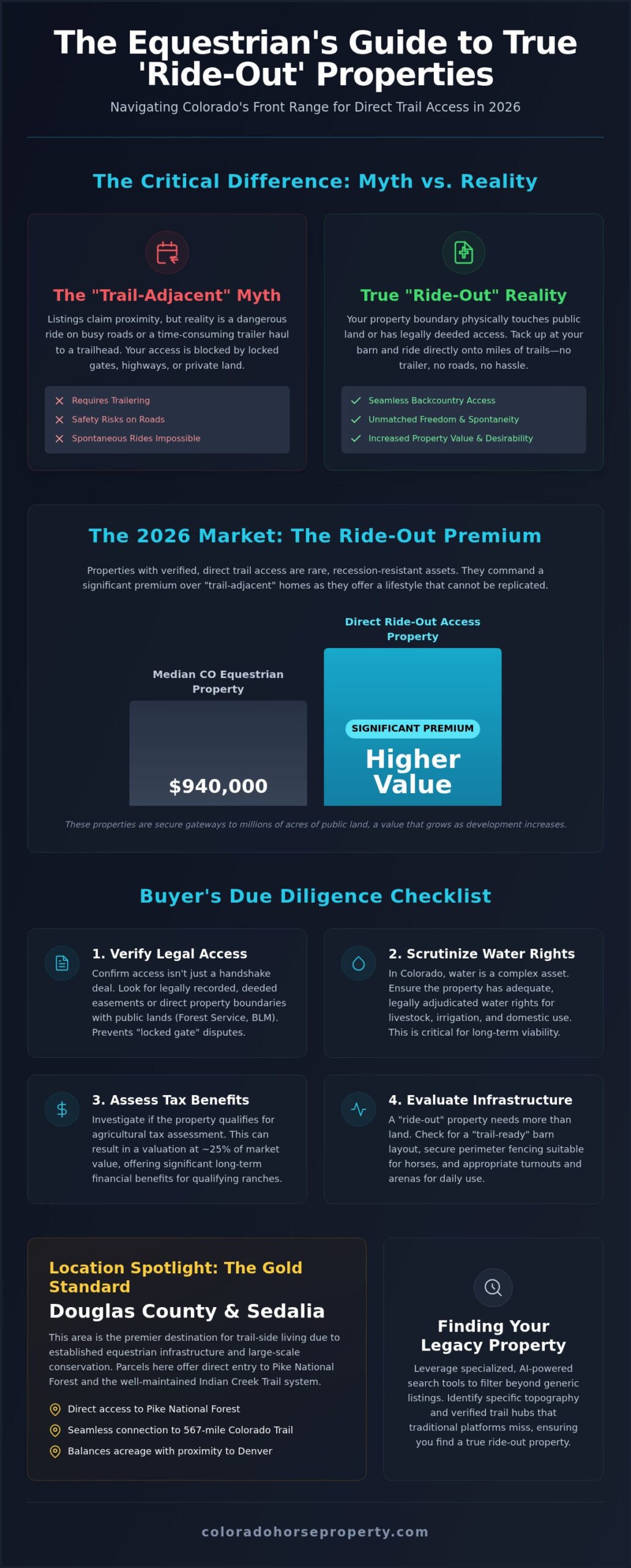
In the real estate market across Colorado’s Front Range, “proximity” is a loose term often used to inflate property values. For a serious horse owner, there is a massive difference between being near a trail and owning a true equestrian property with direct trail access Front Range riders can rely on. Direct access means your property boundary physically touches public land or you hold a recorded, deeded easement that permits livestock passage. Without these legal certainties, you’re just a neighbor to a trail you might not be able to reach without a trailer.
To better understand this concept, watch this helpful video:
In 2026, the value of these parcels has shifted because they offer a “ride-out” lifestyle. This is the ultimate luxury for horse owners. It removes the logistical barrier of the horse trailer. Instead of spending an hour loading gear and driving to a crowded trailhead, you simply tack up at your barn and head out. This seamless connection to the backcountry turns a simple ranch into a legacy asset that provides immediate access to Colorado’s vast wilderness systems.
Why ‘Nearby’ Trails Aren’t Enough
The hidden costs of a “trailer-in” lifestyle add up quickly. You’re looking at increased fuel consumption, constant wear on your truck, and the recurring maintenance of a trailer. Beyond the finances, there’s the safety factor. Riding on paved road shoulders to reach a dirt trailhead is stressful for both horse and rider. True ride-out access provides psychological freedom. You can decide to go for a 20-minute sunset ride on a whim. That spontaneity is impossible when you have to hitch up and haul.
The 2026 Market for Trail-Side Estates
Current data shows that equestrian properties in Colorado have a median listing price of $940,000, but those bordering Forest Service or BLM land carry a significant premium. These parcels are increasingly rare as development pressure increases along the urban corridor. As more public land usage restrictions come into play, private gates that lead directly to trail systems become recession-resistant assets. They aren’t just homes; they’re secure gateways to millions of acres of protected land. Investors and luxury buyers prioritize an equestrian property with direct trail access Front Range locations offer because you can’t manufacture more land that borders a national forest.
Top Front Range Trail Segments for Equestrian Properties
Douglas County remains the premier destination for trail-side living due to its established infrastructure and large-scale conservation efforts. The Sedalia foothills are particularly coveted because they offer direct entry to the Indian Creek Trailhead and the Pike National Forest. This area provides a seamless connection to miles of multi-use paths that are well-maintained and horse-friendly. When you’re navigating the equestrian real estate Colorado market, Sedalia’s large-acreage parcels are often the first to be snatched up. It’s helpful to review BLM guidelines for equestrian trail use to understand how shared-use trails are managed in these popular Douglas County corridors.
Buffalo Creek and the Jefferson County Foothills
The Buffalo Creek Trail System in Jefferson County is a world-class destination known for its decomposed granite soil, which provides excellent footing for horses even after heavy rain. Finding a property that borders US Forest Service land here is like owning a private gateway to some of the state’s most scenic backcountry. However, zoning in Jefferson County requires a careful eye. You must verify the specific animal units allowed on each parcel and check for any local setbacks that might impact your barn placement. These “hidden gems” aren’t always easy to spot on standard real estate apps. Using a specialized AI-powered horse property search is the most efficient way to filter for the specific topography and boundary requirements needed for a true ride-out lifestyle in 2026.
The demand for these parcels has stayed high through 2026 because they offer a permanent solution to the increasing congestion at public trailheads. By owning land that connects directly to these systems, you bypass the parking lot stress and enjoy the landscape the way it was intended to be seen: from the saddle.
Boundary Realities: Legal Access vs. Physical Proximity
Physical proximity to a trailhead doesn’t always translate to legal access. A common pitfall for buyers is the “Locked Gate” problem. You might find a parcel where the back fence line borders thousands of acres of Pike National Forest, yet discover the Forest Service won’t allow a private gate. Federal agencies often restrict access to designated public entry points to manage erosion and wildlife impact. Securing an equestrian property with direct trail access Front Range riders actually want requires verifying recorded, deeded easements that specifically permit livestock passage across neighboring private or public land.
In 2026, we verify these boundaries using high-resolution GIS mapping technology. These tools provide real-time overlays of property lines against public land management layers. It’s also vital to consult Colorado equine liability statutes to understand your rights and responsibilities when trail riding crosses various jurisdictions. Title insurance plays a critical role here. It doesn’t just protect the title to your home; it should also insure your legal right to use any off-property easements that provide that coveted trail connection. Protecting your equestrian property with direct trail access Front Range investment means looking beyond the fence line during the due diligence period.
Zoning and Land Management for Trail Properties
Zoning dictates the long-term viability of your ranch. Some properties carry conservation easements that preserve the landscape but might restrict where you can build barns or arenas. When searching for horse property for sale in colorado, pay close attention to the agricultural tax status. In 2026, land with agricultural zoning is assessed at 25% of its actual value, a significant drop from the 6.8% residential rate. This tax advantage makes larger acreage more affordable, provided you meet the state’s production or grazing requirements.
The Importance of Water and Grazing Rights
Trail access is only half the battle; your horses need healthy pasture. Colorado operates under the Doctrine of Prior Appropriation, meaning water rights are “first in time, first in right.” These rights are separate from land ownership. If a property lacks adjudicated water rights for irrigation or livestock, your trail-side dream could turn into a dusty lot. For larger operations, we often look for properties with existing grazing permits on adjacent public lands. This allows you to expand your footprint without buying more acreage. For more details on managing these complex assets, see our guide to colorado land management.
Essential Infrastructure for Trail-Side Horse Ranches
Building a functional home for your horses requires more than just four walls and a roof. An equestrian property with direct trail access Front Range owners value must be designed for maximum efficiency. A “trail-ready” barn layout prioritizes the transition from the stall to the backcountry. This means wide aisles for tacking up and clear, unobstructed paths to the property’s exit gates. Fencing is another critical consideration. You want perimeter systems that are secure enough to contain livestock but low-profile enough to preserve your views of the foothills. High-tensile polymer or pipe fencing are popular 2026 choices that balance safety with the expansive aesthetics of the region.
While your primary focus might be on the trails, an all-weather arena is essential for off-season training. Colorado’s winters can be unpredictable, and having footing that drains well and resists freezing ensures your horse stays fit year-round. Don’t forget storage. Even if you rarely use a trailer because of your ride-out access, you still need a dedicated, level pad for your hauling equipment. This keeps the rig out of the mud and ready for emergency vet visits or occasional trips to regional events. Keeping your equipment in top shape is just as important as maintaining the land itself.
The ‘Trail Room’ and Tack Management
A dedicated “trail room” or mudroom is a game-changer for backcountry riders. These spaces should be designed to house bulky gear like saddlebags, pack equipment, and GPS units. After a long ride, a professional-grade wash rack with hot water is a necessity for cooling down horses and cleaning off trail dust. It’s also wise to include a designated veterinary area for routine care and post-trail inspections. If you’re deciding between existing structures or starting from scratch, our guide on horse barns for sale offers a deep dive into the pros and cons of each approach.
Sustainable Pasture and Trail Maintenance
Owning land that connects to public systems comes with stewardship responsibilities. You’ll need to maintain your private trail connectors to prevent erosion, especially during the spring runoff. In the high-altitude Front Range climate, pasture health requires active management. This includes rotating grazing areas and implementing effective manure composting systems to keep the soil productive. Most importantly, properties bordering National Forest land must prioritize wildfire mitigation. This involves creating defensible space around your barn and clearing underbrush along your fence lines. If you’re ready to find a property with these specific features, you can use our AI-powered search to filter by infrastructure requirements.
Finding Your Legacy Property with AI and Local Expertise
Generic real estate platforms are built for suburban homes, not specialized ranches. They often label a listing with “trail access” just because it’s within a few miles of a park. This leads to wasted time for buyers seeking an equestrian property with direct trail access Front Range riders can actually use. Our approach combines high-tech data filtering with decades of boots-on-the-ground knowledge. We ensure that “direct access” means a physical gate to the backcountry, not a trailer ride to a trailhead. Reviewing these listings without specialized tools is often a recipe for frustration in a competitive market.
Leveraging AI for Niche Equestrian Features
Our proprietary AI-powered search technology goes beyond basic filters. It analyzes specific equestrian topography and cross-references it with public land management databases. This allows us to identify parcels with true “ride-out” capability and specific barn configurations that meet your needs. In a low-inventory 2026 market, this efficiency is vital. We can quickly isolate properties with verified water rights and grazing potential. This saves you from the frustration of viewing land that doesn’t meet the legal requirements for livestock. The data-driven approach ensures you only see properties that truly fit your lifestyle.
Partnering with Specialized Front Range Brokers
Technology is only half the equation. Mark and Alison Eibner bring 40 years of experience in the ranches for sale colorado market. This tenure has built a local network that often uncovers off-market deals before they ever hit the MLS. Our leadership-forward approach means we take a personal interest in your goals. We act as partners rather than just transaction managers. This specialized division of Realty Oasis provides the reassurance of a seasoned expert in every negotiation.
Closing a deal on an equestrian property with direct trail access Front Range requires managing complex contracts. These aren’t standard residential agreements. They involve title contingencies for easements, water right transfers, and specific zoning disclosures. We manage these high-stakes details through our transaction management services to protect your investment. Your next step is a detailed consultation to define your trail-side goals. We’ll start a data-driven search to find your legacy property on the Front Range and guide you through the escrow process with confidence.
Secure Your Ride-Out Legacy on the Front Range
Securing a true equestrian property with direct trail access Front Range riders dream of requires more than just looking at a map. You’ve learned that physical proximity to public land doesn’t always guarantee a legal entrance, and that “trailer-free” living depends on verified deeded easements and proper 2026 infrastructure. By focusing on essential trail-ready barn designs and taking advantage of Colorado’s agricultural tax benefits, you can build a sustainable lifestyle that preserves both your time and your investment.
Don’t leave your backcountry access to chance or generic search engines that miss the technical details. Mark and Alison Eibner bring 40 years of specialized Colorado experience to your search. We use proprietary trail-access search technology to filter for the exact topography and legal rights you need for a true ride-out ranch. This specialized division of Realty Oasis ensures every transaction is managed with the expertise required for complex land and water rights.
Start Your AI-Powered Search for Front Range Trail Properties and take the first step toward a seamless connection with the Colorado wilderness. Your horse is ready to ride out; we’re here to help you find the gate.
Frequently Asked Questions
What does ‘direct trail access’ actually mean in a real estate listing?
Direct trail access means your property boundary physically touches public land or includes a recorded, deeded easement for livestock passage. It isn’t a vague marketing term for being “nearby.” True ride-out capability allows you to tack up at your barn and enter a trail system without crossing a public road or using a trailer. We verify these claims through legal documentation and GIS mapping to ensure the access is permanent.
Does bordering a National Forest guarantee I can ride onto it?
Bordering a National Forest doesn’t automatically grant you the right to install a gate and ride onto federal land. The “Locked Gate” problem is common when the Forest Service restricts access to protect wildlife or manage erosion. You must verify if a specific parcel has an existing permit or if it’s located near a designated public entry point. Our team checks these federal boundaries to confirm your actual ride-out potential.
How many acres do I need for a horse property with trail access on the Front Range?
While the average equestrian property in Colorado is 80.9 acres, you can often find an equestrian property with direct trail access Front Range riders love on as little as 5 to 35 acres. The requirement depends on local zoning and animal unit densities. Smaller parcels bordering public land are highly sought after because the adjacent trails effectively expand your riding footprint without the cost of maintaining additional private acreage.
Are there specific Douglas County zoning laws for horse properties?
Douglas County has specific regulations regarding animal units and manure management that every buyer should review. Most horse properties here benefit from agricultural zoning, which assesses at 25% of actual value compared to the 6.8% residential rate. You’ll need to meet specific land use criteria to maintain this status. We help you navigate these county-specific setbacks and zoning codes to ensure your infrastructure plans remain fully compliant.
How do water rights affect the value of an equestrian property in 2026?
Water rights are a critical value driver because they’re legally separate from the land title in Colorado. Under the Doctrine of Prior Appropriation, having adjudicated water rights for livestock and irrigation ensures your pastures stay productive during drought cycles. Without these rights, you may be restricted from watering your horses or maintaining grazing land. This legal complexity makes verified water documentation a top priority during the due diligence phase of any purchase.
Can I build my own trail connector to public land?
You can’t build a trail connector across a property boundary without a formal agreement or deeded easement. If your land doesn’t touch the trail, you’ll need permission from neighboring landowners or the managing public agency. Attempting to create unauthorized paths can lead to legal disputes or fines. We specialize in identifying properties that already have these legal connectors in place, saving you from the uncertainty of seeking new permissions.
What are the best Front Range towns for ride-out equestrian living?
Sedalia and Buffalo Creek are widely considered the gold standard for ride-out living due to their proximity to the Pike National Forest. Other top locations include Larkspur and parts of Elizabeth, where large-acreage parcels often border extensive trail networks. These towns offer a balance of rural lifestyle and accessibility to the Denver corridor. Choosing the right town often depends on your specific needs for commute times and your desired trail technicality.
How does the AI search tool identify trail access specifically?
Our proprietary AI search technology filters listings by cross-referencing property boundaries with high-resolution topographic maps and public land databases. Unlike generic platforms, it identifies the specific intersection of private fence lines and trailheads. This data-driven approach allows us to find an equestrian property with direct trail access Front Range generic sites often miss. We then verify these AI results with our 40 years of local real estate experience to ensure accuracy.