
Imagine closing on your dream ten-acre ranch in Douglas County, only to receive a code enforcement notice three weeks later because your “Animal Units” were calculated incorrectly. It is a nightmare scenario that many horse owners face as suburban development encroaches on traditional agricultural land. You want the freedom of the Front Range, but the complex “layer cake” of state laws, county ordinances, and hidden HOA restrictions makes it harder than ever to feel secure in your investment.
Securing your legacy requires mastering the specific zoning for equestrian property Colorado demands in 2026. This guide will help you navigate the groundbreaking protections of SB25-149, which now allows municipalities to establish dedicated equestrian zones to preserve our rural heritage. You’ll learn how to calculate animal density for counties like Jefferson and Larimer, understand the 25 percent agricultural tax assessment, and see how AI-powered search tools can verify a property’s legal status before you sign a contract. We will break down the “Pass Wide and Slow” doctrine and the essential due diligence steps needed to ensure your property remains a protected asset for years to come.
Key Takeaways
- Understand how the 2026 SB25-149 law creates protected “Equestrian Zones” to shield your property from urban encroachment.
- Learn to calculate “Animal Units” (AU) accurately to ensure your livestock density aligns with specific county land use codes.
- Identify the hierarchy of authority where HOA covenants may restrict horse ownership even if the county zoning allows it.
- Master a professional due diligence protocol for verifying zoning for equestrian property Colorado using official assessor maps and parcel IDs.
- Discover how to leverage AI-powered search tools to filter for properties with verified equestrian infrastructure and legal “Use by Right” status.
The 2026 Colorado Equestrian Zoning Landscape: Understanding SB25-149
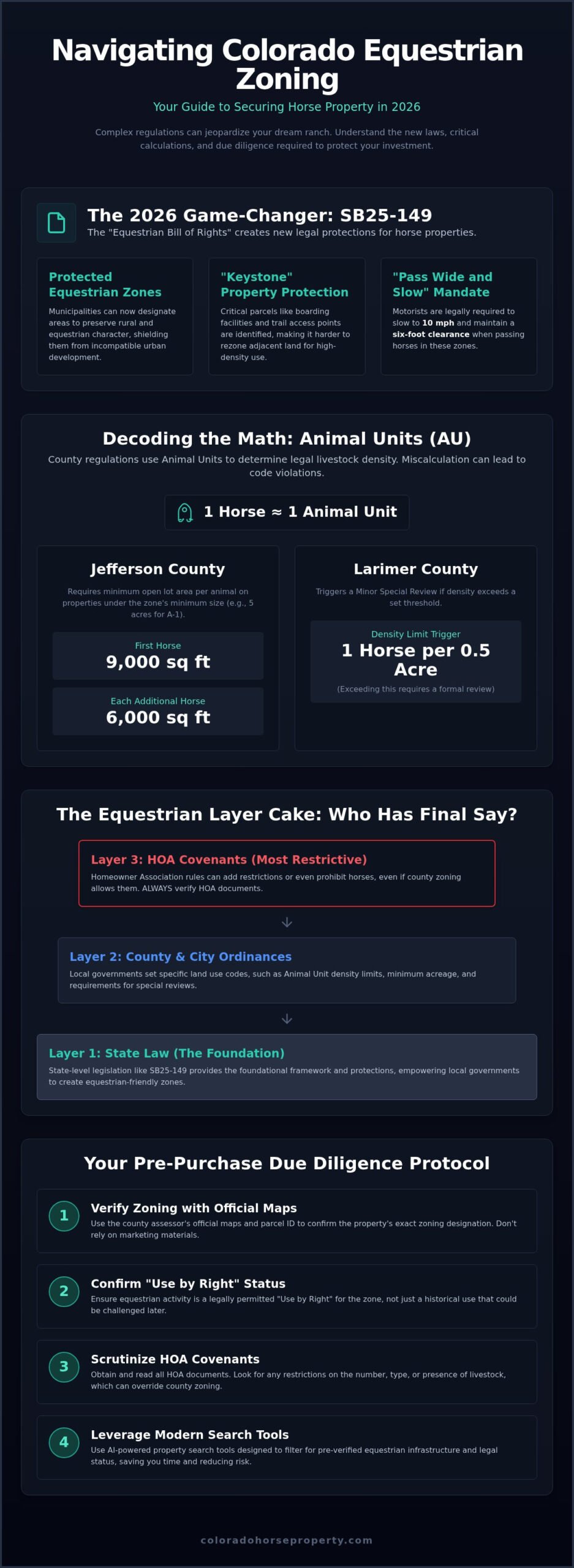
The year 2026 marks a pivotal shift for horse owners across the Front Range and Western Slope. For decades, urban sprawl has threatened the trails and pastures that define the Colorado lifestyle. SB25-149, known as the “Equestrian Bill of Rights,” finally provides the legal teeth needed to protect these spaces. While the history of Zoning in the United States has often prioritized high-density development, this new state law empowers local governments to designate specific “Equestrian Zones” as protected asset classes. It’s no longer just about where you can keep a horse; it’s about preserving the infrastructure that makes riding possible.
This legislation introduces the concept of “Keystone Properties.” These are specific land parcels, such as boarding facilities or trail access points, that anchor a neighborhood’s equestrian character. By identifying these properties, the law makes it significantly harder for developers to rezone adjacent land for high-density housing that would otherwise choke out trail access. If you are looking at zoning for equestrian property Colorado offers today, you’re looking at a landscape where your right to ride is increasingly shielded by state mandate.
To better understand the practical side of these regulations and how they impact your investment, watch this overview:
What Qualifies as a Protected Equestrian Zone?
Under SB25-149, a municipality doesn’t just grant a zone by request; the area must meet strict criteria. Protected zones typically include equestrian-centric residential neighborhoods or areas with public venues like fairgrounds and arenas. A key feature of these zones is the mandatory “Pass Wide and Slow” road sign mandate. Motorists are now legally required to slow to 10 mph and maintain a six-foot clearance when passing horses. This isn’t just a safety rule; it’s a zoning tool that signals a neighborhood’s primary use is equestrian, which helps deter incompatible commercial development.
How State Protections Interact with Local Government Duties
Local counties now have a proactive duty to map their equestrian infrastructure. This includes identifying trailer parking, road crossings, and trail connectivity in their master plans. When you evaluate zoning for equestrian property Colorado, you must look at these maps. A property’s value in 2026 is tied directly to its inclusion in these master plans. Your local county planner has become a vital resource, as they now manage the data that determines if a property is a “Use by Right” location or if it faces future encroachment. These maps provide the “green light” buyers need to secure their equestrian legacy with confidence.
Decoding the Math: Animal Units and Density Limits
The foundation of any property purchase is the “Animal Unit” (AU). This metric standardizes different types of livestock to determine how much life a specific plot of land can support. While the technical definition can shift based on weight or species, one horse typically equals one animal unit in most Colorado counties. Understanding this math is the only way to ensure your zoning for equestrian property Colorado compliance remains intact. These calculations are rooted in the state’s broader effort to balance agricultural heritage with environmental health, as seen in the text of Colorado SB25-149.
Calculating Your Capacity: A County-by-County Logic
Front Range counties like Jefferson and Larimer have stricter density limits than the more expansive Western Slope. In Jefferson County, if your property doesn’t meet the minimum lot size for its zone (such as 5 acres for A-1), you need 9,000 square feet of open lot area for the first horse and 6,000 square feet for each additional animal. Larimer County triggers a Minor Special Review if you exceed one horse per half-acre. These rules prevent the degradation of local grasslands and protect the long-term health of the soil.
It’s vital to distinguish between gross acreage and useable acreage. A ten-acre parcel might only offer seven acres of actual pasture once you account for the house, driveway, and mandatory setbacks. Setbacks are non-negotiable distances between your structures and property lines. For example, some zones require accessory buildings for horses to be set back at least 100 feet from the front lot line. If you ignore these boundaries, you risk code enforcement fines that can reach thousands of dollars.
Infrastructure and Zoning Synergy
Zoning also dictates the type of shelter you can provide. Permanent barns require different permits than temporary “loafing” sheds. If you plan on building, check out this guide on horse barns for sale to understand the structural requirements. Additionally, many counties now require a formal manure management plan if you hit specific density thresholds. These plans ensure that high-density operations don’t compromise local groundwater or create public nuisances.
You can often increase your allowed horse count by submitting a managed grazing plan. These plans prove to county officials that you have the infrastructure and expertise to prevent overgrazing and soil erosion. It’s a proactive way to maximize your land’s utility while staying within the law. If you’re unsure about the specific math for a listing, our AI-powered search tools can help filter properties by their verified livestock capacity based on current 2026 regulations.
The Equestrian Layer Cake: Navigating County, City, and HOA Rules
A property’s legal standing is rarely determined by a single document. Instead, it’s a “layer cake” of regulations where the most restrictive rule usually wins. While you might find the ideal zoning for equestrian property Colorado offers at the county level, private restrictions can still limit your lifestyle. Understanding this hierarchy is the difference between a secure investment and a costly legal battle. If the county allows four horses but your Homeowners Association (HOA) allows only two, you’re legally bound to the lower number. This underscores why professional oversight is vital; for example, My Florida HOA Manager provides the management expertise needed to ensure association rules are clearly communicated and financially sound. Private covenants are essentially contracts you sign at the closing table; they don’t need to align with public zoning to be enforceable.
Don’t assume that “Agricultural” or “Rural Residential” zoning guarantees your right to keep horses. Many buyers are caught off guard by “HOA Traps” on large 35-plus acre parcels. These developments often use private covenants to maintain a specific aesthetic or environmental standard. You might face restrictions on barn colors, manure composting locations, or even the specific breeds of livestock allowed. To uncover these, you must carefully review the Title Commitment and the Common Interest Community (CIC) disclosure during your inspection period. These documents reveal the hidden rules that county maps won’t show you.
The “Legacy Clause” is another critical factor. This allows for grandfathered land use rights if a property was used for horses before a zoning change occurred. However, these rights are often fragile. If the equestrian use is “abandoned” for a specific period, usually twelve consecutive months, the property may lose its protected status and must comply with modern, potentially stricter, regulations.
Special Use Permits (SUP) and Variances
If your goals go beyond personal use, such as running a boarding facility or a training stable, a “Use by Right” designation might not be enough. Most Colorado counties require a Special Use Permit (SUP) for commercial equestrian operations. This process involves public hearings and neighbor notifications. If you’re seeking a property for these purposes, professional representation from experts in equestrian real estate Colorado is essential to help you evaluate the likelihood of permit approval. If a property almost meets your needs, you might apply for a zoning variance, but these are rarely granted unless you can prove a unique “hardship” caused by the land’s physical characteristics.
Due Diligence Protocol: Verifying Zoning Before You Buy
Verifying the legal status of a ranch requires more than a casual glance at a sales flyer. In 2026, the complexity of zoning for equestrian property Colorado mandates a rigorous, multi-step verification process. You must rely on official documentation rather than verbal assurances from sellers or neighbors. This protocol ensures that your intended use, whether for a private stable or a larger operation, is legally protected before you commit capital. Mistakes in this phase can lead to permanent restrictions or costly code enforcement actions.
The first step is obtaining the official Zoning Map and Parcel ID from the County Assessor. This unique identifier allows you to cross-reference the property with the specific County Land Use Code. You’re looking for “Use by Right” livestock designations. If the property is listed as “Conditional Use,” you may face significant hurdles or public hearings to keep your horses. If an HOA is involved, request an Estoppel Certificate. This document legally binds the association to a statement of the property’s current standing, ensuring there are no outstanding violations or hidden restrictions that could jeopardize your equestrian goals.
The 2026 Verification Checklist
When you contact the County Planning Department, your questions must be specific. Ask if the parcel falls within a protected SB25-149 zone, which provides enhanced safety and land-use shields. Verify the exact number of Animal Units permitted and ask about any pending zoning changes in the vicinity. A professional land survey is also vital. It confirms that fences and barns aren’t encroaching on easements or neighboring parcels, which can trigger zoning disputes years after the purchase. Don’t rely on existing fence lines as legal boundaries.
Water Rights and Zoning Synergy
Water is the lifeblood of any Colorado ranch. You must verify that your well permit allows for livestock consumption. A “Domestic” well permit typically covers household use and the watering of domestic animals, while a “Household Use Only” permit is strictly limited to indoor plumbing. If your water rights don’t match your livestock density goals, the property’s zoning becomes irrelevant. For a deeper look at these requirements, see our guide on Colorado land. Ensuring your well permit supports your herd is a critical part of your due diligence.
Expert guidance is the final piece of the puzzle. Working with a specialized representative who understands the nuances of rural transactions can save you from expensive mistakes. Our AI-powered search tools are designed to help you identify zoning-verified properties from the start, streamlining your path to a successful closing and securing your equestrian legacy.
Strategic Acquisition: Finding Zoning-Verified Properties
Mainstream real estate portals are built for standard residential sales, not the nuanced legalities of a working ranch. These generic search sites often tag a listing as “horse-friendly” based on a seller’s personal description rather than a verified legal status. This leads many buyers into what we call “Sarah’s mistake.” Sarah represents the 15 percent of buyers who discover, often weeks after closing, that their property has major zoning red flags; these include illegal outbuildings or expired “Animal Unit” counts. To avoid these risks, you need a search strategy that prioritizes zoning for equestrian property Colorado law recognizes as valid in 2026.
Finding the right land often requires looking beyond the public Multiple Listing Service (MLS). In highly restricted equestrian zones, the most valuable “Keystone Properties” are often sold as pocket listings. These off-market opportunities are only accessible through deep industry connections and a reputation for closing complex rural transactions. Expert representation ensures you aren’t just looking at what’s available, but what’s legally viable for your specific herd and infrastructure goals.
The AI Search Advantage
Our proprietary platform changes how you interact with land data. By integrating 2026 zoning maps and county-specific land use codes directly into the interface, we filter out properties that don’t meet your hard requirements. Whether you need a specific arena size, a minimum of five stalls, or a parcel that falls within a protected SB25-149 zone, the AI does the heavy lifting. This technology reduces your search time by 60 percent by eliminating listings with hidden livestock restrictions or insufficient water rights. You don’t have to manually cross-reference assessor maps; the system verifies the data points before you ever book a showing.
Partnering with the Eibners
Success in the Colorado ranch market is built on tenure. Mark and Alison Eibner bring 40 years of Front Range experience to every transaction. This longevity is critical when managing the “layer cake” of regulations discussed earlier. We protect your earnest money by utilizing zoning-contingent contracts. These legal safeguards allow you to walk away if the due diligence period reveals that the county or HOA won’t support your intended livestock density. We don’t just find you a house; we secure your lifestyle through specialized transaction management and a no-nonsense approach to land rights.
Start your AI-powered horse property search today and find a property that is truly horse-ready.
Secure Your Colorado Equestrian Legacy
The complexity of 2026 regulations doesn’t have to stand between you and your dream ranch. By understanding the new protections offered by SB25-149 and mastering the “layer cake” of county and HOA rules, you can move with total confidence. Success in this market requires a strict due diligence protocol, from verifying Animal Units to ensuring your well permit matches your livestock goals. Navigating the specific zoning for equestrian property Colorado requires more than just a standard map; it demands specialized expertise and modern tools.
Don’t risk your investment on generic search platforms that miss critical livestock red flags. With 40 years of specialized Colorado experience and proprietary AI-powered niche search technology, we provide the expert buyer and seller representation you need to find a truly horse-ready property. It’s time to turn your vision into a legally protected reality on the Front Range or the Western Slope. We look forward to helping you find the perfect space for your lifestyle and your animals.
Find Your Zoning-Verified Colorado Dream Home
Frequently Asked Questions
Can I keep horses on a property zoned as Residential in Colorado?
Generally, horses are not permitted in strictly residential zones unless the property has a specific agricultural overlay or meets minimum lot size requirements. Most suburban residential designations prohibit livestock to prevent noise and odor issues. You must check the specific Land Use Code for that parcel’s sub-designation, as some “Rural Residential” zones allow horses if the acreage is sufficient to meet county animal density standards.
What is the minimum acreage required for a horse property in Colorado?
There is no single statewide minimum; requirements vary by county and specific zoning district. Jefferson County often requires 5 acres for A-1 zoning, though smaller parcels can keep horses if they meet open lot area square footage requirements. Larimer County often uses a one-half acre per horse metric. Always verify the specific zoning for equestrian property Colorado before assuming a parcel is large enough for your herd.
How does SB25-149 protect my rights as a horse owner?
SB25-149, also known as the “Equestrian Bill of Rights,” allows local governments to designate protected “Equestrian Zones” to shield neighborhoods from urban encroachment. It mandates “Pass Wide and Slow” road signs and requires motorists to maintain a six-foot clearance at 10 mph. Additionally, it requires counties to map out and preserve equestrian infrastructure like trail crossings and trailer parking in their long-term master plans to ensure connectivity.
What happens if I have more horses than the zoning allows?
Exceeding your allowed “Animal Units” can result in code enforcement fines and mandatory removal of the animals. In some jurisdictions, you can apply for a Minor Special Review or a variance if you can prove your land management practices prevent overgrazing. However, variances are rarely granted without proof of a unique physical hardship related to the land itself. Proactive compliance is always cheaper than legal defense.
Does a “Grandfathered” zoning status transfer to the new buyer?
Yes, legal non-conforming use rights typically stay with the land, but they are extremely fragile. If the equestrian use is discontinued for a specific period, often twelve consecutive months in many Colorado counties, the status is lost forever. The property must then comply with current 2026 zoning laws. Buyers should always secure an official letter from the county planning department confirming the grandfathered status is still active.
How do I find out if an HOA allows horses before making an offer?
You must review the Covenants, Conditions, and Restrictions (CC&Rs) and the Title Commitment before the inspection deadline. Don’t rely on the seller’s word or the county’s agricultural zoning. Request an Estoppel Certificate from the HOA board to confirm the property’s compliance and any outstanding violations. Our AI-powered search technology can also help filter for properties where these private restrictions have already been identified and verified.
What is the difference between a “Use by Right” and a “Conditional Use” for horses?
“Use by Right” means you can keep horses without seeking additional government approval, provided you follow standard density rules. “Conditional Use” requires a public hearing and a special permit, which neighbors can oppose. Securing zoning for equestrian property Colorado is much safer when the land is already designated as a “Use by Right” for livestock, as it removes the uncertainty of a political approval process.
Can zoning laws change after I purchase my horse property?
Yes, local governments can update their master plans and land-use codes at any time. While existing uses are often grandfathered in, new structures or expanded herds might be restricted under the new rules. This is why the protections in SB25-149 are so critical; they provide a state-level framework that encourages counties to maintain their equestrian character even as surrounding areas experience rapid suburban development and population growth.