
What if your private backyard extended across two million acres of protected wilderness? For many buyers, the search for ranches for sale bordering national forest Colorado is driven by a desire for permanent privacy and direct trail access. You want a home where the views won’t be developed and your horses never need a trailer to reach the high country. It’s a lifestyle that represents the ultimate finite resource in real estate, but securing it requires more than just a standard map search.
We know that “private access” is often a gray area on standard listing sites. You shouldn’t have to worry about hidden public easements or unclear boundaries when you’re making a legacy investment. This 2026 guide will help you navigate the complexities of Forest Service regulations, including the $1.69 per animal unit month grazing fees and the critical impacts of House Bill 26-1340 on water rights. We’ll show you how to identify true borders and secure a property that offers the uninterrupted freedom you’ve worked for.
Key Takeaways
- Understand the “finite resource” factor that allows forest-bordering properties to appreciate faster than standard land-locked parcels.
- Identify the differences between Colorado’s premier regions, from the luxury mountain recreation in White River to the rugged, large-acreage opportunities in the San Juans.
- Learn how to manage public “bleed-over” and navigate specific fencing responsibilities shared between private owners and federal land agencies.
- Discover how to use AI-powered search to find ranches for sale bordering national forest Colorado that offer verified trail connectivity without the need for horse trailering.
- Determine the necessary steps for securing Forest Service grazing permits to maximize the agricultural utility of your new legacy ranch.
What Does It Mean to Own a Ranch Bordering National Forest?
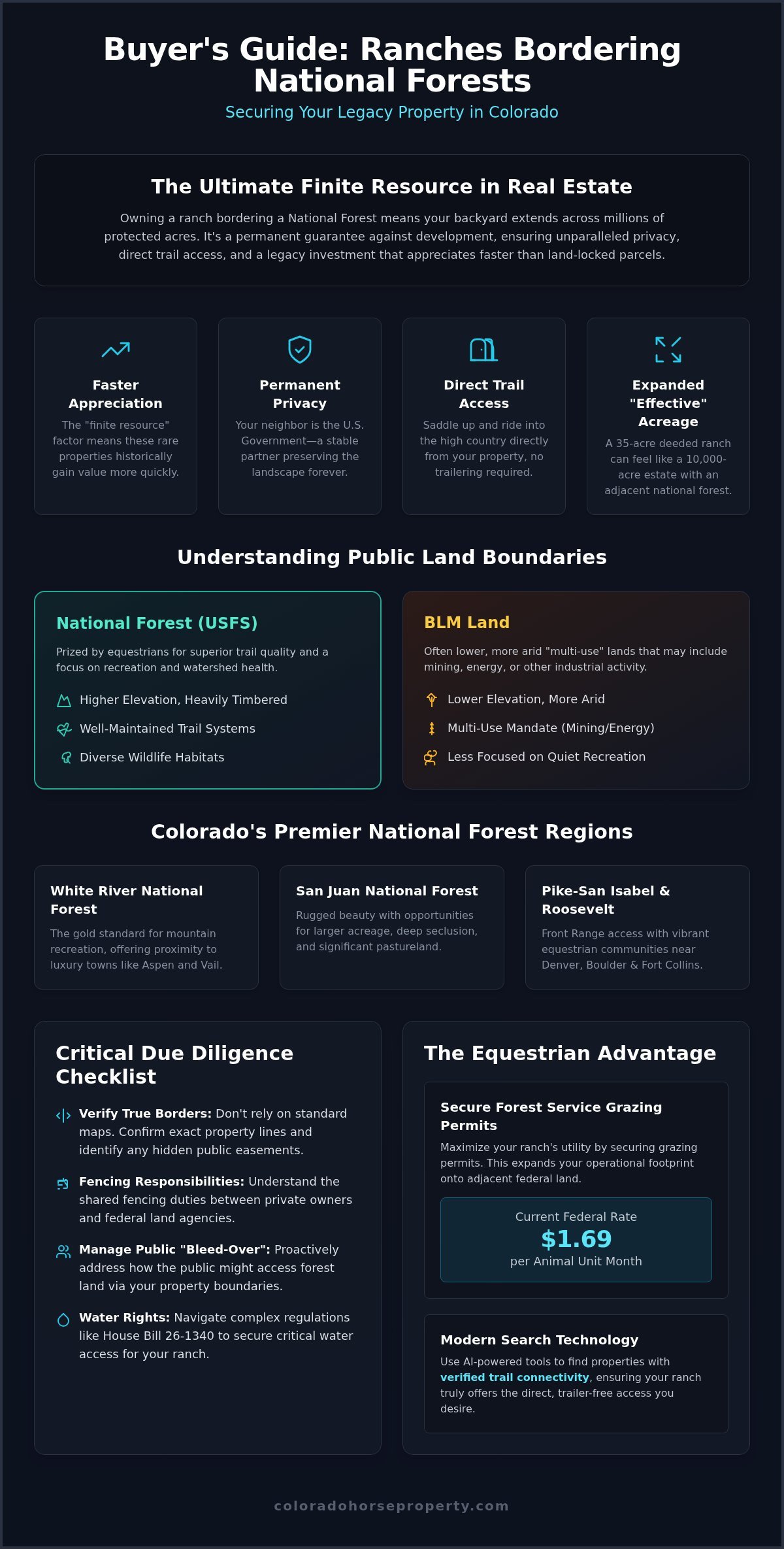
Owning a property that shares a boundary with federal land is a rare opportunity in the Rocky Mountains. In the specialized market of ranches for sale bordering national forest Colorado, “adjoining” means your deeded property line physically touches the United States Forest Service (USFS) boundary. This creates a permanent buffer against development. Unlike a private neighbor who might eventually subdivide their land, the federal government acts as a stable neighbor that preserves the landscape. You are essentially buying a front-row seat to millions of acres of protected wilderness.
This proximity creates what we call the “finite resource” factor. There is a limited supply of private land that touches the National Forests in Colorado. Because this supply is fixed and the demand for recreational access is growing, these properties historically appreciate faster than land-locked parcels. Our 40 years of experience in the Colorado Front Range and high country has shown that a forest border is one of the most resilient value-adds a ranch can possess. You aren’t just purchasing acreage; you’re securing a lifestyle of guaranteed seclusion and infinite views.
To better understand the scale and beauty of these properties, watch this look at a premier Colorado ranch with extensive forest boundaries:
The Difference Between National Forest and BLM Land
While both are public lands, the management styles differ significantly. National Forest land is typically higher in elevation, heavily timbered, and managed with a strong focus on recreation and watershed health. This results in well-maintained trail systems and diverse wildlife habitats. The Bureau of Land Management (BLM) often manages lower, more arid “multi-use” lands that may include mining or energy development. Horse owners specifically prize USFS boundaries because the trail quality is often superior, providing a more aesthetic and quiet riding experience away from industrial activity.
Deeded Acreage vs. Effective Acreage
When you browse ranches for sale bordering national forest Colorado, it’s vital to distinguish between what you own and what you can use. A 35-acre ranch can feel like a 10,000-acre estate if it has a private gate into the forest. This “perceived privacy” is a massive driver in valuation. Effective acreage is the total usable land including adjacent public access. This concept allows a buyer to enjoy the utility of a massive ranch while only paying property taxes on a smaller, more manageable deeded parcel. It’s a strategic way to own the West without the overhead of thousands of private acres.
Exploring Colorado’s Premier National Forest Regions for Ranch Buyers
Colorado’s geography dictates the ranching lifestyle. Searching for ranches for sale bordering national forest Colorado requires understanding the specific character of each forest. The White River National Forest is often considered the gold standard for mountain recreation. It offers world-class riding and proximity to luxury mountain towns like Aspen and Vail. In contrast, the San Juan National Forest in Southwest Colorado provides more rugged beauty and opportunities for larger acreage. This region is ideal for buyers looking for deep seclusion and significant pastureland for livestock.
Proximity to urban centers is the hallmark of the Pike-San Isabel and Roosevelt National Forests. These areas support vibrant equestrian communities with easier commutes to Denver, Boulder, and Fort Collins. However, inventory remains exceptionally tight in these Front Range corridors. Understanding Colorado Forest Land Ownership is essential here, as private parcels touching these forests are rare and highly sought after. The Pike-San Isabel region is particularly popular for its expansive trail systems that connect directly to private ranch boundaries.
The Front Range vs. The Western Slope
Accessibility is the primary trade-off. Front Range ranches offer shorter drives to major airports and professional services. The Western Slope provides deeper seclusion and often more reliable water rights for agricultural use. Climate variations also play a role; Western Slope ranches might experience heavier snowpack but benefit from longer growing seasons in certain protected valleys. In 2026, buyers are showing a clear preference for properties with turnkey infrastructure on the Western Slope, where the market for A-Class recreational ranches remains competitive. Currently, the most forest-bordering inventory sits in more remote western counties where historic holdings are occasionally brought to market.
High-Country Ranches and Seasonal Realities
Elevation changes everything. A ranch at 9,000 feet bordering the forest will face different seasonal road closures than one at 7,000 feet. Forest Service gate management can restrict motorized access to your “backdoor” during winter months to protect wildlife and road beds. It’s vital to review The Ultimate Guide to Buying Colorado Land in 2026 to understand how these seasonal factors influence property value and utility. If you want to see what’s currently available in these premier regions, you can use our specialized search tools to filter by specific forest boundaries and trail connectivity.
Critical Due Diligence: Fencing, Access, and Easements
Buying ranches for sale bordering national forest Colorado involves more than a handshake and a view. You must verify the exact location of the boundary line through a professional survey. Old fence lines aren’t always legal boundaries. A modern survey is the only way to prevent encroachment disputes that can tie up a property in court for years. It’s common for historic trails or old outbuildings to “drift” over the line. Don’t assume the existing fence is correct just because it looks old.
Fencing responsibility is a major point of confusion for new buyers. In most agricultural areas of Colorado, partition fence statutes require adjoining landowners to share costs. However, the federal government operates differently. If you want to keep public livestock out or your own horses in, the financial burden of building and maintaining that boundary fence often rests solely on you. The Forest Service doesn’t typically contribute funds or labor to private fencing projects. You’re responsible for keeping your animals on your deeded acreage.
You also have to manage public “bleed-over.” During peak hunting seasons, the line between private land and public forest becomes a flashpoint. Without clear signage and a legal fence, hikers and hunters may inadvertently cross onto your land. This is the “no-trespass” reality of owning a border ranch. It requires active management and clear communication to protect your privacy and livestock from well-meaning but lost recreationists.
Water Rights and Forest Runoff
Water that originates on federal land is subject to strict regulation. If a spring starts on USFS land and flows onto your ranch, you don’t automatically own that water. You need decreed water rights to use it legally. Additionally, heavy snowpack runoff from the forest can impact your drainage infrastructure and road quality. For a deeper dive into these complexities, consult our Colorado Ranches for Sale: The 2026 Expert Buyer’s Guide. Understanding these legalities before closing is essential for protecting your investment.
USFS Access Points and Gates
Finding ranches for sale bordering national forest Colorado with truly private access is rare. Many buyers believe a forest border gives them exclusive access to the woods. It doesn’t. While you can install a private gate, you may need a Special Use Permit to do so legally. These permits are governed by specific Federal regulations for private land access. Remember that while you have a “backdoor” into the wilderness, the public can often reach your boundary from other trailheads. This proximity creates potential liability if recreationists get injured near your property lines, so ensure your insurance policy accounts for this specific risk.
The Equestrian Advantage: Trails, Grazing, and Outfitting
The ultimate luxury for an equestrian is leaving the trailer in the barn. When you secure one of the ranches for sale bordering national forest Colorado, your ride begins the moment you swing into the saddle. You bypass the logistics of loading, hauling, and finding parking at crowded trailheads. This immediate access allows for spontaneous sunset rides or multi-day pack trips into the wilderness. However, this proximity requires a proactive approach to land management and trail stewardship. While you have a backdoor to millions of acres, you cannot clear new trails or use motorized equipment on USFS land without specific authorization. Most owners focus on maintaining the “social trails” that connect their private gates to established federal systems.
For those managing livestock, Forest Service grazing allotments are a significant asset. As of March 1, 2026, the federal grazing fee is $1.69 per animal unit month (AUM) for lands administered by the U.S. Forest Service. Securing these permits can dramatically increase the carrying capacity of your ranch without requiring additional deeded acreage. We help our clients evaluate existing allotments during the due diligence phase, as these permits are not always guaranteed to transfer with a sale. If your goal is a working ranch, understanding the history and health of the adjacent allotment is just as important as the quality of your private hay meadows.
Managing horse-ready infrastructure at the forest edge also presents unique challenges. Your fencing must be robust enough to contain high-energy horses while remaining wildlife-friendly for the elk and deer that migrate through the boundary. Water troughs near the forest border should be equipped with heaters or high-flow valves to prevent freezing during the long high-country winters. If you are ready to find a property that perfectly balances these technical requirements with world-class trail access, you can explore our current listings of forest-bordering ranches.
Conditioning Horses for High-Altitude Forest Riding
Living at 7,000 feet or higher changes your horse’s physiology. Horses moved from lower elevations need a structured acclimation period to build the lung capacity required for steep mountain trails. You must also account for local wildlife. While elk are a common sight, the presence of bears or mountain lions near the forest edge requires a high level of “bomb-proofing” for your trail horses. Additionally, bordering protected land means you must be vigilant about weed control; using certified weed-free hay is often a requirement for any supplemental feeding to prevent invasive species from “hitching a ride” into the national forest.
Outfitting and Commercial Potential
Running a commercial outfitting or riding business from your ranch involves navigating both county zoning and federal permits. While your private land might be zoned for agricultural use, taking clients onto USFS land requires a separate commercial outfitting permit, which are often capped in high-demand areas. Colorado’s Right-to-Farm statutes provide legal protections for ranch owners against nuisance lawsuits, ensuring that established agricultural practices can continue even as nearby areas develop. Always verify that your intended commercial use aligns with both local regulations and the specific management plan of the adjoining national forest.
Finding Your Legacy Ranch with AI-Powered Search
Mass-market listing portals are designed for residential neighborhoods, not high-altitude acreage. These general platforms often rely on automated tags that misidentify a property as “bordering” when it is actually separated by a narrow county road or a strip of private land. This leads to significant frustration for buyers specifically seeking ranches for sale bordering national forest Colorado. You need a search system that understands the complex geometry of rural property lines and federal boundaries.
Our proprietary AI-Powered Horse Property Search solves this by analyzing spatial data and trail connectivity with surgical precision. It differentiates between a simple “corner touch” and a mile-long shared boundary, which is a critical distinction for anyone planning to build private trail connectors. This technology allows us to verify that the “effective acreage” described in previous sections is a legal reality, ensuring your backdoor access to the wilderness is truly private and unobstructed.
Technology is most effective when paired with seasoned human expertise. Mark and Alison Eibner use 40 years of experience in the Colorado Front Range and high country to validate every AI-generated lead against historical plat maps and Forest Service records. We verify the “on-the-ground” reality of forest access before you ever schedule a showing. This hybrid approach of advanced data and four decades of local knowledge is how we identify competitive opportunities that often remain hidden from the public market.
The Realty Oasis Advantage
Our deep roots in the Colorado ranching community give you a distinct advantage in a market with exceptionally limited inventory. We provide full-cycle brokerage services, from initial valuation through the complexities of title and escrow coordination. We understand the specialized requirements of land and livestock owners, including the nuances of resource management and zoning. This expertise allows us to represent buyers in competitive “off-market” deals for forest-bordering properties that never reach the standard listing sites.
Start Your Search Today
Securing a ranch with a verified National Forest border is a strategic move that requires the right tools. You can start your journey by setting up custom alerts that filter for specific equestrian features like indoor arenas, hay production, and direct trail connectivity. Our team is ready to manage every technical detail of your transaction, ensuring that your investment in Colorado’s wilderness is secure and professionally managed. Search National Forest Bordering Ranches Now and let Colorado Horse Property find your next legacy estate.
Secure Your Legacy at the Forest Edge
Owning land that touches a National Forest is a strategic move for any equestrian or investor. This guide has detailed how these properties offer a permanent buffer against development and provide “effective acreage” that far exceeds your deeded property lines. Success in this specialized market requires precise due diligence on boundary surveys, water rights, and the $1.69 per AUM grazing fees that define the 2026 landscape. You now have the framework to evaluate these rare opportunities with the confidence of a seasoned rancher.
Finding the right ranches for sale bordering national forest Colorado shouldn’t be a matter of guesswork. We combine our 40 years of Colorado Front Range expertise with proprietary technology to help you navigate these complex deals. Our specialized buyer representation ensures you understand every easement and regulation before you commit to a purchase. We focus on the technical details so you can focus on the lifestyle.
Find Your National Forest Bordering Ranch with our AI Search Tool today. This tool is built specifically for equestrian features and true boundary identification. Your dream of private backdoor access to millions of acres of pristine wilderness is within reach.
Frequently Asked Questions
Can I build a private gate directly into the National Forest from my property?
You can install a gate on your own property line, but you generally need a Special Use Permit from the U.S. Forest Service to access public land through a private entrance. While you own the deeded land, the federal government owns the boundary. You aren’t allowed to clear trails or install permanent structures on public land without specific written authorization from the local ranger district.
Does bordering a National Forest increase my property taxes in Colorado?
The border itself doesn’t trigger a tax hike, but the increased market value of the land often leads to higher assessments. In 2026, the agricultural property tax assessment rate is 25% of the actual value. Because ranches for sale bordering national forest Colorado are considered a finite resource with high recreational demand, the underlying land value is typically higher than that of land-locked parcels.
Are there restrictions on hunting on my own land if it borders a National Forest?
You must follow all Colorado Parks and Wildlife (CPW) regulations and season dates regardless of your property’s location. Hunting on your private land is legal, but you cannot shoot across the boundary into public land without a valid license for that specific unit. Remember that the 2026 big game hunting application deadline for deer, elk, and moose was April 7.
What is the difference between USFS land and BLM land for horse owners?
National Forest land typically offers higher elevations and more timber, which provides superior trail systems and shade for summer riding. BLM land is often lower, more arid, and managed for industrial “multi-use” like mining. Most horse owners prefer ranches for sale bordering national forest Colorado because the USFS management style focuses more heavily on recreation and watershed health.
Can I graze my horses on the National Forest land next to my ranch?
You cannot graze livestock on public land without a valid grazing permit for a specific allotment. As of March 1, 2026, the federal grazing fee is $1.69 per animal unit month (AUM). These permits are specific legal instruments. You shouldn’t assume that buying a ranch with a forest border automatically grants you the right to use the adjacent public grass.
How do I verify if a property truly shares a boundary with the National Forest?
A professional land survey is the only definitive way to verify a shared boundary. Standard listing sites often use “National Forest” as a marketing keyword even if a road or a thin strip of private land separates the parcels. We use proprietary AI search tools to validate physical boundary connectivity and ensure your “backdoor access” is legally sound before you close.
What are the fire mitigation responsibilities for ranches bordering forest land?
You are responsible for creating defensible space on your own deeded acreage. While the Forest Service manages the public side of the line, their mitigation schedules might not match your property’s needs. It’s vital to manage timber and clear brush within the first 100 feet of your structures to reduce risk. Many owners participate in community wildfire protection plans to coordinate efforts with federal neighbors.
Is it harder to get insurance for a ranch bordering a National Forest?
Insurance can be more complex and expensive due to the perceived wildfire risk in heavily timbered areas. Some standard carriers may avoid these “high-risk” zones entirely. We recommend working with specialized agricultural insurers who understand the value of your mitigation work. They can often provide better rates for properties that maintain clear defensible space and have reliable water sources for fire suppression.