
What if your private riding sanctuary could also guarantee you a seat at the table for Colorado’s most coveted big-game tags? Finding a premier Colorado horse property with riding trails is often a frustrating exercise in decoding vague listing descriptions and navigating the complex CPW tag draw system. You likely understand that the best land isn’t just about the views; it’s about the specific rights and access that come with the deed. You want a property where livestock management and wildlife habitat don’t just coexist but actually thrive together.
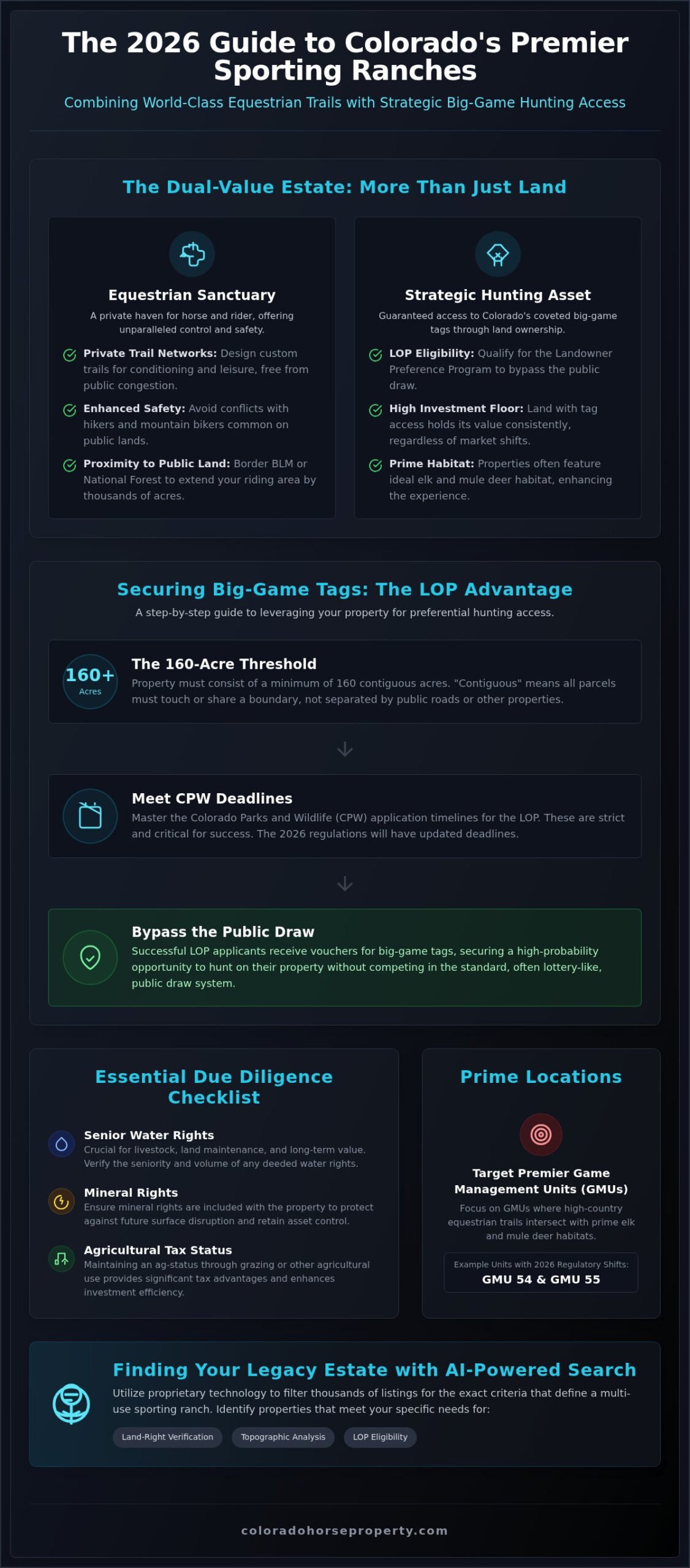
This 2026 guide is designed to help you acquire a legacy property that combines world-class riding trails with strategic hunting access through the Landowner Preference Program. You’ll discover how to target 160 plus acre parcels that secure LOP eligibility and provide a private trail network for year-round use. We will preview the critical 2026 regulatory shifts, including the new limited license requirements in units like GMU 54 and 55, and show you how to use specialized search tools to identify properties with the water and hunting rights necessary for long-term asset appreciation.
Key Takeaways
- Learn how to identify a Colorado horse property with riding trails that qualifies for the Landowner Preference Program (LOP) by meeting the 160-acre contiguous requirement.
- Master the 2026 CPW application deadlines and voucher process to secure big-game tags without navigating the standard public draw.
- Understand the critical role of senior water rights and mineral rights in protecting your ranch’s long-term utility and investment value.
- Discover the best Game Management Units (GMUs) in Colorado where high-country equestrian trails intersect with prime elk and mule deer habitat.
- Utilize proprietary AI-powered search technology to filter for properties that meet specific land-right and topographic criteria for multi-use estates.
The Hybrid Value of Colorado Horse Property with Riding Trails and Hunting Land
A “Sporting Ranch” in Colorado represents a specialized real estate category that bridges the gap between traditional equestrian facilities and high-quality big-game habitat. While many listings focus solely on barns or arenas, the true value in 2026 lies in the land’s multi-functional utility. A premier Colorado horse property with riding trails often serves as a dual-purpose sanctuary for both livestock and wildlife. These properties are strategic assets that provide exclusive access to the regional landscape, ensuring that your investment serves your passion for riding and your interest in conservation or hunting.
Properties bordering Bureau of Land Management (BLM) or National Forest land offer a significant “buffer effect.” This proximity effectively extends your usable acreage without the associated tax burden, as your horses can transition from private paths to thousands of acres of public land. This location factor often dictates the price per acre. Parcels located within high-demand Game Management Units (GMUs) command a premium because they offer a rare combination of recreational freedom and biological diversity. The intersection of trail access and hunting potential creates a market dynamic where the land’s utility is as high as its aesthetic appeal. If you’re interested in how this aesthetic appeal translates to other world-class locations, click here to explore the private ocean-view trail rides at Connemara Ranch.
To better understand how these features integrate into a single estate, watch this helpful video:
Why Private Trails Outperform Public Access in 2026
While iconic systems like The Colorado Trail offer incredible scenery, they are increasingly crowded with mountain bikers and hikers. For horse owners, public trail congestion creates safety risks and “multi-use” conflicts that can ruin a ride. Private trails allow you to control the environment completely. You can design specific inclines for conditioning, select footing that suits your horse’s needs, and ride at any hour without encountering motorized vehicles. This level of exclusivity is a top priority for buyers currently evaluating a horse property for sale in Colorado.
Investment Potential of Multi-Use Acreage
Securing Tags: The Landowner Preference Program (LOP) for Equestrian Properties
Acquiring a Colorado horse property with riding trails often serves a dual purpose: providing a home for your herd and securing exclusive access to big-game hunting. The Landowner Preference Program (LOP) is the primary mechanism that rewards large-acreage owners with a higher probability of obtaining hunting tags. This program isn’t just a perk; it’s a strategic tool for managing wildlife populations on your land while bypassing the increasingly competitive public draw system.
The 160-Acre Threshold: What Horse Owners Need to Know
Eligibility for the LOP begins with a strict 160-acre contiguous requirement. In the eyes of Colorado Parks and Wildlife (CPW), “contiguous” means the parcels must touch at a point or share a boundary. For buyers looking at a Colorado horse property with riding trails, this means you can’t simply add up disconnected 40-acre plots to reach the limit. If a public road divides your property, it usually doesn’t break contiguity, but a neighbor’s parcel in between will. The LOP program’s primary benefit for 2026 buyers is the ability to secure hunting vouchers in limited-draw units that are otherwise nearly impossible to draw as a member of the general public.
If you find a property that falls just short of this limit, consider looking at adjacent parcels. We often help clients identify opportunities to combine smaller holdings through our AI-powered search tools to reach that critical 160-acre mark. This legal threshold is non-negotiable for tag allocation for elk, mule deer, and pronghorn. Once you meet this acreage, you’re positioned to capitalize on the land’s full recreational potential.
Voucher Allocation and Strategy
The 2026 CPW application window is vital for your planning. You must register your land for the LOP by December 1st to be eligible for the following year’s draw. Once registered, which is valid for five years, you can apply for landowner vouchers between March 1st and April 7th, 2026. These vouchers are transferable, meaning you can gift or sell them to family members or guests, making your ranch a premier destination for private sporting events.
Success in the draw depends on the specific Game Management Unit (GMU). In units like 54, 55, and 551, where over-the-counter elk licenses have been eliminated for the 2026 season, landowner vouchers have become significantly more valuable. Effective habitat management, such as maintaining water sources and high-quality forage, ensures that resident herds remain on your property. This biological consistency, paired with strategic application timing, turns your equestrian estate into a high-functioning sporting asset. When evaluating potential ranches, always verify the LOP registration status during the due diligence phase to ensure a seamless transition of hunting rights at closing.
Strategic Locations: Where Riding Trails Meet Prime Game Management Units (GMUs)
Selecting the right region for your Colorado horse property with riding trails involves more than just a preference for mountain views. It’s a strategic decision that dictates your specific hunting opportunities and the length of your annual riding season. In Colorado, geography and Game Management Units (GMUs) are inextricably linked. While the Front Range Foothills offer excellent mule deer habitat and year-round accessibility, the Southwest provides rugged alpine systems that challenge both horse and rider. Each quadrant offers a distinct profile for the sporting enthusiast.
- The Northwest: Home to the massive White River elk herd and high-altitude trails.
- The Front Range: Ideal for those who need proximity to urban centers without sacrificing trail privacy.
- The Southwest: Offers dramatic topography and some of the most scenic riding in the American West.
- The Eastern Plains: A stronghold for trophy whitetail and expansive, manageable acreage.
Northwest Colorado: The Ultimate Sporting Destination
Meeker, Craig, and Steamboat Springs remain the “Gold Standard” for multi-use ranches. This region isn’t just about the scenery; it’s about the biology of the land. The Northwest holds the state’s largest elk populations, making it the premier choice for hunters. However, the steep topography requires careful planning. Designing a Colorado horse property with riding trails in this terrain means accounting for erosion control and safe switchbacks. For those seeking significant acreage to support these systems, our listings for Colorado ranches for sale provide the scale needed for both expansive trail networks and LOP eligibility.
The Eastern Plains: Hidden Gems for Horse and Hunt
The Eastern Plains are often overlooked, but they offer unique advantages for the pragmatic buyer. Riparian corridors, or river bottoms, are the lifeblood of this region. These areas attract trophy whitetail and waterfowl, providing high-quality hunting in a different setting than the high timber. From an operational standpoint, the lower elevation is a major benefit. You’ll enjoy more riding days per year and easier livestock management during the winter months. Don’t assume the land is boring because it’s flatter. The presence of deep arroyos and hidden canyons creates technical trail opportunities that are perfect for training and exploring without the extreme elevation gain of the Rockies.
Essential Due Diligence for Multi-Use Colorado Ranches
Due diligence for a multi-use ranch requires a deeper technical dive than a standard residential purchase. When you acquire a Colorado horse property with riding trails, you’re managing a complex ecosystem. You must verify that your recreational goals don’t conflict with existing legal encumbrances that could diminish the land’s value or your privacy. Protecting your investment means looking beneath the surface and beyond the fence line to secure your rights for the long term.
- Mineral Rights: Severed mineral rights can lead to surface disruption if a third party decides to extract resources. Always aim to acquire the mineral estate or secure a surface use agreement.
- Easements: Ensure that no prescriptive easements or historical right-of-ways allow public hunters or neighbors to cross your private trail system.
- Fencing: Wildlife-friendly designs are essential for multi-use land. Using a smooth bottom wire set 16 inches off the ground allows fawns and calves to pass under safely, while a sturdy top wire keeps your horses contained.
Water: The Lifeblood of the Property
In Colorado, water rights are separate from land ownership, making it legally necessary to verify adjudicated decrees through the Division of Water Resources to ensure your property’s future utility. Senior water rights are the gold standard. In a state where water is often more valuable than the dirt it sits on, having a decree that predates your neighbors’ ensures your troughs and ponds stay full during a dry August. “Live water,” such as year-round creeks or springs, acts as a primary magnet for game movement. Identifying whether a water source is adjudicated or non-adjudicated during your due diligence period is the difference between a thriving sporting ranch and a dry parcel with limited utility.
Boundary and Access Management
Managing “corner-crossing” issues is a high priority for 2026 buyers. This occurs when the public attempts to step from one piece of public land to another at a shared corner with your private property. Without a professional survey, these boundaries remain vague, leading to potential trespassing and liability issues on your equestrian estate. Accurate boundary markers are vital for protecting your private trail network from unauthorized use. For deeper insights into boundary requirements, consult our guide on Colorado land to avoid common pitfalls during the acquisition phase.
Securing a legacy property requires an expert who understands these technical nuances. Start your search with Colorado Horse Property to access listings vetted for these critical land rights.
Finding Your Legacy Estate with AI-Powered Property Search
Locating a premier Colorado horse property with riding trails requires a level of data precision that standard real estate platforms simply cannot provide. Most general search engines fail to account for Game Management Unit boundaries or the specific topography needed for sustainable trail systems. Our proprietary AI-powered search bridges this gap by allowing you to filter listings based on technical land-right features and recreational utility. This technology streamlines the discovery phase, ensuring you only spend time on parcels that meet the 160-acre LOP threshold or possess the senior water decrees essential for a functional ranch.
Mark and Alison Eibner bring over 40 years of Colorado real estate experience to every transaction. They understand that a multi-use ranch is more than just a home; it’s a complex asset involving title coordination, escrow management, and specialized land use laws. By partnering with Meridian Title & Escrow and Club Realm, we provide a full-cycle brokerage experience that protects your interests from the initial search to the final signature at the closing table. This collaborative approach ensures that your legacy estate is secured with professional oversight at every stage.
Beyond public listings, we provide access to exclusive off-market equestrian and hunting estates. These legacy properties are often held in private portfolios and never reach the open market. Our deep roots in the rural land community allow us to connect buyers with these unique opportunities before they are widely publicized. This gives our clients a distinct advantage in a market where high-quality acreage is increasingly scarce.
The AI Advantage in Niche Real Estate
Our platform is the only tool specifically designed to filter for contiguous 160 plus acre parcels with existing riding trails. You can narrow your search by proximity to National Forest borders, ensuring your private trail system connects seamlessly with thousands of acres of public land. The system also allows for custom alerts in high-demand Game Management Units. This means you are notified the moment a property with trophy-quality hunting potential and established equestrian infrastructure hits the market. This data-driven approach removes the guesswork from land acquisition.
Closing with Confidence: Expert Representation
Generalist agents often miss the nuances of LOP tags, water rights, and mineral estates. These details are the difference between a secure investment and a legal headache. We specialize in transaction management for multi-million dollar sporting ranches, where the stakes involve more than just square footage. From verifying historical water use to ensuring your trail access is protected from public easements, our expertise covers the technical requirements that generalists overlook. If you are ready to secure a property that meets your highest standards for riding and hunting, contact Colorado Horse Property to start your specialized search today.
Securing Your 2026 Sporting Legacy
Acquiring a premier Colorado horse property with riding trails is a strategic investment that requires balancing equestrian utility with complex land rights. You now understand how the 160-acre contiguous requirement opens doors to the Landowner Preference Program and why specific Game Management Units are critical for your 2026 hunting objectives. From verifying senior water decrees to managing boundary surveys, the technical details define the long-term value of your ranch. Don’t leave these factors to chance with generalist representation that lacks deep rural experience.
With 40 years of specialized Colorado expertise, we help you navigate these multi-use transactions with confidence. Our team provides full-service transaction and title coordination to ensure your surface and mineral rights are protected. By utilizing our proprietary data filters, you can bypass the noise of the general market and focus on properties that offer genuine sporting potential and private trail exclusivity. The legacy estate you’ve been searching for is out there; you just need the right tools to identify it.
Find your Colorado horse property with riding trails using our AI-powered search and take the first step toward owning a premier Western estate. We look forward to helping you secure a property that supports your lifestyle and your passion for years to come.
Frequently Asked Questions
How many acres do I need for landowner hunting tags in Colorado?
You need a minimum of 160 contiguous acres of private agricultural land to qualify for the Landowner Preference Program (LOP). This acreage must share a common boundary and be owned by the same individual or entity. If your Colorado horse property with riding trails meets this threshold, you become eligible to apply for vouchers that bypass the standard public draw process.
Can I hunt on my horse property if it is less than 160 acres?
Yes, you are permitted to hunt on your private land regardless of the total acreage, provided you hold a valid hunting license for that specific unit and season. The 160 acre rule only applies to eligibility for the Landowner Preference Program. Owners of smaller parcels must obtain their tags through the standard CPW primary draw or purchase over-the-counter licenses when available.
Do Colorado horse properties with riding trails usually have public easements?
Most private equestrian estates do not have public easements, but you must verify this during your due diligence period. Some properties bordering public land may have historical right of ways or prescriptive easements that allow access. A professional survey and title search are the only ways to ensure your private trail network remains exclusive and free from public intrusion.
What is the difference between a GMU and a hunt code?
A Game Management Unit (GMU) is a specific geographic boundary defined by Colorado Parks and Wildlife to manage wildlife populations. A hunt code is a unique alphanumeric identifier used during the application process to specify the species, sex, season, and method of take. You must select the correct hunt code for your specific GMU to participate in the draw.
How do water rights affect the value of a hunting and horse ranch?
Water rights are a primary driver of property value because they ensure the survival of livestock and attract big game. Senior water decrees are particularly valuable because they provide water security even during drought years. A hunting ranch with adjudicated water sources will consistently outperform dry parcels in both resale value and consistent wildlife residency.
Can I build my own riding trails on BLM-adjacent property?
You have the right to construct trails anywhere within your private property boundaries. You cannot build, clear, or modify trails on adjacent Bureau of Land Management (BLM) land without formal federal authorization. Many owners design their private Colorado horse property with riding trails to terminate at legal access points into public lands to extend their riding range.
What are the 2026 deadlines for the Colorado Landowner Preference Program?
The deadline to register your land for the LOP to be eligible for the next year is December 1st. For the 2026 season, the application window for landowner vouchers runs from March 1st to April 7th at 8 p.m. MST. Missing these specific dates will disqualify you from receiving landowner preference for that hunting cycle.
Is it better to buy land in an Over-the-Counter (OTC) or Limited Draw unit?
Buying in a limited draw unit often provides a higher quality sporting experience due to reduced hunter pressure and better age classes for game. However, this makes LOP eligibility much more important for consistent access. In 2026, units like GMU 54 and 55 have shifted to limited draw for elk, significantly increasing the value of a Colorado horse property with riding trails that includes landowner vouchers.