
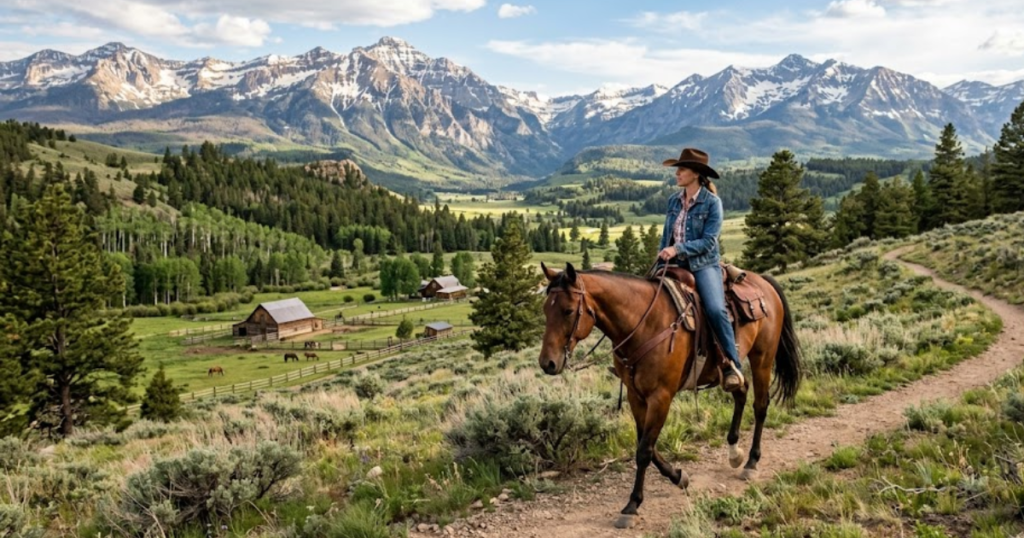
You finally close on your dream five-acre property. It has a beautiful barn, mountain views, and lush pastures. On your first Saturday morning, you saddle up your gelding, ride to the end of your driveway, and realize… you have nowhere to go. The road is a busy, paved 55-mph county highway with blind curves, and the adjacent open space explicitly bans hooved animals.
To ride safely, you have to load your horse into the trailer, fight weekend traffic, and park at a crowded trailhead. Suddenly, your dream property feels like an expensive boarding facility.
When searching for horse properties in Colorado, the true value of a property isn’t just in the soil, it is in the surrounding infrastructure. The most highly sought-after equestrian properties allow you to ride directly off your property onto a sanctioned trail system.
Here is a breakdown of which Colorado counties offer the best combination of legal horse zoning and expansive open space.
Best Colorado Counties for Equestrian Trails and Zoning
Quick Summary: The Saddle-Up Metric
- The "Trailer Trap": Buying acreage does not guarantee access to riding. Many buyers purchase 10 acres in a restrictive county only to realize they have to hook up the trailer and drive 45 minutes to find a public soft-surface trail.
- Douglas County Dominance: Douglas County is widely considered the gold standard for Colorado equestrians, offering favorable Agricultural (AG) and Large Rural Residential (LRR) zoning, along with a massive network of dedicated non-motorized trails.
- Boulder's Premium Open Space: Boulder County offers incredible trail access through its expansive open-space programs, and agricultural zoning allows up to 4 horses per acre. However, the price per acre is significantly higher.
- Jefferson County Mountain Living: For buyers wanting trees and varied terrain, Jefferson County, specifically around Evergreen and Conifer, offers A-1 and A-2 zoning with direct access to Denver Mountain Parks.
1. Douglas County: The Equestrian Epicenter
Located south of Denver, Douglas County has intentionally preserved its equestrian heritage through smart zoning and aggressive open-space acquisition.
- The Zoning Advantage: Douglas County offers several highly favorable zoning districts for buyers, including A1 (Agricultural One), LRR (Large Rural Residential), and ER (Estate Residential). These zones generally have clear, reasonable allowances for hooved animals and accessory structures like barns and arenas.
- The Trail Network: The county boasts an unparalleled network of soft-surface, non-motorized trails perfect for riding. Properties near Bayou Gulch Regional Park, Dawson Butte, or the Cherry Creek Trail corridor offer riders access to miles of varied terrain.
2. Jefferson County: Foothills and Forest Access
If your dream is to ride through ponderosa pines rather than open prairie, "Jeffco" is the target destination.
- Equestrian Neighborhoods: Areas such as Evergreen, including Soda Creek and Blue Creek, and Conifer offer a mountain-living lifestyle with robust equestrian infrastructure. Many of these properties are zoned A-1, A-2, or SR-2, accommodating livestock and hay storage.
- Public Lands: Buyers in Jefferson County often have the distinct advantage of riding directly into Denver Mountain Parks or adjacent National Forest land, providing virtually limitless trail riding right from the barn door.
3. Boulder County: Luxury Pastures and Protected Plains
Boulder County is famously protective of its open space, making it a highly desirable, albeit expensive, destination for horse owners.
- Density Rules: In Boulder County, properties zoned for forestry or rural residential typically allow up to two horses per acre of pasture. In comparison, agricultural-zoned properties can allow up to four horses per acre.
- The Riding Experience: The county has invested heavily in acquiring open space. Neighborhoods like Boulder Heights and Sugarloaf provide residents with quick access to equestrian-friendly trails, including those in the Boulder Valley Ranch open space and the Foothills Trail.
4. Elbert County: The True Acreage Play
Located just east of Douglas County, Elbert County, including towns like Elizabeth and Kiowa, is the destination for buyers who prioritize massive acreage and unrestricted agricultural freedom over manicured county parks.
- Fewer Restrictions: Elbert County is historically agricultural. Buyers here face far fewer restrictions on boarding operations, arena construction, and herd size.
- The Trade-Off: While you will get significantly more land for your money, Elbert County relies more on private dirt roads and wide-open plains for riding rather than the highly developed, formal trail systems found in Douglas or Boulder counties.
We Analyze the Trail Maps Before You Buy
We don't just look at the property lines; we look at what lies beyond them.
When our team represents you, we cross-reference a property's location with county trail maps, zoning codes, and HOA restrictions. We ensure that when you buy a property to live the equestrian lifestyle, you actually have the legal right and the geographic ability to saddle up and ride out your back gate.
Contact Us Today to find premium horse properties Colorado buyers trust for exceptional trail access.
Browse Active Colorado Horse Properties: Browse active Colorado horse ranches for sale or ask our team about finding a premium horse property for rent in Colorado with direct open space access
Frequently Asked Questions (FAQ) About Colorado Equestrian Zoning
If a property has 10 acres, does that automatically mean I can keep horses?
No. Acreage does not supersede zoning. If a 10-acre parcel is located in a high-density residential zone, a protected environmental overlay, or a strict HOA, horses may be strictly prohibited. Always verify the specific county zoning code, like Douglas County's AG or LRR, before purchasing.
Can I run a commercial boarding or training business on my horse property?
This is a critical distinction. Most rural residential zoning allows for private horse ownership based on an animal-unit-per-acre calculation. Running a commercial boarding facility or hosting public riding lessons often requires a special "Use by Right" permit or commercial agricultural zoning.
Are motorized vehicles, like dirt bikes, allowed on county equestrian trails?
In counties with dedicated open space programs, like Douglas and Boulder, most designated equestrian trails are strictly categorized as "soft-surface, non-motorized, multiple-use," meaning you will share them with hikers and mountain bikers, but not ATVs or dirt bikes.