
With 58.19% of Colorado facing extreme drought as of May 2026, buying a ranch without senior water rights isn’t just a risk; it’s a liability. You likely understand that a standard residential agent can find you a beautiful kitchen, but they often lack the technical expertise to evaluate complex agricultural assets. It’s frustrating to waste weeks touring properties only to find the zoning doesn’t allow for your specific number of horses or the well permit is restricted.
This guide will show you why hiring a specialist horse property realtor Colorado is non-negotiable for securing a property that is legal, functional, and safe for your livestock. We’ll provide the expert guidance you need on Colorado-specific land laws to ensure a smooth closing. You’ll learn what to look for in a representative, from their knowledge of Senate Bill 25-149 equestrian zones to the technical differences between a basic loafing shed and a professional arena. We’re breaking down everything you need to know about water seniority and livestock infrastructure in the current 2026 market.
Key Takeaways
- Distinguish between “equestrian lifestyle” and “equestrian infrastructure” to avoid buying a property that looks good but fails to function for livestock.
- Learn how a specialist horse property realtor Colorado identifies 2026 land-use regulations that impact your ability to build new barns or professional arenas.
- Discover how AI-powered search technology finds specialized listings that general sites miss by filtering for specific pasture quality and stabling requirements.
- Understand the regional market nuances between the Front Range and Western Slope to make a data-driven investment in the current 2026 climate.
- Navigate the complexities of agricultural transactions with a team that provides full-service support, including buyer representation and title coordination.
Why a Specialist Horse Property Realtor is Essential in Colorado
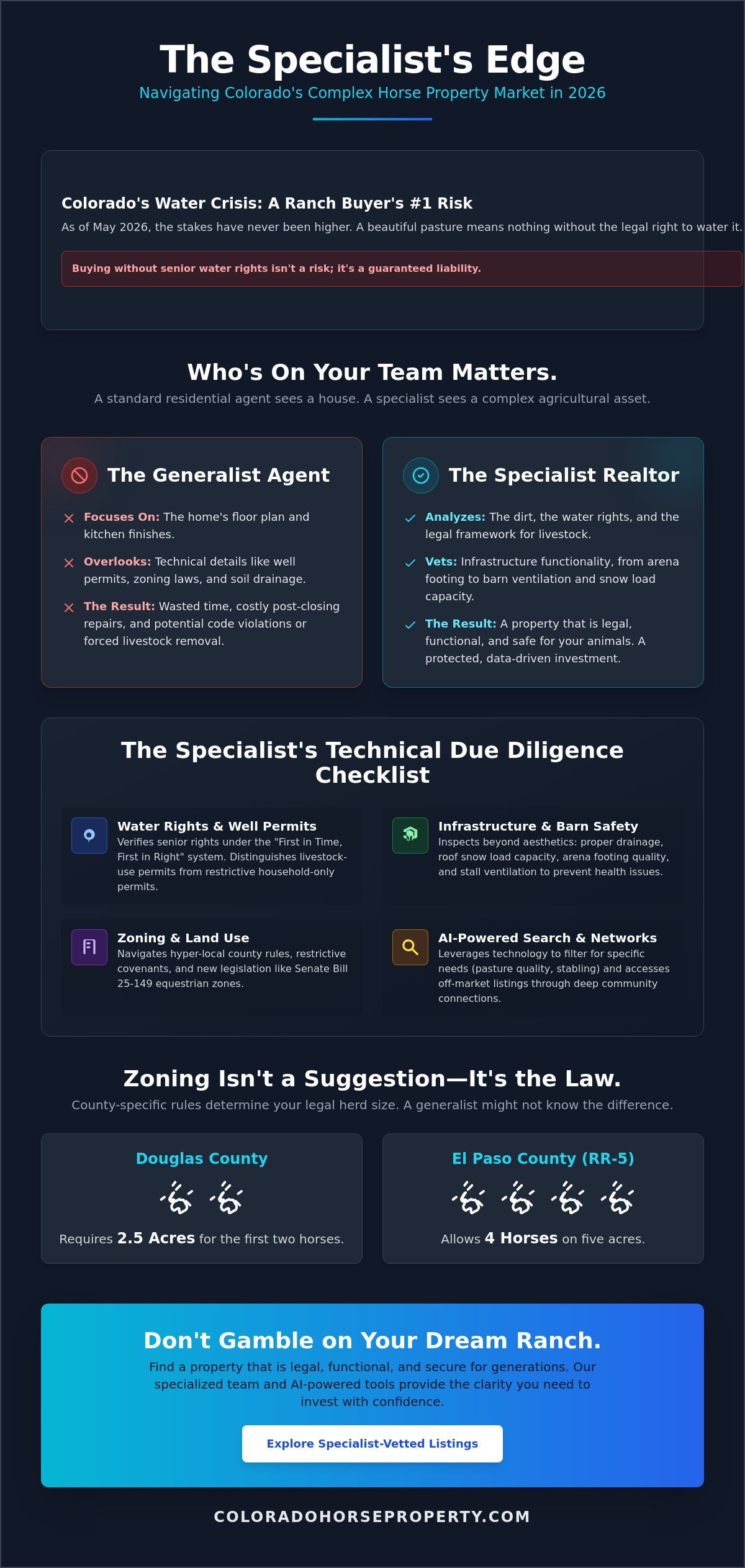
Buying a home in a suburban cul-de-sac is a simple transaction. Buying a 35-acre ranch in the Front Range is a complex agricultural acquisition. A specialist horse property realtor Colorado doesn’t just look at the floor plan; they analyze the dirt, the water, and the legal framework that keeps your horses safe. Generalist agents often treat acreage as a large yard, ignoring the technical requirements of animal husbandry and resource management. This lack of niche knowledge can lead to expensive mistakes that a standard residential contract won’t protect you from.
To see how these considerations play out in specific regions like Teller County, watch this video:
Many listings are marketed as horse-friendly simply because they have a fence. True functionality requires understanding equestrian facilities from a structural and operational perspective. A specialist knows that a beautiful lifestyle property might lack the drainage needed for a winter paddock or the structural integrity to support a heavy snow load on a barn roof. They vet these details before you ever step foot on the property, which is vital in a market where the average days on market is 154 days. You don’t want to spend months waiting for a closing only to find out the land is unusable for your herd.
The Risk of Generalist Representation
A standard agent might miss restrictive covenants that forbid metal buildings or specific barn designs. Zoning laws in Colorado are hyper-local and strict. For example, Douglas County requires 2.5 acres for the first two horses, while an RR-5 district in El Paso County allows four horses on five acres. Missing these nuances can lead to code violations or forced livestock removal. Beyond zoning, failing to properly inspect a high-capacity well or a septic system designed for a house rather than a working ranch can cost you tens of thousands in post-closing repairs.
Defining the Specialist Value Proposition
Expert realtors evaluate technical details like arena footing materials and stall ventilation patterns that prevent respiratory issues in horses. They act as consultants, helping you navigate Colorado’s Right to Farm legislation and the new 2026 equestrian zones created by Senate Bill 25-149. Because they’re immersed in the local horse community, they often have access to off-market listings and niche networks that aren’t visible on standard apps. This peer-to-peer connection ensures you’re buying into a community that supports your agricultural goals and protects your investment.
The Technical Checklist: What Your Realtor Must Evaluate
Evaluating a property through the lens of a horse owner requires a technical eye. A specialist horse property realtor Colorado understands that a picturesque meadow is useless if the soil doesn’t drain or the well permit is restricted to household use only. As of May 2026, with 58.19% of the state in extreme drought, verifying water seniority is the most critical step in your due diligence process. A generalist agent might see a green pasture; a specialist sees the potential for a dry well and a failed investment.
Water Rights and Well Permits
Colorado operates under the Prior Appropriation System, which follows the principle of first in time, first in right. It’s vital to distinguish between a basic well permit and Colorado water rights that allow for livestock watering or pasture irrigation. Many rural properties only have “household-only” permits, which legally forbid you from watering a single horse. Your realtor must investigate augmentation plans to ensure you won’t face legal action during a dry spell. If you need to verify specific water access for a ranch, you can search current horse property listings to see which properties include documented senior rights.
Infrastructure and Barn Safety
Infrastructure isn’t just about aesthetics. Your realtor must evaluate the structural integrity of existing barns, looking for fire hazards in outdated electrical systems or poor ventilation that leads to respiratory issues like heaves. Stall dimensions matter too. A 10×10 stall might work for a pony, but a 12×12 is the standard for larger breeds. If you’re a competitive rider, you’ll need to verify that arena dimensions meet the specific requirements for your discipline, whether it’s the 20×60 meters required for a standard Dressage court or the specialized footing needed for Reining.
Zoning designations like A-1 versus RA dictate more than just the number of horses allowed. They impact your ability to run a commercial boarding operation or host clinics under the 2026 land-use regulations. Soil analysis is equally important. Clay-heavy soils in certain parts of the Front Range can lead to pudding pastures and ruined arena bases without proper drainage. Finally, your realtor must check easements and turn-radii to ensure a 40-foot gooseneck trailer can safely navigate the driveway without getting stuck or damaging the road.
Navigating the Colorado Equestrian Market in 2026
The 2026 market shows a stabilization of rural property values, making it a strategic year for land acquisition. With an average listing price of $1,764,787 for equestrian properties and a 25% agricultural tax assessment rate, buyers must evaluate the long-term carrying costs of their investment. A specialist horse property realtor Colorado understands that valuation isn’t just about square footage; it’s about the replacement cost of infrastructure. Improvements like professional-grade footing or heated wash racks significantly boost a property’s appraisal, but only if your agent knows how to document these specialized assets for a lender.
Regional Spotlights: From Parker to Fort Collins
Douglas County remains the gold standard for luxury equestrian estates, particularly around Parker and Castle Rock. However, we’re seeing emerging value in Elbert and Weld counties for those seeking larger ranch operations. Climate factors vary wildly across these zones. You’ll need wind protection on the eastern plains, while high-country properties require structures built for heavy snow loads. Understanding Small acreage management is essential here, as soil quality and manure management regulations differ significantly between the Front Range and the Western Slope.
The impact of Senate Bill 25-149, effective August 12, 2026, cannot be overstated. It authorizes municipalities to create “equestrian zones” and infrastructure maps. This simplifies the path for new barn construction in participating counties but requires a realtor who stays current on local land-use votes. Seasonal timing also matters; touring a property in May allows you to see the true state of the pastures after the spring melt, which is far more revealing than a mid-winter inspection when snow hides drainage issues.
The Closing Ecosystem: Title and Escrow
Standard title companies often stumble over complex ranch legal descriptions involving multiple parcels, grazing leases, or senior water rights. We utilize a full-service brokerage model that includes transaction management and title coordination through specialized partners like Meridian Title & Escrow. This ensures that every easement and water right is accurately recorded during the closing process. To understand how these technical details and infrastructure quality impact your bottom line, see our guide on horse real estate for sale and market valuations.
AI-Powered Search: A New Era for Equestrian Real Estate
Standard search engines often fail because they rely on broad categories. If a listing agent doesn’t check a specific box, a functional ranch disappears from your results. A specialist horse property realtor Colorado uses AI to scan thousands of data points and photos to find these hidden listings. This technology identifies infrastructure like round pens or specific barn configurations even when they aren’t labeled in the text. It ensures you see every viable option in your target area.
The speed of this system gives you a distinct advantage. While others wait for updates on national real estate portals, our AI provides alerts the moment a property enters the market. It also analyzes aerial imagery to evaluate the land’s actual utility. It can distinguish between a steep, unusable hillside and a level, five-acre pasture. This ensures you don’t waste time on properties that look good in photos but fail in person.
Beyond Keyword Filtering
Standard filters for “acreage” don’t tell you if the ground is suitable for a heavy horse. Our proprietary search looks deeper, identifying properties with high-quality arena footing or layouts that support efficient pasture rotation. We use predictive analytics to evaluate if a listing price aligns with the property’s agricultural potential. This prevents you from paying a premium for a lifestyle property that lacks the functional bones needed for a serious equestrian operation.
The Buyer Experience with Colorado Horse Property
Searching for a ranch shouldn’t be a chore. Our system delivers a curated feed that matches your specific discipline, whether you need a cutting pen or a regulation dressage court. This process is built on the foundation of our equestrian real estate Colorado guide. By combining machine learning with our decades of field experience, we ensure every result is a viable candidate for your horses.
Ready to see what’s currently available? Find your Colorado Horse Property with our AI Search Tool to see the latest listings that match your exact criteria.
Choosing Your Partner: The Colorado Horse Property Difference
Selecting the right representation is the final, most critical step in your journey. A specialist horse property realtor Colorado acts as your advocate through every technical hurdle, from water right transfers to zoning disputes. At Colorado Horse Property, our leadership is defined by Mark and Alison Eibner. They bring decades of specialized experience to the table. This isn’t just a business; it’s a legacy built on 40 years of history with Realty Oasis. When you enter a negotiation for a multi-million dollar ranch, that tenure matters. It gives you the edge in contract discussions where generalist agents often falter.
Our brokerage operates on a full-service model. We don’t just find you a listing and walk away. We manage the entire lifecycle of the transaction. This includes AI-powered property discovery, professional buyer representation, and meticulous transaction management. We even coordinate title and escrow services to ensure your agricultural assets are legally protected. This integrated approach removes the friction from complex land deals. You get the benefit of modern technology paired with the wisdom of seasoned professionals who understand the nuances of the Colorado landscape.
Expert Buyer Representation
Property valuation for equestrian estates is an art form. Most residential appraisers look at the house first and the land second. We reverse that. We understand the “extra” value of a well-designed 12-stall barn, a mirrored indoor arena, or senior water rights that provide literal lifeblood to your pastures. Our negotiation strategies are tailored for these agricultural complexities. We know how to structure deals that account for equipment inclusions, hay inventory, and grazing leases. For deeper insights into these strategies, read our guide on horse property for sale in colorado.
Ready to Start Your Search?
The 2026 Colorado market moves quickly. You need a partner who combines high-tech tools with high-touch service. You can use our proprietary AI tool to run your first search today and see listings that match your specific discipline. If you’re ready for a more personalized approach, contact our Englewood office. We provide a comprehensive market analysis that goes beyond simple “comps” to look at the true utility of your target properties. We analyze soil, water, and infrastructure to ensure your investment is sound.
The path to owning your dream ranch starts with expert guidance. Don’t settle for a generalist when you can have a seasoned team that speaks your language. Find your Colorado Horse Property with our AI Search Tool and let’s define your equestrian goals together.
Secure Your Colorado Equestrian Future
Securing a functional ranch in 2026 requires more than just a standard home search. You’ve seen how critical senior water rights and specific county zoning are to the safety and legality of your livestock. Relying on a generalist agent in this market often leads to missed details that could cost you thousands in remediation or lost land utility. By partnering with a specialist horse property realtor Colorado, you gain an advocate who understands the technical requirements of arena footing, barn ventilation, and the latest 2026 land-use regulations.
Led by Mark and Alison Eibner, our team brings 40 years of local real estate expertise to every transaction. We combine this long-standing industry tenure with proprietary AI-powered search technology to find listings that meet your exact equestrian needs before they reach the general public. Whether you’re looking for a turnkey facility in Douglas County or a sprawling ranch on the Western Slope, we provide the expert representation you deserve. Don’t leave your dream property to chance.
Start your AI-powered horse property search now and take the first step toward a secure and functional equestrian lifestyle. We look forward to helping you find the perfect place for you and your horses.
Frequently Asked Questions
What makes someone a specialist horse property realtor in Colorado?
A specialist possesses a deep understanding of agricultural land use, senior water rights, and livestock infrastructure. They evaluate properties based on soil drainage, barn structural integrity, and local zoning rather than just residential aesthetics. This expertise allows them to identify risks that a general agent might overlook, such as restricted well permits or illegal manure management setups. Their role is to act as a land-use consultant throughout the entire transaction.
How much acreage do I actually need for two horses in Colorado?
Acreage requirements depend entirely on specific county zoning codes and the land’s carrying capacity. In Douglas County, the code generally requires 2.5 acres for the first two horses. Conversely, an RR-5 district in El Paso County typically requires five acres to house four horses. You must always verify the specific “horse-per-acre” rule with the local planning department before submitting an offer to ensure your herd is legal.
Do I need a special inspection for a horse property?
Yes, you must conduct specialized inspections beyond the standard home walkthrough to protect your investment. These include a high-capacity well test to verify flow rates and a septic inspection to ensure the system can handle ranch operations. It is also wise to have a structural engineer or a specialist horse property realtor Colorado evaluate barn foundations and arena drainage to prevent future liabilities or expensive remediation costs.
Can a regular realtor help me with water rights?
Most residential agents lack the technical training to navigate Colorado’s complex Prior Appropriation System. Water rights are legal property interests that require a specific title search and verification of seniority. A specialist ensures you aren’t buying a property with a “household-only” well permit, which legally forbids you from watering your horses. They understand how to verify if the water is adequate for your specific agricultural needs.
How does the AI search tool find better horse properties?
Our AI search tool scans visual data and hidden metadata to identify properties with functional infrastructure that standard filters miss. It finds listings that lack the “horse property” keyword but possess the necessary flat topography, barns, and fencing visible in aerial photography. This allows you to discover off-market or poorly categorized opportunities. You save time by only viewing properties that meet the strict physical requirements of a working horse facility.
What are the most horse-friendly counties in Colorado for 2026?
Douglas and El Paso counties remain top choices due to established equestrian infrastructure and clear zoning regulations. Weld and Elbert counties are increasingly popular for buyers seeking larger ranch operations at a lower cost per acre. With the August 2026 implementation of Senate Bill 25-149, counties that actively map equestrian zones and infrastructure will become even more desirable for long-term property value and ease of use.
What should I ask a realtor before hiring them for a ranch purchase?
Ask the agent how many agricultural transactions they’ve closed and if they understand the difference between junior and senior water rights. Inquire about their knowledge of local manure management setbacks and “Right to Farm” protections. A specialist horse property realtor Colorado should be able to explain how local soil types impact your arena footing. They should also provide references from other livestock owners who have used their services.
How do commissions work for equestrian property sales?
Commissions for equestrian properties function similarly to residential sales, with the average rate in Colorado sitting at 5.71% as of February 2026. These fees are typically negotiated between the seller and their listing agent and then shared with the buyer’s representative. Always review your buyer representation agreement to understand how these costs are handled. Specialized agents provide significantly more value for this fee by protecting you from complex agricultural liabilities.