
As of early 2026, 82% of real estate professionals have adopted AI tools, yet many buyers still spend months touring “horse properties” that are actually just residential lots with a garden shed. You’ve likely felt the frustration of inaccurate listing tags or the fear of buying a beautiful acreage only to find out it lacks the legal water rights for your livestock. It’s exhausting to filter through generic national portals that don’t understand the difference between a decorative fence and a functional corral. This guide will show you how to master advanced search filters for horse real estate to eliminate these duds and secure a move-in ready estate.
We’ll dive into the technical search parameters required to navigate Colorado’s specific land-use challenges while avoiding common property deal-breakers. You’ll learn how to use specialized technology to predict property suitability and verify zoning laws before you book a showing. By the end of this article, you’ll have the expert framework needed to find a property that supports both your horses and your long-term lifestyle goals.
Key Takeaways
- Discover why national real estate portals often misidentify equestrian infrastructure and how to bypass these common data inaccuracies.
- Identify specific barn types and stall specifications, including ventilation and flooring, to ensure a property meets professional equine standards.
- Master advanced search filters for horse real estate to distinguish between domestic and household-only well permits, which determines your legal livestock capacity.
- Learn to navigate Colorado’s complex water rights and 2026 agricultural tax laws to safeguard your property from future legal and financial deal-breakers.
- Leverage proprietary AI tools to find hidden value by prioritizing land quality and proximity to regional equestrian venues over residential aesthetics.
Why Standard Real Estate Filters Fail Equestrian Buyers
Most residential portals are built to sell houses, not ranches. They categorize properties based on square footage and kitchen finishes, often overlooking the technical specifications of essential infrastructure for horse properties. When a search engine prioritizes a fourth bedroom over a four-stall barn, the equestrian buyer loses. This data conflict creates a massive gap between what a listing claims and what actually exists on the ground.
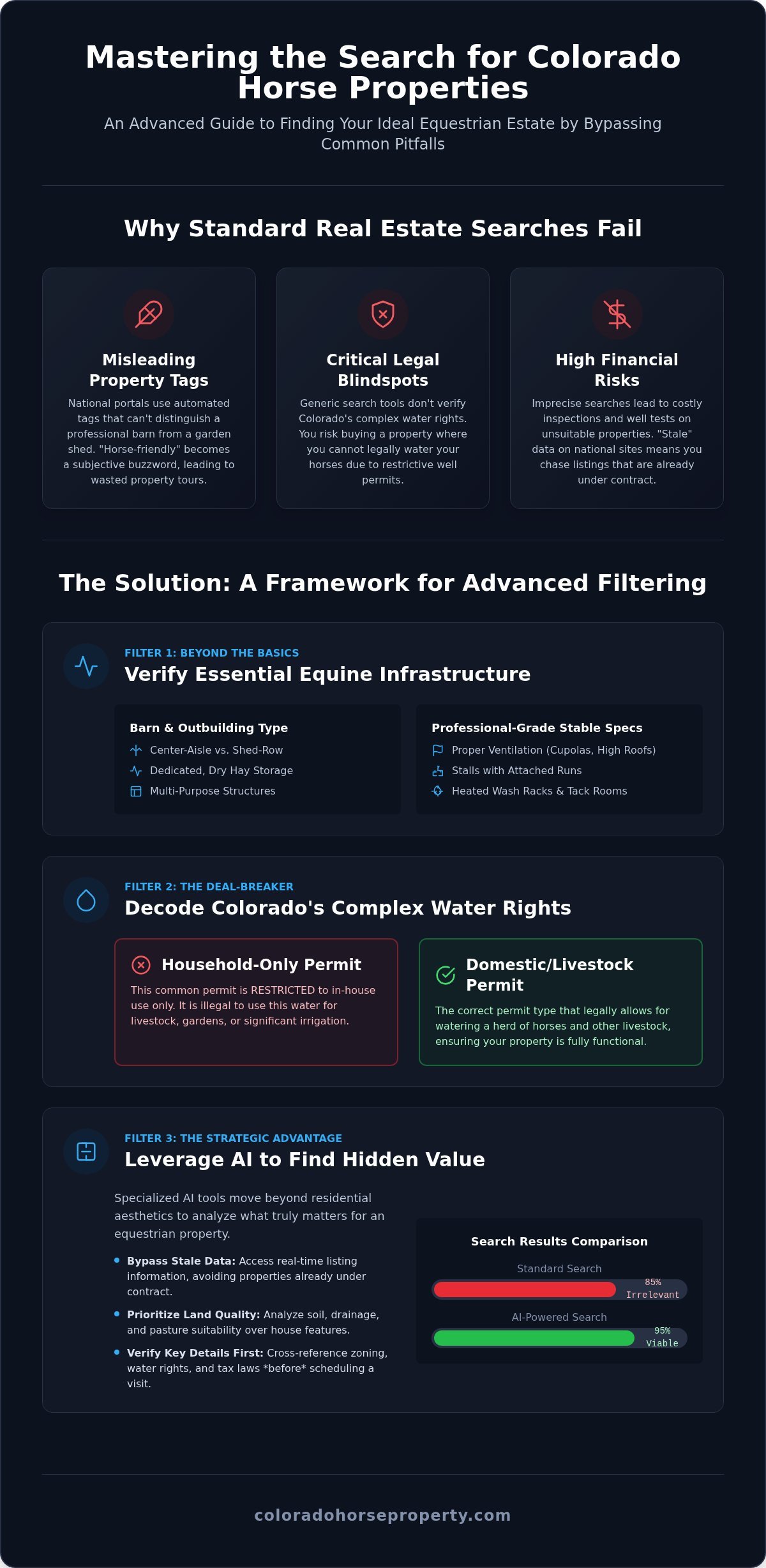
Colorado’s legal environment makes this gap even more dangerous. Unlike other states, our water rights are complex and often decoupled from the land title. General real estate apps aren’t programmed to check the difference between an exempt domestic well and a restricted household-only permit. Without advanced search filters for horse real estate, you risk purchasing a property where you cannot legally water your herd.
The Problem with Automated Property Tags
Automated algorithms frequently mislabel rural structures. A machine learning tool might identify a backyard storage shed as a functional stable, leading to “phantom amenities” that disappear upon physical inspection. To understand how businesses can prevent these digital misidentifications, you can explore AEO Audit services that help optimize brand data for AI search engines. The term “horse-friendly” is also frequently used as a subjective marketing buzzword rather than a verified zoning status. Relying on these generic tags often leads to viewing properties that lack the necessary drainage or pasture quality for livestock. It’s common to find “active” listings that have actually been under contract for weeks because large-scale databases fail to update rural data in real time.
Financial Risks of Poor Search Precision
Searching without precision isn’t just frustrating; it’s expensive. Buyers often incur significant costs for inspections or well tests on properties that should have been filtered out immediately due to zoning conflicts or un-permitted structures. By using our AI-Powered Horse Property Search, you bypass the “stale” data found on national aggregators. Our specialized search tools understand the “dirt under the boots” reality of Colorado land, ensuring your capital is spent on viable prospects rather than chasing residential listings that can’t support an equestrian lifestyle.
Essential Infrastructure Filters for Functional Horse Properties
Finding a property that supports your equine goals requires moving beyond the basic “horse property” checkbox. High-performing advanced search filters for horse real estate allow you to categorize outbuildings by their specific utility. A shed-row barn might suffice for a hobbyist, but a professional trainer often requires a center-aisle configuration for better workflow and climate control. These filters help you identify multi-purpose structures that include dedicated hay storage, which is vital for maintaining a dry supply during Colorado’s unpredictable winters.
Infrastructure is only as functional as the resources supporting it. Even the most sophisticated stable becomes a liability without a legal water source for livestock. When evaluating a barn’s capacity, you must cross-reference it with Colorado water rights to ensure your well permit allows for the number of stalls you intend to fill. Using technical search parameters helps you avoid properties where the “dream barn” is legally restricted from being used to its full potential.
Advanced Stable and Stall Parameters
A professional-grade stable filter should look for more than just a roof and four walls. You need to distinguish between hobby stables and professional boarding facilities by filtering for specific amenities. Look for these key markers:
- Stalls with runs: Essential for equine respiratory health and daily movement.
- Wash racks: Identification of indoor, heated wash bays with proper drainage.
- Tack rooms: Search for climate-controlled spaces to protect leather and equipment.
- Flooring material: Filtering for rubber mats over crushed rock or concrete to reduce leg fatigue.
Ventilation is another critical factor. Advanced filters can help you find barns designed with high-pitched roofs or cupolas, which are necessary for air exchange in enclosed stables. If you are struggling to find these specific details on national sites, you can access specialized listings that prioritize these technical equine specifications.
Training Facility and Arena Search Logic
For competitive riders, the arena is the heart of the property. Generic searches often fail to specify if an arena is 60×120 or a full regulation size for dressage or roping. Precise filters allow you to search by footing type, such as natural sand or proprietary artificial mixes. This distinction is important because artificial footing often requires less water but a higher initial maintenance budget. You should also filter for lighting availability and round pens, ensuring the property is ready for training on day one. By using advanced search filters for horse real estate, you can target properties with existing hot walkers or specific fencing materials like high-visibility vinyl or pipe-and-cable, which are safer than traditional wire for high-energy horses.
Navigating Colorado’s Technical Filters: Water Rights and Zoning
While the physical barn is visible during a walkthrough, the legal right to water your horses is often hidden in complex state records. In Colorado, the distinction between a domestic well and a household-only well is the difference between a functional ranch and a dry residential lot. Advanced search filters for horse real estate must account for these permit types to prevent legal disaster. A domestic well permit allows for the watering of livestock, while a household-only permit limits usage strictly to indoor plumbing. If you plan to keep multiple horses, filtering for a domestic permit is a non-negotiable step in your due diligence.
Water seniority is another critical filter. Colorado operates on a “first in time, first in right” basis. If you hold junior water rights, a “call” on the river during a drought could legally prevent you from using your water. You should also filter for properties with established conservation easements if you want to ensure the surrounding land is protected from future high-density development. These easements safeguard the rural character of your investment and protect the local ecosystem.
Deciphering Colorado Well Permits
The Colorado Division of Water Resources charges approximately $100 for a typical exempt domestic well permit application, but the value of an existing, high-producing well is worth much more. When using our AI-Powered Horse Property Search, you can filter for specific well permit numbers to verify historical flow rates. Look for these technical markers:
- Augmentation Plans: These allow for increased water usage by replacing the water consumed, essential for larger herds.
- Commercial Well Status: A requirement if you intend to run a professional boarding or training business.
- Denver Basin Aquifers: Specific evaluation fees may apply here, so filtering for depth and aquifer type is vital for long-term reliability.
Zoning and Land Use Restrictions
Zoning determines the “animal units” allowed per acre. While A-1 zoning is generally more permissive, A-2 zoning may have stricter limits on the number of livestock. Under the 2026 law SB26-010, documented agricultural use is now required to maintain specific tax benefits, making zoning filters even more important for your bottom line. You must also distinguish between unincorporated land and properties within an HOA. Unincorporated areas often offer more freedom for building additional outbuildings, whereas covenant-controlled communities may restrict fence types or manure management practices. Using advanced search filters for horse real estate to identify “non-conforming use” permits can also reveal properties that have grandfathered rights to operate as equestrian facilities in areas that have since been rezoned.
Strategic Search: Using AI Filters to Find Hidden Value
Smart buyers realize that a luxury home can be renovated, but poor soil or lack of trail access is permanent. The “Acreage-First” approach focuses on securing high-quality land before worrying about the residential structure. By utilizing advanced search filters for horse real estate, you can identify properties that adjoin public land, such as National Forest or BLM acreage. This effectively expands your riding territory by thousands of acres without the tax burden of owning it. Predictive AI tools also help identify emerging equestrian hubs in counties like Elbert or Fremont before land prices spike, giving you a first-mover advantage in the market.
As of early 2026, 82% of real estate professionals use AI to streamline workflows. We leverage this technology to monitor market conditions and surface opportunities that generic apps miss. For example, agentic AI can now filter for properties specifically within a 30-minute haul of major Colorado Horse Parks or event centers. This level of precision ensures your investment supports both your training schedule and your long-term property value.
The 3-Step Filter Sequence for Value
Finding an undervalued ranch requires a disciplined search strategy. Instead of looking for a finished “equestrian estate,” use this sequence to find properties with high “sweat equity” potential:
- Step 1: Set a minimum “Domestic Well” filter. This is the foundation of livestock viability and cannot be easily bypassed later.
- Step 2: Filter by “Acreage Tier” to match your grazing needs. If you plan on pasture rotation, look for parcels that allow for at least two to four distinct turnout areas.
- Step 3: Overlay “Barn” filters to find existing infrastructure. Finding a property with a solid shell that needs interior stalls is often cheaper than building from scratch.
Following this logical path helps you strip away the “distraction” of a beautiful home and focus on the utility of the land. You can start your custom search today to see how these tiers narrow down the field to only the most viable options.
Proximity and Lifestyle Search Strategy
Lifestyle buyers often prioritize access to local riding communities. You can use advanced filters to target properties near established trail systems like Fox Run Park. This proximity adds significant resale value and simplifies your daily routine. Additionally, use “Days on Market” filters to identify motivated sellers. In the rural market, a property that has been active for over 90 days may simply be poorly marketed rather than flawed. When combined with a filter for “Senior Water Rights,” these “stale” listings can become powerful long-term investment hedges. You aren’t just buying a home; you’re securing a legacy in the Colorado landscape.
Whether you are building a legacy on a ranch or looking for a dedicated space for your automotive passion, experts like The Garage Condo Guy offer the specialized knowledge required to find high-end vehicle storage in the Colorado market.
Finding Your Colorado Legacy with Proprietary AI Search Tools
Securing a legacy in the Colorado high country requires more than just a standard search query. It demands a system that understands the nuances of sub-surface water rights and the structural integrity of a professional equine facility. Our AI-Powered Horse Property Search is designed to eliminate the “listing noise” that plagues national platforms. By utilizing advanced search filters for horse real estate, you gain access to a proprietary database that prioritizes equine utility over residential aesthetics. This technology doesn’t just find houses; it identifies functional estates with verified pasture sizes and legal livestock capacity.
The 2026 market moves quickly, and generic apps often leave buyers chasing properties that are already under contract. Our tool bridges that gap by providing a direct, unfiltered look at the technical specifications horse owners actually need. Whether you are looking for specific arena footing or documented senior water rights, our system categorizes these assets with precision. This ensures you spend your time visiting properties that are truly move-in ready for your herd.
Real-Time Data Accuracy in 2026
Data accuracy is the foundation of a successful rural purchase. National aggregators often lag behind the actual MLS, showing “active” status for properties that sold days ago. Our direct feed is different. It provides instant notifications for properties matching your “must-have” filters, such as specific stall counts or barn types. This speed is critical when competing for high-value ranches in emerging Colorado hubs. Beyond public listings, our professional network provides access to off-market ranch opportunities that never hit the traditional portals. This gives our clients a distinct advantage in a competitive landscape.
The Expert Human Element Behind the AI
Technology provides the data, but human expertise provides the necessary context. Mark and Alison Eibner are not just real estate professionals; they are people who ride and understand the daily requirements of rural infrastructure. They interpret complex search results to ensure your potential property isn’t hiding future zoning headaches or water permit restrictions. This partnership extends through the entire closing process via our direct integration with Realty Oasis. With 40 years of industry experience, we provide seamless transaction management, including title and escrow coordination. Moving from a basic search to a Complete Buyer’s Guide ensures you are protected at every step. If you’re ready to stop browsing and start buying, launch your advanced search today and find the acreage your horses deserve.
Secure Your Colorado Equestrian Future
Mastering the technical details of Colorado land use is the only way to avoid costly real estate mistakes in 2026. You now understand how to bypass generic listing errors by focusing on barn specifications, water permit types, and strategic AI location data. These advanced search filters for horse real estate act as your legal and financial safeguard. They transform a frustrating search into a targeted mission for functional acreage.
As a specialized division of Realty Oasis, we bring 40 years of Colorado real estate expertise to every search. We combine this deep historical knowledge with proprietary AI search technology to ensure you find a property that truly supports your horses and your lifestyle goals. Don’t settle for a residential lot with a shed when you can secure a functional legacy. Start your advanced AI-powered horse property search now. Your ideal Colorado estate is within reach when you have the right data on your side.
Frequently Asked Questions
What is the most important filter for a Colorado horse property?
The well permit type is the most critical filter for any Colorado ranch. You must verify if a well is “Domestic,” which allows for livestock watering, or “Household-only,” which restricts use to indoor plumbing. Generic sites often overlook this distinction. Without a domestic permit, you cannot legally keep horses on the land regardless of the acreage size or barn quality.
Can I filter for properties that allow a specific number of horses?
Yes, you can filter for horse capacity by searching for specific zoning classifications like A-1 or A-2. These designations determine the “animal units” permitted per acre. While standard platforms might just say “horses allowed,” our advanced search filters for horse real estate help you identify properties in unincorporated areas where local regulations are more permissive for larger herds.
How do I search for properties with senior water rights?
Searching for senior water rights requires filtering for properties with decreed water rights and early appropriation dates. In Colorado, “first in time, first in right” means senior holders get their water first during a drought. You should filter for properties that include ditch rights or high-priority well permits to protect your investment from a “call” on the river.
Is there a way to filter for indoor arenas specifically in Colorado?
Yes, our specialized search tool allows you to filter specifically for indoor arenas, which are essential for year-round training in Colorado’s climate. Unlike national aggregators that lump all outbuildings together, our system distinguishes between outdoor riding rings and fully enclosed, clear-span structures. This saves you from wasting time on properties that only offer seasonal training spaces.
Why do some ‘horse properties’ show up in searches but have no barn?
Many properties are tagged as “horse properties” simply because the zoning allows for livestock, even if the land is currently vacant. National databases often use automated tagging that fails to distinguish between a property with existing infrastructure and raw land. Using advanced search filters for horse real estate allows you to specify “existing barn” to filter out these residential-only listings.
What does a ‘Domestic Well’ filter actually mean for my livestock?
A “Domestic Well” filter identifies permits that legally allow for the watering of domestic animals and livestock. In Colorado, an exempt domestic well permit application costs about $100, but the permit itself is a property right. If a property only has a “Household-only” permit, you’re legally barred from using that water for horses, making it a non-functional equestrian site.
How can I find properties that border BLM or National Forest land?
You can find these properties by using a filter for “Adjoining Public Land” or “National Forest Boundary.” This is a strategic way to gain access to extensive trail systems without paying the taxes on thousands of acres. These properties are highly sought after in Colorado because they offer permanent privacy and direct riding access that can’t be blocked by future development.
Are AI search filters more accurate than manual property tags?
AI search filters are significantly more accurate because they cross-reference multiple data sources, including MLS feeds, county records, and water division databases. Manual tags are often entered by residential agents who might not understand agricultural nuances. AI can identify specific features like stall sizes or arena footing by analyzing listing descriptions and tax records, eliminating human error and listing noise.