
What if the five-acre property you’ve been eyeing is legally prohibited from watering a single head of livestock? In the current market, finding a hobby farm for sale Colorado isn’t just about the mountain views; it’s about navigating a complex web of “buy-and-dry” water transfers and shifting local land use codes. You want a peaceful retreat where you can actually use the land, not a legal headache that drains your savings. We know that the technicalities of senior water rights and maintenance requirements can feel overwhelming when you just want to start your rural lifestyle.
This guide will help you master these complexities. You’ll learn how to secure reliable irrigation under the new 2026 water framework and how to leverage recent ADU legislation to maximize your property’s utility. We’ll also show you how AI-powered search tools can pinpoint properties with the exact infrastructure you need. By the end of this article, you’ll have a clear roadmap for finding a turn-key farm that meets every zoning requirement. We’ll explore the 25% agricultural tax assessment benefits and the specific steps needed for a smooth, expert-led transaction in the Front Range.
Key Takeaways
- Understand why keeping your acreage between 2 and 35 acres helps you avoid complex commercial regulations while maintaining a manageable lifestyle property.
- Master the “Prior Appropriation System” to verify senior water rights and protect your agricultural investment from Colorado’s shifting environmental frameworks.
- Discover how to find the perfect hobby farm for sale Colorado by using AI-powered search technology to filter for specific infrastructure like hay storage and tack rooms.
- Compare regional advantages between the Front Range and the Western Slope to align your farming goals with the right soil quality and climate.
- Learn how expert representation and transaction management can simplify the legal hurdles of zoning laws and title coordination.
Defining the Colorado Hobby Farm: Market Trends for 2026
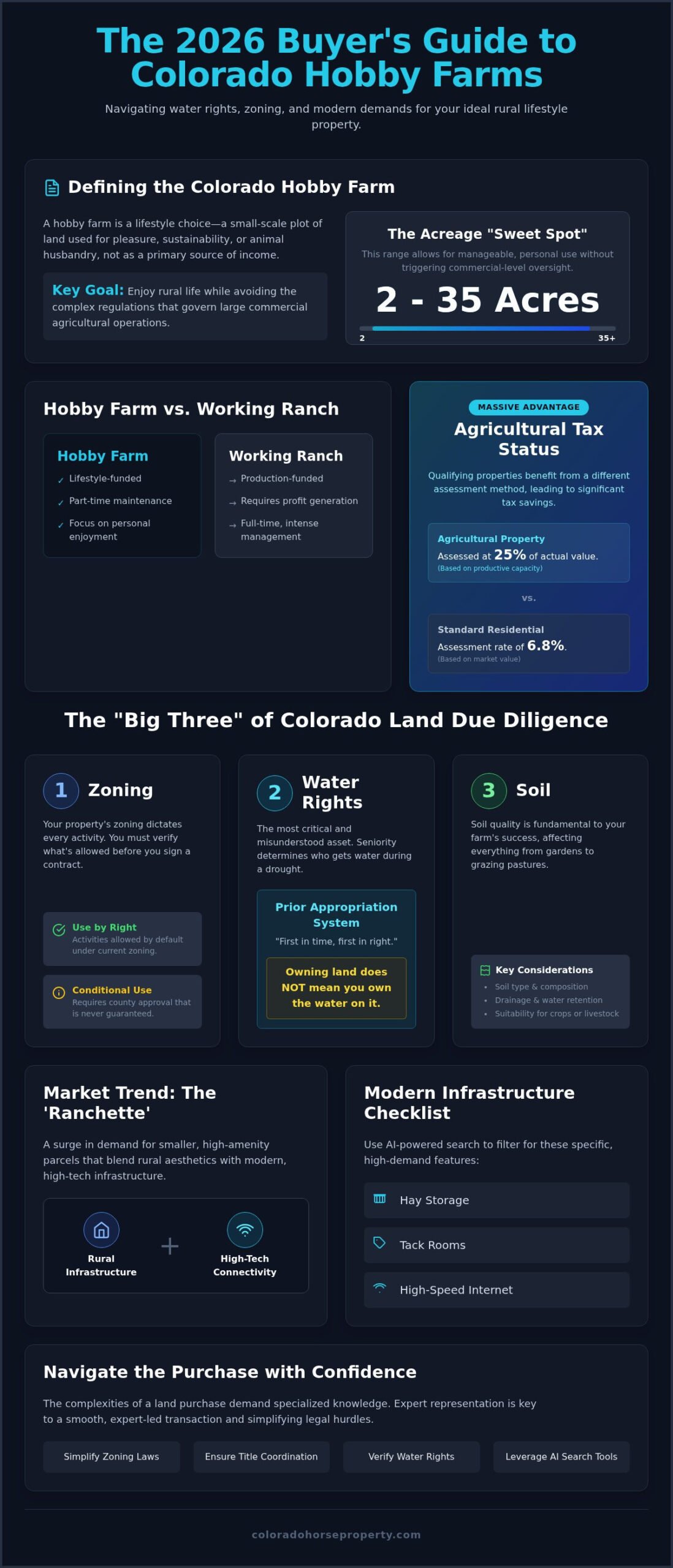
A hobby farm represents a specific lifestyle choice where the land serves your passions rather than your primary paycheck. For those searching for a hobby farm for sale Colorado, the market usually defines these properties as parcels between 2 and 35 acres. This specific range is no accident. It allows owners to enjoy rural life while avoiding the complex commercial regulations that govern larger operations. To ground this in a broader context, one might ask, What is a Hobby Farm? Essentially, it’s a small-scale plot of land used for pleasure, sustainability, or animal husbandry. It’s about a deep connection to the Colorado landscape.
To better understand how these properties look in practice, watch this helpful video:
The 2026 market shows a clear shift toward self-sufficiency. Buyers aren’t just looking for space; they’re looking for utility. This includes properties equipped for organic gardening, small livestock, and sustainable energy. The focus has moved from “owning land” to “managing an ecosystem.” This evolution reflects a desire for a slower pace without sacrificing modern comforts. To help navigate the complexities of modernizing your rural estate or implementing sustainable infrastructure, check out VULPIN Capital for specialized project management services.
Hobby Farm vs. Working Ranch: Key Differences
The distinction between a hobby farm and a working ranch often comes down to the bottom line. Working ranches are production-funded, meaning they must generate profit to survive. Hobby farms are lifestyle-funded. You aren’t relying on the sale of cattle or hay to pay your mortgage. This reduces management intensity significantly. Most hobby farms require only part-time maintenance, making them ideal for professionals who work remotely or in nearby cities. However, don’t ignore the tax benefits. As of late 2026, agriculturally classified property in Colorado is assessed at 25% of its actual value for tax purposes. This is a massive advantage compared to the 6.8% assessment rate for standard residential properties.
The Rise of the ‘Ranchette’ in 2026
We’re seeing a surge in “ranchettes” across the Front Range and Western Slope. These are smaller, high-amenity parcels that often outperform massive ranches in per-acre value. Modern buyers want the aesthetic of a colorado ranch house but require the infrastructure of a high-tech home. Finding a hobby farm for sale Colorado now means looking for properties with fiber-optic internet alongside horse barns. The integration of high-speed tech with rural living has made these parcels the “needle in the haystack” for 2026. They offer the freedom of the plains with the connectivity of an urban office.
The “Big Three” of Colorado Land: Zoning, Water, and Soil
Securing a hobby farm for sale Colorado involves far more than evaluating the kitchen or the view. You’re buying a complex set of rights and restrictions that dictate your daily life. Success in the Western market rests on the “Big Three”: zoning, water, and soil. If any of these fail to align with your goals, your dream property can quickly become a liability. You must verify “Use by Right” versus “Conditional Use” permits before you sign a contract. While some activities are allowed by default, others require county approval that is never guaranteed.
Navigating Colorado Water Rights and Irrigation
Water is the most misunderstood asset in Western real estate. You might see a beautiful stream or a full pond, but that doesn’t mean you have the right to use it. “In Colorado, owning the land does not automatically mean you own the water flowing beneath or across it.” This is the cornerstone of Colorado’s Prior Appropriation System, where seniority determines who gets water during a drought.
Most small parcels rely on a domestic well, which is often restricted to in-house use only. If you plan to irrigate a large garden or water more than a few animals, you’ll need irrigation rights or shares in a local ditch company. Researching ditch company bylaws is essential; these organizations have their own rules for how and when water is delivered. Our team provides expert transaction management to help you verify these details before your earnest money is at risk.
Zoning and Land Use for Livestock
Zoning laws determine your property’s carrying capacity. Counties use a measurement called Animal Units (AUs) to calculate how many horses, cattle, or goats you can keep per acre. Don’t assume that ten acres allows for ten horses. Many counties have strict ratios to prevent overgrazing and soil erosion. You also need to verify zoning for outbuildings. Whether you’re looking for existing horse stables for sale or planning to build your own, setbacks and height restrictions apply.
Even in unincorporated areas, check for HOA covenants. Many rural subdivisions have private rules that are stricter than county laws. They might ban certain types of livestock or limit the size of your barn. Beyond the legalities, consider the soil. Soil quality affects everything from the nutrition in your pastures to the viability of your septic system. A “perc test” is non-negotiable for properties without city sewer access, as poor drainage can prevent you from building a home altogether. When searching for a hobby farm for sale Colorado, these technical details are what truly define a property’s value.
Regional Guide: Finding Your Ideal Colorado Location
Choosing where to buy a hobby farm for sale Colorado depends entirely on your primary goal. Are you looking for a weekend retreat near the city, or do you intend to produce award winning peaches on the Western Slope? Geography dictates everything from your property tax bill to the length of your growing season. While the mountain views are a universal draw, the agricultural reality varies wildly between the Front Range, the high alpine valleys, and the eastern plains. You must align your lifestyle expectations with the physical constraints of the land.
Front Range Favorites: Boulder to Larkspur
The Front Range remains the most competitive market for equestrian real estate Colorado. Properties in Douglas and Elbert Counties are particularly prized for their rolling terrain and established horse trails. In 2026, we’re seeing “gentleman farms” in these areas command premium prices, with average listing values often exceeding $1.27 million. Zoning in these counties is typically favorable for livestock, but you’ll pay for the proximity to Denver and Colorado Springs. These parcels offer the best balance of luxury living and agricultural utility for professionals who still need to commute.
The Western Slope: Paonia and Beyond
If your dream involves orchards, vineyards, or organic vegetable production, look toward the Western Slope. The North Fork Valley, specifically around Paonia and Hotchkiss, has become the state’s “farm-to-table” capital. This region benefits from unique microclimates and relatively stable irrigation from the Colorado River Basin. When searching for farm land for sale in colorado, the Western Slope offers rich soil and a longer growing season than the high mountains. It’s the ideal location for buyers who want a functional, productive small farm.
High Country and the Plains
The High Country offers unmatched scenery, but the agricultural challenges are significant. You’ll deal with a short growing season, sometimes less than 90 days, and harsh winters that require heavy-duty outbuildings. Conversely, Southeastern Colorado provides the most acreage for your dollar. You can find large parcels for $600 to $5,000 per acre, but water vetting is critical here. The “buy and dry” trend has hit the plains hard, making it easy to buy land that lacks the legal right to grow anything. We use AI-powered search technology to filter these regions by water reliability, ensuring you don’t buy a “dry” farm by mistake. Whether you want the lush valleys of the west or the expansive plains of the south, understanding these regional nuances is the first step toward a successful purchase.
Essential Infrastructure for a Functional Small Farm
A picturesque acreage is just a plot of land until you add the infrastructure required to manage it. When you evaluate a hobby farm for sale Colorado, the quality of existing outbuildings and fencing often dictates the property’s true value. Utilizing a specialized service like Lin Inspects ensures these structures are thoroughly vetted for safety and longevity before you finalize your purchase. You don’t want to discover after closing that the perimeter fence is failing or that the barn lacks adequate ventilation. Functional infrastructure protects your livestock, your equipment, and your investment. It turns a piece of land into a manageable home for your animals.
Existing structures should be inspected for more than just aesthetics. Check the foundation for shifting and ensure the electrical system can handle modern demands. A 2026 hobby farm barn isn’t complete without heated automatic waterers and high-density rubber matting. These features reduce daily labor and improve animal health during Colorado’s sub-zero winter nights. Proper ventilation is also non-negotiable to prevent respiratory issues in horses and livestock.
You’ll often face the choice between building new or buying an established horse property for sale in colorado. Buying existing infrastructure usually saves time and money, provided the layout is functional. Look for tack rooms with climate control and hay storage that’s separate from animal stalls to reduce fire risks. If the current barn is outdated, calculate the cost of upgrades before making an offer.
Fencing and Pasture Management
Fencing is your most critical safety feature. For horses and small ruminants, no-climb wire with a top rail is the gold standard. Vinyl fencing offers high visibility and low maintenance, though it’s often more expensive. Beyond the perimeter, cross-fencing is essential for rotational grazing. On small acreage, rotating your animals between pastures prevents overgrazing and keeps the soil healthy. This is especially important in Colorado’s semi-arid climate where grass takes longer to recover.
Be vigilant about toxic weeds. Locoweed is common in Colorado pastures and can be fatal to livestock if ingested. Proper drainage and manure management are also vital. Poorly drained paddocks become mud pits that harbor bacteria and pests. Ensure your property has a designated area for composting manure that complies with local environmental regulations. Finally, consider access. Your driveway and gates must accommodate large hay deliveries and horse trailers. A property with no room for a trailer to turn around will cause endless frustration. If you’re ready to find a property that’s already set up for success, use our AI-powered search to filter for specific barn configurations and fenced acreage.
Navigating the Purchase: AI Search and Expert Representation
Traditional real estate platforms are designed for suburban residential sales. They prioritize bedroom counts and kitchen finishes over the technical data points that dictate your daily life on a farm. When you’re looking for a hobby farm for sale Colorado, generic filters simply don’t work. They can’t tell you if a property’s zoning actually allows for your specific livestock or if the barn has the necessary electrical capacity for heated waterers. You need a specialized approach that understands the intersection of land utility and property law.
Using AI to Find Your “Needle in a Haystack”
Our search process moves beyond basic keywords to identify the niche features that make or break an agricultural property. This includes filtering for specific arena dimensions, pasture types, and even the seniority of water rights. “Our AI-powered search technology analyzes thousands of listings to isolate properties that meet 20+ specific equestrian and agricultural criteria.” This level of precision saves you from visiting dozens of properties that look good in photos but fail to meet your technical requirements. By isolating properties that already meet your livestock zoning needs, we cut through the noise of the standard residential market.
The Realty Oasis Advantage: 40 Years of Expertise
While technology finds the land, expert representation secures the deal. Mark and Alison Eibner bring 40 years of experience in the Colorado Front Range to every transaction. They act as your primary vetting resource for rural infrastructure, identifying potential red flags in barns or fencing before you ever reach the inspection phase. Their long-standing tenure in this niche market is your best insurance against a “bad” land purchase that could cost thousands in future remediation.
Rural closings are significantly more complex than standard home sales. They require specialized title and escrow knowledge to handle water share transfers and easement verifications. We coordinate directly with Meridian Title & Escrow to ensure these technical details are managed with precision. From contract negotiations to the final title search, our team provides full-service transaction management tailored to the unique needs of the Colorado agricultural community. Finding a hobby farm for sale Colorado is a major life goal; our job is to ensure the transaction is as stable as the land you’re buying.
Securing Your Colorado Agricultural Legacy
Buying a hobby farm for sale Colorado is about more than just finding acreage; it’s about securing a lifestyle backed by legal and technical certainty. You now understand the critical importance of vetting senior water rights and verifying county-specific zoning before committing to a contract. You also know that the right infrastructure, from ventilated barns to safe perimeter fencing, is what makes a property functional for the long term. These elements are the foundation of a successful rural transition.
Navigating this complex market doesn’t have to be overwhelming. The Eibner team brings 40 years of specialized experience to your search, ensuring every technical detail is scrutinized. By combining our deep industry tenure with our specialized AI search technology, we isolate properties with the exact equestrian and farm features you require. This data-driven approach, paired with expert buyer representation, protects your investment from the common pitfalls of rural real estate. Start your AI-powered search for Colorado hobby farms today! Your dream of a sustainable, peaceful retreat is within reach; let’s find the land that makes it a reality.
Frequently Asked Questions
How many acres do I need for a hobby farm in Colorado?
Most hobby farms in the state range from 2 to 35 acres. This specific size keeps the property manageable while qualifying for certain agricultural tax benefits. Smaller parcels under 2 acres often struggle with restrictive livestock zoning. Larger parcels over 35 acres may trigger complex commercial regulations. Your ideal acreage depends on your specific goals for livestock and the local county animal unit calculations for carrying capacity.
Can I have horses on a property zoned as residential?
It depends entirely on your local county or municipal zoning code. Some residential zones allow limited livestock by right, while others require a conditional use permit. Even if the county allows large animals, private HOA covenants might prohibit them. You must verify the specific animal unit allowance for the parcel before purchasing. Our AI search tool helps filter properties that explicitly meet these livestock zoning requirements.
What is the difference between senior and junior water rights?
Senior water rights have a priority date that is older than junior rights. Under the state’s Prior Appropriation System, the oldest rights are fulfilled first during a drought. If you hold junior rights, your water supply may be shut off completely so that senior holders downstream can get their full allocation. Understanding this hierarchy is essential when evaluating a hobby farm for sale Colorado to ensure your irrigation is reliable.
Do I need a special permit to sell eggs or produce from my Colorado farm?
Most small-scale producers operate under the Colorado Cottage Food Act. This law allows you to sell limited amounts of eggs and certain produce directly to consumers without a retail food license. However, you must complete a food safety course and follow specific labeling requirements. If you plan to scale up to commercial wholesale, you’ll need to transition to a licensed facility and obtain local health department permits for your operation.
How much does a typical hobby farm cost in Colorado in 2026?
As of September 2026, the average listing price for a hobby farm in Colorado is $1,276,348. This averages out to approximately $63,717 per acre, though prices vary significantly by region. Rural or agricultural land away from the Front Range is much more affordable, ranging from $600 to $5,000 per acre. Factors like senior water rights and high-end equestrian infrastructure will push these prices toward the higher end of the market spectrum.
What are “Agricultural Tax Credits” and does my property qualify?
Colorado offers a significant tax advantage through agricultural classification. Qualifying land is assessed at 25% of its actual value for tax purposes, compared to the 6.8% rate for standard residential property. To qualify, you must prove the land is being used for a primary purpose of producing a profit from crops or livestock. Simply owning a few pets doesn’t count; you need documented agricultural activity to maintain this beneficial tax status.
Is it better to buy raw land or a developed hobby farm?
Buying a developed property is usually more cost-effective and faster. Building new barns, installing perimeter fencing, and drilling a well can take years and often costs more than the market value those improvements add. However, raw land allows for a custom layout that fits your specific workflow perfectly. If you choose raw land, ensure you’ve verified well permits and septic viability before closing, as these are not guaranteed in all areas.
What should I check during a rural property inspection?
A rural inspection must go beyond the home’s interior. You need a perc test to verify septic system viability and a well production test to ensure adequate flow. Check outbuildings for structural integrity and electrical safety, especially in older barns. Inspect all fencing for no-climb safety and search the pastures for toxic weeds like Locoweed. Our team at Colorado Horse Property leverages 40 years of experience to help you identify these critical red flags.