
In 2026, the most beautiful view on a Colorado ranch isn’t the snow-capped peaks. It’s a decree for senior water rights. You’ve likely spent hours browsing recreational ranches for sale Colorado, dreaming of expansive acreage and the rugged lifestyle. You already know that a ranch without proven productivity is just a high-maintenance hobby, yet the legal and technical hurdles of land ownership can feel overwhelming.
This guide will help you master the technical requirements of livestock capacity, senior water rights, and AI-driven land search to secure a productive Colorado working ranch. We’ll move beyond the aesthetic appeal to focus on operational profitability and long-term land health. You’ll gain the clarity needed to make a confident investment in a legacy property that stands the test of time.
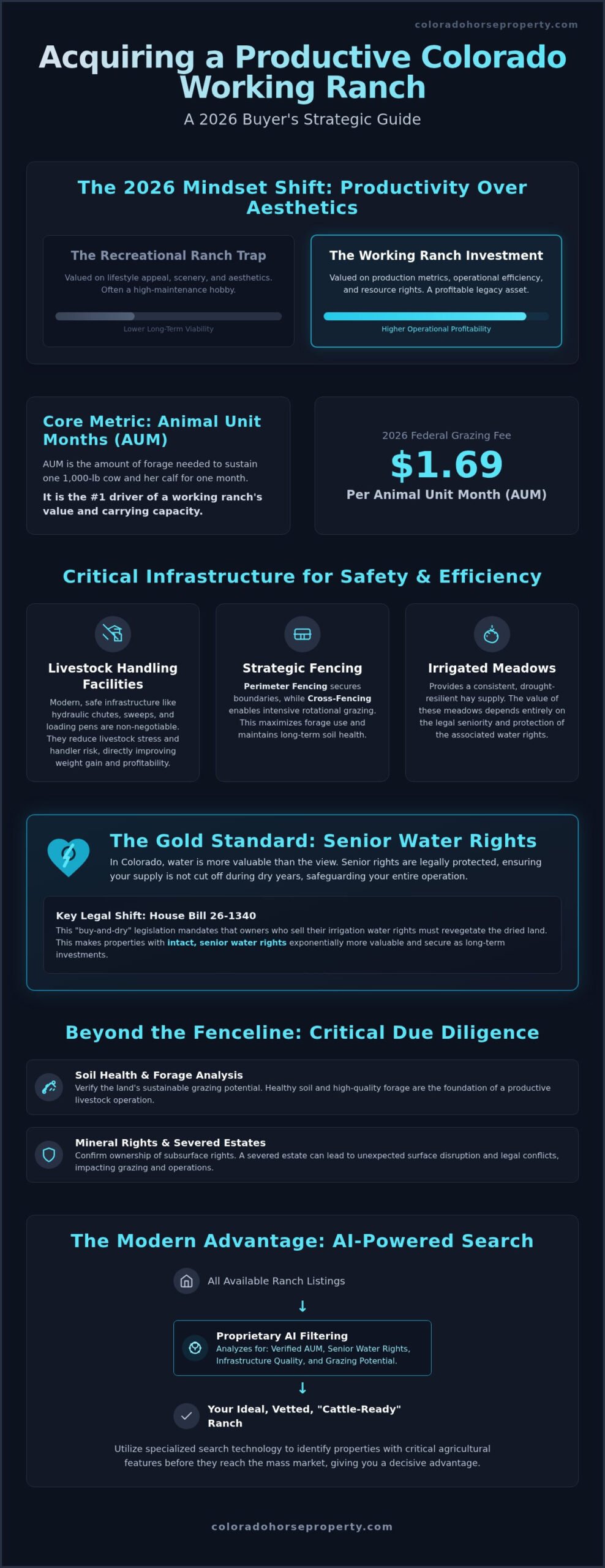
We’ll examine the critical 2026 market shifts, including the $1.69 federal grazing fee and the impact of House Bill 26-1340 on water transfers. From calculating Animal Unit Months (AUM) to navigating BLM and USFS lease transfers, this preview of our expert strategy ensures you acquire a ranch with verified agricultural utility and secured resource rights.
Key Takeaways
- Prioritize productivity metrics like Animal Unit Months (AUM) over aesthetic appeal to ensure your ranch investment remains operationally profitable in the 2026 market.
- Evaluate critical infrastructure, including livestock handling facilities and fencing standards, to maintain safety and support intensive rotational grazing.
- Navigate the complexities of Colorado water law and secure senior rights when searching for recreational ranches for sale in Englewood, Colorado to protect your land’s long-term utility.
- Conduct thorough due diligence on soil health, mineral rights, and severed estates to avoid hidden liabilities and verify sustainable grazing potential.
- Utilize proprietary AI-powered search technology to identify cattle-ready properties with specific agricultural features before they reach the general market.
Evaluating Working Cattle Ranches for Sale in Colorado (2026)
The search for recreational ranches for sale Colorado often starts with a vision of wide open spaces and historic barns. While the “cowboy aesthetic” is a major draw, a successful 2026 acquisition requires looking past the scenery to the underlying productivity metrics. A true working ranch is an asset defined by its ability to support livestock, which depends entirely on forage quality and water seniority. Understanding the history of Ranching in the United States provides helpful context, but Colorado’s specific 2026 regulations make local expertise mandatory.
The 2026 market landscape presents a unique environment for buyers. Agricultural property is currently assessed at a 25% tax rate, provided the land has been classified as such for the preceding ten years. With federal grazing fees set at $1.69 per animal unit month (AUM), the operational math is different than it was even two years ago. High-stakes agricultural transactions require a deep understanding of these shifting numbers to avoid overpaying for land that lacks the infrastructure for actual production.
Working vs. Recreational Ranches: Key Differences
Valuation models for these properties diverge significantly. A recreational property is priced on lifestyle appeal, whereas a working ranch relies on production-based valuation. To maintain agricultural tax status, you must prove the land has been used for agricultural purposes for at least two years. When you browse recreational ranches for sale Colorado, you should prioritize these questions:
- What is the verified AUM for the current grazing season?
- Are the handling facilities, such as chutes and loading pens, compliant with modern safety standards?
- Does the property have a history of sustainable herd health and consistent weight gains?
Colorado Ranch Market Outlook for 2026
Forage availability is the primary driver of land prices in 2026. Regions like the Front Range and Western Slope are seeing a shift toward regenerative practices to combat climate trends. The new “buy-and-dry” legislation, House Bill 26-1340, now requires owners who sell irrigation water rights to revegetate the land. This makes properties with intact, senior water rights more valuable than ever. Using an AI-powered search tool is the most efficient way to filter for these specific technical requirements before a listing reaches the mass market. Specialized buyer representation ensures you don’t just buy a view; you acquire a functional legacy. For those integrating these acquisitions into a broader tax strategy, Cornerstone Real Estate Investment Services provides specialized expertise in Delaware Statutory Trust (DST) properties for 1031 exchanges.
Critical Infrastructure and Livestock Capacity Requirements
Fencing is another critical investment. You must distinguish between perimeter fencing, which secures your property line, and cross-fencing, which allows for intensive rotational grazing. Proper cross-fencing maximizes forage utilization and prevents overgrazing, which is vital for maintaining soil health in Colorado’s semi-arid climate. Additionally, the viability of your hay production depends on water access. Irrigated meadows provide a consistent yield regardless of seasonal rainfall, but they require a deep understanding of Colorado’s water rights system to ensure your supply is legally protected.
Functional Infrastructure: Beyond the Ranch House
The structural integrity of your outbuildings determines how well you can weather a Colorado winter. Calving sheds must be positioned to offer protection from prevailing winds, often utilizing natural windbreaks or man-made livestock shelters. Equipment shops and hay lofts should be accessible year-round. This means road maintenance is a primary concern; your interior roads must support heavy livestock transport and hay delivery trucks even during the spring thaw. If you aren’t sure how to evaluate these technical specs, you can use our AI-powered search tools to filter for properties with specific, verified infrastructure.
Carrying Capacity and Forage Math
Determining a property’s true value requires an honest assessment of its carrying capacity. You should verify historical stocking rates rather than relying on aesthetic estimates. Altitude plays a significant role here, as higher elevations have shorter grazing seasons and higher nutritional requirements for livestock. An Animal Unit Month (AUM) is the amount of forage needed by one 1,000-pound cow and her calf for one month. Understanding this forage math is essential for calculating operational profitability. In 2026, with the federal grazing fee at $1.69 per AUM, having a clear picture of your land’s productivity is the only way to secure a legacy property with verified agricultural utility.
Navigating Colorado Water Rights and Grazing Leases
Colorado operates under the “First in Time, First in Right” doctrine. This legal framework means the person who first put water to a beneficial use has a superior claim over anyone who followed. When you evaluate recreational ranches for sale Colorado, the seniority of these rights determines the property’s true market value and operational viability. You’ll encounter three main types of water: surface water from rivers or creeks, groundwater from wells, and Ditch Company shares. Each requires a different level of scrutiny during due diligence. Ditch shares, for example, represent a pro-rata portion of a larger water decree and are managed by a board rather than the individual landowner.
The role of the Water Court is central to any agricultural sale. Any change in the point of diversion, the type of use, or the place of use requires a formal application and decree. This process ensures that a new owner’s water use doesn’t injure other rights holders on the same stream system. Because water is the lifeblood of the high desert, specialized buyer representation is non-negotiable to verify that the water rights described in a listing are actually supported by historical use and current decrees.
Securing Senior Water Rights
Reading a water decree is a technical skill that involves verifying the priority date, the volume of water allowed, and the specific “beneficial use” recognized by the state. Senior rights are those with the oldest priority dates; they are the last to be shut off during a “call” on the river. In contrast, junior rights are highly vulnerable during drought cycles. If you hold junior rights, you may find your headgates locked just when your meadows need moisture the most. See our guide on water rights in Colorado for legal context on how these decrees impact land value.
Public Land Grazing Permits (BLM & USFS)
Many productive operations expand their footprint by utilizing public land. Navigating Colorado grazing leases and federal permits requires understanding that these allotments do not automatically transfer with the deed. For 2026, the federal grazing fee is $1.69 per animal unit month (AUM) for BLM and USFS lands. State trust lands operate on a different scale, with a base rate of $25.64 per AUM effective through June 2027.
To hold a federal permit, you must own a “base property” capable of supporting the livestock when they aren’t on the allotment. During a sale, the buyer must apply to the agency for a permit transfer, which is subject to a review of the ranch’s management plan. Potential pitfalls include term permits being reduced to temporary use or new AUM restrictions based on range conditions. Verifying the status of these allotments before closing is essential to ensuring your herd has enough forage for the entire season.
Due Diligence: Soil Quality, Minerals, and Easements
Evaluating recreational ranches for sale Colorado requires a look beneath the surface. Soil health is the foundation of any working ranch. You should conduct a comprehensive soil analysis to test for nutrient levels and sustainable grazing potential. In the 2026 tax year, maintaining agricultural status depends on verified land use. Poor soil can jeopardize your productivity and your 25% assessment rate. Environmental assessments are equally vital. You must account for noxious weed management and the impact of local wildlife habitats on your forage availability. If a property has been neglected, the cost of restoring native grasses can be substantial. This is especially true under House Bill 26-1340, which emphasizes land revegetation following water rights transfers.
Environmental assessments should also include a review of wildlife migration patterns. While elk and mule deer add recreational value, they also compete with livestock for forage. Understanding how these species interact with your land helps you set realistic carrying capacities. You don’t want to buy a property only to find that your AUM is cut in half by wintering elk herds. A thorough due diligence period allows you to verify these variables before committing to a high-stakes agricultural acquisition.
The Complexity of Mineral Rights in Colorado
Colorado is a split estate state. This means the person who owns the surface may not own the mineral rights beneath it. Severed mineral estates are common across the Front Range and Western Slope. If a third party owns the minerals, they may have a legal right to access the surface for extraction. This can disrupt cattle operations and impact land value. Regional oil and gas activity is a primary concern for buyers because it affects everything from road wear to livestock safety. You need a thorough mineral title search conducted by specialized partners to understand exactly what you’re buying. Our team works with experts like Meridian Title & Escrow to navigate these complex land closures and ensure your surface rights are protected.
Conservation Easements: Legacy vs. Limitation
Conservation easements offer significant tax incentives for preserving agricultural heritage and providing habitat for native species. They are a powerful tool for families looking to protect open space from development. However, these agreements are perpetual and can severely limit your operational flexibility. An easement might prevent you from subdividing the land, expanding infrastructure, or building new equipment shops. When evaluating existing easements on ranches for sale colorado, you must ensure the restrictions align with your long-term goals. Some easements are more restrictive than others regarding grazing intensity or the placement of new fencing.
To ensure your due diligence is handled by experts with 40 years of regional experience, connect with our specialized buyer representation team to review your potential acquisition.
Finding Your Legacy Ranch with AI-Powered Search
Finding the right recreational ranches for sale Colorado requires a shift from traditional browsing to technical data analysis. Most listing sites rely on broad keywords like “acreage” or “barn,” which fail to capture the nuances of a working operation. Our proprietary AI-powered search technology bridges this gap by identifying cattle-ready land before it reaches the mass market. By scanning for specific infrastructure and historical productivity data, we ensure you only view properties that meet your operational standards. This approach saves time and prevents the frustration of visiting properties that lack the technical utility needed for a productive legacy.
Our firm, Colorado Horse Property, brings 40 years of regional expertise to every search. We don’t just act as brokers; we serve as specialized consultants who understand the intersection of land management and real estate. Our niche expertise in agricultural property allows us to evaluate the structural integrity of outbuildings and the viability of grazing rotations with a seasoned eye. We leverage our deep industry tenure to provide a supportive partnership that guides you from the initial search to the final closing table.
Leveraging AI for Specific Agricultural Needs
Our AI tools go beyond basic filters to target specific AUM requirements and water decree seniority. This capability is vital for comparing colorado ranches for sale across different counties with varying climates and soil types. You can isolate properties with existing cattle ranch zoning and high-quality handling facilities, such as hydraulic chutes and loading pens. By using data to compare forage yields and water reliability, you can make an informed decision based on verified utility rather than aesthetic appeal. This data-driven strategy identifies the most productive land in the Colorado Front Range and beyond.
The Path to Closing: Expert Representation
The transition from a successful search to a finalized closing requires expert buyer representation. Negotiating complex agricultural contracts involves more than just the land price; you must account for livestock, specialized equipment, and the transfer of water shares. We coordinate with Meridian Title & Escrow for multi-parcel land deals to ensure every legal detail is addressed, from severed mineral estates to conservation easement restrictions.
The final walkthrough is a critical step in our transaction management process. We verify the functionality of water systems, including solar wells and gravity-fed troughs, and assess the condition of all fencing and outbuildings. Our goal is to ensure that when you take possession of your new ranch, the infrastructure is ready to support your herd immediately. With our specialized team behind you, you can secure a legacy property with the confidence that every technical and legal requirement has been met.
Secure Your Colorado Agricultural Legacy
Securing a productive cattle ranch in 2026 requires looking beyond the horizon to the technical details of the land. Success depends on mastering forage math, securing senior water rights, and performing rigorous due diligence on split mineral estates. As you browse recreational ranches for sale Colorado, remember that true value lies in a property’s verified agricultural utility and operational profitability. You need an asset that performs as well as it inspires.
Our specialized agricultural and equestrian division brings 40 years of regional expertise to your search. We use proprietary AI property search technology to filter for cattle-ready infrastructure and water decree seniority before listings hit the mass market. This seasoned, no-nonsense approach ensures you acquire a legacy property built for long-term production. We help you navigate the complexities of 2026 grazing fees and new water legislation with confidence.
Ready to find a ranch that meets your specific technical requirements? Start Your AI-Powered Search for Colorado Cattle Ranches today. With the right data and expert representation, you can confidently secure your piece of the American West.
Frequently Asked Questions
How much does a working cattle ranch cost in Colorado?
The average price for a Colorado ranch listing is $3,753,248, though costs vary based on water seniority and infrastructure. On average, land sells for approximately $3,647 per acre. High-quality working properties with senior water rights often command a premium. When searching for recreational ranches for sale Colorado, remember that “working” status adds value through productivity that “lifestyle” properties lack.
How many acres do I need to raise cattle in Colorado?
Acreage requirements depend on the land’s carrying capacity rather than a fixed number. In the lush Front Range, you might support a cow-calf pair on 15 to 30 acres, while arid Western Slope regions may require 100 acres or more per pair. You must calculate the total Animal Unit Months (AUM) available on the deeded and leased land to ensure the property can sustain your specific herd size year-round.
What are the most important water rights for a cattle ranch?
Senior water rights with an early priority date are the most critical asset for any rancher. Because Colorado follows the “First in Time, First in Right” doctrine, senior holders get their full allocation before junior holders receive anything. You should prioritize surface rights for irrigation and stock water decrees. Always verify the historical beneficial use and ensure the water decree is properly recorded with the Colorado Division of Water Resources.
Can I transfer a BLM grazing permit when I buy a ranch?
BLM grazing permits don’t automatically transfer with the land deed. A buyer must apply to the Bureau of Land Management for a new permit after closing. To qualify, you must own a “base property” that can support your livestock when they aren’t on federal land. For 2026, the federal grazing fee is $1.69 per AUM. We recommend including a contingency in your contract to verify permit eligibility before the sale is finalized.
What is a “turnkey” working cattle ranch?
A turnkey ranch includes everything needed to start operations immediately upon closing. This typically encompasses the land, livestock, machinery, and existing water shares. It often features a full suite of infrastructure like calving sheds, hydraulic chutes, and perimeter fencing. Buying turnkey simplifies the transition but requires a detailed inventory and valuation of the non-real estate assets. Our team specializes in managing these multi-faceted transactions to ensure no equipment or livestock is overlooked.
Do I need a special real estate agent to buy a ranch?
Yes, you need an agent with niche expertise in agricultural law and land management. Standard residential agents often lack the experience to evaluate AUM, water decrees, or mineral rights. Colorado Horse Property offers 40 years of regional tenure and proprietary AI search technology to help you identify viable cattle land. We understand the technical requirements of the 2026 market and provide the expert representation needed for high-stakes agricultural acquisitions.
What are Animal Unit Months (AUM) and why do they matter?
An Animal Unit Month (AUM) represents the amount of forage needed to sustain one 1,000-pound cow and her calf for one month. This metric is the industry standard for measuring a ranch’s carrying capacity and operational profitability. It matters because it dictates how many cattle the land can legally and sustainably support. Overestimating AUM leads to overgrazing, while underestimating it leaves money on the table. Accurate forage math is essential for any long-term investment.
Are there tax benefits to owning a working ranch in Colorado?
Colorado offers significant tax benefits through agricultural land classification. For the 2026 tax year, agricultural property is assessed at 25% of its actual value, which is lower than most non-residential properties. To qualify, the land must have been used for agricultural purposes for at least two years. This status can save owners thousands of dollars annually. We work with partners to ensure your due diligence confirms the property’s historical and current agricultural eligibility.