
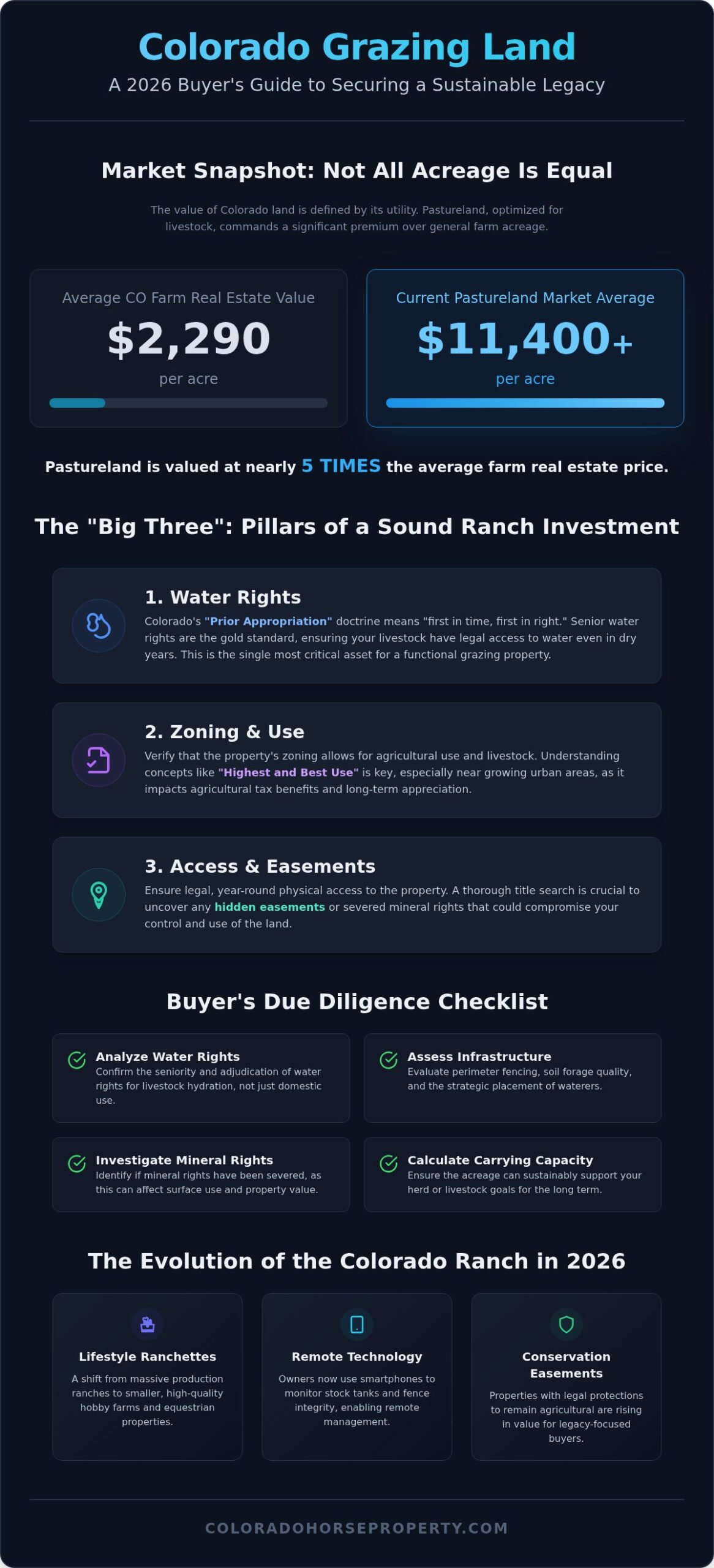
Did you know that while the average Colorado farm real estate value sits at $2,290 per acre, the current market for pastureland is averaging over $11,400 per acre? This massive gap highlights a critical reality for 2026 buyers. Not all dirt is created equal. You’re likely looking for more than just acreage; you want a sustainable foundation for your livestock or an equestrian legacy that won’t run dry. It’s frustrating to find a perfect plot only to discover the water rights are junior or the soil’s carrying capacity can’t support your herd.
We’ve designed this guide to help you find the best Colorado grazing land for sale without falling into common traps like hidden easements or underestimated well costs. You’ll learn how to leverage AI-powered search tools to filter for sub-irrigated meadows and senior water seniority. We’ll also dive into the latest 2026 State Land Board grazing rates and the technical due diligence required to protect your investment. This preview of the current market landscape ensures you understand exactly what it takes to secure a high-quality property. By the end of this guide, you’ll have a clear roadmap to securing a property that offers both functional utility and long-term value.
Key Takeaways
- Learn how the “Prior Appropriation” doctrine impacts your water access and why senior rights are the gold standard for livestock hydration.
- Discover the critical infrastructure differences between grazing and farm land, from perimeter fencing requirements to soil forage quality.
- Navigate the complexities of Colorado grazing land for sale by identifying severed mineral rights and environmental risks before you close.
- Leverage AI-powered search tools to find specific assets like sub-irrigated meadows and equestrian-ready facilities with precision.
- Secure a sustainable legacy by calculating the true carrying capacity of acreage to ensure it meets your long-term agricultural goals.
Understanding Grazing Land for Sale: More Than Just Open Space
Grazing land isn’t just a scenic view; it’s a managed agricultural asset designed for the nutritional support of livestock. In Colorado, we distinguish between Rangelands and improved pastures. Rangelands are often native landscapes with minimal human intervention, while improved grazing land features high-tensile fencing, strategic waterers, and managed forage. For those looking at Colorado grazing land for sale, understanding this distinction is the first step toward a viable operation. It’s about the land’s ability to produce grass that translates into pounds on cattle or health for horses.
To better understand the nuances of land acquisition in the Centennial State, watch this helpful video:
As we move through 2026, land remains a premier inflation hedge for savvy investors. Unlike volatile financial markets, physical acreage holds intrinsic value through its biological productivity and limited supply. Near the Front Range, we frequently discuss the “Highest and Best Use” for agricultural acreage. This concept analyzes whether a parcel is best suited for traditional cattle grazing, a professional equestrian facility, or long-term conservation. Investors prioritize land that can generate agricultural tax benefits while appreciating in value due to its proximity to growing urban centers like Douglas or Elbert counties.
The Evolution of the Colorado Ranch in 2026
The traditional model of massive production ranches is evolving. We’ve seen a significant shift toward “lifestyle ranchettes” and smaller hobby farms that prioritize quality over sheer quantity. Modern owners now utilize remote monitoring technology to check stock tanks and fence integrity from their smartphones, making it possible to manage grazing land from afar. Additionally, land with existing conservation easements is rising in value. These legal protections ensure the property remains agricultural in perpetuity, which appeals to buyers looking to preserve a legacy while benefiting from specific tax advantages.
Why Niche Specialization Matters in Your Search
General real estate platforms often fail to provide the technical data required for a successful agricultural purchase. They might list total acreage but omit critical soil types or water adjudication details. Finding colorado ranches for sale requires a deeper dive into the specific needs of your animals. Our 40 years of local experience helps us identify properties with superior grazing potential that generalists often overlook. We understand that a successful deal depends on technical specifications, not just a pretty horizon.
The “Big Three” for Colorado Ranching: Water Rights, Zoning, and Access
Securing the right Colorado grazing land for sale requires looking far beneath the surface. While the grass might look lush today, the legal framework of the property determines its true utility for the decades to come. In Colorado, we focus on three pillars: water, zoning, and access. If any of these are compromised, your investment could become a liability rather than a legacy. You don’t want to find out after closing that your livestock have no legal right to the water on your land.
Navigating Colorado Water Rights
Colorado operates under the “Prior Appropriation” doctrine, a system often summarized as “first in time, first in right.” This means the oldest water rights get their full allocation before newer, junior rights receive a single drop. Understanding Colorado’s water rights system is non-negotiable for anyone running livestock. You must distinguish between household-only wells and well permits that specifically allow for livestock hydration. Many 35-acre parcels include domestic well permits, but you must verify the adjudication during your due diligence period. Senior water rights are the primary driver of 2026 land value. Without them, your pastures may go dormant during the dry seasons when your herd needs forage most.
Zoning and Agricultural Tax Status
Zoning classifications like A-1 and A-2 dictate more than just where you can build your home. These codes set the legal limit for animal density on your acreage, which can vary significantly between Elbert and Douglas counties. While “Right to Farm” laws protect your agricultural activities from nuisance complaints, you must still adhere to specific density regulations and setbacks. Qualifying for agricultural tax status is essential for lowering your yearly carrying costs. This status is typically tied to the land’s actual agricultural production or its history of grazing use. Proper zoning also ensures you have the legal right to build horse barns for sale or other necessary infrastructure without facing zoning variances or neighbor disputes.
Finally, never confuse physical access with legal access. You might drive a well-maintained gravel road to a property today, but if that road crosses a neighbor’s land without a recorded easement, your access isn’t guaranteed. Rural Colorado is full of prescriptive easements and “handshake deals” that don’t hold up in a title search. Always verify that your parcel has deeded, legal access to a public right-of-way. If these technicalities feel overwhelming, seeking specialized buyer representation can save you from a costly mistake during the negotiation phase.
Grazing Land vs. Farm Land: Which Investment Fits Your Lifestyle?
Choosing between grazing and farm land is about more than just what you want to see out your window. It’s about soil chemistry, water delivery, and your daily chore list. Farm land requires arable, deep soils suitable for heavy machinery and irrigation pivots. Grazing land focuses on nutrient-dense forage that can thrive in Colorado’s semi-arid climate. While colorado land often serves hybrid purposes, the infrastructure for each is vastly different. Managing cattle on grass is generally less labor-intensive than the high-stakes cycle of planting and harvesting required for row crops. For many buyers, the lower overhead of a grazing operation is the key to a sustainable lifestyle.
Evaluating Carrying Capacity (AUM)
When evaluating Colorado grazing land for sale, you must understand the Animal Unit Month (AUM). This metric defines the amount of forage needed to support one 1,000-pound cow and her calf for 30 days. On the Colorado Front Range, you might need 15 to 40 acres per AUM depending on annual precipitation and local soil health. In contrast, sub-irrigated meadows on the Western Slope can support an AUM on significantly less acreage. If you’re bringing horses, don’t assume they graze like cattle. Horses typically consume more forage and are harder on the root systems. A safe rule is to calculate 1.25 to 1.5 AUM per horse to ensure your pastures remain productive year after year.
Infrastructure Needs for Forage Management
Your daily operations depend on functional, existing infrastructure. Unlike farm land that prioritizes irrigation pivots and leveled fields, grazing land relies on robust perimeter and cross-fencing. High-tensile wire or pipe fencing is the professional standard for livestock safety and containment. In the unpredictable Colorado climate, loafing sheds and natural windbreaks are essential. These structures provide critical shelter from the thin-air sun and sudden mountain blizzards. You should also check the integrity of stock wells and storage tanks. Solar-powered pump systems are the 2026 standard for remote acreage. They offer a reliable water source without the massive expense of running electrical lines to distant corners of the property. Investing in property with these systems already in place can save you tens of thousands in immediate infrastructure costs.
Due Diligence Checklist for Purchasing Colorado Acreage
Before you sign a contract on Colorado grazing land for sale, you must execute a rigorous due diligence plan. This process is your only protection against expensive legal and environmental liabilities that aren’t always visible during a casual walkthrough. Unlike residential deals, rural land transactions require a technical deep dive into the history of the soil and the legal standing of the title. We recommend following these five critical steps to protect your investment.
- Step 1: Verify mineral rights. Surface rights are often severed in Colorado; you might own the pasture but not the rights to the oil or gas beneath it.
- Step 2: Conduct a Phase I Environmental Site Assessment. This check identifies old dump sites, buried fuel tanks, or chemical spills from previous ranching operations.
- Step 3: Review the title commitment. Look specifically for prescriptive easements and existing grazing leases that could grant third parties access to your property.
- Step 4: Confirm utility availability. In 2026, high-speed internet is essential for remote property management and security monitoring.
- Step 5: Hire a specialized land surveyor. Never trust legacy fence lines as true boundaries; a professional survey verifies exactly where your acreage begins and ends.
The Hidden Traps of Rural Colorado Land
Rural properties often come with legal obligations that surprise new owners. Most Colorado counties have strict regulations regarding “noxious weeds.” As the landowner, you’re legally required to manage invasive species like leafy spurge or Canada thistle; failure to do so can lead to county-enforced mitigation and liens on your property. You should also check for public trail easements. Some grazing parcels are subject to historic access rights that allow hikers or hunters to cross your private land. Finally, investigate the cost of bringing power to the lot line. In 2026, extending electrical infrastructure even a short distance can cost tens of thousands, making solar-powered systems a more viable alternative for many.
Expert Transaction Management
Standard residential agents often lack the specialized knowledge to handle rural zoning and water adjudication. They might miss a severed mineral interest or fail to recognize the implications of a specific easement. Working with equestrian real estate Colorado specialists ensures that every technicality is addressed during title and escrow. A broker who understands the “boots on the ground” reality of ranching will help you navigate these complexities with confidence. To ensure your purchase is sound, reach out to us for comprehensive buyer representation and transaction management.
Finding Your Legacy: Using AI to Source the Perfect Grazing Property
Finding the right Colorado grazing land for sale in the competitive 2026 market requires more than just scrolling through generic listing sites. You need a tool that understands the granular requirements of a working ranch or a high-end equestrian estate. Our proprietary AI-Powered Horse Property Search bridges the gap between raw data and your specific lifestyle goals. It doesn’t just show you total acreage; it identifies sub-irrigated meadows, existing arenas, and the forage quality essential for your livestock’s health. This targeted approach saves you weeks of wasted site visits by highlighting properties that actually meet your carrying capacity needs.
Leveraging Technology for Niche Real Estate
AI technology now analyzes high-resolution satellite imagery to evaluate topography and seasonal forage patterns before you ever step foot on the dirt. By filtering for “horse-ready” infrastructure like perimeter fencing and loafing sheds, you can avoid the massive post-purchase costs often associated with raw land. This technology allows you to find highly specific ranches for sale colorado that match your AUM requirements. While AI finds the data and identifies the patterns, Mark and Alison Eibner provide the seasoned wisdom and local context necessary to close a complex deal. Our 40 years of experience ensures that the tech-driven data aligns with the practical reality of the Colorado Front Range.
Your Next Steps in the Colorado Market
The 2026 market rewards the prepared buyer. By setting up “Smart Alerts,” you receive immediate notifications when new Colorado grazing land for sale matches your specific criteria, giving you a critical first-mover advantage. Before you pull the trigger, ensure your finances are in order. Agricultural loans often have different down payment requirements and terms compared to standard residential mortgages, so speaking with a specialized lender is a vital early step. Once your numbers are solid, the best move is to schedule a strategy call to define your grazing and lifestyle goals. We help you move from passive browsing to a targeted acquisition strategy that secures your family’s legacy. Don’t leave your dream to chance when you can use data-driven insights to start your AI-powered grazing land search today.
Securing Your Colorado Agricultural Legacy
Buying a ranch in 2026 requires a technical approach to traditional land ownership. You’ve learned that water seniority under the Prior Appropriation doctrine and the true carrying capacity of the soil are more important than total acreage. Avoiding hidden traps like severed mineral rights or prescriptive easements ensures your investment remains a source of freedom rather than a legal burden. Securing Colorado grazing land for sale doesn’t have to be a gamble when you have the right data at your fingertips.
Mark and Alison Eibner bring 40 years of industry experience to your search. We specialize in Colorado Front Range equestrian and ranch properties, providing comprehensive transaction management from the initial contract to the final closing. We understand the unique needs of livestock owners because we’re peers in this community. Leverage our proprietary technology to filter for the specific forage and infrastructure your animals require to thrive.
Find your perfect Colorado grazing land with our AI-Powered Search Tool. Your future on the range is waiting, and we’re ready to help you claim it.
Frequently Asked Questions
How much does an average acre of grazing land cost in Colorado in 2026?
As of August 2026, the average listing price for pastureland in Colorado is approximately $11,432 per acre. This figure reflects current market listings, though the USDA recently reported the broader farm real estate value at a lower average of $2,290 per acre. Prices fluctuate based on water seniority and proximity to the Front Range. Buyers should expect to pay a premium for Colorado grazing land for sale that includes adjudicated water rights and existing fencing.
What is the difference between grazing land and a “ranchette”?
Grazing land is acreage managed primarily for the nutritional support of livestock, often focusing on large scale forage production. A ranchette is a smaller lifestyle property, typically under 40 acres, that prioritizes residential use and hobby farming. While grazing land is valued by its carrying capacity and AUM, ranchettes are often valued by their proximity to urban centers and the quality of their home improvements. Ranchettes usually have higher per-acre costs due to these residential features.
Do I automatically own the water under my grazing land in Colorado?
You don’t automatically own the water beneath your land because Colorado treats water rights as separate from property ownership. The state follows the Prior Appropriation doctrine, which prioritizes older, senior rights over newer ones. You’ll generally need to secure a well permit from the Colorado Division of Water Resources. While parcels of 35 acres or more often qualify for domestic and livestock use, you must verify the specific adjudication of your rights during the due diligence period.
What are mineral rights and why are they often severed from the land?
Mineral rights involve the ownership of oil, gas, and solid minerals located beneath the surface of the property. In Colorado, these rights are often severed, meaning a previous owner sold the subsurface rights while keeping the surface acreage. This separation allows a third party to potentially access the surface to extract resources. It’s vital to conduct a thorough title search to see if the mineral estate is intact or if you’re only purchasing the surface rights.
How many acres do I need to qualify for agricultural tax status in Elbert County?
In Elbert County, you typically need a minimum of 35 acres to qualify for agricultural tax status, though smaller parcels can qualify if they demonstrate consistent agricultural production. This status is based on the land’s actual use for grazing or crops rather than its potential. Maintaining this classification significantly reduces your annual property tax burden compared to residential rates. You should always verify the specific 2026 requirements with the county assessor’s office before finalizing your purchase.
Can I get a traditional mortgage for raw grazing land in Colorado?
Getting a traditional residential mortgage for raw land is extremely difficult because most conventional lenders require a primary home on the site. You’ll likely need to work with specialized agricultural lenders or apply for a land loan, which often requires a down payment between 20% and 50%. These loans typically have shorter terms and different interest rate structures. Financing for Colorado grazing land for sale often depends on your credit history and the land’s ability to generate agricultural income.
What does “carrying capacity” mean for my livestock?
Carrying capacity is the maximum number of animals a specific acreage can support without damaging the forage or soil health. This is usually measured in Animal Unit Months, or AUM, which represents the forage needed for one cow and calf pair for 30 days. Factors like annual precipitation, grass variety, and soil quality determine this capacity. Overgrazing can destroy your pastures for years, making it essential to understand these limits before you move your herd onto the property.
What is a conservation easement and how does it affect grazing land value?
A conservation easement is a voluntary legal agreement that permanently restricts development on a property to protect its agricultural or ecological value. While this agreement can lower the immediate market price by removing development potential, it provides significant federal and state tax benefits. For many ranchers, these easements are a strategic way to preserve a family legacy while receiving a cash payment or tax credit. It ensures the land remains dedicated to grazing and open space in perpetuity.