
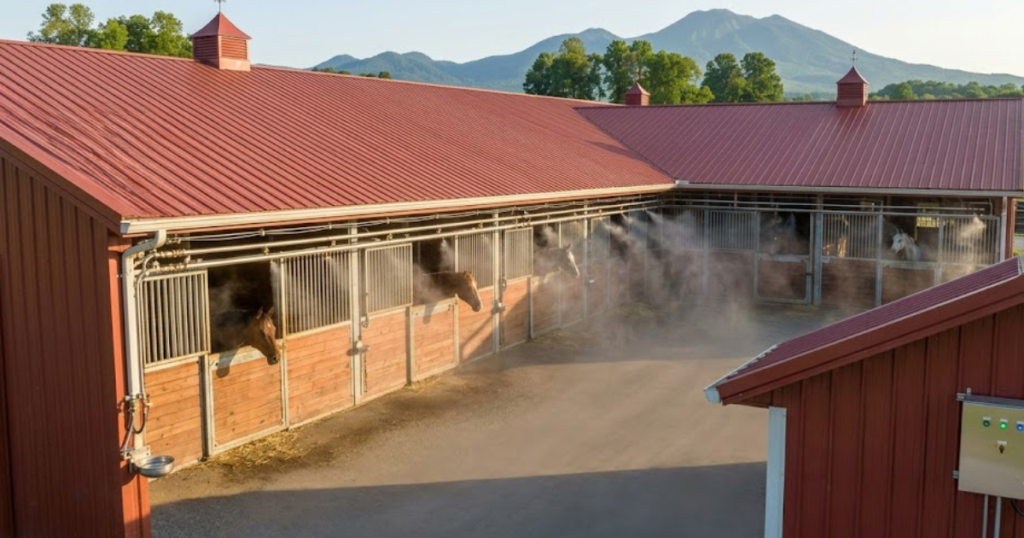
You walk down the wide center aisle of a stunning, custom-built equestrian property in mid-July. Despite the surrounding pastures and nearby creek, the barn interior is blissfully quiet. There is no frantic tail swishing, no stomping hooves echoing off the concrete, and the horses look relaxed in their stalls.
You look up and notice thin nylon tubing running perfectly along the ceiling joists, dropping down to brass nozzles positioned carefully over each stall. Every few hours, a soft hum fills the feed room, and a fine, almost invisible mist falls from the ceiling. You aren’t just touring a barn; you are touring a biologically defended fortress.
When buyers explore horse properties in Colorado, they frequently admire the custom stall fronts and the wash rack. However, the true luxury of a barn is measured by the comfort of the animals inside it during peak insect season. An automated overhead fly-spray system is a hallmark of a high-end facility, but only if it actually works.
Here is how to evaluate the presence, functionality, and hidden costs of an integrated fly-control system before you make an offer on the farm.
Is the Property Located Near an Active Summer Habitat or Migration Corridor for Predatory Mountain Lions, Bears, or Coyotes?
Quick Summary: The Apex Reality
- The Corridor Trap: Predators do not wander randomly; they follow natural topographical funnels like dry creek beds, ridgelines, and dense timber lines. If your property sits across one of these ancient highways, predators will pass through your pastures constantly.
- The Miniature and Foal Vulnerability: While a healthy, 1,200-pound Warmblood can usually fend for itself, foals, miniature horses, donkeys, and barn goats are prime, easy targets for opportunistic mountain lions and aggressive coyote packs.
- The Bear Magnet: Black bears rarely eat horses, but their sense of smell is legendary. They will literally rip the door off a tack room to get to molasses-soaked sweet feed. A bear tearing through a barn aisle will terrify stalled horses, leading to catastrophic, panic-induced stall injuries.
- The Fence Fallacy: Standard three-rail wood or vinyl fencing does absolutely nothing to stop a predator. Defending a herd requires specialized infrastructure, such as woven no-climb wire, offset electric top wires, and fully secured feed rooms.
Scenic open-space adjacency can come with real wildlife exposure. A beautiful creek, timber line, or forest edge may also function as a predator corridor that directly affects herd safety.
1. Identifying Natural Wildlife Funnels
Predators are ambush hunters. They avoid open, exposed ground and instead use the topography as cover.
- The Riparian Highway: Creek beds, arroyos, and dense willow thickets are the most heavily traveled wildlife corridors in the West. They provide predators with water, shade, and total concealment. If a property's primary pasture includes a dense, brushy creek crossing, your horses are sharing space with passing predators.
- The Ridgeline Saddle: In mountainous terrain, predators will take the path of least resistance over a ridge. A saddle, a low dip between two higher peaks, acts as a natural funnel. If your barn is built directly in the center of a saddle, wildlife will naturally route right past your stalls.
- The Ambush Canopy: Mountain lions hunt by dropping from above or sprinting from dense cover. Look at the edges of the pasture. If thick, low-hanging tree branches stretch directly over the grazing areas, you have a high-risk ambush zone that needs immediate, aggressive timber mitigation.
2. Profiling the Local Threats
Different predators require entirely different defensive strategies.
- Mountain Lions (Cougars): Lethal, silent, and highly athletic. They can easily clear a standard 5-foot pasture fence without touching the top rail. Their primary victims on horse farms are foals, minis, and small livestock.
- Black Bears: Bears are driven entirely by their stomachs. If a property has fruit trees, like crabapples, near the barn, or if the previous owners stored grain in cheap plastic trash cans in the breezeway, bears have likely already mapped the property as a food source. The primary danger to your horses is the sheer terror and chaos a bear causes when it invades an enclosed barn at night.
- Coyote & Wolf Packs: Coyotes hunt in highly coordinated packs. They will test fences, dig under gates, and aggressively harass livestock until an animal is separated or exhausted. Additionally, with the reintroduction of gray wolves to Colorado, pack-predator defense is becoming a vital consideration for Western Slope buyers.
The predator threat is not one-size-fits-all. The right defensive setup depends on whether the local issue is cougars, bears, coyotes, or multiple overlapping risks.
3. Evaluating Perimeter Defenses
A visually beautiful fence is useless if it does not protect the animals inside.
- The V-Mesh Standard: The gold standard for predator defense is heavy-gauge V-mesh, or no-climb woven-wire fencing. The gaps in the wire are too small for a coyote to squeeze through or a horse to catch a hoof in.
- The Electric Offset: Because bears and lions can climb, a premium perimeter fence will feature an offset hot wire, electric wire, positioned six inches outward from the top rail. When a predator rears up to climb, the hot wire strikes them in the chest or face, serving as a powerful psychological and physical deterrent.
- The Clear Zone: The fence line itself must be cleared of dense brush. There should be a 10-to-15-foot dead zone of mowed grass or dirt on the outside of the pasture fence. Predators hate crossing open ground; stripping away their cover stops them from stalking right up to the fence line.
4. Barn Security and the Nighttime Lockdown
If a property is located in a high-risk predator zone, your daily management routine will have to change.
- The Fortified Feed Room: Grain, sweet feed, and supplements must be stored in heavy-metal bins inside a room with a solid-core door and a heavy-duty deadbolt. If a bear can smell it and reach it, they will destroy the building to get it.
- The Nighttime Dry Lot: You cannot safely leave vulnerable horses out on massive, 20-acre timbered pastures overnight. The property must have a fortified, closely monitored dry lot or a fully enclosed stall system located directly next to the main house, where the herd can be safely locked down from dusk until dawn.
- Lighting and Alarm Infrastructure: Check the exterior of the barn for high-powered, motion-sensor floodlights. While lights will not stop a starving predator, sudden, bright illumination strips away their stealth cover and frequently spooks them back into the tree line.
We Evaluate the Environment Before You Buy
We do not just look at the acreage; we analyze the ecosystem.
When Mark Eibner and Belinda Seville represent you in your rural property search, we evaluate the land through the eyes of a Western land manager. We identify natural wildlife corridors, inspect the structural integrity of the perimeter fencing, and help you determine what immediate upgrades are necessary to keep your herd completely safe from the predators that share the mountains.
Contact Us Today to find premium horse properties Colorado buyers trust for secure, defensible, and beautifully engineered layouts.
Browse Active Colorado Horse Properties: Browse active Colorado horse ranches for sale or ask our team about finding a premium horse property for rent in Colorado while you search for a safe, permanent estate
Frequently Asked Questions (FAQ) About Predators and Horses
Do donkeys really protect horses from mountain lions?
No. This is a very common and dangerous myth. A standard or mammoth donkey is highly aggressive toward canines and will violently stomp a coyote to death. However, a mountain lion is an apex feline ambush predator; it will easily stalk, kill, and eat a donkey. Defending against lions requires physical fencing and nighttime lockups, not a guard donkey.
Can I legally shoot a predator if it attacks my horse in Colorado?
Generally, yes. Under Colorado Parks and Wildlife regulations, property owners have the right to use lethal force to protect their livestock from an active attack by a mountain lion, bear, or coyote. However, you must immediately report the kill to a CPW officer, and you cannot keep any part of the animal.
Will leaving a radio playing in the barn all night keep bears away?
Only temporarily. Bears and coyotes are incredibly intelligent and will quickly habituate to fake human presence, such as a radio or motion-sensor lights. Once they realize the noise does not pose a physical threat, they will ignore it. The only permanent solution is a physical barrier, sturdy doors, and a painful deterrent, electric fencing.