
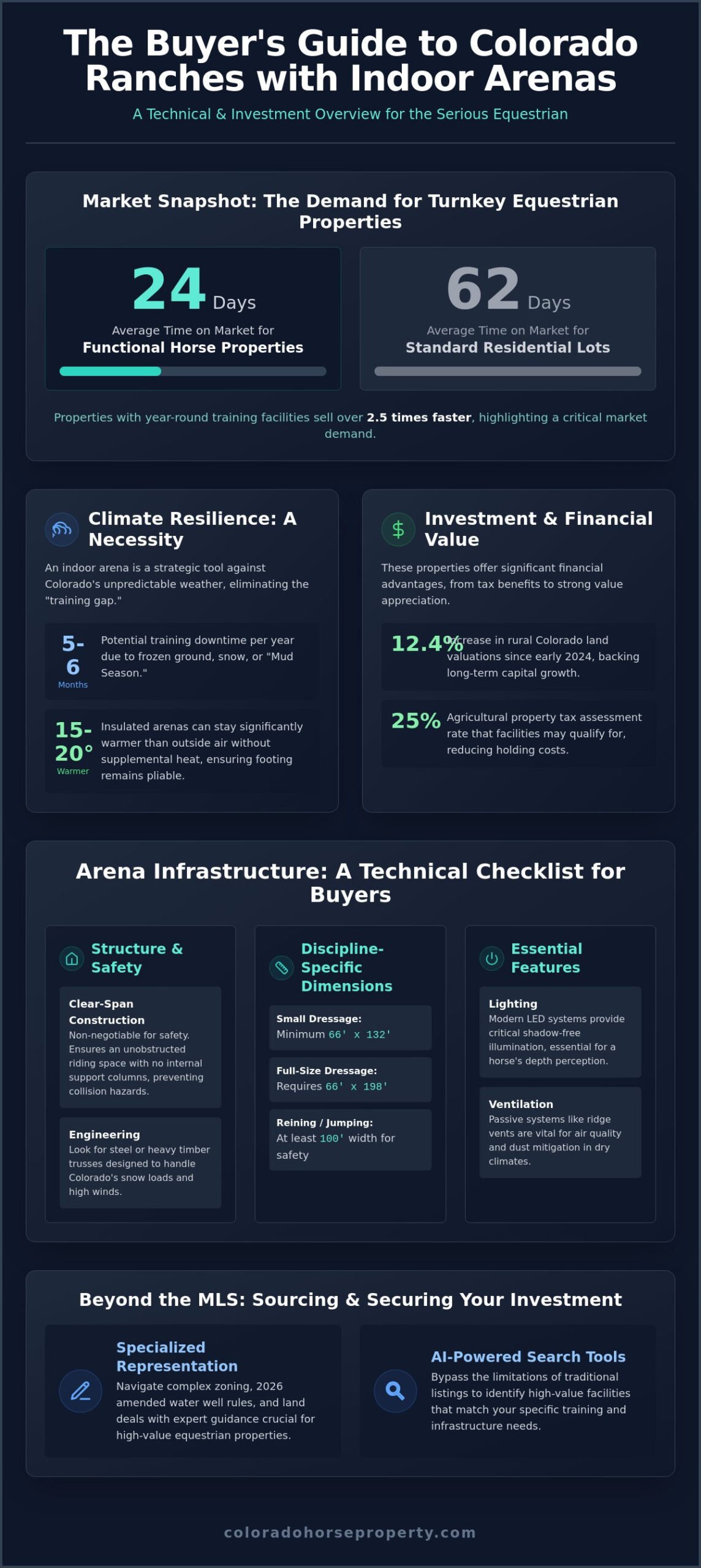
Functional horse properties in the Front Range are currently selling in an average of just 24 days, compared to 62 days for standard residential lots. This 2026 market demand shows that serious riders aren’t just looking for a home; they’re searching for year-round training utility. You understand that finding Colorado ranches with indoor arenas for sale requires more than a casual search. It’s a high-stakes investment where footing quality, ventilation, and structural engineering determine your daily success.
We agree that the technical side of equestrian real estate can feel overwhelming, especially with the 2026 amended water well rules and complex zoning laws. This guide will teach you how to evaluate professional-grade facilities, capitalize on the 25% agricultural property tax assessment, and source properties using specialized AI tools. We’ll preview the essential steps to securing a turnkey ranch that allows for 365-day training while protecting your long-term capital and ensuring your horses have the best possible environment.
Key Takeaways
- Understand why an indoor arena is a critical climate-control tool in Colorado and how it directly impacts your property’s long-term resale value.
- Learn the non-negotiable technical specifications for Colorado ranches with indoor arenas for sale, including clear-span engineering and discipline-specific dimensions.
- Evaluate essential infrastructure beyond the riding hall, such as efficient barn-to-arena integration and the management of sub-irrigated pastures.
- Discover how AI-powered search tools bypass the limitations of traditional MLS listings to identify high-value equestrian facilities that fit your specific training needs.
- Gain insights into securing your investment through specialized representation that understands the nuances of Colorado land deals and water rights.
The Strategic Value of Colorado Ranches with Indoor Arenas
In the Colorado Front Range, the riding season shouldn’t be dictated by the first blizzard of October. For serious horse owners, Colorado ranches with indoor arenas for sale represent a strategic hedge against the Rockies’ unpredictable climate. An indoor facility isn’t just a luxury; it’s a critical tool for maintaining consistency in training and horse health. Without one, you’re looking at a “training gap” that can span five to six months of the year when outdoor footing is either frozen solid, buried under snow, or turned into a deep mud pit during the spring thaw. High-altitude environments also bring intense UV rays and high winds that can degrade outdoor arena footing quickly, making the sheltered environment of a covered arena a necessity for professional-level work.
To better understand how these properties integrate residential life with professional-grade facilities, watch this helpful video:
Climate Resilience for the Colorado Equestrian
High-altitude environments present unique challenges like “Mud Season,” where thawing ground becomes a safety hazard for equestrian sports and disciplines. A properly engineered indoor arena manages these swings. It provides a controlled environment that protects horses from extreme temperature shifts and wind chill. Insulation is vital here. In January and February, an insulated metal or wood-frame building can stay 15 to 20 degrees warmer than the outside air without supplemental heat. This ensures the footing remains pliable and the riders stay focused. Beyond temperature control, these structures mitigate the respiratory risks associated with the dusty, dry air common in the high plains by allowing for sophisticated dust-suppression systems.
Investment Potential and Ranch Valuation
The market data from early 2026 is clear. Functional horse properties are moving nearly three times faster than standard residential lots. While a typical home might sit for two months, a ranch with a professional-grade arena often sells in just 24 days. This liquidity is backed by rising land values, with rural Colorado valuations increasing by 12.4% since early 2024. From a tax perspective, these structures often qualify under the 25% agricultural property tax assessment rate, provided the land meets state requirements for agricultural use. Buying existing Colorado ranches with indoor arenas for sale is often more cost-effective than starting a new build. Construction costs for large agricultural structures and the complexity of 2026 building permit trends mean that turnkey facilities command a significant premium. These properties hold their value during market shifts because the supply of permitted, high-quality indoor riding space remains low relative to the growing demand from equestrian enthusiasts moving to the Front Range.
Evaluating Arena Infrastructure: A Technical Checklist for Buyers
When searching for Colorado ranches with indoor arenas for sale, don’t treat the arena as a simple checkbox. High-end equestrian facilities require specific engineering to remain safe and functional. Clear-span construction is the primary feature to verify. The absence of internal pillars is non-negotiable for safety. Support columns inside a riding space create collision hazards and severely limit your ability to ride accurate patterns or set full jumping courses. Professional-grade arenas typically feature steel or heavy timber trusses that span the entire width of the building, providing an unobstructed workspace for both horse and rider.
Dimensions must align with your specific discipline to ensure long-term utility. A standard small dressage court requires at least 66 by 132 feet, while a full-size competitive court needs 66 by 198 feet. For reining or jumping, you should look for widths of at least 100 feet. This allows for safe circling and enough room to approach fences without being crowded by the walls. Lighting and ventilation also play critical roles in air quality. Modern LED systems are now the standard, providing shadow-free illumination that helps a horse’s depth perception. Passive ventilation, such as ridge vents and oversized eave vents, prevents the buildup of ammonia and dust that can lead to chronic respiratory issues.
The Science of Arena Footing
Footing is a multi-layered system, not just a layer of dirt. A quality indoor arena starts with a laser-graded, compacted base of clay or crushed limestone. In Colorado, sand is a common top layer, but premium facilities often use GGT (German Geo Textile) or polymer blends to provide better energy return and shear strength. Dust mitigation is another factor that separates professional facilities from amateur ones. While many older barns rely on overhead sprinkler systems, 2026 buyers are increasingly seeking wax-coated or “dustless” footing that requires no water and maintains its consistency regardless of humidity levels. You can search for properties with specific footing types to ensure the facility matches your training standards.
Structural Integrity and Snow Loads
Colorado’s wind zones and heavy snowfalls demand rigorous structural standards. Steel-frame buildings offer excellent durability, though wood-frame “pole barns” remain popular for their thermal properties. The roof pitch is vital for snow management. A steeper pitch allows snow to shed more easily, preventing dangerous weight accumulation. In 2026, verifying a building’s engineered snow load rating is the most critical technical step for any buyer looking at high-country properties. These ratings confirm the structure was designed to withstand the specific local climate conditions of the Rockies, protecting your horses and your investment from structural failure during extreme winter events.
Crucial Ranch Features Beyond the Arena
A professional training facility is only as good as its logistical layout. When evaluating Colorado ranches with indoor arenas for sale, look closely at how the barn integrates with the riding space. An attached or breezeway-connected design is the gold standard in the Rockies. It allows you to move horses from their stalls to the arena without exposing them to sudden temperature drops or icy winds. High-end properties often feature heated tack rooms, centralized wash racks with industrial drainage, and wide shed-row aisles that accommodate heavy equipment for stall cleaning and footing maintenance.
Land management is the next priority. Sub-irrigated pastures are a high-value asset in Colorado’s arid climate, providing natural forage that can significantly offset hay costs. However, many professional trainers prefer properties with well-engineered dry lot turnouts. These areas use crushed rock or specialized grids to prevent mud and protect pasture health during the spring thaw. Logistics matter just as much as the soil. Ensure the property features a wide-radius driveway and reinforced parking pads. A 40-foot gooseneck trailer requires ample space to maneuver, and you don’t want to be limited by narrow gates or soft ground. Location also drives value. Properties within a 45-minute commute of equestrian hubs like Parker or Fort Collins saw a 14% price increase in the last year, reflecting the demand for proximity to major show circuits.
Colorado Water Rights and Equine Needs
Water is the most complex part of any Colorado land deal. As of January 1, 2026, the Division of Water Resources has implemented amended rules for well construction and reporting. You must ensure your well permit isn’t restricted to “household use only,” as this won’t legally allow you to water livestock or run a dust-suppression system in your arena. New rules now require the submission of Form GWS-31A for well development, making it essential to have a clear record of the well’s yield and legal status. For a deeper dive into navigating these permits, consult our guide to equestrian real estate Colorado.
Zoning and Land Use Regulations
Zoning determines whether your ranch is a private hobby farm or a commercial training center. Agricultural zoning is usually required if you intend to board horses or host clinics. It’s also the primary requirement for accessing the 25% property tax assessment rate for the 2026 tax year. Beyond the property lines, check for existing easements that provide direct trail access to state parks or open space. If you’re considering a property that needs upgrades, see our advice on horse barns for sale to understand the current costs of building vs. buying established infrastructure.
How to Source Premium Ranches Using AI Search Tools
Traditional real estate platforms often fail equestrian buyers because their search filters are designed for suburban homes. A standard MLS search might tell you a property has “outbuildings,” but it won’t specify if the arena has a 100-foot clear-span or professional GGT footing. This data gap forces buyers to manually scroll through thousands of irrelevant listings. In the 2026 market, where functional Colorado ranches with indoor arenas for sale are under contract in an average of 24 days, you can’t afford to waste time on manual research. You need a system that identifies high-value infrastructure instantly.
The AI-Powered Search Advantage
Our proprietary AI-powered horse property search tool solves this inefficiency by scanning thousands of lines of listing data for technical keywords that competitors miss. Instead of broad categories, the system identifies specific arena dimensions, barn capacities, and footing materials buried in agent remarks. This technology allows you to filter for properties based on proximity to critical infrastructure like equine surgical centers or major show grounds in the Front Range corridor. By automating the discovery phase, you can see ‘hidden’ arena properties the moment they hit the market, often before they appear on national portals. You can start your journey by using our AI-powered horse property search to find facilities that match your discipline’s specific needs.
Conducting the Property Inspection
Once the AI identifies a potential match, the physical inspection requires a specialized eye. You aren’t just looking at the house; you’re auditing a commercial-grade training facility. When touring a ranch with a professional arena, start with the footing. Dig past the top layer to check the consistency of the base and look for signs of uneven settling. Check the structural ‘red flags’ in the arena building, such as daylight visible through corner joints or signs of condensation on the underside of the roof, which indicates poor ventilation.
The final stage of sourcing involves a deep dive into the property’s legal health. With 40 years of experience in the Colorado Front Range, we understand that a premium facility is worthless without secure land rights. This is where specialized transaction management becomes vital. We review title and escrow documents to verify that the 2026 amended water well rules are satisfied and that no restrictive easements interfere with your training operations. Navigating these high-value transactions with a seasoned expert ensures that your investment is protected from the first tour to the final signature at the closing table.
Securing Your Colorado Equestrian Legacy
Securing a high-value ranch is a complex process that extends far beyond the initial property tour. While the search for Colorado ranches with indoor arenas for sale starts with identifying the right infrastructure, the successful acquisition of these assets requires a deep understanding of Colorado’s unique legal and agricultural landscape. Mark and Alison Eibner bring 40 years of specialized experience to this process, ensuring that your transition to a professional-grade facility is handled with technical precision. With rural land valuations rising by 12.4% since 2024, the margin for error in these high-stakes transactions has narrowed. You need a team that understands how to value a 100-foot clear-span arena just as accurately as the acreage it sits on.
Our role involves full-cycle transaction management. We guide you from the initial AI-powered search through the technical inspections and into the final stages of title and escrow. This seasoned approach protects you from common pitfalls, such as properties with restrictive zoning that might prohibit your training goals or wells that don’t meet the January 2026 reporting standards. Moving to a professional-grade ranch is a significant lifestyle shift. It requires a partner who understands the daily demands of livestock management and the infrastructure needed to support 365-day training in the Rockies.
Expert Buyer Representation
We don’t just look at comparable sales; we negotiate based on the intrinsic value of the equestrian improvements. A property with a 15% premium for its professional-grade barn must be vetted for structural longevity and utility. Our team coordinates closely with trusted title and escrow partners, such as Meridian Title, to ensure every easement and water right is fully documented before you sign. This level of detail is essential for protecting your capital in a market where functional horse properties sell in an average of just 24 days. For a broader perspective on the current market, explore the Ultimate Guide to Buying Colorado Land.
Next Steps for 2026 Buyers
The first step toward securing your legacy is data. Setting up a custom AI search profile today allows you to receive real-time alerts the moment new Colorado ranches with indoor arenas for sale enter the market. This gives you a critical head start over other buyers. Once your parameters are set, schedule a consultation with our team to discuss your discipline-specific needs. Whether you’re preparing your current property for sale or looking for a significant upgrade, we provide the specialized expertise needed to navigate the 2026 Colorado ranch market with confidence.
Secure Your Year-Round Riding Future
Finding Colorado ranches with indoor arenas for sale is about more than just acreage. It requires a deep dive into technical specifications like clear-span construction and the latest 2026 water well regulations. We’ve seen that functional horse properties move fast, often in under 25 days, so having a data-driven advantage is essential. By focusing on infrastructure quality and legal compliance, you protect both your capital investment and your horses’ well-being. A turnkey facility ensures that the Rockies’ climate never dictates your training schedule.
Mark and Alison Eibner bring 40 years of local expertise to every transaction, ensuring you have a seasoned partner in your corner. Our proprietary AI search technology bypasses the limitations of traditional listings to find the exact dimensions and footing types you need. Ready to stop scrolling and start training? You can Start Your AI-Powered Search for Colorado Ranches with Arenas today. Your dream of a professional 365-day training facility in the Front Range is within reach, and we’re here to help you secure it.
Frequently Asked Questions
How much value does an indoor arena add to a Colorado ranch?
An indoor arena typically adds a 15% premium to the property’s valuation compared to standard residential listings. In the 2026 market, functional horse properties sell in an average of 24 days, while standard lots sit for 62 days. This increased liquidity and valuation make Colorado ranches with indoor arenas for sale a highly stable real estate investment for those prioritizing year-round training utility.
What are the standard dimensions for a professional indoor riding arena?
Professional dimensions depend on your specific discipline. A full dressage court requires 66 by 198 feet, while jumping and reining disciplines perform best in clear-span structures at least 100 feet wide. These dimensions ensure enough space for safe approaches and accurate patterns. You should always verify the clear-span height to ensure there is enough clearance for jumping or high-headed horses.
Do I need a specific well permit to water an indoor arena in Colorado?
You absolutely need a specific permit. A household-only well permit cannot legally be used for livestock or arena dust suppression. Under the amended 2026 water well construction rules, buyers must verify that the existing permit allows for agricultural or commercial use. Reporting well cleaning and development on the new Form GWS-31A is now a requirement for wells constructed after January 1, 2026.
What is the best type of footing for an indoor arena in a dry climate?
For Colorado’s dry climate, wax-coated or polymer-blended footings like GGT are the superior choice. These dustless options don’t require the constant watering that traditional sand bases do, which is critical given state water restrictions. They maintain consistent shear strength and energy return without becoming deep or powdery, ensuring your horses stay sound during intense training sessions.
Are there specific zoning requirements for building an indoor arena in Colorado?
Zoning determines the legality of your facility. Most counties require agricultural zoning for large riding structures to qualify for the 25% property tax assessment rate in 2026. Residential zoning often has strict limits on the number of livestock allowed per acre. It’s vital to check local setbacks and building height restrictions before assuming you can expand an existing facility or build a new one.
How does AI search help find ranches with arenas more effectively?
AI search tools identify specific infrastructure details that traditional MLS filters miss. Our proprietary system scans thousands of listing descriptions for technical terms like GGT footing or 120×200 arena. This allows you to find Colorado ranches with indoor arenas for sale that meet your exact training requirements without spending months manually scrolling through residential properties that lack the necessary equestrian improvements.
What are the typical maintenance costs for a large indoor riding facility?
Maintenance costs vary based on the footing and lighting systems installed. Traditional sand arenas require regular dragging and significant water for dust control, while wax-coated footings have higher upfront costs but lower daily maintenance needs. Upgrading to LED lighting can reduce electricity consumption significantly. You should also budget for periodic footing replenishment and annual structural inspections of the arena’s roof and ventilation systems.
Can I run a commercial boarding business on a ranch with an indoor arena?
Running a commercial boarding business requires specific zoning and water rights. You must verify that your well permit allows for commercial livestock use, as domestic permits are often limited to the owner’s animals. Many counties also require a Special Use Permit (SUP) for boarding operations. Always consult with a specialized broker to ensure the property’s legal framework supports your business goals before closing.