
With entry-level horse properties on the Front Range now starting at $1.25 million, a single oversight in water rights can turn a legacy investment into a dry, unusable liability. You want more than just a scenic view. You need a facility that functions as hard as you do, but you have likely realized that traditional lenders often reject rural properties and pasture carrying capacities are frequently overstated. It’s a high-stakes environment where the invisible assets matter just as much as the fencing.
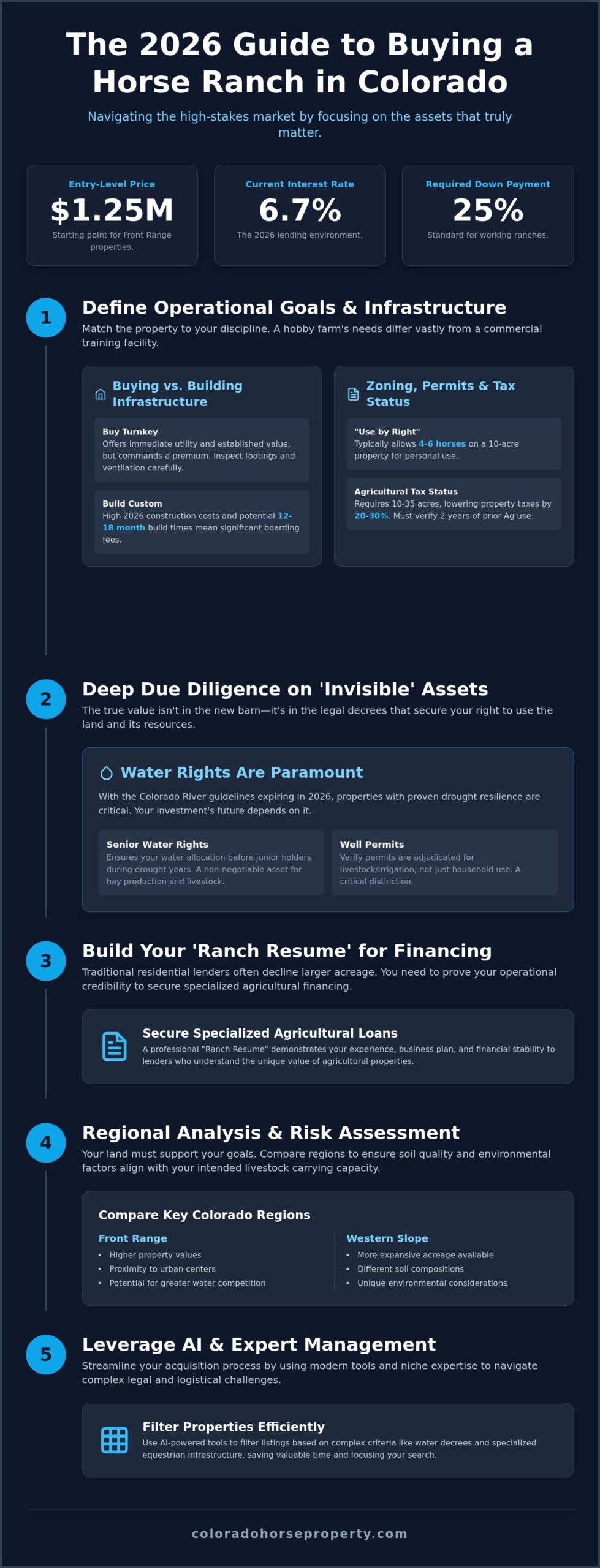
This guide will show you the precise steps to buying a horse ranch in Colorado in 2026. You will learn how to navigate the current 6.7 percent interest rate environment and secure the 25 percent down payment required for working ranches. We will also cover how to qualify for agricultural tax status to lower your overhead by up to 30 percent. We’ll preview the due diligence secrets used by niche experts to verify senior water rights and operational utility, ensuring your transition to the ranching lifestyle is both legally secure and permanent.
Key Takeaways
- Learn how to audit existing infrastructure to decide if buying a turnkey facility or building a custom barn is the most cost-effective path for your specific discipline.
- Master the essential steps to buying a horse ranch in Colorado by prioritizing “invisible” assets like senior water rights and specific well permits over cosmetic upgrades.
- Discover how to build a professional “Ranch Resume” to secure specialized agricultural financing that traditional residential lenders often decline for larger acreage.
- Compare regional soil quality and environmental risks between the Front Range and Western Slope to ensure your land supports your intended livestock carrying capacity.
- Streamline your acquisition process by using AI-powered tools to filter properties based on complex legal decrees and specialized equestrian infrastructure.
Step 1: Define Your Operational Goals and Infrastructure Needs
Defining your goals is the foundation of the steps to buying a horse ranch in Colorado. A property designed for a hobbyist with two retired geldings looks vastly different from a commercial boarding facility or a professional training center. You must decide if your priority is expansive grazing acreage or high-end structural infrastructure. Understanding the foundational overview of ranching helps clarify that your land is a tool for your specific discipline. Operational utility means looking past the aesthetics of a farmhouse. You need to evaluate if the trailer turnaround is wide enough for a four-horse gooseneck or if the hay storage is positioned for efficient daily feeding routines. Misjudging these logistics can add hours of labor to your weekly schedule.
To better understand the initial requirements for your search, watch this helpful video:
Buying vs. Building Infrastructure
With construction costs in 2026 remaining high, the choice between finding existing horse barns for sale and building from scratch is a major financial pivot. Turnkey properties often command a premium because they offer immediate utility and established resale value. When evaluating existing structures, inspect the structural integrity of the arena footings and the ventilation in the stalls. Retrofitting an old barn to meet modern safety standards can often exceed the cost of a new pre-engineered metal building. Consider the lead times for contractors in rural Colorado. A turnkey barn allows you to move your horses immediately, while a new build might leave you paying for boarding fees for twelve to eighteen months.
Zoning and Land Use Permits
Your dream of hosting clinics depends entirely on county zoning. Most Colorado counties allow for four to six horses on a 10-acre property under “Use by Right” status. However, commercial activities like boarding or public events often require a “Conditional Use” permit, which involves public hearings and neighbor approval. Never assume that because a neighbor has a public arena, you will be granted the same rights. Verifying these permits is one of the most critical steps to buying a horse ranch in Colorado. You must also check for agricultural land classifications. In many counties, you need a minimum of 10 to 35 acres to qualify for agricultural tax rates, which can lower your property taxes by 20% to 30%. Confirming the previous two years of agricultural use is essential to maintaining this status after the sale.
Step 2: Conduct Deep Due Diligence on ‘Invisible’ Assets
While a pristine arena is impressive, the actual value of a property lies in its legal title and resource access. One of the most overlooked steps to buying a horse ranch in Colorado is the verification of ‘invisible’ assets. These include water decrees, mineral ownership, and legal easements that dictate how you can use the land. Without these protections, your operational utility can vanish during a dry season or a legal dispute. Professional buyers look past the fences and focus on the paper trail that secures the property’s future.
The 2026 Colorado Water Landscape
Water rights are paramount. With the 2007 Colorado River operating guidelines expiring in 2026, ranch valuations are shifting toward properties with proven drought resilience. You must distinguish between well permits for household use and those adjudicated for livestock watering or irrigation. Consulting the state’s database on Colorado water rights and regulations is a non-negotiable part of your due diligence. Senior water rights are the most critical asset for a colorado ranch. These rights ensure you receive your allocation before junior holders during drought years. This is vital for maintaining hay production and livestock health when stream flows are low.
Mineral Rights and Split Estates
Colorado is a split estate state. This means the person who owns the surface land might not own the minerals beneath it. If a third party holds the mineral rights, they may have the legal right to enter your property to extract oil, gas, or coal. During the title phase of the steps to buying a horse ranch in Colorado, you should conduct a separate mineral search. This process helps you understand if you are buying the full fee simple estate or just the surface rights. If you find a split estate, look for properties with existing surface use agreements. These documents limit where drilling or mining can occur, protecting your pastures and training areas from industrial intrusion.
Access and easements also require scrutiny. Legal access on paper doesn’t always translate to physical access for a semi-truck delivering hay or a large horse trailer. Check for shared driveways or utility easements that might restrict where you can build future outbuildings. If you need help navigating these technical details, our expert buyer representation can manage the specialized due diligence required for complex rural acquisitions.
Step 3: Build Your ‘Ranch Resume’ for Specialized Financing
Securing funding is one of the most technical steps to buying a horse ranch in Colorado. You cannot walk into a big-box bank with a low-down-payment residential loan and expect to close on forty acres with a ten-stall barn. Traditional lenders use automated systems that flag large parcels as high-risk liabilities. In the 2026 market, where interest rates for agricultural and raw land loans have stabilized around 6.7 percent, having a specialized financial strategy is the only way to move from browsing to owning.
Why Traditional Lenders Struggle with Ranches
Most residential mortgages have an “acreage ceiling.” When a property exceeds 10 to 35 acres, standard secondary market buyers often refuse the loan. Banks struggle to value specialized infrastructure correctly. A professional-grade indoor arena might cost $250,000 to build, but a standard residential appraiser might only give it a fraction of that value. This creates a valuation gap that can kill a deal. You must target lenders who specialize in horse real estate for sale. These specialists understand that the barn, fencing, and water rights are functional assets that contribute to the property’s long-term legacy value.
To overcome these hurdles, you should create a “Ranch Resume.” This document acts as a business plan for the property. Even if you are a hobbyist, the lender needs to see how the land will be managed. Detail your plans for manure management, weed control, and hay production. This professional approach proves you are a capable steward of the land, which reduces the lender’s perceived risk.
The Essential Financial Checklist
Preparation is key when pursuing specialized financing for land. You should compile well permits, soil maps, and proof of agricultural exemption status before your first meeting. In 2026, lenders prioritize stability and land utility. An existing agricultural tax status can lower your debt-to-income ratio by reducing annual property taxes by 20% to 30%. However, be prepared for a 25 percent down payment, which is the standard requirement for most working ranch lending scenarios this year.
Explore modern lending trends like portfolio loans or the Colorado Agricultural Future Loan Program. These programs often provide more flexible terms for buyers who implement conservation practices. A credit audit specifically for land acquisition is also necessary. Rural lenders often look at different risk factors than urban ones, focusing on the longevity of the land’s productivity rather than just your personal income stream. Following these steps to buying a horse ranch in Colorado ensures your financing is as sturdy as your perimeter fencing.
Step 4: Regional Analysis and Environmental Risk Assessment
Choosing the right location is one of the most personal steps to buying a horse ranch in Colorado. The Front Range offers unmatched access to equine hospitals and the show circuit, but entry-level prices for functional properties often start at $1.25 million. Conversely, the Western Slope and San Luis Valley provide the expansive privacy many legacy buyers seek. However, you must weigh this privacy against the increased travel time for specialized veterinary care and farrier services. In 2026, regional ranching viability is increasingly tied to local climate resilience and infrastructure access.
Soil Health and Pasture Management
Testing for “Colorado clay” is essential before finalizing a purchase. This heavy soil type significantly impacts arena drainage and can lead to standing water or slick surfaces during the spring thaw. You should also check for high-alkali levels, which can stunt grass growth and limit the carrying capacity of land for sale in colorado. While most counties allow four to six horses on a 10-acre property, this is a legal limit rather than a biological one. Sustainable grazing practices, such as rotational grazing and cross-fencing, are required to maintain your agricultural tax status. This status can reduce your tax burden by up to 30 percent, but it requires active land stewardship that prevents overgrazing and soil erosion.
Wildfire and Climate Resilience
With Colorado operating under drought-response conditions in early 2026, wildfire mitigation is no longer optional. Insurance providers now require clear defensible space around barns, hay storage, and dwellings. When evaluating a property, look for existing fire breaks and the proximity of high-volume water sources. Climate resilience also means assessing flood plains, especially in areas where recent fire scars have changed the way water moves across the terrain. Protecting your investment means choosing land that can withstand these environmental pressures without compromising the safety of your livestock. You must also consider the availability of year-round access, as heavy snow or seasonal flooding can isolate remote properties.
Finding a property that balances these environmental risks requires deep regional knowledge and data-driven insights. Start your journey by using our AI-powered horse property search to filter for acreage that meets both your soil quality and safety requirements.
Step 5: Leverage AI Search and Expert Transaction Management
The final phase of the steps to buying a horse ranch in Colorado involves bridging the gap between digital data and physical closing. Standard real estate platforms are designed for residential subdivisions, not for complex agricultural assets. They often fail to account for the nuances of water decrees, grazing leases, or specialized outbuildings. To navigate this, you need a search process that filters for functional utility and a transaction team that understands the legal weight of a water court filing. Combining technology with veteran expertise ensures you don’t just find a property, but you secure a viable long-term investment.
The Power of AI in Horse Property Search
AI-powered search tools represent a significant shift in how equestrian land is acquired in 2026. These proprietary systems allow you to filter for “invisible” features that standard searches miss, such as specific well permits or senior water rights discussed in earlier steps. By analyzing 2026 market data, AI can identify undervalued parcels where the land’s carrying capacity exceeds its current listing price. This technology saves hundreds of hours by automatically eliminating properties that fail to meet strict equestrian zoning or lack the necessary “Use by Right” permits for your specific discipline. It allows you to focus only on properties that are truly “horse-ready” from a legal and operational standpoint.
Expert Representation with Mark and Alison Eibner
Successful ranch acquisitions require more than just a search tool; they require seasoned advocacy. Mark and Alison Eibner bring 40 years of Front Range expertise to the negotiating table. This longevity is crucial when managing the “appraisal gap” for outbuildings, where traditional valuations often fall short of replacement costs. A specialized agent knows how to present your “Ranch Resume” to lenders and appraisers to ensure the full value of your arena, fencing, and water assets is recognized. They act as a peer to the ranching community, speaking the language of both the buyer and the local county assessors.
Closing the deal involves coordinating a specialized team of title and escrow partners who are familiar with agricultural transfers. These professionals ensure that water rights are properly deeded and that existing grazing or mineral leases are clearly disclosed. You must verify that all water court filings are up to date before the final signature. By finalizing your “Ranch Resume” and leveraging equestrian real estate Colorado expertise, you can close with the confidence that your legacy property is legally secure. Following these steps to buying a horse ranch in Colorado transforms a complex search into a streamlined path toward owning your piece of the West.
Secure Your Colorado Equestrian Legacy
Success in the 2026 market depends on looking beyond the surface. You now understand that verifying senior water rights and soil health is just as critical as inspecting the barn’s structural integrity. By building a professional “Ranch Resume,” you can bridge the valuation gap and secure specialized financing that traditional lenders often miss. These technical steps to buying a horse ranch in Colorado ensure your investment provides both operational utility and long-term peace of mind.
Our team combines 40 years of specialized Colorado ranch expertise with proprietary technology to simplify this complex process. You’ll gain access to a network of specialized ranch lenders and use our data-driven filters to find properties that meet strict zoning and resource requirements. This proactive approach saves you time and protects your capital. Find your 2026 Colorado horse ranch with our AI-powered search tool!
Your dream of expansive space and a functional equine facility is within reach when you’ve got the right experts by your side. We’re ready to help you secure a property that supports your lifestyle for decades to come.
Frequently Asked Questions
What is the minimum acreage I need for a horse ranch in Colorado?
Most Colorado counties allow four to six horses on a 10-acre property without requiring special use permits. However, to qualify for agricultural land classification and the associated tax benefits, you typically need between 10 and 35 acres depending on the specific county assessor’s rules. Smaller ranchettes are available, but they often lack the carrying capacity for sustainable grazing without heavy supplemental feeding.
How do I verify if a property has senior water rights?
You verify senior water rights by searching the Colorado Division of Water Resources (DWR) database for adjudicated decrees and priority dates. A senior right has an earlier appropriation date than other holders on the same stream system, ensuring you receive your allocation first during drought conditions. It is essential to have a specialized water attorney or consultant review these records during your due diligence steps to buying a horse ranch in Colorado.
Can I get a standard 30-year mortgage for a 40-acre horse ranch?
Standard 30-year residential mortgages are rarely available for properties exceeding 10 to 20 acres because big-box lenders view large parcels as non-conforming. You will likely need a specialized agricultural loan or a portfolio product from a rural lender. These loans often require a 25 percent down payment and a “Ranch Resume” that details your land management plan and the property’s potential for agricultural productivity.
What is the difference between an ‘equestrian house’ and a ‘working ranch’ for lending?
An equestrian house is primarily valued as a residential residence with minor outbuildings, while a working ranch is treated as an agricultural asset where the land and infrastructure generate value. Lenders distinguish between the two based on acreage and the intended use of the property. Working ranches require more complex appraisals that account for water rights, hay production, and specialized facilities like professional-grade indoor arenas.
How does agricultural zoning affect my property taxes in Colorado?
Agricultural zoning can lower your property taxes by 20% to 30% compared to residential rates because the land is valued based on its productive capacity rather than its market value. To maintain this status, the property must have been used for genuine agricultural purposes for the two years prior to the current tax year. Each county assessor has specific requirements for what constitutes a profit-oriented agricultural operation.
What should I look for in a Colorado ranch’s soil for a riding arena?
You should look for soil with high sand or loam content and avoid areas dominated by heavy “Colorado clay” that traps moisture. Clay soils expand when wet and shrink when dry, which can ruin the base of an arena and cause uneven footings. Testing for drainage and alkali levels is one of the important steps to buying a horse ranch in Colorado to ensure your riding surfaces remain safe and usable year-round.
Do I need a special inspector for horse barns and outbuildings?
You need a specialized inspector who understands agricultural infrastructure, as standard home inspectors often lack the expertise to evaluate barns, arenas, and irrigation systems. A ranch-specific inspector will check for structural integrity in large-span outbuildings, proper ventilation in stalls, and the condition of specialized fencing. They also evaluate the functionality of well pumps and pressure tanks that support high-volume livestock watering needs.
How long does it typically take to close on a Colorado horse property?
Closing on a Colorado horse property typically takes 45 to 60 days, which is longer than a standard residential transaction. This extended timeline is necessary to complete specialized due diligence, such as water right title searches, environmental risk assessments, and agricultural appraisals. Coordination between niche lenders and title companies familiar with rural easements is essential to ensure a smooth transition of ownership without legal delays.