
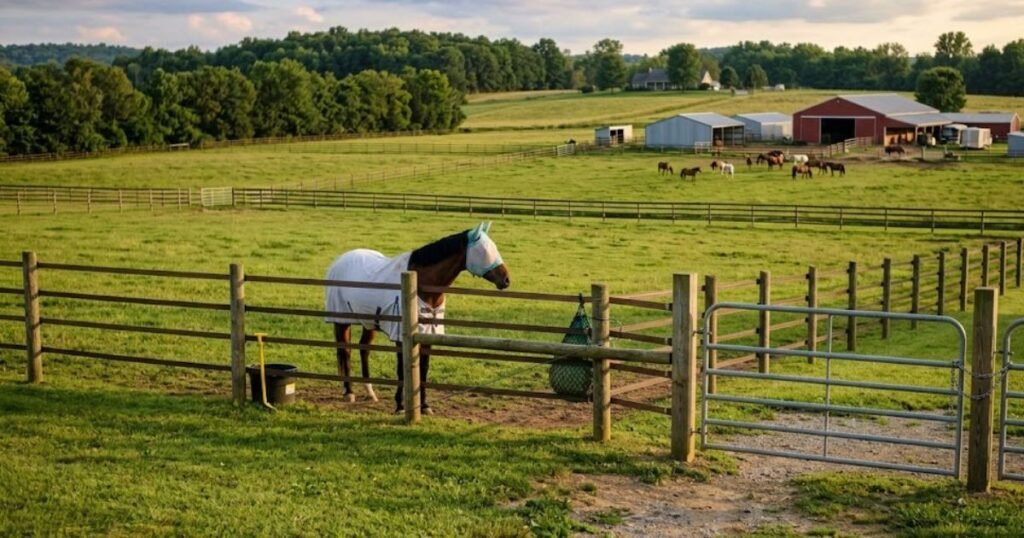
You bring your prize jumper back from a grueling three-week summer show circuit in Parker, Colorado. He looks a little tired and has a slight runny nose, which you chalk up to the dusty arena. You turn him out in the holding pen right next to your pregnant broodmare so he can stretch his legs.
Two days later, your vet diagnoses him with Equine Herpesvirus (EHV-1). Because they touched noses over the fence, your broodmare is now exposed, and your entire farm is placed on a strict, terrifying, and expensive medical lockdown.
When touring horse properties colorado buyers love, it is easy to get distracted by the beautiful main barn and the sprawling green pastures. But if you actively compete, travel to clinics, or frequently buy new horses, the most critical piece of infrastructure on the farm is the one sitting completely by itself.
Here is how to evaluate a property’s biosecurity layout before you close the deal.
Is There a Dedicated Quarantine Paddock Far Enough Away From the Main Herd to Isolate Horses Returning From Busy Summer Show Circuits?
Quick Summary: The Show-Ring Souvenir
- The Aerosol Threat: Highly contagious equine diseases, like Equine Herpesvirus or Strangles, do not just spread by touch. They travel through the air. A true quarantine paddock must be located at least 30 to 50 feet away from the main herd to prevent aerosol transmission.
- The Fence-Line Fail: A quarantine pen cannot share a common fence line with a healthy pasture. If horses can touch noses over the top rail, the quarantine is completely useless.
- The Drainage Danger: You must evaluate the topography. If the isolation paddock sits on a hill and drains directly into the main herd's water trough or grazing area during a rainstorm, the runoff will carry the bacteria straight to your healthy horses.
- The Dedicated Logistics: A functional isolation zone requires its own dedicated infrastructure, including separate water hydrants, independent muck tubs, and separate gear storage, so you never accidentally cross-contaminate the main barn while doing daily chores.
If you show, travel, or bring new horses onto the farm, quarantine layout is not an extra feature. It is one of the most important disease-control systems on the property.
1. The Aerosol Perimeter and Wind Flow
Viruses do not respect property lines, and they certainly do not respect standard pasture fences.
- The Minimum Distance: Equine respiratory pathogens can travel significantly far on a stiff breeze. The industry standard for a safe biosecurity perimeter is a minimum of 30 to 50 feet of empty, dead space between the quarantine paddock and any healthy horse.
- The Wind Vector: Look at the prevailing winds on the property. If the quarantine paddock is located directly upwind of the main barn, every time the isolated horse coughs, the summer breeze will carry the aerosolized virus straight down the aisle to the rest of your herd. The ideal quarantine zone is located firmly downwind.
Distance alone is not enough. A quarantine paddock needs both physical separation and the right wind relationship to the rest of the farm.
2. The Fence-Line and Topography Trap
Physical separation is about more than just air. It is about touch and water.
- The Double-Fence Mandate: If an isolation pen shares a fence line with a main pasture, it is not an isolation pen. Horses are highly social and will naturally gravitate toward each other, stretching over the fence to sniff and groom. A premium property utilizes double fencing—two parallel fences separated by a 15-foot alleyway—to make physical contact impossible.
- The Runoff Reality: Look closely at the slope of the land. If the quarantine paddock sits at the top of a hill, a heavy summer monsoon will wash the manure, urine, and bacteria from the sick horse directly down into the grazing grass of the healthy herd. The isolation zone must be located either downhill or on a completely separate drainage plane.
3. Workflow and Dedicated Infrastructure
A quarantine is only as strong as the human managing it. If the property's layout forces you to cut corners, the biosecurity will fail.
- Independent Water: Does the isolation paddock have its own frost-free hydrant? If you have to drag a 100-foot hose from the main barn to the sick pen, and then drag that same contaminated hose back into the main aisle, you have just spread the virus yourself.
- Separate Storage: A functional quarantine zone must have a small, weather-proof shed nearby, even just a simple tack locker. This allows you to store a dedicated halter, lead rope, thermometer, and muck fork that never enter the main barn.
- The Chore Route: You should always feed and clean the healthy horses first, and the quarantined horse last. The property layout should naturally support this flow, allowing you to finish your chores at the isolation pen and walk directly to the house to change your clothes and wash your hands, rather than walking back through the main barn.
We Evaluate Biosecurity Before You Buy
We do not just look at the stalls; we map the containment zones.
When Mark Eibner and Belinda Seville represent you in buying a rural estate, we analyze the property like a veterinary clinic. We measure the distances between outbuildings, evaluate the topography for dangerous drainage overlaps, and ensure you have the infrastructure necessary to travel, compete, and bring your horses home safely.
Contact Us Today to find premium horse properties Colorado buyers rely on for professional, safe, and healthy herd management.
Browse Active Colorado Horse Properties: Browse active Colorado horse ranches for sale or ask our team about finding a premium horse property for rent Colorado while you search for your permanent equestrian sanctuary
Frequently Asked Questions (FAQ) About Quarantine Paddocks
How long should a new horse or a horse returning from a show be kept in the quarantine paddock?
The standard veterinary recommendation is a strict minimum of 14 to 21 days. This covers the incubation period for most major respiratory and neurological equine diseases, ensuring the horse does not break with a fever after being introduced to the main herd.
Can I just use an empty stall at the very end of the main barn aisle for quarantine?
No. If the stall shares the same roof and airflow as the rest of the barn, it provides zero protection against aerosolized viruses like Equine Influenza or EHV. The horse must be housed in a completely separate building or a distant outdoor paddock with a shelter.
What is Strangles and why is it so hard to clean out of a barn?
Strangles is a highly contagious bacterial infection of the upper respiratory tract. The bacteria, Streptococcus equi, is notoriously hardy and can survive in the environment—on wooden fence rails, in water troughs, and on shared pitchforks—for weeks or even months under the right conditions, which is why strict separation of gear is critical.