
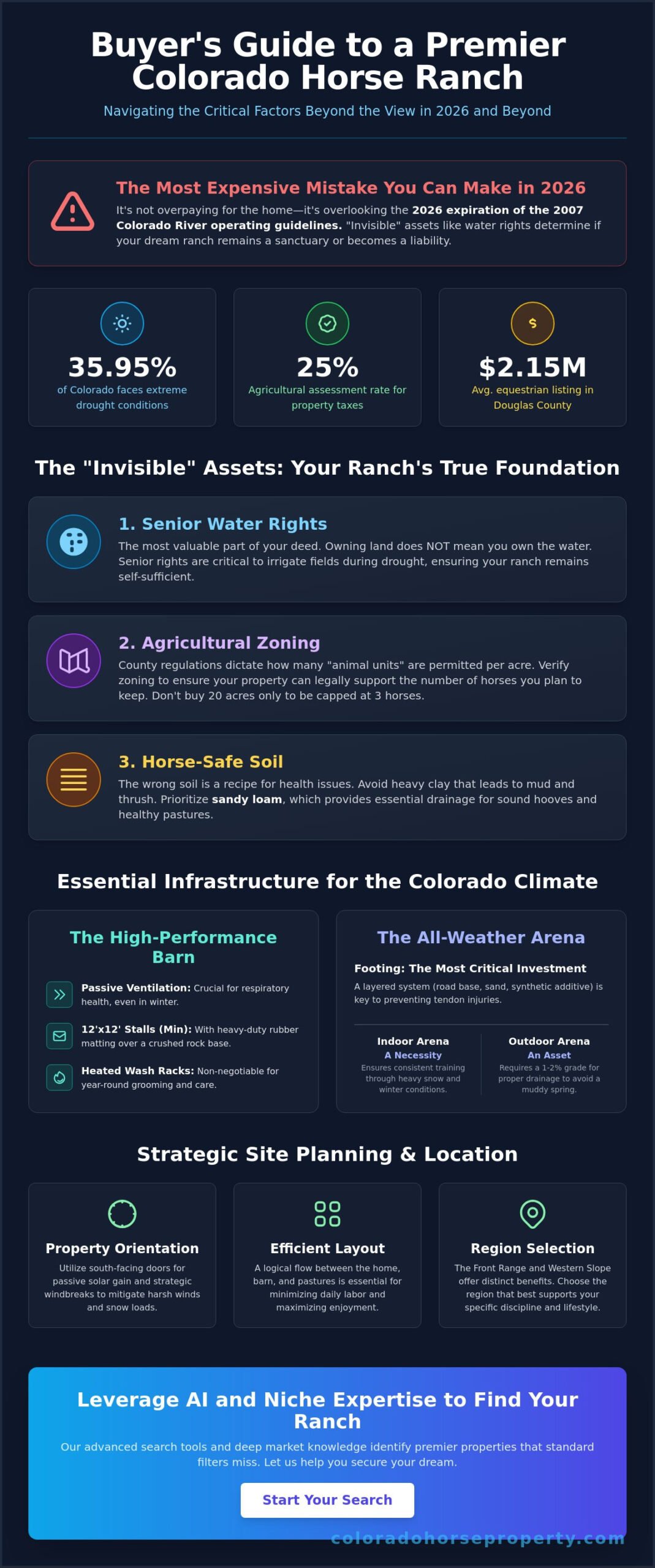
In 2026, the most expensive mistake you can make when buying a dream horse ranch in Colorado isn’t overpaying for the home, it’s overlooking the expiration of the 2007 Colorado River operating guidelines. While a stunning mountain backdrop and a custom ten stall barn are easy to fall in love with, the “invisible” assets like senior water rights and specific agricultural zoning determine whether your property remains a sanctuary or becomes a liability. With over 35% of the state currently facing extreme drought conditions, the technical details of land management have never been more critical for the serious equestrian buyer.
You likely already know that finding a property with the right soil and infrastructure is a complex challenge. You want a ranch that supports your specific discipline and maintains its value through shifting market cycles. This guide provides a professional roadmap to identify, evaluate, and secure a premier equestrian estate using expert insights on modern infrastructure and AI-driven property searches. We’ll explore the latest 2026 water regulations, explain the 25% agricultural assessment rate for property taxes, and show you how to minimize logistical friction during your purchase.
Key Takeaways
- Learn why operational utility and specialized infrastructure are more critical than aesthetics for long-term property valuation.
- Identify the specific barn and arena specifications required to handle Colorado’s unique climate and demanding winter conditions.
- Gain clarity on the legal complexities of senior water rights and well permit restrictions to ensure your land supports livestock.
- Leverage AI-powered search tools and niche expertise to find your dream horse ranch in Colorado by identifying features standard filters miss.
- Compare the distinct regional benefits of the Front Range and Western Slope to determine which area best supports your specific discipline.
What Defines a Dream Horse Ranch in Colorado?
A dream horse ranch in Colorado represents the intersection of high-end lifestyle and rigorous agricultural demand. It’s easy to be captivated by a wrap-around porch or a mountain silhouette, but the actual value lies in the land’s capacity to support livestock efficiently. To understand the foundational requirements of these properties, one should first ask: What is a ranch? In a professional context, it’s a dedicated facility where infrastructure and resource management take priority over purely residential features. A standard acreage might offer space, but a true ranch offers utility.
Many buyers mistake a large residential lot for a functional ranch. A premier equestrian estate requires specific property orientations to mitigate high-altitude winds and heavy snow loads. South-facing barn doors and strategically placed windbreaks aren’t just design choices; they’re essential for animal welfare and operational longevity. Whether you choose a turn-key facility or a fixer-upper, the property must demonstrate a logical flow between the home, the barn, and the pastures. Efficiency in daily chores is what separates a frustrating property from a dream investment.
To better understand this concept, watch this helpful video:
The “Invisible” Assets of a Premier Ranch
Water rights are the most significant part of your deed. In Colorado, owning the land doesn’t automatically mean you own the water. Senior water rights allow you to irrigate hay fields even during drought years, which is vital since 35.95% of the state is currently in extreme-exceptional drought as of June 2026. Beyond water, you must evaluate agricultural zoning. Many counties have strict livestock limits or “animal units” per acre. You don’t want to buy twenty acres only to find you’re legally capped at three horses. Finally, check the soil. Heavy clay leads to mud and thrush, while sandy loam provides the horse-safe drainage necessary for sound hooves.
Aspirational Lifestyle vs. Practical Management
Balancing a scenic mountain view with the need for flat, usable space is a common hurdle. You might want a home perched on a ridge, but your training arena needs level ground to prevent injury and ensure proper footing. High-end buyers often prioritize proximity to public trail systems, but a private on-property riding loop adds significant resale value and privacy. In Douglas County, where the average equestrian listing reaches $2,153,254, location remains the primary driver of value. Choosing a region with established equestrian communities ensures your dream horse ranch in Colorado remains a liquid and desirable asset for decades.
Essential Infrastructure for a High-End Equestrian Estate
Building a dream horse ranch in Colorado requires more than just land; it requires engineered facilities that withstand the Rocky Mountain climate. High-end barns must prioritize passive ventilation. While it’s tempting to seal a barn tight during a February blizzard, stagnant air leads to respiratory distress in horses. Stalls should be at least 12×12 feet with heavy-duty rubber matting over a crushed rock base to ensure proper drainage. Indoor wash racks with dedicated water heating systems are non-negotiable for year-round care and maintenance.
Footing material is the most critical investment on the ranch. A base of compacted road base topped with high-quality sub-angular sand and a synthetic additive provides the necessary rebound and grip. This prevents the tendon injuries common on poorly engineered surfaces. High-performance footing allows for consistent training regardless of the outside conditions.
Indoor vs. Outdoor Arenas
In the Rockies, an indoor arena isn’t a luxury. It’s a requirement for consistent training. Professional-grade facilities often include LED lighting and integrated sound systems for clinic environments. Outdoor arenas still play a role but require a 1% to 2% grade for drainage to prevent seasonal downtime during the spring thaw. Without proper grading, an outdoor arena can become unusable for weeks during the transition from winter to spring.
Sustainable Pasture Management
With 35.95% of the state in extreme-exceptional drought as of June 2026, pasture health is fragile. Rotational grazing layouts allow for forage recovery and prevent overgrazing. Automatic watering systems must be designed with heating elements or deep-bury valves to prevent freezing at high altitudes. Understanding the existing horse barns for sale on a property helps you determine if the current layout supports these long-term management goals.
Storage logistics are often an afterthought but impact daily operations significantly. A single horse consumes approximately 3.65 tons of hay per year. Your facility needs dry, ventilated storage for at least a year’s supply to hedge against rising hay prices, which currently range from $2,500 to $3,500 per horse annually. For fencing, non-climb wire with a top rail offers the highest safety rating, while pipe fencing provides the durability needed for high-traffic areas. If you’re ready to evaluate specific facility layouts, you can browse specialized listings that meet these technical standards.
Navigating Colorado-Specific Ranch Logistics
Securing a dream horse ranch in Colorado requires a technical understanding of the state’s complex legal landscape. You aren’t just purchasing land; you’re acquiring a specific bundle of rights that can be restricted or severed. In a state where 64.05% of the land is currently classified between abnormally dry and severe drought, these legal “invisible” assets dictate the true utility of your property. If the property’s access or water rights are flawed, even the most expensive indoor arena loses its value.
Access is a primary logistical concern for professional equestrian operations. You must verify that the deeded access is wide enough for large semi-trailers delivering hay or commercial horse vans. Many rural properties rely on shared private roads. Without a recorded maintenance agreement, you could face disputes over snow removal or road grading during the muddy spring thaw. Always ensure that easements for utility companies don’t infringe on your planned building sites for future barns or round pens.
Water Rights and Irrigation
Colorado operates under the “Prior Appropriation” doctrine, often summarized as “first in time, first in right.” Senior water rights are the most valuable asset on a ranch because they are the last to be curtailed during a drought. When conducting due diligence, you must verify the validity and transferability of water shares in a ditch company. It’s a common mistake to assume that a running stream on the property grants you the right to use that water. In reality, that water likely belongs to a downstream user with a more senior decree.
An augmentation plan is a court-approved document that allows well owners to replace the water they consume so that senior water rights holders are not legally injured. If you’re looking at a property with a “household-use-only” well, you cannot legally water a single horse or irrigate a small paddock. You need a “domestic” well permit to support livestock. Additionally, a new law signed in May 2026, HB 1340, now requires entities purchasing agricultural water rights to remain responsible for the revegetation of the land, adding a layer of environmental responsibility to water transfers.
Zoning and Land Use Permits
Zoning classifications like A-1 or A-2 vary significantly between counties. In Douglas County, where the average equestrian listing is $2,153,254, zoning rules regarding “animal units” are strictly enforced. You may need a Special Use Permit if you plan to host clinics, recognized shows, or run a commercial boarding operation. These permits often involve public hearings and specific requirements for manure management and traffic control. Consulting with equestrian real estate Colorado specialists is the most efficient way to decode these regional nuances before you sign a contract.
Conservation easements offer another layer of logistical strategy. By voluntarily restricting development, you can secure significant tax benefits and protect the ranch’s character. Since agricultural land is assessed at 25% of its actual value for property tax purposes in 2026, these easements can further enhance the long-term financial viability of a large-scale horse property.
Choosing the Right Region for Your Colorado Ranch
Regional choice dictates everything from your annual hay costs to the length of your riding season. Colorado’s topography creates distinct markets, and you must weigh the benefits of proximity to urban hubs against the need for expansive, affordable land. Finding your dream horse ranch in Colorado involves analyzing these regional trade-offs. A property in the high plains offers different utility than one nestled in the San Juan Mountains.
Front Range Equestrian Communities
Douglas and Elbert counties remain the top choice for equestrians who need to maintain a professional connection to Denver or Colorado Springs. In Douglas County, the average price per acre for equestrian land is $62,429. This reflects its status as a premier hub for the competitive circuit. This area puts you minutes from the Colorado Horse Park and elite veterinary specialists. The market for horse property for sale in colorado in these counties is fast-paced. Buyers here often prioritize high-end, turn-key facilities and community trail systems over total acreage.
Western Slope and Rural Acreage
If you seek scale and traditional ranching culture, the Western Slope offers significant value. Near Grand Junction and Montrose, acreage is often more accessible than the statewide average listing price of $1,756,513. The Uncompahgre Valley is particularly popular for its milder winters and year-round riding potential. Managing larger herds is more feasible on colorado ranches for sale in this region. You’ll find expansive parcels with senior water rights that are increasingly difficult to secure near the metro areas. This region is ideal for those who want to be part of a deep-rooted agricultural community.
High-altitude mountain ranches above 8,000 feet present a different set of challenges. The summer grazing is lush, but the growing season is short. You might find that one valley has 30 more frost-free days than the next due to air drainage and solar orientation. These micro-climates affect your annual hay consumption, which averages 3.65 tons per horse. In the high country, you’ll likely spend more on supplemental feed during the long winters. Annual hay costs currently range from $2,500 to $3,500 per horse, so regional production capacity is a major financial factor. Before committing to a specific county, search for properties by region to see how infrastructure and price points shift across the state.
Finding Your Dream Ranch with AI and Expert Guidance
Finding a dream horse ranch in Colorado requires a search strategy as specialized as the properties themselves. In the same way that Blumenberg Consulting provides specialized positioning and communication strategies for technology and IT companies, securing a premier estate in 2026 requires tools and representation that speak the language of land management and animal husbandry. Traditional real estate websites often fail the equestrian buyer by prioritizing residential amenities over agricultural utility. They focus on kitchen finishes while ignoring the critical data points that define a functional ranch.
National real estate portals typically lack the granular filters necessary for a sophisticated search. They don’t account for the difference between a decorative barn and a professional training facility. Utilizing a platform built specifically for this niche ensures you aren’t wasting time on properties that legally or physically cannot support your horses.
The Power of Specialized Search
Our AI-Powered Horse Property Search identifies specific equestrian features that standard MLS filters miss. You can filter for indoor arenas, specific pasture sizes, and existing barn infrastructure with precision. This technology saves time by eliminating properties that don’t meet strict agricultural requirements or zoning laws. When you access ranches for sale colorado through our proprietary platform, you’re viewing data curated for the serious landowner. This system ensures that every listing you review has been vetted for its operational potential, allowing you to focus only on viable investments.
Expert Buyer Representation
Expert Buyer Representation is the final piece of the puzzle. Working with Mark and Alison Eibner provides a 40-year competitive advantage in the Colorado market. They understand the nuances of local counties and the technical requirements of different riding disciplines. Their experience ensures that your Transaction Management is handled with professional oversight. From evaluating title reports to coordinating Title and Escrow Services, having a niche authority on your side prevents costly legal errors. AI search bridges the gap between dreams and data by turning complex land requirements into actionable property matches.
The transition from digital search to boots-on-the-ground tours is where the final due diligence happens. Walking the fence lines and inspecting the “invisible” assets like well permits and soil quality requires a seasoned eye. Once the AI has narrowed the field, our team provides the expert guidance needed to evaluate the physical integrity of the ranch. This comprehensive approach ensures you don’t just find a property, but you secure a legacy that supports your specific equestrian goals for years to come.
Secure Your Legacy on the Colorado Range
Securing a premier equestrian estate requires more than an appreciation for mountain views. It demands a technical approach to water rights, zoning, and specialized infrastructure. You’ve learned that the “invisible” assets of a property, such as senior water decrees and soil composition, are what truly define long-term value. Whether you’re targeting the high-end estates of Douglas County or the expansive acreage of the Western Slope, your success depends on precise data and expert representation.
Our team brings 40 years of Colorado real estate expertise to your search. We combine specialized AI-driven equestrian search technology with comprehensive transaction management and title services to ensure a seamless purchase. This specialized approach eliminates the friction of traditional searches and focuses only on properties that meet your specific professional requirements. Finding your dream horse ranch in Colorado is a significant milestone that requires a partner who understands the unique needs of land and livestock owners.
Take the first step toward your new lifestyle today. Find your dream Colorado horse ranch with our AI-powered search tool and start your journey with confidence. Your ideal property is out there.
Frequently Asked Questions
How many acres do I need for a horse ranch in Colorado?
You typically need at least 35 acres to qualify for a domestic well permit that allows for unrestricted livestock watering. However, many counties allow smaller hobby farms of 5 to 10 acres if they are connected to community water systems or have specific well augmentations. Always check the local “animal unit” density rules, as these determine exactly how many horses you can legally keep on your dream horse ranch in Colorado.
What are the most important water rights to look for in a ranch sale?
Senior water rights with an early decree date are the most valuable assets in any ranch transaction. These rights ensure you’re among the last to be curtailed during drought conditions, which currently affect over 64% of the state as of June 2026. You must also verify that the rights are adjudicated for your specific intended use, such as irrigation or livestock watering, to ensure they transfer legally with the deed.
Can I build a horse barn on any property zoned as agricultural?
Agricultural zoning doesn’t grant an automatic right to build any structure. You must still comply with county-specific setbacks from property lines, manure management regulations, and existing utility easements. Some properties may also have conservation easements that strictly limit the footprint of new buildings or require specific architectural styles to maintain the rural character of the region. Always verify the building envelope before closing.
What is the difference between a ranch and a ranchette in Colorado?
A ranch is typically a large-scale agricultural operation designed for production or professional training, often exceeding 40 acres. A ranchette is a smaller residential acreage, usually between 2 and 15 acres, that supports a few horses but lacks the scale for commercial hay production. Ranchettes are popular in the Front Range for commuting equestrians who want a rural lifestyle without the responsibilities of full-scale land management.
How do Colorado winters affect horse property maintenance?
Colorado winters require specialized infrastructure to manage frozen water lines and heavy snow loads. You must invest in heated automatic waterers or tank heaters to prevent dehydration in sub-zero temperatures. Spring brings the “mud season,” where proper drainage and sacrifice lots become essential to prevent pasture damage and hoof issues like thrush during the annual thaw. South-facing barn orientations help maximize natural snow melt.
Is it better to buy a turn-key ranch or raw land and build?
Buying a turn-key ranch is often more cost-effective because the price of building new infrastructure has risen significantly by 2026. Renovating existing facilities allows you to move in immediately, whereas raw land requires years of permitting for wells, septic systems, and power. However, building from scratch is the only way to ensure every stall and arena meets your exact discipline requirements. Most professional buyers prefer existing infrastructure to avoid construction delays.
How does an AI-powered search help find horse properties?
An AI-powered search identifies specific equestrian assets that standard real estate filters often ignore. It can scan listing descriptions for high-performance arena footing, stall counts, and specific barn ventilation styles with high precision. This technology saves you time by filtering out properties that lack the necessary infrastructure or legal water rights to support a dream horse ranch in Colorado, ensuring you only tour viable options.
What should I look for in horse property soil quality?
Look for sandy loam or well-drained soils that provide a safe, stable surface for training and grazing. Heavy clay soils are problematic because they retain moisture, leading to deep mud and increased risk of soft tissue injuries for your horses. You should also test for high levels of selenium or other minerals that can affect the health of your forage. Proper soil quality reduces the need for expensive supplemental footing in your paddocks.