
Your dream of owning a ranch isn’t just about the horses; it’s a strategic financial move that can consolidate your lifestyle costs into a high-value real estate asset. Many equestrian enthusiasts find themselves searching for the best way of convincing my spouse to buy a horse property while balancing family finances and long-term goals. It’s common to feel misunderstood when your partner sees a potential money pit, especially with mortgage rates for a 30-year fixed loan sitting at 6.49%. You aren’t just asking for a hobby. You’re proposing a fundamental shift in how your family builds equity while connecting with the expansive Colorado landscape.
This guide will show you how to turn a “no” into a “yes” by presenting a data-driven, lifestyle-focused case for equestrian real estate. We’ll bridge the gap between your passion and their practical concerns about ranch management and financial commitment. You’ll learn how to compare monthly full-board fees, which can exceed $1,200, against the long-term appreciation of mid-sized acreage. We’ll also cover technical essentials like Colorado water rights and agricultural tax assessments. By the end, you’ll have a clear path to professional validation and a shared vision for your future home.
Key Takeaways
- Identify the three main pillars of resistance, specifically financial, lifestyle, and labor, to move beyond emotional arguments toward a logical discussion.
- Use a data-driven approach for convincing my spouse to buy a horse property by comparing the “lost” capital of monthly boarding fees against long-term equity and Colorado’s agricultural tax benefits.
- Highlight the non-equestrian benefits of acreage, such as increased privacy, unobstructed mountain views, and space for diverse recreational activities like gardening or ATVs.
- Protect your investment by prioritizing technical due diligence, specifically focusing on Colorado water rights and zoning regulations that can make or break a property’s utility.
- Leverage AI-powered search tools to find properties that satisfy both partners’ “must-haves,” reducing search fatigue and ensuring the home meets modern lifestyle standards.
Addressing Common Objections: The Skeptical Spouse’s Perspective
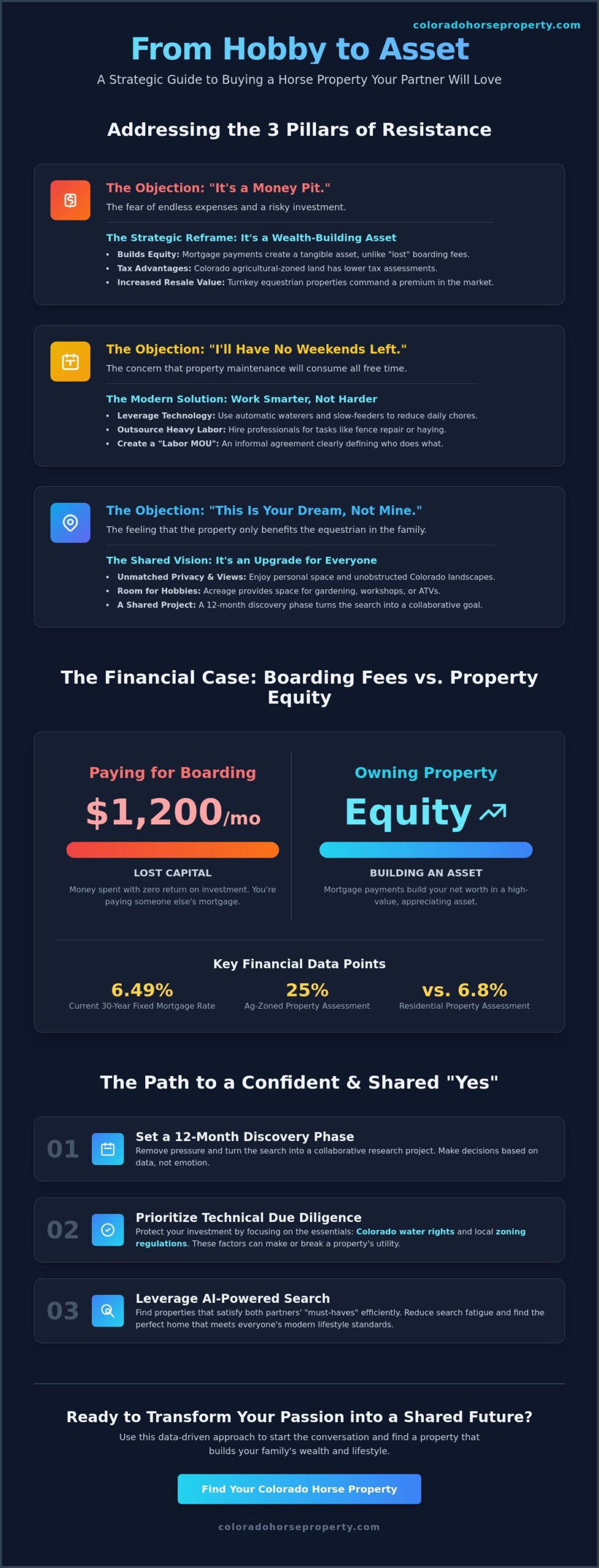
Successful negotiations for a new ranch start with empathy. You aren’t just buying a home; you’re proposing a massive capital investment and a shift in daily habits. Most resistance boils down to three pillars: financial commitment, lifestyle changes, and the physical labor required. When convincing my spouse to buy a horse property, it’s vital to address these concerns head-on rather than dismissing them as a lack of support. Acknowledging these hurdles shows you’re approaching the move as a responsible partner, not just a hobbyist.
Emotional selling often fails in the high-stakes world of Colorado real estate. Describing the joy of Equestrianism won’t settle a spouse’s anxiety about a 6.49% mortgage rate. You must validate their skepticism. Acknowledging that a ranch is a complex asset builds a collaborative atmosphere. It moves you from being a dreamer to a strategist. This shift is essential for making a decision that benefits your entire family’s future.
To better understand this concept, watch this helpful video:
Don’t rush into a purchase. Set a 12-month discovery phase. This timeline removes the pressure of an immediate “yes” and allows both partners to research zoning, water rights, and local infrastructure. It turns a potential argument into a shared project where data leads the way. Taking this time ensures that when you finally make an offer, it’s based on a shared vision rather than a compromise.
The Financial Fear: Is it a Money Pit?
Many spouses fear the property will become a bottomless money pit. You must distinguish between “horse expenses,” which are recurring costs, and “real estate appreciation,” which builds wealth. In Colorado, agricultural-zoned property is assessed at 25% of actual value, while residential property sits at 6.8% for local governments. Presenting a transparent report that compares $1,200 monthly boarding fees against property equity helps clarify the investment’s value. Focus on the fact that your monthly “rent” at a boarding stable is lost capital, while a mortgage payment builds a tangible asset.
The Labor Burden: Who Does the Work?
The fear of being tied to the land is a common deal-breaker. Address this by researching modern barn technologies, like automatic watering systems and slow-feeders, that slash daily maintenance time. Discuss the outsourcing model for heavy tasks like fence repair or haying. Finally, create a Labor MOU. This informal agreement defines who handles specific chores, ensuring the work doesn’t fall on the non-rider’s shoulders. By defining boundaries early, you reassure your partner that their weekends won’t be consumed by ranch chores they didn’t sign up for.
The Financial Case: Boarding Fees vs. Property Equity
Shifting the conversation from a hobby to a financial strategy is the most effective way of convincing my spouse to buy a horse property. While boarding provides convenience, it represents a total loss of capital. When you pay a facility owner, you’re essentially subsidizing their mortgage instead of building your own wealth. Consolidating your residential mortgage and your equestrian expenses into a single, manageable payment simplifies your balance sheet. It turns a recurring monthly drain into a tangible real estate asset that can appreciate over time.
Equestrian improvements like professional-grade barns and fenced pastures aren’t just functional. They increase the resale value of the home to a highly motivated niche market. In Colorado, turnkey properties often command a premium because buyers want to avoid the rising costs of construction and permitting. By investing in these assets now, you’re positioning your home as a specialized piece of real estate that stands out in a crowded market. You can start your journey by browsing current listings on coloradohorseproperty.com to see how these improvements impact market pricing.
Boarding vs. Owning: A 10-Year Comparison
The numbers speak for themselves when you look at a decade-long horizon. In the Front Range, full board ranges from $700 to over $1,200 per month. Over ten years, even at the lower end, you will spend $84,000 with zero return on investment. This doesn’t include the “hidden costs” like fuel for daily trips to the stable or the lack of control over feed quality and facility maintenance. A Guide to First-Time Horse Ownership can help you quantify these variables for a more accurate comparison. Transitioning that money into a property mortgage builds equity in land, a resource that is becoming increasingly scarce near Colorado’s urban centers.
Agricultural Tax Status and Incentives
Colorado offers significant tax advantages for land used for agricultural purposes. Under state law, property classified as agricultural is valued based on its productive capacity rather than its market value. This often results in a lower overall tax burden compared to standard residential properties. You can also generate income on-site through small-scale hay production or by offering limited boarding to others. It’s important to note that 35+ acre parcels in Colorado often qualify for different tax treatments and simplified well-permitting processes. These incentives make larger tracts of land more financially sustainable than they might appear at first glance.
Colorado Lifestyle Perks for the Non-Rider
The Colorado landscape is a primary draw for rural buyers in 2026. Recent market data shows a 12% increase in buyers seeking rural acreage over suburban options. This trend is driven by the desire for recreational versatility. On your own land, you have the space for private hiking trails, ATV paths, or extensive organic gardens. You aren’t just buying a place to keep animals; you’re securing a home base for every outdoor hobby your family enjoys. It’s about the utility of the land and how it serves the entire household’s long-term goals.
Privacy and Space in the Front Range
The density of suburbs like Englewood or Denver often leads to noise complaints and a lack of privacy. Acreage provides essential buffer zones between you and the next property owner. These zones offer long-term peace of mind and the quiet necessary for a high-quality lifestyle. For example, living near areas like fox run park colorado allows you to enjoy regional beauty while maintaining your own private sanctuary. This separation from the suburban grind is a major selling point for a partner who values quiet and personal space.
Multi-Purpose Outbuildings
A well-designed colorado ranch house often features open-concept living that appeals to modern tastes. However, the true utility lies in the outbuildings. A horse barn doesn’t have to be exclusively for livestock. These structures can serve as climate-controlled workshops, garages for car collectors, or professional art studios. When you frame the barn as a multi-purpose asset, it becomes a benefit for the non-rider’s interests too. It provides the square footage needed for specialized hobbies that a standard two-car garage could never accommodate.
Technical Due Diligence: Pre-empting Practical Hurdles
To successfully navigate convincing my spouse to buy a horse property, you must replace anxiety with technical certainty. Buying a ranch involves complexities that a standard residential agent isn’t equipped to handle. Professional representation is non-negotiable for these transactions. You need an expert who understands how to vet a property’s infrastructure, from septic capacity to the viability of the soil for grazing. This level of due diligence proves to your partner that you aren’t just chasing a whim, but are conducting a rigorous business evaluation of a specialized asset.
Technical hurdles often cause the most friction in marital discussions about relocation. By identifying potential deal-breakers early, you protect your family’s capital and emotional energy. Whether it’s the quality of the fencing or the structural integrity of a 20-year-old barn, knowing the facts allows for a logical decision-making process. You can secure expert buyer representation through our team to ensure every technical detail is scrutinized before you commit to a purchase.
Water Rights and Well Permits
Water is the most significant factor in Colorado real estate. In 2026, the scarcity of resources makes understanding water rights in Colorado the ultimate priority. You must distinguish between a “Household Use Only” permit and a “Domestic” well permit. A “Household Use Only” permit legally prohibits the watering of livestock, which makes it a deal-breaker for any equestrian property. You must verify water production rates and legal permit status before making an offer to ensure your horses have a sustainable, legal water source.
Zoning and Covenants
Don’t assume that the presence of a barn and a fence means the land is legally equestrian. There is a significant difference between a property being “Horse Friendly” and being “Equestrian Zoned” for your specific needs. Many Colorado communities have Homeowners Associations (HOAs) with rules that can be stricter than county zoning, often restricting barn sizes or the number of animals allowed on-site. Colorado county assessors typically define one mature horse as 1.0 Animal Unit, and each property has a specific AU limit per acre that you must strictly follow.
Pasture management and soil quality are the final components of your due diligence. Poor soil leads to overgrazing, dust issues, and expensive supplemental hay costs. Evaluating the land’s carrying capacity ensures the property is sustainable for the long term. This practical approach demonstrates to your spouse that you’ve considered the daily operational realities and the environmental health of the land, further solidifying the case for your investment.
Finding the Middle Ground with AI-Powered Search
Finding the perfect compromise requires more than just a list of houses. It requires a tool that understands the intersection of residential luxury and agricultural utility. This approach is essential for convincing my spouse to buy a horse property because it validates both partners’ wish lists simultaneously. Instead of viewing a property that only serves one person’s interests, our AI identifies high-value homes that also feature professional-grade equestrian infrastructure. This technology removes the “either/or” mentality and replaces it with a search for a home that enhances everyone’s daily life.
Search fatigue is a significant contributor to marital stress during a relocation. Sifting through thousands of irrelevant listings leads to burnout and frustration. By using AI to narrow the field to “turn-key” facilities, you minimize the immediate labor concerns that often trigger a “no” from a skeptical partner. These properties are ready for use on day one; this means you can focus on enjoying the Colorado landscape rather than managing a construction site or repairing old fences. This efficiency keeps the excitement of the move alive while reducing the friction of the search process.
Customized Search Parameters
Our platform allows you to drill down into the granular details that matter most in the Front Range. You can filter for specific water rights, arena types, and exact proximity to urban centers. AI also helps identify undervalued properties with significant equestrian potential that might be missed by traditional search methods. We invite you to try our equestrian real estate Colorado search tool to see how these filters can align your family’s goals. This precision ensures that every property you tour is a viable contender for both the rider and the non-rider.
The Expert Advantage
Working with specialized agents like Mark and Alison Eibner provides a layer of reassurance that generalist realtors cannot offer. They act as knowledgeable peers who understand the financial and emotional weight of these decisions. With 40 years of experience in the field, they can spot potential issues in a listing before you even step foot on the dirt. Their expertise helps you navigate the complex family dynamics that often accompany a lifestyle change of this magnitude.
Beyond finding the right property, the team at Realty Oasis provides comprehensive transaction management, including title and escrow services. This professional oversight ensures a smooth transition and builds the trust necessary to move forward with confidence. Don’t let the technicalities of ranch real estate stall your progress. Reach out to schedule a Family Strategy Session with our team today to develop a clear financial path and a shared vision for your new lifestyle.
Building Your Shared Colorado Future
Transitioning from a suburban lot to a rural ranch is a significant evolution for any family. You’ve learned that convincing my spouse to buy a horse property isn’t about emotional pleas; it’s about presenting a logical case built on equity growth and technical due diligence. By contrasting the wasted capital of boarding fees against the tax advantages of Colorado’s agricultural land, you turn a hobby into a legacy. You’ve also seen how acreage offers privacy and recreational benefits that serve everyone, regardless of whether they ride.
You don’t have to navigate these complex zoning and water rights issues alone. Mark and Alison Eibner bring 40 years of specialized Colorado real estate expertise to every transaction, ensuring your family’s investment is protected. Our proprietary AI search technology simplifies the process by filtering for the exact niche features your lifestyle requires, from modern kitchens to functional barns. Start your AI-powered search for the perfect Colorado horse property today and find a home that fulfills every item on both your wish lists. Your dream of a wide-open lifestyle is closer than you think.
Frequently Asked Questions
How many acres do I really need for two horses in Colorado?
You generally need at least 2.5 to 5 acres for two horses, though local zoning determines the final number. Most Colorado counties use an “Animal Unit” (AU) system where one mature horse equals 1.0 AU. While there is no statewide limit, density regulations vary significantly by county or HOA. Ensuring you have enough space prevents overgrazing and keeps your pastures sustainable for the long term.
Does buying a horse property actually increase my net worth?
Yes, owning a horse property builds equity in a specialized asset class that is becoming increasingly rare. Instead of losing over $1,200 per month on boarding fees, you are investing that capital into your own land. Mid-sized parcels between 10 and 35 acres are in high demand near urban centers. This scarcity drives long-term appreciation and makes the property a valuable component of your financial portfolio.
What are the most common hidden costs of owning a ranch?
The most common hidden costs involve infrastructure maintenance and land management. You must budget for fence repairs, well pump servicing, and specialized equipment like a tractor or manure spreader. Weed control and pasture reseeding are also recurring expenses. Factor in higher property insurance for outbuildings like barns and hay sheds to ensure your entire investment is fully protected against Colorado weather.
Can I get a standard residential mortgage for a horse property?
You can often secure a standard residential mortgage for properties under 20 acres if the home is the primary value. Conventional 30-year fixed rates in Colorado are currently 6.49%. However, properties with significant agricultural income or massive acreage may require specialized farm or ranch loans. It is essential to work with a lender who understands rural appraisals to ensure the outbuildings are valued correctly during the process.
How do I check for water rights before buying a Colorado ranch?
You check for water rights by reviewing the specific well permit with the Colorado Division of Water Resources. A “Household Use Only” permit is a major risk because it legally prohibits watering livestock. You must find a “Domestic” well permit that allows for animal consumption. Verifying these rights is a critical step in convincing my spouse to buy a horse property without future legal or operational hurdles.
Is it better to buy a ‘turn-key’ horse property or build my own barn?
Buying a turn-key property is generally better because it avoids the 12 to 18 month construction and permitting timeline. Building a barn from scratch in 2026 involves rising material costs and complex county setback requirements. Turn-key homes with existing arenas and stalls provide immediate utility. This approach minimizes the stress of a move and ensures you aren’t living on a construction site for your first year.
What happens if my spouse hates the extra work after we move?
Address potential labor resentment by investing in automation and hiring local help for heavy tasks. Automatic waterers and slow-feeders can reduce daily chores to under 30 minutes. Establishing a clear Labor MOU before the move ensures that responsibilities are shared fairly. If the workload remains a concern, outsourcing fence maintenance or hay delivery preserves your relationship and allows both partners to enjoy the lifestyle.