
What if your county zoning says you can have four horses, but your neighbors have the legal power to say zero? In Colorado, your HOA isn’t just a neighborhood association; it’s the supreme court of your property rights. Many buyers believe agricultural zoning is the final word, but Colorado horse property HOA rules are often far more restrictive than local government laws. You might find land that looks perfect, only to discover that an Architectural Review Committee has banned the specific arena style you need or restricted manure management to the point of being unworkable.
We understand that you’re looking for freedom and space, not a list of reasons why you can’t build a paddock. This guide will help you master the complexities of Colorado equestrian HOAs so you can protect your lifestyle and your livestock before signing a contract. We will walk through the 2026 legal updates to the Colorado Common Interest Ownership Act, explain why a household-only well permit is a deal-breaker for animal owners, and provide a clear checklist for vetting a community’s horse-friendliness before you commit your capital.
Key Takeaways
- Understand why private CC&Rs often override county zoning laws, making the HOA the final authority on how many horses you can keep.
- Identify how “Horse Math” and Architectural Review Committees can limit your total animal count and dictate the specific materials used for your barns.
- Learn how to navigate Colorado horse property HOA rules by requesting a resale disclosure packet and reviewing board minutes before you commit.
- Spot hidden “nuisance” clauses and manure management mandates that could impact your daily operations, fly control, and composting plans.
- Discover how to use specialized AI search tools to find acreage in horse-friendly counties or properties with minimal restrictive covenants.
The Legal Hierarchy: How Colorado HOA Rules Govern Horse Properties
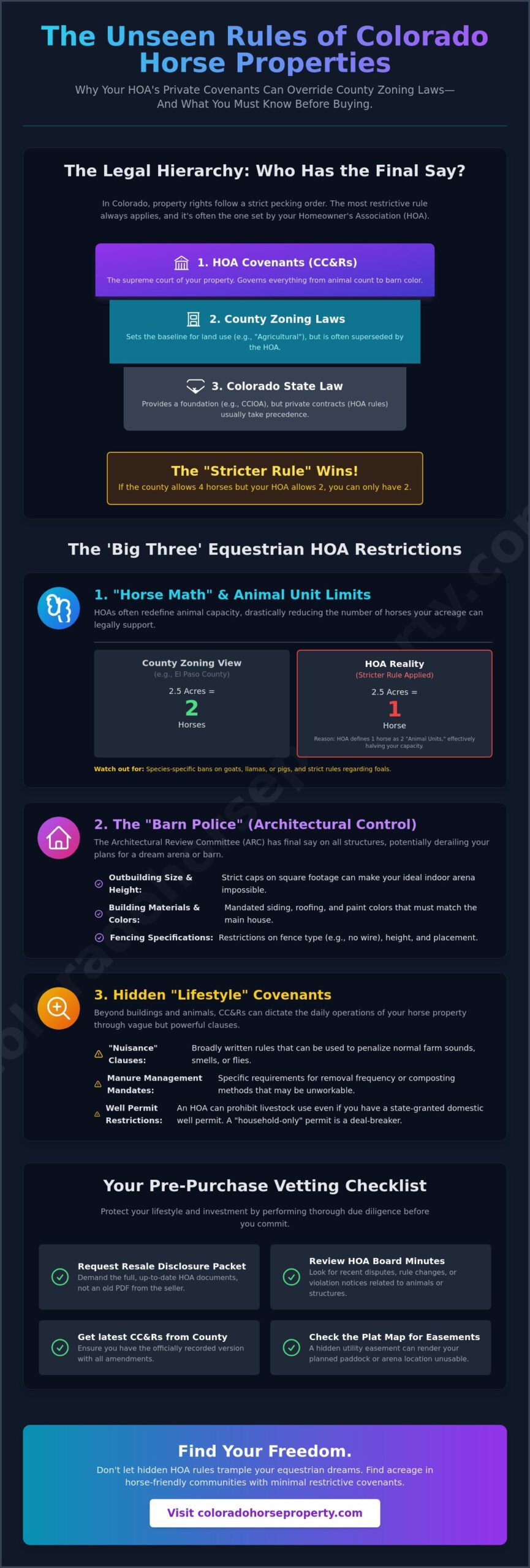
Buying rural land in Colorado feels like gaining ultimate freedom, but a homeowner association (HOA) can quickly narrow that scope. While county zoning might label your land as “Agricultural,” private covenants often impose much stricter standards. This is known as the “Stricter Rule.” If the county allows four horses but your HOA only allows two, the HOA’s rule is the one you must follow. Understanding Colorado horse property HOA rules requires looking past the marketing flyers and into the recorded legal documents. A “zoned for horses” label on a listing is only half the story if the private contract you sign at closing strips those rights away.
To better understand the reality of these properties, watch this helpful video:
CC&Rs: The Constitution of Your Ranch
Your Covenants, Conditions, and Restrictions (CC&Rs) are the private constitution of your property. They govern everything from the color of your barn to the specific type of fencing allowed. Don’t rely on an old PDF provided by a seller. You need the version currently recorded with the county clerk to ensure you have the latest amendments. Governance documents set the legal framework, while “Guidelines” often give boards discretionary power over your infrastructure. If your discipline requires a 100×200 indoor arena, you must ensure the guidelines don’t cap outbuilding square footage at a fraction of that size.
Why the HOA Wins the Zoning Battle
Colorado courts generally uphold private contract law over municipal code. Even on a 35-acre parcel where state law might grant you a domestic well permit for livestock, an HOA can legally prohibit animals entirely. Under the Colorado Common Interest Ownership Act (CCIOA), HOAs must follow strict compliance standards as of 2026. This includes specific notice periods for violations and caps on interest for unpaid fees at 8% per year. However, these protections don’t stop a board from enforcing restrictive covenants that were in place when you purchased the land. You also need to check the plat map for hidden easements. A utility easement running through the middle of your planned paddock can make that “horse-friendly” acreage unusable despite what the zoning says.
Common Equestrian HOA Restrictions: The ‘Big Three’ to Watch For
Once you understand the legal hierarchy, you must confront the daily reality of Colorado horse property HOA rules. These restrictions generally fall into three categories that can make or break your equestrian lifestyle. The most common pitfall is “Horse Math,” where the HOA uses a different calculation than the county to determine how many animals your land can support. While a county might allow a specific number of horses based on acreage, the HOA often has the final word on the density and type of livestock permitted on your property.
Animal Unit Limits and Species Restrictions
HOAs often define an “Animal Unit” with more precision than local zoning. For instance, while El Paso County typically requires 2.5 acres for the first two horses, an HOA could declare that one horse equals two animal units, effectively halving your capacity. You might also find species-specific bans. Some communities welcome horses but strictly prohibit “noisy” or “smelly” livestock like goats, llamas, or pigs. Even if you have a legal right to keep a mare, check the rules regarding foals. A surprise addition can technically put you in violation of animal count limits the moment it’s born. While Colorado state law on HOA animal restrictions has historically focused on domestic pets, it established a precedent for how boards manage animals, though specific livestock protections remain limited.
Architectural Control: Barns, Arenas, and Fencing
The Architectural Review Committee (ARC), often nicknamed the “Barn Police,” holds the keys to your infrastructure. They control outbuilding height, roof pitch, and even the color of your siding. In many Colorado equestrian communities, barbed wire is strictly forbidden in favor of more aesthetic options like three-rail vinyl or powder-coated steel. If you plan to ride year-round, investigate arena permissions early. Lighting and noise ordinances frequently prevent the construction of indoor arenas or the use of stadium lights for evening training sessions. Using an AI-powered horse property search can help you filter for communities that already permit the specific structures you need.
Never rely on the “grandfathered” myth. Just because the previous owner had five horses doesn’t mean you’ll be allowed the same. Covenants can change, and variances often expire upon the sale of the property. Finally, be aware of commercial restrictions. Most residential equestrian HOAs ban professional horse training or boarding. If you plan to offset your mortgage by boarding a neighbor’s gelding, you may find yourself facing daily fines. Under 2026 standards, HOAs must provide a 30-day period to cure these violations before legal action, but the financial strain of non-compliance adds up quickly.
Hidden ‘Lifestyle’ Covenants in Equestrian Communities
Ownership rights go beyond the number of animals in your pasture. In many Colorado developments, lifestyle covenants dictate the daily mechanics of your ranch. These rules often include a “Nuisance” clause, which acts as a catch-all for complaints regarding flies, dust, or smells. Even if you are within your legal animal count, a board can issue fines if they determine your property management creates an “unreasonable” impact on neighbors. Consulting the Colorado Horse Council’s guide to equine laws provides a baseline for state standards, but Colorado horse property HOA rules are frequently much stricter than these general guidelines.
Manure management is another area where private restrictions often exceed county health requirements. Some HOAs mandate the weekly removal of all waste by a third-party service, effectively banning on-site composting. This can add a significant recurring cost to your monthly budget. Additionally, check for commercial use bans. Many residential equestrian communities prohibit owners from giving paid riding lessons or hosting clinics on their property. Water usage is also a critical 2026 concern. With stricter oversight on well permits, some HOAs now limit the volume of water you can use for dust suppression in your arena, which can make summer riding difficult.
Trailer Parking and Equipment Storage
One of the most frequent points of contention in Colorado equestrian communities is the storage of essential equipment. Many HOAs prohibit parking horse trailers, tractors, or hay balers in view of the street. This often forces owners to build expensive detached garages or install high-cost visual buffers like privacy fencing or mature treelines. Before you buy, measure your trailer and compare it to the HOA’s allowable structure heights. If the rules cap outbuildings at 12 feet but your living-quarters trailer requires 14 feet of clearance, you may find yourself paying for off-site storage despite owning multiple acres.
Guest Horses and Temporary Boarding
If you enjoy hosting friends for weekend trail rides, pay close attention to temporary livestock clauses. Some HOAs have strict time limits on how long a “guest horse” can stay on the property, often capping visits at 48 or 72 hours. These rules are designed to prevent unpermitted boarding. You may also be required to provide the HOA board with proof of insurance for any visiting animals. Failure to comply with these “lifestyle” details can lead to legal action under the updated 2026 CCIOA standards, which require HOAs to strictly document violations before pursuing foreclosure for unpaid assessments.
Due Diligence: How to Vet a Colorado Horse Property HOA
Vetting a community requires more than a casual conversation with a listing agent. Under 2026 Colorado transparency laws, HOAs must provide electronic access to documents and maintain detailed records of board actions. This makes it easier than ever to uncover how Colorado horse property HOA rules are actually enforced on the ground. You shouldn’t wait until you’re under contract to begin this investigation. Proactive due diligence is the only way to ensure your specific equine discipline won’t be sidelined by a restrictive board or a sudden special assessment.
Follow these five steps to verify the long-term viability of a property:
- Step 1: Request the “Resale Disclosure” packet immediately. This contains the current budget and any pending legal issues.
- Step 2: Review the last 12 months of Board Meeting minutes. Look for recurring complaints about manure, dust, or trailer parking.
- Step 3: Analyze the HOA’s financial health. Check the Reserve Study to see if they have funds for maintaining shared bridle paths or private roads.
- Step 4: Verify “Animal Unit” counts with the HOA manager directly. Get a written confirmation of how many horses are allowed on the specific lot you’re eyeing.
- Step 5: Inspect the neighborhood for active code violations. If you see multiple “Stop Work” orders on new barns, the Architectural Review Committee (ARC) may be difficult to work with.
Reviewing the Resale Certificate and Financials
A low monthly HOA fee isn’t always a benefit. In equestrian communities, a median fee of $140 might signal that the association isn’t properly funding the maintenance of shared assets like community arenas or fences. Check for pending special assessments. If the community’s private roads need resurfacing, you could be hit with a five-figure bill shortly after closing. You also need to be aware of the “Colorado American Dream Act” (HB 25-1272). As of January 1, 2026, HOAs need 65% owner approval to file construction defect lawsuits. This protects the association’s reserves but can make it harder to hold developers accountable for infrastructure failures. For a thorough review of these documents, consider specialized buyer representation to help navigate the fine print.
Interviewing Neighbors and the Board
The most valuable data often comes from current residents. Ask horse-owning neighbors if the board enforces “unwritten” rules regarding turnout times or arena usage. You should also gauge the temperament of the current ARC. Some committees are supportive of agricultural improvements, while others act as “Barn Police,” scrutinizing everything from your choice of siding to the placement of your hay storage. Ask the board for clarity on the 2026 compliance standards. Under HB 22-1137, they must provide a written notice and a 30-day cure period before issuing fines. If the board seems unaware of these legal requirements, it’s a major red flag for potential mismanagement.
Finding Your Freedom: Searching for Properties with Minimal Restrictions
While 51.6% of Colorado homes listed for sale in 2025 included HOA fees, horse owners often seek the remaining half of the market to avoid overreaching boards. Finding land where Colorado horse property HOA rules don’t apply requires a strategic shift in your search parameters. You should target unincorporated areas where county zoning remains the primary authority. Counties like Weld and Elbert are historically more permissive, often allowing for higher animal densities and more flexible building codes than suburbanized regions like Boulder or parts of El Paso County. These areas provide the expansive space and freedom that draw equestrian buyers to the Rocky Mountain region.
Unincorporated land offers greater autonomy for infrastructure projects like large indoor arenas or multi-stall barns. However, you must still contend with state regulations. For example, owning 35 acres or more generally entitles you to a Domestic Well permit. This is vital for watering livestock and irrigating up to one acre. If you buy a smaller parcel in a platted subdivision, you might be restricted to a “Household Use Only” permit, which legally prohibits watering horses. Working with a specialist who understands the intersection of water law, zoning, and private covenants is non-negotiable. A generalist agent might miss a “no-commercial-use” clause that prevents you from training, or a well permit restriction that makes your land unusable for livestock. We provide expert buyer representation and transaction management to ensure every legal detail aligns with your agricultural goals.
Identifying ‘No-HOA’ Acreage in Colorado
The “35-Acre Rule” is a cornerstone of rural Colorado real estate. Parcels of this size or larger often exist outside formal subdivisions, meaning they are frequently free from traditional associations. Even without an HOA, you must check for “Deed Restrictions.” These are permanent limitations on the land that stay with the title regardless of whether a board exists to enforce them. Using comprehensive equestrian real estate Colorado guides can help you identify which pockets of the state offer the most autonomy for your specific needs. These guides help you navigate the nuances of each county’s unique approach to land use and livestock management.
Leveraging AI Search for Equestrian-Friendly Communities
Traditional search platforms often fail to distinguish between a “horse-friendly” home and a functional ranch. Our proprietary system allows you to filter specifically for properties where outbuildings are permitted and livestock counts meet your requirements. We go beyond the listing description by having our team verify the current Colorado horse property HOA rules or deed restrictions before you schedule a showing. This prevents the frustration of falling in love with a property only to find its covenants ban your specific trailer or manure management plan. Find your unrestricted Colorado dream property with our AI search tool today and secure the lifestyle you’ve worked for.
Secure Your Equestrian Future in Colorado
Success in the Colorado rural market requires looking beyond the acreage and into the fine print. You now know that private covenants often override county zoning and that “Horse Math” can drastically change your animal capacity. Understanding Colorado horse property HOA rules is the difference between a functional ranch and a property that restricts your every move. By vetting board minutes, analyzing reserve funds, and verifying water rights, you can protect your investment and your livestock from unexpected restrictions.
Our team brings 40+ years of Colorado real estate experience to your side. We provide specialized expertise in title and escrow for ranch transactions, ensuring your property rights are fully protected. Use our proprietary AI search to filter for specific infrastructure needs like barns and arenas while verifying the underlying water rights. Start your AI-powered search for Colorado horse properties here to find land that supports your vision without the interference of restrictive boards. Your dream ranch is within reach once you have the right data.
Frequently Asked Questions
Can a Colorado HOA change the rules to ban horses after I move in?
Yes, an HOA can legally amend its covenants to ban horses if they follow the voting procedures outlined in their bylaws. This typically requires a supermajority of the homeowners, often 67%, to agree to the change. If the rules change, you may be forced to relocate your animals unless a specific “grandfather clause” is included in the amendment. Always check the amendment history in the resale packet before buying.
What is the difference between an HOA and a ‘Covenant Protected’ community?
A “Covenant Protected” community often lacks a formal board or monthly fees but still has recorded restrictions that run with the land. In these cases, individual neighbors have the legal right to sue for enforcement of the rules. An HOA is a formal entity with the power to levy fines, maintain common areas, and initiate foreclosures for unpaid assessments under the Colorado Common Interest Ownership Act.
Does the ‘Right to Farm’ act protect my horse property from HOA complaints?
The Colorado Right to Farm Act generally doesn’t protect you from private HOA enforcement actions. This law is designed to protect established agricultural operations from nuisance lawsuits filed by new neighbors moving into rural areas. Since Colorado horse property HOA rules are part of a private contract you sign at closing, the association’s specific restrictions will almost always take precedence over general state agricultural protections.
How many horses are typically allowed per acre in a Colorado HOA?
While county zoning might allow one horse per half-acre, many equestrian HOAs limit owners to two horses per 2.5 to 5 acres. These communities often use an “Animal Unit” system to manage property density and soil health. You must verify the specific “horse math” in the CC&Rs because the association’s rules are frequently more restrictive than the county’s baseline requirements for acreage.
What happens if I build a barn without HOA approval in Colorado?
Building a barn without approval can result in the HOA forcing you to dismantle the structure at your own expense. They may also issue daily fines or place a lien on your property for non-compliance. Under 2026 regulations, the board must provide a written notice and a 30-day period to cure the violation before they can pursue legal action for anything other than a safety hazard.
Are mini-horses or donkeys treated differently by HOA rules?
Mini-horses and donkeys are often treated as standard livestock, but some CC&Rs define them as “small animals” or half-units. If the documents don’t specifically mention miniature breeds, the board will likely count them as full-sized horses regarding your total animal limit. Always seek a written variance or clarification from the board if you plan to keep smaller equine breeds on your lot.
Can I run a horse boarding business in a Colorado residential HOA?
Most residential HOAs strictly prohibit commercial operations, including professional horse boarding or training. Even if your zoning allows for a home business, the private covenants likely ban “commercial use” to limit traffic and noise in the neighborhood. If you want to run a business, you should target acreage in counties like Weld or Elbert where restrictions are minimal or non-existent.
How do I find out if a property has an active HOA if it’s not in the listing?
You can find out if a property has an active association by performing a title search or checking the county clerk and recorder’s office. Colorado horse property HOA rules must be recorded against the property’s title to be enforceable. If a listing is vague, look for a “Declaration of Covenants” in the property’s legal history to see if an association was ever formally established.