
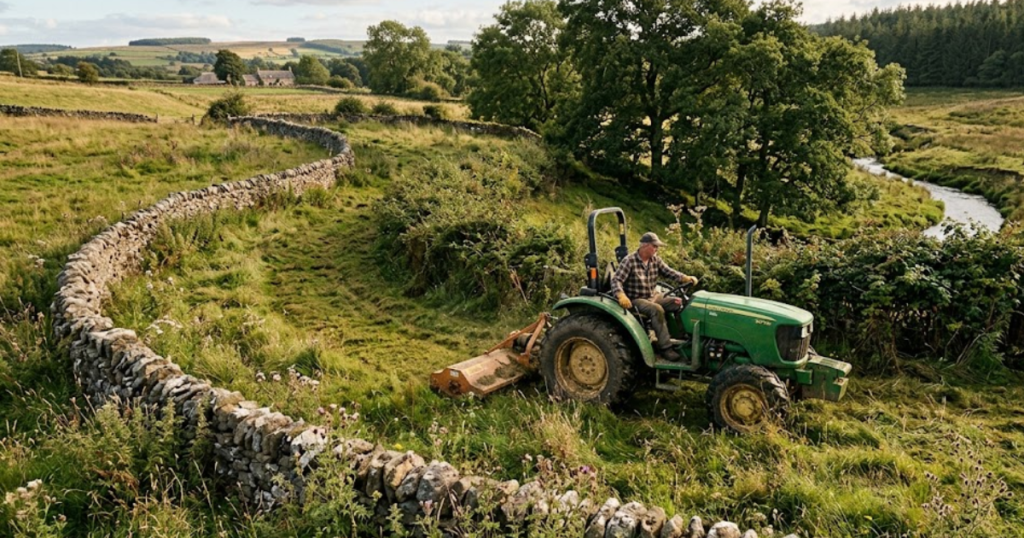
You find a beautiful, sprawling horse property with 15 acres of fully fenced turnout. On paper, it looks perfect. However, when you walk the land, you realize the pasture boundaries follow a winding, jagged creek line on one side, an angled easement road on the other, and a series of sharp, triangular points cutting around old rock outcroppings.
You hook up your tractor to your new 10-foot pasture drag to break up the manure piles and clear the spring weeds. Within twenty minutes, you are exhausted and frustrated. Every time you approach the irregular boundaries, you have to stop, lift the implement, back up, make a multi-point turn, and carefully maneuver around a jagged fence corner. What should have been a relaxing two-hour chore turns into an all-day obstacle course.
When shopping for horse properties colorado buyers heavily focus on the total acreage but rarely look at the actual geometry of the fence lines. The physical shape of your turnout spaces directly impacts your weekly labor, your equipment wear-and-tear, and the safety of your horses.
Here is how to evaluate pasture shapes to ensure an efficient, easily managed equestrian facility.
Is the Pasture "Irregularly Shaped," Making It Hard to Mow or Drag?
Quick Summary: The Efficiency Curve
- The Geometric Advantage: Square or rectangular pastures are the easiest to manage. They allow you to maintain a continuous, steady speed when driving a tractor, maximizing the efficiency of your equipment.
- The "Dead Space" Nightmare: Tight, acute corners and narrow bottlenecks create traps for heavy machinery. You cannot safely pull a 12-foot pasture drag or a massive rotary cutter into an irregular, wedge-shaped corner without constantly backing up and manual maneuvering.
- The Fence-Line Friction: Irregularly shaped pastures require complex, zigzagging fence lines. This drastically increases your initial fencing material costs and adds dozens of extra corner posts—the primary failure points where horses can get cornered and bullied by the herd.
- The Maintenance Deficit: If a section of your pasture is too awkward or narrow to easily reach with a tractor, it will quickly get neglected. These maintenance blind spots rapidly turn into breeding grounds for toxic weeds and invasive brush.
Pasture shape affects more than looks on a survey. It changes your maintenance time, machinery efficiency, fence budget, and how safely the herd moves through the turnout.
1. The Tractor Logistics: Turning Radius and Implement Width
Managing a healthy pasture requires regular maintenance, which means driving heavy implements over every square inch of the dirt.
- The Wide-Sweep Problem: Pasture tools, like rotary mowers, shredders, seed drills, fertilizer spreaders, and chain-link drags, are wide, rigid pieces of steel. They are designed to travel in long, unbroken straight lines.
- The Corner Bottleneck: When an implement is 8 to 12 feet wide, turning a sharp 45-degree corner means the inside of the tool stops moving while the outside swings violently. This causes the blades to gouge the turf or forces you to leave large, uncut patches of weeds in every single corner.
- The Reversing Hazard: Backing up a tractor while pulling a heavy, articulated implement is difficult and dangerous. In an irregularly shaped pasture with tight wedges, you will spend half your time shifting gears and shifting directions just to cut a small patch of grass.
2. Herd Dynamics and the "Corner Trap"
The shape of your pasture does not just affect your tractor; it heavily influences how your horses interact with one another.
- The Flight Boundary: Horses are herd animals with a strong flight instinct. In a wide-open square or rectangle, a submissive horse can easily run away from a dominant herd mate, circling around to a safe distance.
- The Acute Danger: Irregular pastures with sharp, triangular points or narrow finger corridors create natural traps. If a dominant horse chases a submissive horse into an acute, narrow corner, the submissive horse has no escape route. This is where the majority of pasture-kick injuries, fence collisions, and torn blankets occur.
- The Ideal Circle: If your property has irregular boundaries, savvy horsemen will use interior cross-fencing to smooth out the sharp angles, keeping the horse turnout zones round or square, while leaving the awkward exterior wedges as dedicated lanes for driving machinery or storing equipment.
Fence geometry shapes herd behavior. Awkward points and narrow corridors can turn normal turnout into a higher-risk environment for lower-ranking horses.
3. The True Cost of Zigzag Fencing
Fencing is the most expensive infrastructure item on any horse property, and irregular shapes will inflate your budget rapidly.
- The Post Count Inflation: A straight line requires two strong corner posts and standard line posts in between. A winding, jagged boundary requires a heavy, braced corner or pull post at every single turn. This can easily double or triple your initial fencing labor and material costs.
- The Structural Failure Points: In Colorado's expansive soils and high-wind environments, fence lines experience massive tension. Straight fences distribute this tension evenly. Every sharp angle and turn in a fence line creates an uneven lateral pull, making those posts highly susceptible to leaning, snapping, or pulling straight out of the ground over time.
4. Evaluating the Shape Before You Buy
You can easily identify geometric traps before you ever schedule a physical showing.
- The Satellite Survey: Before driving out to tour Colorado horse ranches for sale, hop onto Google Earth or your local county's GIS mapping platform. Trace the perimeter fence lines of the pastures. Look out for narrow dog-legs, sharp triangular wedges, or deep indentations caused by neighboring easements.
- The Clean Sweep Test: Ask yourself: Can I drive a standard pickup truck or tractor in a continuous loop around the perimeter without ever shifting into reverse? If the answer is no, you must budget extra time and effort for manual weed-whacking, mowing, and careful pasture management in those dead zones.
We Measure the Flow Before You Buy
We do not just look at the perimeter on a flyer; we evaluate how the land functions under real-world management.
When our team represents you in your search for the perfect equestrian estate, we analyze the geometry of the infrastructure. We evaluate fence layouts, measure equipment clearances, and ensure that your property is designed for smooth, efficient operations—giving you more time to ride and less time maneuvering machinery.
Contact Us Today to find premium horse properties Colorado buyers choose for highly functional, easily managed layouts.
Browse Active Colorado Horse Properties: Browse active Colorado horse ranches for sale or ask our team about finding a premium horse property for rent Colorado featuring clean, square, and highly productive acreage
Frequently Asked Questions (FAQ) About Pasture Shapes
Can I use temporary electric tape to fix an irregularly shaped pasture?
Yes, absolutely. Step-in plastic posts and electric poly-tape are fantastic tools for sectioning off awkward, sharp corners. By blocking off the tight triangles from your horses, you create a safe, rounded turnout zone for the herd while keeping the awkward corners open for easy tractor access.
Are round pastures better than square pastures for horses?
Round pastures are technically the safest for herd dynamics because there are absolutely no corners for a horse to get trapped in. However, they are incredibly difficult to mow or drag efficiently with standard agricultural equipment because you are constantly turning, which can tear up the turf. A rectangle with slightly rounded or cut-off corners is the ultimate layout.
How wide does a pasture bottleneck or alleyway need to be for a tractor?
If your pasture has a narrow corridor connecting two larger grazing areas, that lane should be an absolute minimum of 16 to 20 feet wide. This leaves plenty of room to safely drive a wide mower or drag through without risking catching your equipment on the fence posts or gates on either side.