
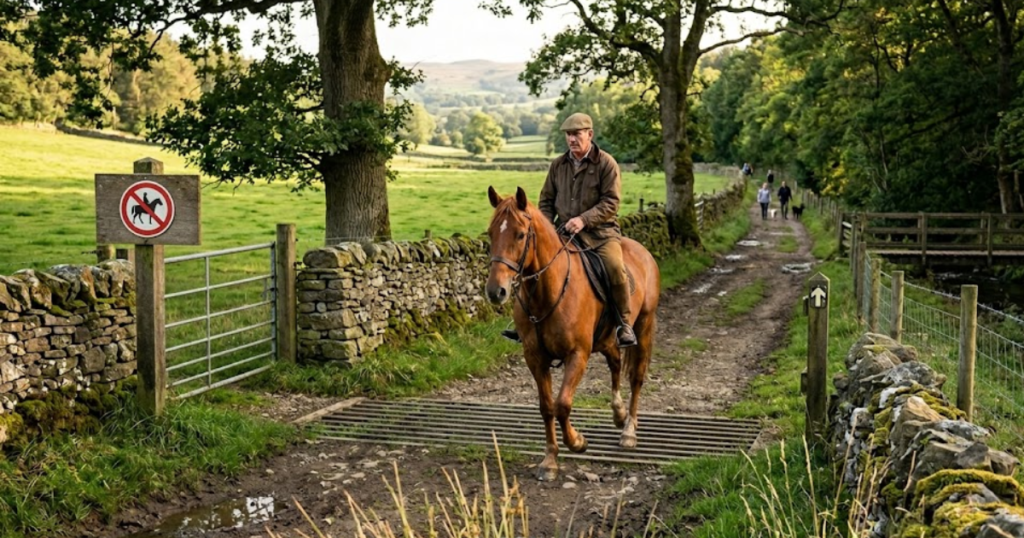
You close on a breathtaking 40-acre property that backs directly up to National Forest land. The back 20 acres are unfenced. On your first Saturday morning in the new house, you look out the window and see a group of four riders casually hacking their horses right through the middle of your pasture.
You drive out on your ATV and politely inform them that this is private property. The trail boss smiles and says, “We’ve been riding this shortcut to the forest for 25 years. The old owner never cared.”
The next day, you hire a contractor to stretch a barbed-wire fence across the trail. A month later, you are served with a lawsuit. A Colorado judge eventually rules in favor of the riders, ordering you to tear down the fence and legally establishing a permanent “Prescriptive Easement” directly through your land.
When buying a horse property, what you cannot see on paper is often more dangerous than what you can. Prescriptive easements are the ghosts of rural real estate. Here is how to spot them and protect your property rights before you buy.
Are There "Prescriptive Easements" Where Locals Have a Right to Ride Through?
Quick Summary: The Unwritten Right-of-Way
- The Historic Claim: Unlike standard easements, a prescriptive easement is not written down in a deed. It is a legal right to use someone else's land created entirely by historic, continuous, and unpermitted use.
- The 18-Year Rule: Under Colorado law, if a neighbor or the public has openly used a path across your property without permission for 18 continuous years, they can legally claim a permanent right to keep using it.
- The Title Insurance Blind Spot: Standard title insurance policies specifically exclude unrecorded easements. Because prescriptive easements are usually unwritten until a judge decrees them, your title company will not protect you or pay your legal fees if a dispute arises.
- The Fencing Conflict: Buying a rural property and immediately slapping a locked gate across a well-worn neighborhood trail is the fastest way to trigger a massive, expensive lawsuit with your new neighbors.
Prescriptive easements can create major surprises because the risk often comes from local habit and physical use on the land, not from something clearly recorded in the standard title paperwork.
1. The Anatomy of a Prescriptive Easement
To understand the threat, you have to understand how the law views adverse use. For someone to claim a prescriptive easement in Colorado, they must prove their use of the land was:
- Open and Notorious: They were not sneaking across the land in the middle of the night. The trail is visible, and the use was obvious to anyone paying attention.
- Continuous: The use must be consistent, for example riding through every summer, for a strictly defined statutory period, which is 18 years in Colorado.
- Adverse (Without Permission): This is the kicker. If the previous owner gave them explicit, documented permission to ride there, it is not adverse, and an easement cannot form. An easement only forms if the riders essentially trespassed and the owner did nothing to stop them for 18 years.
2. The "Title Commitment" Trap
Most buyers assume their title insurance protects them from surprise land grabs. It usually does not.
- The Standard Exception: When you receive your title commitment during escrow, look closely at the Schedule B exceptions. You will almost always see a clause excluding coverage for easements, or claims of easements, not shown by the public records.
- The Burden of Discovery: Because the trail riding group has not recorded their 25-year history at the county clerk's office, the title company has no way of knowing it exists. The burden of discovering these unwritten claims falls entirely on you and your real estate agent during the physical inspection.
Title work may confirm ownership of the parcel while still leaving you exposed to long-used routes and access claims that were never formally recorded.
3. The Visual Inspection: Reading the Dirt
You must read the land like a tracker to find the invisible easements.
- The Beaten Path: When touring a sprawling property, you cannot just look at the barn. You must walk or drive the perimeter. Are there well-worn two-track roads, hiking trails, or hoof prints cutting across corners of the property that do not lead to your own buildings?
- The Suspicious Gate: Look closely at the boundary fences. Is there a random gate installed on your fence line that connects to a neighbor's pasture or the public forest? If there is a gate, someone put it there to get through.
- The Cut Wire: Sometimes, neighbors will simply cut a section of wire to create a pass-through. If you see repaired wire or makeshift pass-throughs, it is a massive red flag that the boundary is not being respected.
4. How to Defeat a Prescriptive Claim
If you fall in love with a property that clearly has a neighborhood trail running through it, you must neutralize the threat before or immediately after closing.
- The Permission Defense: The absolute kryptonite to a prescriptive easement is permission. If you put up a sign that says Permissive Use Only: Right to Revoke Reserved, or if you hand the local riding club a written letter stating, I give you permission to ride here, but I can revoke it at any time, you have destroyed the adverse requirement. The clock stops, and they can no longer claim the land.
- The Pre-Closing Survey: If you suspect an issue, you can demand the seller resolve it before closing, often by having the seller formally grant and record a revocable license to the neighbors, ensuring you buy the land with a clean slate.
We Scout the Perimeter Before You Buy
We do not just trust the paperwork; we investigate the physical reality of the land.
When Mark Eibner and Belinda Seville represent you, we actively hunt for unrecorded easements. We walk the fence lines, look for suspicious trails, and talk to the neighbors. We want to ensure that when you buy a private sanctuary, it actually remains private.
Contact Us Today to find premium horse properties Colorado buyers trust for secure boundaries and clean titles.
Browse Active Colorado Horse Properties: Browse active Colorado horse ranches for sale or ask our team about finding a horse property for rent Colorado while you search for your permanent, highly secure equestrian estate
Frequently Asked Questions (FAQ) About Prescriptive Easements
Can I just block the trail and see if anyone complains?
This is a terrible and expensive strategy. If a prescriptive easement has already matured, the 18 years have passed, blocking it is technically illegal, even if it has not been decreed by a judge yet. It will likely trigger immediate hostility and a costly lawsuit that you could lose.
Do utility companies use prescriptive easements?
Yes, occasionally. While modern power lines and gas pipes almost always have recorded, deeded easements, very old rural utility lines might have been installed 60 years ago on a handshake. If the line is visibly there, the utility company has a prescriptive right to keep it there and access it for maintenance.
If I buy a property with a decreed prescriptive easement, who is responsible for maintaining the trail?
The person who benefits from the easement, the dominant estate, is generally responsible for the cost of maintaining it, not the property owner, the servient estate. However, you cannot do anything to intentionally damage the trail or make it impassable for them.