
In Colorado equestrian real estate, the deal isn’t actually finished when the offer is accepted. It’s won during the closing process through rigorous Colorado horse property transaction management that protects your agricultural viability. You likely feel that a standard residential closing is insufficient for the technical demands of a working ranch. It’s natural to worry about inheriting water right liabilities or falling out of compliance with 2026 agricultural zoning laws. You need to know that your land and livestock are protected before the final documents are signed.
As we move through 2026, the emotional and financial stakes of equestrian investments have never been higher. With median list prices for Denver area horse properties reaching $1,530,000 as of May 2026, there’s zero room for error. To help verify these high-value investments, you can explore AI-Powered Property Valuation Reports options to gain an objective, data-driven perspective on current market trends. A dedicated specialist in Colorado horse property transaction management acts as the “air traffic controller” for the deal. They ensure that specialized vendors, from well inspectors to land surveyors, provide the data needed to protect your capital. This proactive oversight prevents the small oversights that often lead to catastrophic financial losses after the keys are handed over. It’s about ensuring the dream of land ownership doesn’t become a legal nightmare.
This guide will help you master these complexities with specialized strategies tailored for our state’s specific rural requirements. You’ll learn how to handle the latest 2026 regulatory updates, including the mandatory new Commission-approved forms and the critical HB 1340 revegetation requirements for water rights. We’ll walk through the essential steps to coordinate specialized vendors and manage the 25 percent agricultural assessment rates. This overview provides a clear roadmap for a seamless, professional closing that honors both your lifestyle goals and your property’s long-term utility.
Key Takeaways
- Understand why specialized Colorado horse property transaction management is essential for navigating the state’s unique water laws and agricultural encumbrances.
- Learn the critical differences between standard residential inspections and comprehensive ranch infrastructure audits, including well permit verifications.
- Discover how to comply with 2026 House Bill 1340 revegetation requirements to protect your land’s future value during a water right transfer.
- Identify the steps needed to verify “Current Use” tax status to maintain the 2026 agricultural assessment rate of 25 percent.
- Explore how integrating AI-powered search with professional title and escrow services streamlines the extended due diligence periods required for equestrian estates.
The Complexity of Colorado Horse Property Transaction Management
In the context of specialized real estate, Colorado horse property transaction management is the rigorous coordination of legal, financial, and agricultural due diligence required to move a property from contract to closing. It’s far more than simple administrative paperwork. It involves verifying that every aspect of the land, from the soil health to the legal title, aligns with the buyer’s intended use. Because of the complexities of a real estate transaction involving livestock, standard residential processes often fall short. Colorado’s varied terrain and intricate water laws make a “one size fits all” approach incredibly risky for both buyers and sellers, often leading to litigation or loss of property utility.
To better understand the modern approach to these processes, watch this helpful video:
As we move through 2026, the emotional and financial stakes of equestrian investments have never been higher. With median list prices for Denver area horse properties reaching $1,530,000 as of May 2026, there’s zero room for error. A dedicated specialist in Colorado horse property transaction management acts as the “air traffic controller” for the deal. They ensure that specialized vendors, from well inspectors to land surveyors, provide the data needed to protect your capital. This proactive oversight prevents the small oversights that often lead to catastrophic financial losses after the keys are handed over. It’s about ensuring the dream of land ownership doesn’t become a legal nightmare.
Why Equestrian Deals Often Fail
Many deals collapse because of issues that don’t exist in urban markets. Unresolved water right disputes often surface too late, leaving buyers with land they can’t legally irrigate. We also see zoning misinterpretations regarding livestock-per-acre limits. Failure to coordinate specialized inspections for arena footing or high-capacity septic systems can lead to massive post-closing expenses that should’ve been negotiated during the due diligence period.
The 2026 Colorado Real Estate Landscape
The current year brings new challenges to the closing table. 2026 property tax assessments are a major factor, with agricultural improved property taxed at a 25 percent assessment rate compared to the 7.05 percent rate for school-related residential value. There’s also increased scrutiny on agricultural land use and conservation easements. Digital transaction platforms are now bridging the gap in rural areas, allowing for faster document execution while maintaining the detailed records required for complex land transfers.
Key Components of Specialized Equestrian Transaction Management
Effective Colorado horse property transaction management requires a deep understanding of the intersection between real estate law and agricultural operations. Unlike a standard residential closing, where the focus remains on the home structure, equestrian deals prioritize the land’s utility and legal standing. This process involves coordinating title and escrow services that specifically account for agricultural encumbrances. It also requires managing complex document flows for grazing leases and land-use permits that are often essential for maintaining a property’s tax status. A transaction manager serves as the central liaison, ensuring that specialized inspectors for septic systems, high-capacity wells, and arena infrastructure provide their reports within the tight windows of the due diligence period.
Title and Escrow Logistics
Title and escrow coordination for high-value ranches involves more than just verifying ownership. We look for “buy and dry” litigation risks in the title commitment. This occurs when water rights have been sold to municipalities, potentially leaving the land barren and unsuitable for livestock. Managing earnest money for these transactions also requires precision, as the stakes are significantly higher than in typical suburban sales. We also verify historical access easements and boundary lines. In Colorado, the documentary fee is $0.01 per $100 of the sale price, a small but necessary detail to track during the final accounting. For those starting their journey, our AI-powered horse property search helps filter properties by these critical land features before you even reach the contract stage.
Water Right and Well Verification
Navigating Due Diligence regarding water is perhaps the most critical component of the entire workflow. The Colorado Division of Water Resources manages the Prior Appropriation System, and our role is to verify the standing of senior vs. junior water rights during escrow. We ensure that well permits are valid for both domestic use and livestock watering. This includes managing the “Statement of Beneficial Use” filings to prevent the abandonment of rights. Without this verification, a buyer could inherit a property that lacks the legal right to sustain their animals, drastically reducing the asset’s value.
As of 2026, compliance with House Bill 1340 is a mandatory part of the transaction. This law requires entities purchasing agricultural water rights to be responsible for revegetating the land. This prevents erosion and protects the local ecosystem. Managing this specific legal requirement is now a standard part of our specialized workflow. We also verify the “Current Use” tax status to ensure the buyer can maintain the 25 percent agricultural assessment rate, rather than being reclassified at the higher 26 percent rate for vacant land or other property types.
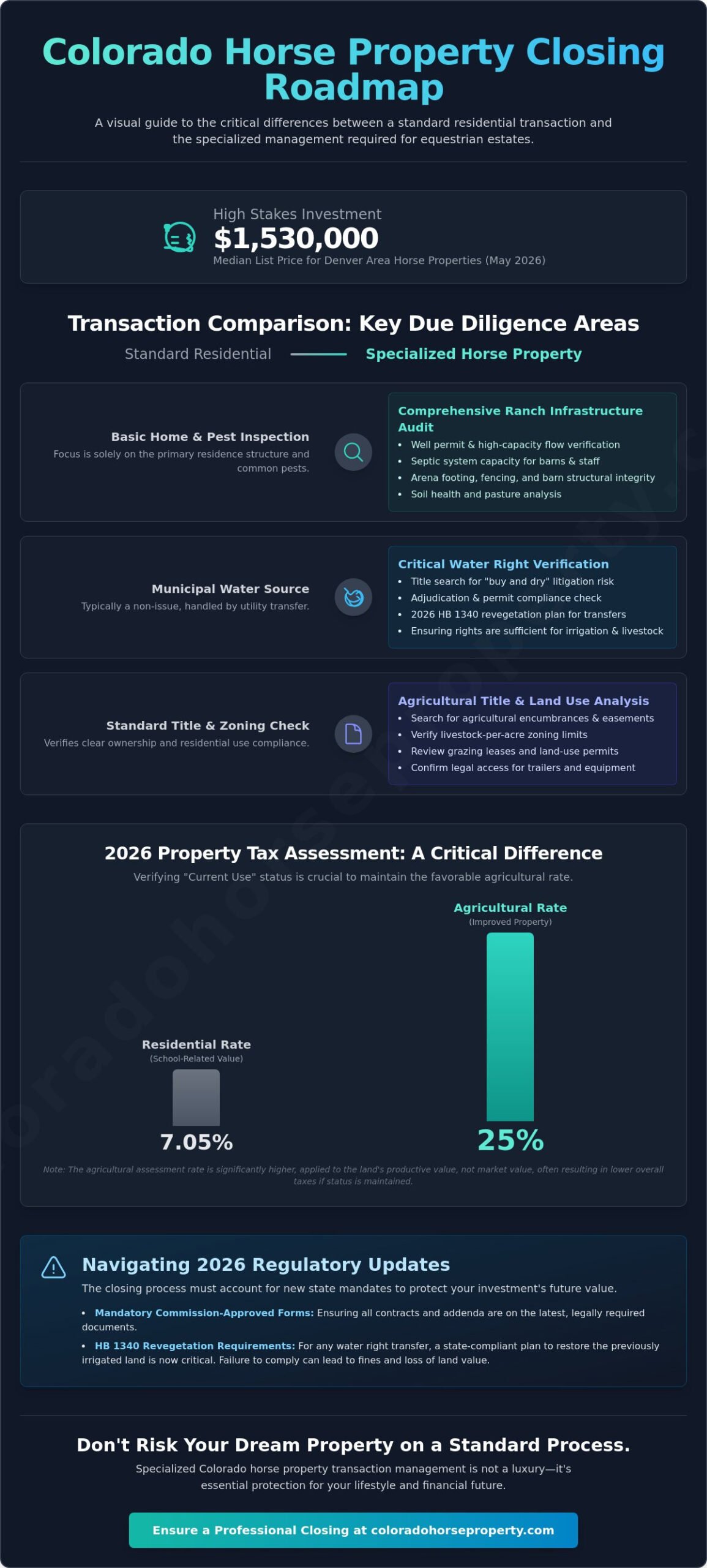
Residential vs. Horse Property Transactions: A Comparison
A standard suburban home sale focuses primarily on the residential structure and its immediate surroundings. In contrast, a horse property sale focuses on the performance of the land and its supporting infrastructure. Because of these fundamental differences, Colorado horse property transaction management requires a much broader scope of due diligence. While a typical Denver bungalow might close in 30 days, an equestrian estate requires significantly more time to verify agricultural viability and legal water usage. You aren’t just buying a house; you’re acquiring a complex agricultural asset that must function as intended from day one.
Standard home inspections don’t cover the most expensive risks on a ranch. A general inspector won’t evaluate the structural integrity of a heavy-duty barn or the pressure levels of an automatic livestock watering system. You need infrastructure audits that specifically examine paddock drainage, fence tension, and manure management systems. These audits are critical for long-term property utility. If the arena footing is poorly constructed or the fencing is hazardous, the cost to remediate these issues can easily reach six figures. Professional management ensures these items are scrutinized before your earnest money becomes non-refundable.
Timeline and Contingency Management
Horse properties usually require 45 to 60 day closing windows. This extended timeframe allows for a comprehensive “Feasibility Study” contingency, which is rarely seen in residential deals. This study is your opportunity to confirm the land can actually support your specific number of horses. It’s about more than just the house. It’s about multi-stage inspections of outbuildings and the verification of grazing capacity. Managing these overlapping deadlines is the core of effective Colorado horse property transaction management. It prevents the rush that often leads to overlooked legal or environmental details.
Specialized Vendor Coordination
A transaction manager coordinates a team of experts that a residential agent wouldn’t typically have in their network. Soil engineers are essential for verifying that the ground can handle the drainage needs of a professional-grade riding arena. We also work with local hay producers to verify historical yields. This ensures you aren’t overpaying for unproductive acreage. Utilizing specialized equestrian transaction management ensures these vendors are scheduled early enough to meet strict contract deadlines. Environmental audits are also common for larger parcels to check for historical land contamination or protected species habitats that could limit your future building plans.
Insurance needs also shift dramatically when livestock are involved. Standard homeowners policies often exclude liability for horses or any boarding activities. Your transaction manager helps ensure that the title and escrow process aligns with specialized farm and ranch policies. This protects your capital and your lifestyle from the moment you take possession of the property.
Navigating Due Diligence: 2026 Regulations and Soil Health
The regulatory landscape for rural land in 2026 has introduced specific requirements that directly impact Colorado horse property transaction management. One of the most significant changes is the implementation of House Bill 1340. This law mandates that any entity purchasing agricultural water rights must take responsibility for revegetating the land to prevent erosion and long-term deterioration. During the due diligence phase, your transaction manager must verify if any water rights transfers are part of the deal and ensure a compliant revegetation plan is in place. Failing to address this can lead to significant legal liabilities and a degraded landscape that’s unsuitable for grazing.
Verifying the ‘Current Use’ tax status is another critical task that happens behind the scenes. In 2026, agricultural improved property is assessed at 25 percent of its actual value. If the property’s agricultural status isn’t correctly transferred or maintained during the closing process, it could be reclassified at the 26 percent rate for “other” property types or lose its agricultural valuation entirely. This oversight can result in a massive jump in annual carrying costs. Professional management ensures all necessary affidavits and production records are filed with the county assessor to preserve these essential tax benefits. If you’re currently evaluating potential sites, you can use our AI-powered search tools to identify properties that already hold these vital agricultural designations.
Soil health has moved from a secondary concern to a primary deal point. We now analyze soil composition and forage quality as standard components of the agricultural audit. You need to know if the land can actually support your horses without constant, expensive supplementation. This involves testing for nutrient density and identifying any invasive species that could be toxic to livestock. In 2026, these tests are often integrated into the broader environmental audit of the ranch.
Compliance with 2026 Land Use Laws
New state-level soil health initiatives now encourage specific grazing rotations and land management practices. We help you navigate these expectations alongside county-specific livestock density regulations. For example, Douglas and Elbert counties have strict limits on how many animals can be kept per acre based on the land’s zoning and water availability. We verify these limits early in the process so you don’t buy a property that can’t legally house your entire herd.
Infrastructure and Utility Verification
Infrastructure audits must go beyond the surface. We coordinate the testing of high-capacity wells and irrigation pumps to ensure they meet the 2026 standards for both flow rate and water quality. Barn electrical systems are also audited for modern safety standards, especially in older structures that may not be equipped for high-draw equipment like heated waterers or therapeutic vibrating plates. If you’re deciding between an existing setup or starting fresh, it’s helpful to review the current market for horse barns for sale to understand typical infrastructure values. Finally, we verify digital connectivity. For remote ranches, we audit the availability of Starlink or local fiber optics to ensure your rural lifestyle doesn’t compromise your professional needs.
Optimizing Your Closing with Colorado Horse Property
Our approach to Colorado horse property transaction management begins long before a contract is signed. We’ve built an integrated system where our AI-powered horse property search feeds directly into our back-end management workflow. This ensures that the specific data points identified during your search, such as zoning and water rights, are the same ones verified during the closing process. By bridging the gap between discovery and the final signature, we eliminate the data silos that often cause delays in rural real estate. Our system is designed to catch discrepancies early, ensuring that the property you fell in love with online is the same one you legally acquire at the closing table.
We’ve established strategic partnerships with Meridian Title & Escrow and Club Realm to handle the heavy lifting of agricultural title work. These entities understand the nuances of land and livestock owners, from historical access easements to complex water court decrees. This specialized network is essential in 2026 as the Colorado Division of Real Estate undergoes its sunset review, potentially leading to shifts in state regulations. Having a team that’s already aligned on these technical requirements provides a layer of security that generalist title companies simply can’t match. We coordinate every detail, from the transfer of grazing leases to the final recording of agricultural affidavits.
For out-of-state buyers, we utilize digital management tools that reduce the friction of managing a Colorado closing from a distance. You can track the progress of well tests, soil audits, and land-use permit filings in real-time. This transparency is vital for buyers who can’t be on-site for every inspection. We act as your eyes and ears on the ground, ensuring that specialized vendors meet their deadlines and that the seller’s disclosures align with our independent findings. It’s a professional, service-oriented partnership that prioritizes your capital and your future lifestyle.
A Full-Cycle Equestrian Ecosystem
Success in this niche market requires more than just a license; it requires decades of boots-on-the-ground experience. We leverage over 40 years of Realty Oasis experience in the Front Range to protect your agricultural investment. Our transaction managers are seasoned experts who know how to navigate the specific challenges of Douglas, Elbert, and Boulder counties. For a deeper look at the entire acquisition process, review our Equestrian Real Estate Colorado: A Complete Buyer’s Guide. We ensure that every contingency is met and every agricultural tax benefit is preserved for the long term.
Start Your Managed Transaction Today
The first step toward a seamless closing is a comprehensive consultation on your specific needs. We’ll discuss your livestock requirements, water usage goals, and infrastructure priorities to build a customized management plan. We handle the heavy lifting of rural closing logistics so you can focus on preparing your horses for their new home. Contact Mark and Alison Eibner today for specialized buyer representation that puts your interests first. Let our expertise in Colorado horse property transaction management turn your equestrian dream into a secure, legal reality.
Secure Your Colorado Equestrian Legacy
Mastering the technical details of a rural closing is the final step in protecting your agricultural investment. You’ve seen how 2026 regulations like the HB 1340 revegetation law and complex water right transfers require more than a standard residential approach. Professional Colorado horse property transaction management bridges the gap between a signed contract and a successful, compliant operation. By coordinating specialized audits for soil health, well capacity, and barn infrastructure, you ensure your land remains a functional asset for years to come.
With over 40 years of experience serving the Front Range, we’ve refined a full-cycle ecosystem that combines AI-powered search tools with expert closing coordination. Our strategic partnerships with Meridian Title & Escrow provide the specialized oversight needed to navigate today’s shifting regulatory landscape. You don’t have to manage these complexities alone. We’re here to handle the logistical heavy lifting so you can focus on the lifestyle you’ve worked hard to build.
Secure Your Colorado Equestrian Future with Expert Transaction Management. Your dream of expansive space and freedom is within reach, and we’re ready to help you cross the finish line with confidence.
Frequently Asked Questions
What is included in Colorado horse property transaction management?
Colorado horse property transaction management includes the comprehensive coordination of legal, financial, and agricultural due diligence. It covers the verification of water rights, the management of specialized infrastructure inspections, and the auditing of land-use permits. We ensure that every vendor, from soil engineers to well technicians, delivers the data needed to protect your investment. This structured approach prevents the technical oversights that often derail complex rural deals after the contract is signed.
How long does a typical horse property closing take in Colorado?
A typical equestrian closing in Colorado takes between 45 and 60 days. This extended window is necessary to accommodate the “Feasibility Study” contingency and multi-stage inspections for barns, outbuildings, and fencing. Unlike a 30-day residential closing, horse properties require time to verify well production rates and navigate the 2026 regulatory updates. These extra weeks provide the space needed to ensure the land’s agricultural viability is legally and physically protected.
Why can’t my residential title company handle a ranch closing?
Most residential title companies lack the specialized knowledge required to identify agricultural encumbrances or historical access easements. They are often unequipped to handle the transfer of water court decrees or the nuances of grazing leases. A specialized firm understands how to look for “buy and dry” risks in the title commitment. Our partnerships ensure that your title and escrow process is managed by professionals who understand the technical requirements of high-value ranch assets.
Do I need a separate attorney for water right transfers?
While our transaction management team handles the coordination of documents, complex water right transfers often benefit from a dedicated water law attorney. We manage the “Statement of Beneficial Use” filings and ensure the chain of title for water is clear. However, if a dispute arises over senior versus junior rights, a specialist provides the necessary legal defense. We act as the liaison between you and these specialized legal experts to streamline the deal.
What is the House Bill 1340 revegetation law in Colorado?
House Bill 1340 is a 2026 Colorado law that requires entities purchasing agricultural water rights to be responsible for revegetating the land. This initiative prevents soil erosion and the deterioration of the local ecosystem when water is moved away from agricultural use. During your transaction, we verify if this law applies to your specific purchase. We ensure that a compliant revegetation plan is in place to protect the property’s future value and environmental health.
How do transaction managers handle 1031 exchanges for ranches?
We coordinate with Qualified Intermediaries to ensure that 1031 exchanges for ranches meet strict IRS identification and closing deadlines. Transaction managers oversee the transfer of like-kind agricultural assets while maintaining the detailed records required for tax deferral. This process includes verifying that the replacement property’s agricultural status and improvements align with 1031 requirements. It’s a high-stakes workflow that requires the precision of seasoned experts to avoid significant tax liabilities.
What are the common red flags found during equestrian due diligence?
Common red flags include unpermitted arena structures, significant drops in well production, and toxic weed infestations like leafy spurge. We also watch for “buy and dry” title issues where water rights were previously severed from the land. Other concerns involve zoning violations regarding livestock density or failing high-capacity septic systems. Identifying these issues during the due diligence period allows us to negotiate repairs or price adjustments before you’re legally committed to the purchase.
Is transaction management included in your buyer representation services?
Yes, transaction management is a core component of our buyer representation services. We provide a full-cycle ecosystem that takes you from an AI-powered search to the final signature at the closing table. Our team manages the logistical heavy lifting of rural closings, ensuring all agricultural and legal requirements are met. This integrated approach provides a seamless experience, allowing you to focus on your horses while we protect your financial and lifestyle interests.