
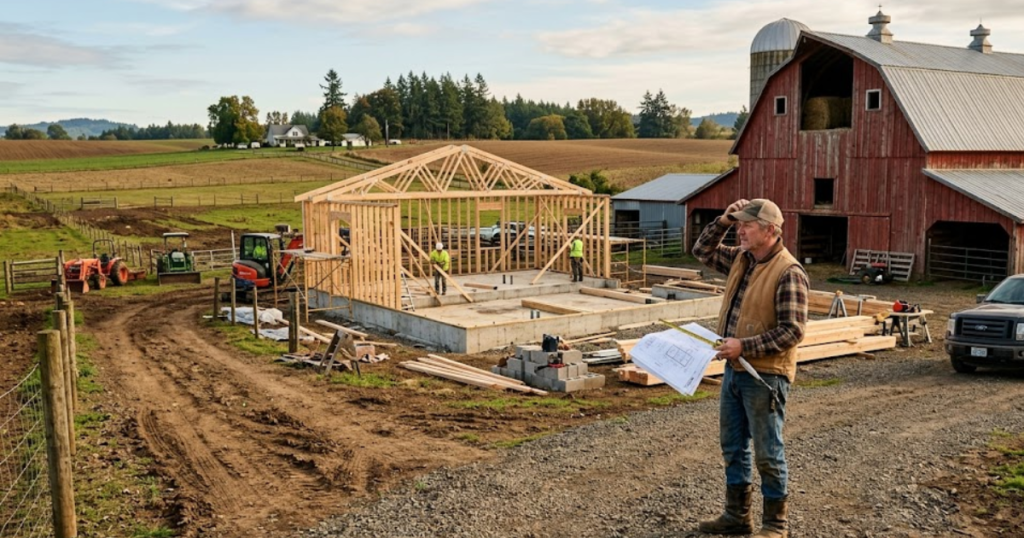
You find the perfect 20-acre property. It has a beautiful house and a small, functional three-stall barn. You buy the farm with the grand vision of immediately building a massive, custom 10-stall center-aisle barn with an attached indoor riding arena for your growing herd.
You carefully budget for the lumber, the concrete, the steel, and the labor. You submit your pristine architectural blueprints to the county planning department. A week later, the county approves the design but hands you an unexpected invoice for $25,000 in “Impact Fees” that must be paid in full before they will hand over the building permit.
Your entire construction budget is instantly derailed before a single shovel hits the dirt.
Equestrians often remember to budget for the building, but they completely forget to budget for the bureaucracy. If you are buying a property with the intent to expand its infrastructure, understanding local impact fees is absolutely critical.
Here is how to navigate the hidden costs of building a new barn.
Are There "Impact Fees" if I Want to Build a Second Barn?
Quick Summary: The Hidden Construction Tax
- The Hidden Toll: Impact fees are hefty, one-time charges levied by local governments on new construction to offset the cost of public services like roads, fire departments, and stormwater management.
- The Impervious Surface Penalty: A massive new barn roof creates thousands of gallons of concentrated rainwater runoff. Counties frequently charge specialized fees to manage this sudden environmental impact.
- The Commercial Trigger: If your second barn is designed to house boarders or host training clinics, the county will likely classify it as a commercial structure, triggering massive traffic and road impact fees.
- The Ag Exemption Battle: While true, profit-generating agricultural operations can sometimes get these fees waived, personal hobby equestrian barns rarely qualify for the exemption.
When you plan a new barn, the county cost can be far more than permit paperwork. Hidden fees can materially change whether your expansion plan is financially realistic.
1. Understanding the "Impact" Tax
Local governments use impact fees to make new development pay for itself.
- The Growth Burden: When you add significant infrastructure to a property, you are increasing the potential burden on the county. More buildings mean a higher risk of fire, more water usage, and more wear and tear on local county roads.
- The Pre-Payment: Impact fees are essentially a pre-payment for these services. The county collects this money upfront to fund the expansion of local fire stations, the paving of rural roads, and the upgrading of regional water treatment facilities.
- The Assessment: These fees are not arbitrary. They are strictly calculated based on the square footage of the new structure and its intended use. A 10,000-square-foot indoor arena will trigger vastly higher fees than a 600-square-foot hay shed.
2. The "Impervious Surface" Problem
In the West, water management is heavily regulated and heavily taxed.
- The Footprint: When you build a large barn, you are covering native, absorbing dirt with a hard, impervious surface, the concrete pad and the metal roof.
- The Runoff Calculation: Rainwater can no longer soak into that ground. It violently sheets off the roof. The county calculates exactly how many gallons of runoff your new barn will generate during a severe storm.
- The Stormwater Fee: Because this sudden influx of runoff can overwhelm county drainage ditches, erode neighboring properties, or pollute local waterways, many counties assess a strict stormwater impact fee to fund regional drainage mitigation.
Even a private horse barn can trigger substantial fees if the county treats the structure as a major change in runoff behavior and site engineering demand.
3. Traffic and the "Commercial" Label
How you plan to use the barn dictates how the county will tax it.
- The Hobby Use: If the county planning department determines the new barn is strictly for your own personal riding horses, the impact fees are generally lower, classified under residential accessory structures.
- The Commercial Trigger: If your blueprints include a public restroom, a massive tack room with ten individual lockers, or an oversized parking area for horse trailers, the county will immediately flag the project as a commercial boarding or training facility.
- The Road Impact: Commercial facilities generate daily traffic from clients, veterinarians, farriers, and hay delivery trucks. The county will assess a road and traffic impact fee which can easily add tens of thousands of dollars to your permit costs to offset the wear on their rural asphalt.
4. The Agricultural Exemption Battle
Many buyers assume that because a barn holds horses, it is an agricultural building and therefore exempt from standard building codes and impact fees. This is a dangerous assumption.
- The Profit Requirement: Just like the Greenbelt property tax rules, most counties only grant agricultural building exemptions to legitimate, profit-seeking farming operations, like cattle ranching or large-scale crop production.
- The Pleasure Penalty: If the county determines your horses are for personal pleasure or a hobby, they will strip the agricultural exemption. Your new barn will be treated exactly like a massive residential garage, subjecting it to the full brunt of standard impact fees.
We Calculate the True Cost Before You Buy
We do not just look at where the new barn could go; we calculate what it will cost to put it there.
When Mark Eibner and Belinda Seville represent you in buying a horse property, we help you look past the purchase price. If your goal is to expand the facility, we investigate the specific county’s fee schedules, zoning overlays, and agricultural exemption rules during your due diligence period. We want your construction budget to go toward premium stalls, not unexpected government taxes.
Contact Us Today to find a property where your expansion goals are financially viable.
Browse Active Colorado Horse Properties: Browse Active Colorado Horse Properties with existing, fully permitted equestrian infrastructure
Frequently Asked Questions (FAQ) About Impact Fees
Do I have to pay impact fees if I am just replacing an old barn that burned down or collapsed?
Usually, no. If you are rebuilding a structure of the exact same square footage and use, most counties consider the impact fees to have been paid by the original structure. However, if you tear down a 1,000-square-foot shed and replace it with a 5,000-square-foot barn, you will be charged impact fees on the 4,000 square feet of new impact.
Can I finance the county impact fees into my construction loan?
Yes, most agricultural and residential construction loans allow you to roll the cost of permits and county impact fees directly into the total loan amount, provided the final appraised value of the completed property supports the total cost.
Are impact fees a standard flat rate across the whole state?
Not at all. Impact fees are highly localized. They vary wildly not just from county to county, but even depending on which specific rural fire district or water district the property falls into. A barn built in one zip code might trigger $2,000 in fees, while the exact same barn built five miles down the road in a different district might trigger $20,000 in fees.