
While much of the Front Range feels increasingly overcrowded, Kiowa remains the last true frontier for equestrians who want proximity to Denver without sacrificing the grit of a ranching community. You’re likely looking for a Kiowa CO horse property for sale because you want space for your herd, but you also know that the “perfect” 40 acres can quickly become a liability if the water rights are junior or the zoning is restrictive. It’s a valid concern; with Colorado’s Phase 2 Drought Response Plan activated as of March 2026, the stakes for rural land ownership have never been higher.
We understand that you’re looking for more than just a house; you’re looking for a place that supports your lifestyle and dreams. This guide will show you why Kiowa is the premier destination for Colorado horse lovers and how to navigate the local market to find your perfect equestrian estate. We’ll analyze the current 0.43% property tax rate, explain why Elbert County’s one-animal-unit-per-half-acre rule matters for your livestock, and provide a roadmap to securing a property with functional outbuildings that can withstand the plains’ high winds.
Key Takeaways
- Learn the specific Elbert County density limits for Agricultural and Residential zones to ensure your livestock numbers remain legally compliant.
- Understand the critical distinction between household-only and domestic well permits to secure a reliable water supply for your herd.
- Identify the essential barn and arena specifications required to maintain a functional ranch in Kiowa’s unique climate and soil conditions.
- Discover how to use AI-powered search tools to filter every Kiowa CO horse property for sale by specific equestrian assets like hay storage and tack rooms.
- Gain a strategic advantage by learning how niche brokerages evaluate rural land differently than generalist real estate agents.
Why Kiowa is the Premier Destination for Colorado Horse Properties
Kiowa sits at the geographical and cultural heart of Elbert County, serving as a sanctuary for those who find the suburbs of Parker or Elizabeth too restrictive. While neighboring towns have seen rapid residential development, Kiowa, Colorado maintains a steadfast commitment to its ranching roots. The landscape here offers a distinct geographic advantage for horse owners: rolling plains that provide natural drainage and sandy loam soil that’s easier on a horse’s joints than the heavy clay found closer to the mountains. This environment is exactly why the horse property for sale in colorado market has shifted focus toward this area in 2026.
Buyers looking for a Kiowa CO horse property for sale often find they can secure significantly more acreage for their investment compared to Douglas County. The community isn’t just “horse-friendly” by name; the local infrastructure is built around the needs of large animals, from wide road shoulders for trailers to specialized feed stores that have operated for decades. It’s a place where your neighbors understand the importance of fence maintenance and water conservation as much as you do.
To visualize the lifestyle and acreage available in this region, watch this tour of a local ranch:
The “Pioneer Spirit” of Elbert County
The local culture centers on the Elbert County Fair, an annual event that highlights the region’s deep ties to agriculture and equine sports. Residents enjoy a rare balance of rural privacy without total isolation. You can reach the Denver Tech Center in about 45 minutes or Colorado Springs in 50 minutes, making it feasible for professionals to manage a career while fulfilling their lifestyle and dreams on a working ranch. This “pioneer spirit” isn’t about being primitive; it’s about having the freedom to manage your land and animals without the overreach of urban HOAs.
Property Value and Investment Potential
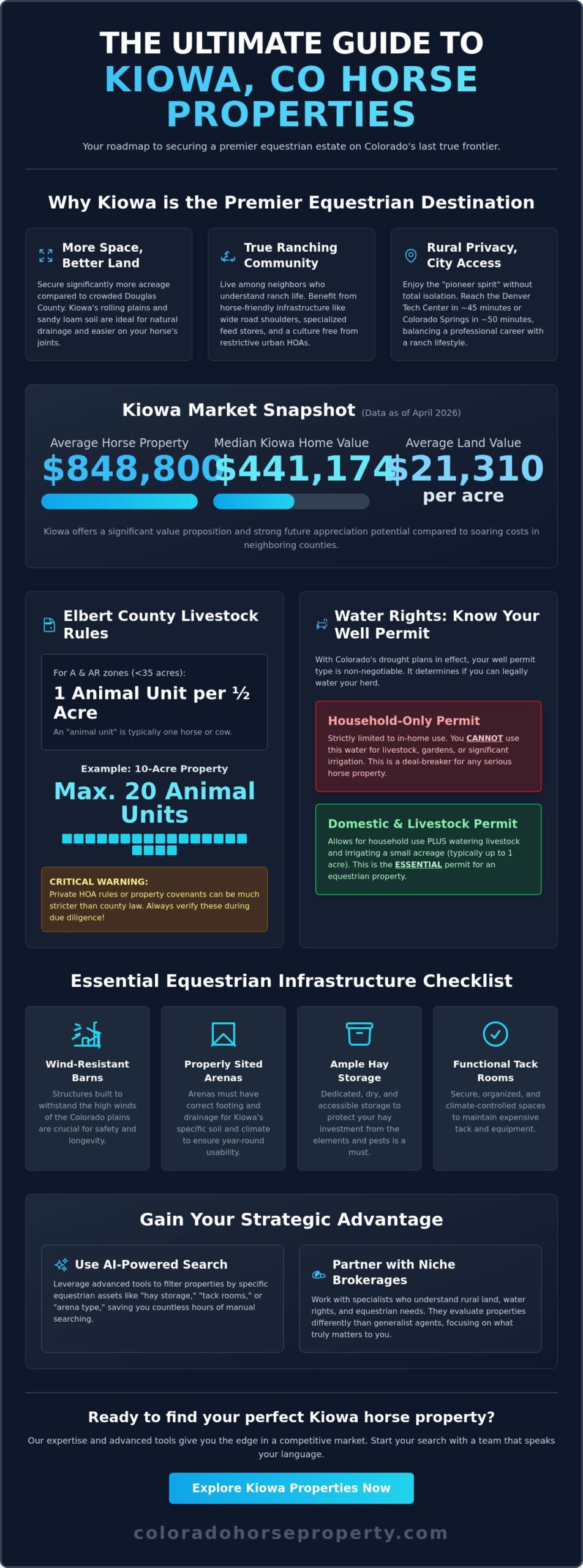
As of April 13, 2026, the median home value in Kiowa is $441,174, but equestrian estates represent a different tier of the market. The average listing price for horse properties near Kiowa currently sits at $848,800, with land valued at an average of $21,310 per acre. These figures represent a significant value play when compared to the soaring costs in Douglas County. Investors and families alike are eyeing Kiowa because the Front Range’s eastward expansion suggests strong future appreciation. Securing a property now means getting in before the “buy and dry” practices of larger cities further impact the availability of quality agricultural land with senior water rights.
Understanding Elbert County Zoning and Livestock Requirements
Understanding the legal framework is the first step when evaluating a Kiowa CO horse property for sale. Elbert County primarily utilizes Agricultural (A) and Agricultural Residential (AR) zoning to manage rural growth and preserve the region’s equestrian heritage. Article XIV of the official Elbert County Zoning Regulations serves as the primary rulebook for land use. For most residential horse properties under 35 acres, the county applies a density limit of one animal unit per one-half acre. For a 10-acre parcel in Kiowa’s AR or A-2 zones, Elbert County regulations legally permit a maximum density of 20 animal units, provided the well permit supports livestock use.
Don’t assume that unincorporated land is a total free-for-all. Many “ranchette” developments in the area are governed by private Homeowners Associations (HOAs) or covenants that are significantly stricter than county law. If a private covenant limits you to two horses on 35 acres, the county’s more generous allowance won’t protect you from a legal dispute. It’s vital to review the title commitment and any recorded plat notes during your due diligence period to ensure the land truly fits your intended use.
Calculating Your Carrying Capacity
While the law might allow 20 horses on 10 acres, your land’s actual carrying capacity depends on soil health and water availability. Much of the colorado land in this region features sandy loam, which provides excellent drainage but requires careful pasture management to prevent overgrazing. An “Animal Unit” is defined as one horse, mule, or bovine. Maintaining these animals requires a permit verified by the Colorado Division of Water Resources to ensure your well is legally allowed to provide water for livestock. If you’re unsure about a specific parcel’s potential, you can consult with our expert team to review the land’s history and potential.
Building and Improvement Permits
Adding infrastructure like barns or outdoor arenas requires navigating the local permit process. Setback requirements are strictly enforced to ensure structures don’t encroach on utility easements or neighboring property lines. If you plan to add a secondary residence or “mother-in-law” suite, you’ll need to verify that both your septic system and well permit can handle the additional load. Note that commercial boarding operations are treated differently than private use; a Special Use Permit is often required if you intend to run a training or boarding business. Navigating these requirements is a standard part of the process when viewing a Kiowa CO horse property for sale with our specialized agents.
Must-Have Equestrian Features for Kiowa Ranches
Finding a Kiowa CO horse property for sale that actually works for your herd requires looking beyond the aesthetics of a farmhouse. In the open plains of Elbert County, infrastructure is your primary defense against the elements. High winds are a constant reality here; gusts exceeding 50 miles per hour are common during spring storms. Because of this, pipe fencing or high-visibility polymer tape is vastly superior to traditional wood or thin wire. Wood fences often require constant repair due to sun-bleaching and wind stress, while pipe fencing provides the structural integrity needed to keep horses contained safely.
Windbreaks are equally non-negotiable. Whether you use natural tree lines or constructed three-sided shelters, your horses need a place to escape the biting north winds. When evaluating a property, check the orientation of existing shelters. They should open to the south or southeast to block the prevailing winter weather. If you plan to build new structures, ensure they align with the Elbert County Zoning Regulations regarding setbacks and height restrictions.
Barn Functionality and Ventilation
The debate between center-aisle and shed-row horse barns for sale usually ends in favor of center-aisles in Kiowa. The ability to close large doors at both ends creates a protected workspace during a blizzard. However, ventilation is critical. A sealed barn traps ammonia and moisture, leading to respiratory issues. Look for barns with ridge vents or cupolas that allow for passive airflow. Your tack room should be insulated and rodent-proofed with steel kick plates on the door frames. In 2026, many buyers are also prioritizing hay storage that can hold at least 300 bales, ensuring they have enough forage to last through a heavy Elbert County winter without relying on frequent deliveries.
Arena Surface and Drainage
Kiowa’s natural sandy loam is a blessing for arena construction, but it isn’t a “set it and forget it” solution. While the soil drains better than the heavy clay found in Douglas County, you still need a crowned sub-base to prevent pooling. For a Kiowa CO horse property for sale to be considered professional grade, the arena should feature a distinct base layer of compacted road base followed by 2 to 3 inches of washed sand or a rubber-sand mix. Proper footing prevents tendon injuries, especially for high-impact disciplines like reining or jumping. Drainage remains the top priority; an arena that holds water for three days after a rainstorm is a liability that will eventually require a costly renovation.
The Technical Side: Water Rights and Soil in Kiowa
Owning land in Elbert County requires a deep understanding of what lies beneath the surface. When viewing a Kiowa CO horse property for sale, the most critical document you’ll review isn’t the floor plan; it’s the well permit. Colorado water law operates on the principle of “first in time, first in right,” and for rural homeowners, your permit type dictates your daily operations. A “Household Use Only” permit is a common pitfall for new buyers because it strictly forbids watering livestock or irrigating even a small paddock. Under Colorado law, parcels of 35 acres or more generally qualify for a Domestic and Livestock well permit that allows for watering non-commercial livestock and irrigating up to one acre of land.
Most properties in Kiowa tap into one of three major aquifers: the Dawson, Denver, or Arapahoe. The Dawson is the shallowest and most frequently used for domestic wells, providing reliable water for most ranchettes. The Denver and Arapahoe aquifers sit much deeper, often requiring more expensive drilling but offering a more consistent supply during times of drought. With the governor activating Phase 2 of the Colorado Drought Response Plan in March 2026, knowing exactly which aquifer your well draws from is vital for long-term sustainability. Additionally, the region’s sandy loam soil is a primary draw for equestrians because it offers superior drainage, though it requires specific foundation engineering for heavy steel-frame barns to prevent settling.
Navigating Well Permits and Augmentation
During your due diligence period, you must verify the status of the well permit with state records. Don’t rely on a verbal “the water is great” from a seller. If a property only has a restricted household well, you may need to investigate augmentation plans, which involve purchasing water rights from elsewhere to offset your usage. Replacing a well pump or deepening a shaft in 2026 is a significant investment, so we recommend a professional well recovery test to ensure the gallons-per-minute (GPM) flow meets the needs of your specific number of horses.
Pasture Management on the High Plains
Kiowa’s semi-arid environment demands a proactive approach to grazing. Native grasses like Blue Grama and Buffalo Grass are drought-tolerant and highly nutritious, but they can’t survive constant hoof traffic without rest. Successful owners use rotational grazing strategies, dividing their acreage into smaller paddocks to allow grass to recover. We recommend annual soil testing to identify nutrient deficiencies or the encroachment of invasive weeds that can thrive in overgrazed areas. If you’re ready to find land with the right legal protections for your herd, you can search our listings by water rights and acreage to find a secure investment.
Finding Your Kiowa Horse Property with AI-Powered Search
Generic real estate platforms often fail equestrians because they don’t distinguish between a “barn” that’s actually a garden shed and a professional-grade facility. When you’re searching for a Kiowa CO horse property for sale, you need data that matters to your herd’s safety and your daily operations. Our proprietary AI-powered search tool bridges this gap by identifying specific equestrian assets like indoor arenas, hay storage capacity, and established water rights. This technology allows you to filter listings by the features that support your lifestyle and dreams, saving you from wasting time on properties that don’t meet basic equine standards.
Working with a niche brokerage provides a level of protection that a generalist realtor simply can’t offer. We bring nearly four decades of experience to the table, specializing in the unique complexities of horse real estate for sale. We understand that a “great deal” in Kiowa isn’t a deal at all if the well permit is restricted or the soil won’t support a stable foundation. Our no-nonsense approach means we evaluate land for its functional utility first, ensuring every property we represent is a viable long-term investment for your family and your animals.
The Colorado Horse Property Advantage
We don’t just send you listings; we vet them before you ever step foot on the dirt. Our team understands Elbert County’s nuances, from specific wind patterns on the plains to the latest property tax appeal deadlines like the June 8, 2026, cutoff. We’ve built a trusted network of local professionals, including well testers, septic inspectors, and barn builders who specialize in the Kiowa area. Our clients often find their “needle in the haystack” because we have access to ground-level data and legacy property histories that generalist platforms overlook.
Next Steps: Your Kiowa Search Starts Here
Ready to move beyond generic search results? You can set up custom search alerts that notify you the moment a new Kiowa CO horse property for sale hits the market. Whether you’re looking for a 10-acre ranchette or a 100-acre training facility, our team is ready to schedule private tours and help you navigate the transaction from contract to closing. Search Kiowa horse properties for sale with our AI tool now to see the difference that specialized expertise makes in securing your equestrian future.
Secure Your Equestrian Legacy in Elbert County
Finding the right Kiowa CO horse property for sale is about more than just finding a beautiful view. It requires a firm grasp of Elbert County’s one-animal-unit-per-half-acre zoning and a verified Domestic and Livestock well permit. You now have the tools to evaluate sandy loam soil for drainage and identify the structural integrity needed for barns to withstand the high winds of the plains. These technical details are what separate a functional ranch from a costly liability. Understanding these factors ensures your investment remains secure for years to come.
Founders Mark and Alison Eibner bring nearly 40 years of specialized experience to your search, ensuring you don’t overlook critical water rights or restrictive covenants. Our team understands that your ranch is the foundation of your lifestyle and dreams. We use AI-powered search technology to filter for the specific infrastructure, acreage, and permits that generalist real estate tools miss. Stop searching through irrelevant listings and start looking at properties that actually fit your needs.
Find your next Kiowa horse property with our AI-powered search today. Your perfect equestrian estate is waiting on the rolling plains of Kiowa, and we’re here to help you claim it.
Frequently Asked Questions
How many horses can I have on 10 acres in Kiowa, CO?
You can legally keep up to 20 horses on a 10-acre parcel under Elbert County’s current zoning regulations. Article XIV defines the maximum density for domestic hoofed livestock as one animal unit per one-half acre on parcels smaller than 35 acres. This rule applies to zones RA, RA-2, RA-1, AR, and A-2, provided your well permit and soil conditions support that number of animals.
Do all horse properties in Kiowa come with water rights?
No, not every Kiowa CO horse property for sale includes the legal right to water livestock. While many rural properties tap into the Dawson or Denver aquifers, some smaller or older parcels may be restricted by “Household Use Only” permits. You must verify the specific permit status with the Colorado Division of Water Resources to ensure your herd’s water needs are legally met.
What is the difference between a household well and a domestic well in Colorado?
A household well permit strictly limits water use to inside the home, meaning you cannot legally use it for livestock or outdoor irrigation. In contrast, a domestic well permit allows for watering non-commercial livestock and irrigating up to one acre of land. These permits are typically granted for parcels of 35 acres or larger, though some exceptions exist for older subdivided lots.
Are there specific HOAs in Kiowa that prohibit horses?
Most developments in Kiowa are designed for equestrian use, but some private HOAs have covenants that are stricter than county law. For instance, a subdivision might limit a 10-acre lot to only two horses despite the county allowing more. It’s vital to review the title commitment and recorded plat notes during your due diligence to ensure the private rules don’t conflict with your plans.
What should I look for in a barn when buying a Kiowa horse property?
Focus on structural integrity and wind protection to handle the 50-mph gusts common on the plains. A center-aisle barn is superior for blocking winter weather, but it must have ridge vents or cupolas to maintain airflow and prevent respiratory issues. Check that the barn foundation is engineered for sandy loam soil and that the tack room is insulated against the region’s sub-zero winter temperatures.
Is Kiowa, CO a good investment for equestrian real estate in 2026?
Kiowa remains a high-value destination in 2026 as the Front Range expands eastward toward Elbert County. With a median property tax rate of 0.43%, which is lower than the Colorado state median of 0.50%, the long-term carrying costs are attractive. The average listing price for an equestrian-ready Kiowa CO horse property for sale is $848,800, offering more infrastructure for the dollar than neighboring Douglas County.
How far is Kiowa from the Colorado Horse Park in Parker?
Kiowa is approximately 25 miles from the Colorado Horse Park, making it a 35-minute drive via Highway 86. This proximity is a major draw for competitive riders who want the privacy of a rural ranch while staying close to a premier national venue. It also ensures you’re within the service range of the region’s top equine veterinary surgeons and specialized farriers.
What are the property tax benefits for agricultural land in Elbert County?
Land classified as agricultural is assessed at a significantly lower rate than residential land, which can lead to substantial annual savings. To maintain this status, the land must be used for primary production, such as grazing or harvesting hay. In Kiowa, the median annual property tax bill is $1,912, but this can fluctuate based on your agricultural exemptions and the specific improvements on your acreage.